

Buying your first home is a major decision, and it is completely normal to have questions. Whether you are wondering how much home you may be able to afford, what your payment might look like, or which financing options may be available, I am here to help. As both a North Carolina REALTOR® / Professional Real Estate Advisor with the PREMIERE Group of Real Broker LLC® and a licensed Loan Originator NMLS #2597433 with One Real Mortgage, I can help you better understand the homebuying process and your potential financing options. This can make it easier to develop a clear plan based on your goals, budget, and timeline. Not ready to buy yet? That is okay. I am happy to answer your questions and help you develop a practical plan for when the time is right. Starting a pre-approval does not obligate you to purchase a home. It is a practical way to learn more about your potential financing options, estimated payment, and possible next steps. Still Have Questions?
1. Dreaming About Buying a Home
← Back to Homebuyer RoadmapWhether you're ready to start shopping soon or you're just beginning to explore the possibility of homeownership, this lesson is designed to help you make an informed decision based on facts, preparation, and your personal circumstances—not pressure or unrealistic expectations.
1:1 - Am I ready to buy a house?

Deciding whether you are ready to buy a house involves more than wanting a place of your own. Homeownership may offer stability, greater control over your living space, and an opportunity to build equity, but it also creates ongoing financial and property-maintenance responsibilities. The right time to buy depends on your finances, future plans, comfort level, and willingness to take on those responsibilities.
There is no universal age, income, household structure, or life milestone that automatically makes someone ready to become a homeowner. Some prospective buyers are prepared to move forward sooner than they expected, while others may benefit from additional time to save, manage debt, review their credit, or clarify where they want to live. Waiting and preparing can be just as responsible as deciding to begin the buying process.
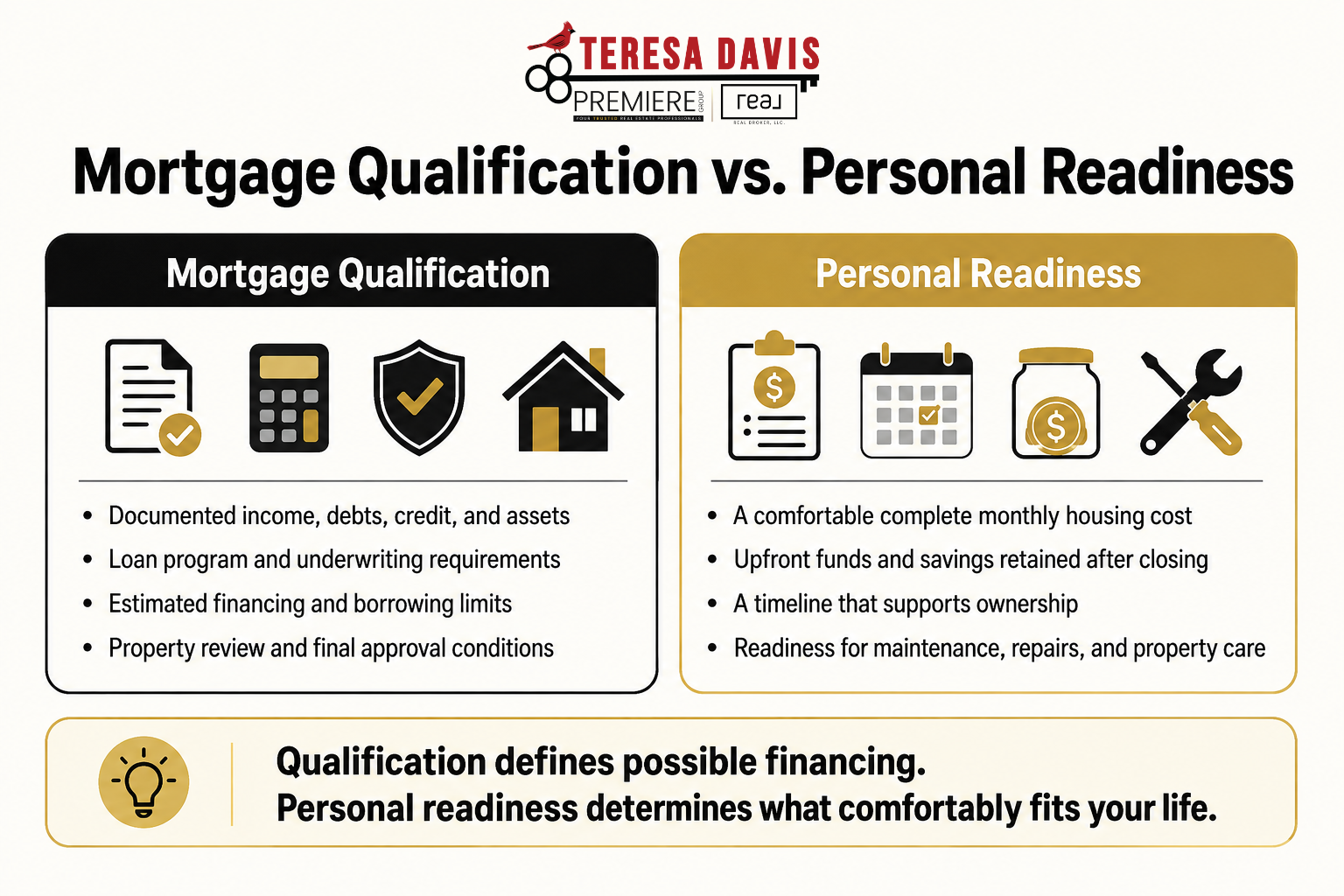
It is also important to distinguish between qualifying for a mortgage and being personally ready to buy. A loan originator evaluates whether you meet financing requirements and how much you may qualify to borrow. Your personal readiness depends on whether the complete cost of homeownership fits comfortably within your budget and whether buying supports your lifestyle and longer-term plans.
Quick Answer
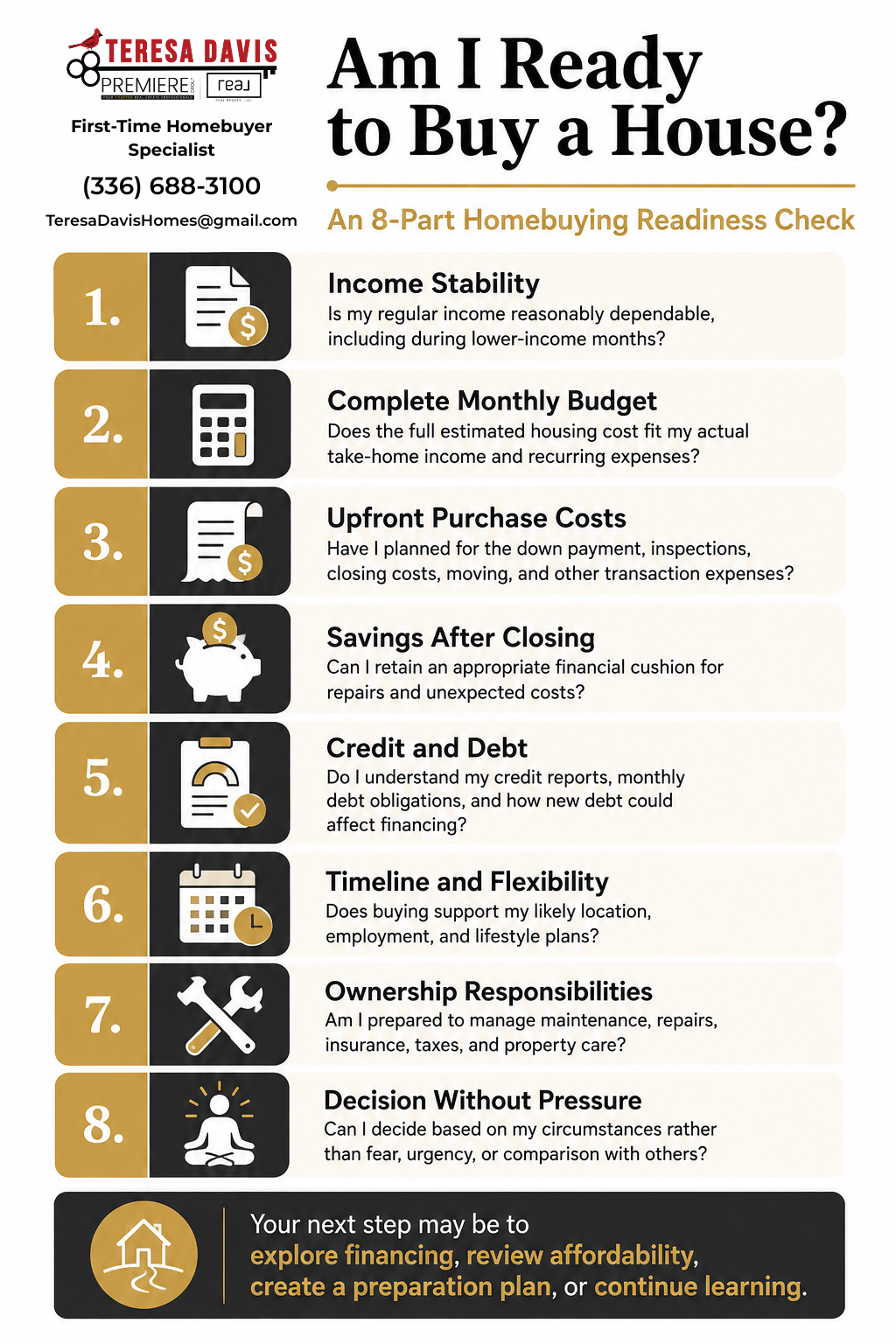
You may be ready to buy a house when your income is reasonably stable, you understand your monthly budget, and you can prepare for both the upfront costs of purchasing and the ongoing expenses of ownership. You should also consider whether you have an appropriate financial cushion, whether your credit and debt are manageable, and whether you expect buying to fit your plans for the next several years.
Readiness does not require perfect finances or certainty about every future event. It does require a realistic understanding of what you can comfortably afford, how homeownership may affect your financial flexibility, and whether you are prepared to manage maintenance, repairs, insurance, property taxes, and other responsibilities.
A mortgage pre-approval can help you understand possible financing options, but an approval amount should not automatically become your spending target. The goal is to choose a home and payment that support your broader priorities rather than stretching your budget simply because financing may be available.
At a Glance
- Your income and employment situation are reasonably stable.
- You understand your take-home income, recurring expenses, debt payments, and savings goals.
- You can prepare for expenses beyond the down payment, including inspections, closing costs, moving expenses, and other transaction-related costs.
- You have considered the complete monthly cost of ownership, not only principal and interest.
- You can retain an appropriate financial cushion for repairs and unexpected expenses after closing.
- You understand how your credit and monthly debt obligations may affect financing.
- You expect buying to support your likely location, employment, and lifestyle plans.
- You are comfortable accepting responsibility for maintenance, repairs, insurance, taxes, and property care.
- You can make the decision based on your circumstances rather than pressure from other people or fear of missing out.
- You are willing to delay buying and create a preparation plan when additional time would improve your financial or personal readiness.
Readiness Is More Than Wanting a Home
Wanting a home of your own is an important starting point, but it is not the only sign that you are ready to buy. You may want more privacy, additional space, a yard, greater control over your living environment, or the opportunity to build equity over time. Those goals can be meaningful, but homeownership also requires a long-term financial commitment and responsibility for the property.
Homebuying readiness usually involves several areas working together:
- Financial capacity.
- Personal stability.
- Future plans.
- Comfort with financial risk.
- Willingness to manage maintenance and repairs.
- Realistic expectations about the buying process.
- The ability to make decisions without feeling pressured.
You do not need to have every detail of your future planned. However, you should understand why you want to buy and how owning a home would support your priorities. Buying because it fits your life is different from buying because friends or relatives have purchased homes, because you feel that renting is always a poor choice, or because you are afraid you will miss your opportunity.
There is also no universal age, income, marital status, household structure, or career milestone that determines when someone should become a homeowner. Readiness depends on your circumstances, not whether you have reached someone else’s idea of the “right” stage of life.
Is Your Income Reasonably Stable?
A home is a long-term financial obligation, so it is important to understand how dependable your income is before committing to a monthly housing expense.
Reasonably stable income does not mean that every buyer must have a traditional salary or remain in the same job indefinitely. Buyers may earn income through hourly work, salaries, commissions, self-employment, seasonal employment, contract work, retirement benefits, or other sources. The important question is whether you understand your income pattern and can reasonably plan around it.
Consider:
- How consistent is your take-home income from month to month?
- Does your income vary because of commissions, overtime, bonuses, seasonal work, or self-employment?
- Are any known employment or income changes likely in the near future?
- Could you continue managing the housing payment during a lower-income month?
- Do you have savings available if your income is temporarily interrupted?
Use your regular take-home income when evaluating your comfort level. Gross income may be used in parts of the mortgage qualification process, but it is not the amount available for your monthly bills and everyday expenses.
A loan originator can explain how different income sources may be evaluated for financing. That financing review is separate from your personal decision about whether the payment would remain comfortable during normal changes in income and expenses.
Do You Understand Your Complete Monthly Budget?
Before deciding how much housing expense you can comfortably manage, you need a clear picture of your current budget. Start by reviewing your regular take-home income and the expenses that already compete for that income. These may include:
- Car payments and transportation costs.
- Credit cards and other debt payments.
- Student loans.
- Childcare.
- Healthcare and insurance expenses.
- Food and household supplies.
- Utilities.
- Phone and internet service.
- Savings contributions.
- Personal and family obligations.
- Entertainment and discretionary spending.
Your budget should reflect how you actually spend money, not an idealized version of what you hope to spend. Reviewing bank and credit card statements from several recent months may help you identify irregular or easily overlooked expenses.
It is also important to leave room for normal life. A housing payment that requires you to eliminate every discretionary expense or stop saving may not be sustainable, even when a lender determines that you qualify for the loan.
Mortgage qualification and personal affordability are related, but they are not the same. A lender evaluates financing requirements using documented income, debts, credit, assets, and the applicable loan guidelines. Your personal budget must also account for priorities and expenses that may not be fully reflected in that calculation.
The maximum amount you qualify to borrow should therefore be treated as a financing limit, not automatically as your target purchase price.
Are You Preparing for Upfront Purchase Costs?
Many first-time buyers focus primarily on the down payment. The down payment is important, but it is not the only expense that may occur before or at closing. Depending on the property, financing, contract terms, and negotiated agreement, upfront costs may include:
- A down payment.
- A due diligence fee in a North Carolina transaction.
- An earnest money deposit.
- A home inspection.
- Specialized inspections or evaluations.
- An appraisal.
- Closing costs.
- Prepaid taxes or insurance.
- Moving expenses.
- Utility deposits or setup costs.
- Immediate repairs or maintenance.
- Basic furnishings, appliances, or household supplies.
These expenses do not apply in exactly the same way to every transaction. Some may be negotiable, some may be financed or credited when permitted, and others may need to be paid before closing.
In North Carolina, the due diligence fee and earnest money deposit are separate contract-related funds. Their amounts and treatment depend on the terms of the transaction. Because these funds may carry financial consequences, buyers should understand them before making an offer and obtain appropriate guidance about the contract.
A realistic homebuying plan should identify which funds are needed before closing, which are due at closing, and which should remain available afterward. Using all available savings for the purchase can leave a new homeowner financially vulnerable when an unexpected expense occurs.
Have You Considered the Complete Monthly Cost of Ownership?
The mortgage payment shown in an advertisement or online calculator may not represent the complete cost of owning the home.
A monthly housing expense may include:
- Mortgage principal.
- Mortgage interest.
- Property taxes.
- Homeowners insurance.
- Mortgage insurance when applicable.
- Homeowners association dues when applicable.
- Utilities.
- Routine maintenance.
- Repairs and replacements.
- Pest control, lawn care, or other property services.
- Additional insurance or property-related expenses when applicable.
Some expenses may be included in a monthly escrow payment, while others must be paid separately. Property taxes, insurance premiums, association dues, and utility costs can also change over time.
Maintenance and repairs are especially important because they may not occur on a predictable schedule. A homeowner could go several months with only routine expenses and then need to address an appliance, plumbing problem, roof issue, heating or cooling repair, or insurance deductible.
When comparing renting and owning, avoid comparing rent only with mortgage principal and interest. A more useful comparison considers the complete estimated ownership expense and the responsibilities that transfer from a landlord to the homeowner.
Can You Maintain an Emergency Cushion After Closing?
Closing on a home should not leave you without funds for ordinary emergencies. Even a carefully inspected property can require repairs after purchase. An inspection provides valuable information about the visible condition of a home at a particular time, but it cannot predict every future problem or eliminate the normal costs of ownership.
An emergency cushion may help you manage:
- Unexpected home repairs.
- Insurance deductibles.
- Appliance replacement.
- Vehicle repairs.
- Medical expenses.
- Temporary income interruptions.
- Higher-than-expected utility bills.
- Other unplanned household costs.
There is no single emergency-fund amount that is appropriate for every buyer. A useful reserve depends on factors such as:
- Income stability.
- Existing financial obligations.
- Household size and responsibilities.
- Property age and condition.
- Insurance deductibles.
- Comfort with financial uncertainty.
- Access to other savings or resources.
The goal is not to reach a perfect savings number. The goal is to avoid entering homeownership with no financial flexibility.
A home purchase may still be possible when savings are limited, especially when a buyer qualifies for an appropriate loan program or assistance option. However, buyers should understand the difference between having enough money to complete the transaction and having enough financial capacity to manage the home afterward.
Are Your Credit and Debt Manageable?
Your credit history and monthly debt obligations can affect the financing options available to you, but they are only part of the homebuying-readiness decision.
A credit report may include information about:
- Credit cards.
- Auto loans.
- Student loans.
- Personal loans.
- Collection accounts.
- Payment history.
- Credit limits and balances.
- Public-record or identity information when applicable.
Before applying for a mortgage, consider reviewing your credit reports for inaccurate information, unfamiliar accounts, or unresolved issues. An error does not automatically correct itself, so identifying concerns early may provide time to investigate and follow the appropriate dispute process.
You should also understand how much of your monthly income is already committed to debt payments. A loan originator may calculate a debt-to-income ratio as part of the financing review, but your personal evaluation should go further. Consider whether your current obligations leave enough room for:
- The complete monthly housing expense.
- Utilities and maintenance.
- Savings.
- Transportation.
- Healthcare.
- Household needs.
- Unexpected expenses.
- Your other financial priorities.
Avoid assuming that imperfect credit automatically means you cannot buy a home. Different loan programs and lenders may have different requirements, and a qualified loan originator can explain the options that may be available based on your documented circumstances.
At the same time, avoid opening new accounts, financing major purchases, or increasing debt without first understanding how those decisions could affect your mortgage application and monthly budget. A new payment may reduce your purchasing capacity or create additional financial pressure.
The goal is not necessarily to eliminate every debt before buying. The goal is to understand your obligations, manage them responsibly, and determine whether adding a housing payment would remain sustainable.
Does Buying Fit Your Likely Timeline?
Buying a home generally involves more time, expense, and responsibility than entering or ending a rental agreement. Before moving forward, consider whether ownership supports your likely plans.
Questions to consider include:
- Do you expect to remain in the area for a meaningful period?
- Could your employment require relocation?
- Are you considering a major career, education, or lifestyle change?
- Do you need the flexibility to move quickly?
- Could your household or space needs change?
- Are you comfortable with the work and costs involved in eventually selling the property?
- Would the home continue to meet your needs if your plans change?
There is no universal number of years that every buyer must remain in a home. The appropriate timeline depends on the purchase costs, future selling costs, local market conditions, the property, and the buyer’s circumstances.
Buying may still be appropriate when your future is not completely certain. Few people can predict every change that may occur. However, if you already expect to relocate soon or need significant flexibility, it may be helpful to compare buying with continuing to rent.
Your timeline should also reflect the time required to prepare. Reviewing finances, exploring mortgage options, selecting professional representation, searching for a property, completing inspections, and closing on a home do not always happen immediately. Beginning with realistic expectations can reduce pressure and improve decision-making.
Are You Comfortable With Homeownership Responsibilities?
Homeownership gives you greater control over your property, but it also makes you responsible for decisions and expenses that may have been handled by a landlord. Depending on the property, those responsibilities may include:
- Routine cleaning and upkeep.
- Lawn and exterior maintenance.
- Heating and cooling system service.
- Plumbing and electrical repairs.
- Appliance repair or replacement.
- Roof, siding, window, or foundation concerns.
- Pest prevention and treatment.
- Homeowners insurance.
- Property taxes.
- Association dues and rules when applicable.
- Planning for major systems and components.
- Responding to emergencies involving the property.
You do not need to know how to complete every repair yourself. Homeowners often rely on qualified contractors, service professionals, inspectors, insurance professionals, and other specialists. However, you should be prepared to identify problems, make decisions, obtain estimates, schedule work, and pay for the services that are needed.
The type of property can affect the level of responsibility. A detached home, townhouse, condominium, manufactured home, or property with acreage may involve different maintenance obligations, association requirements, insurance considerations, and ongoing costs.
Understanding these responsibilities before buying can help you choose a property that matches your available time, budget, and comfort level. A home that appears affordable at closing may not feel affordable if its maintenance needs exceed what you can reasonably manage.
Can You Separate Readiness From Outside Pressure?
Homebuying decisions are often influenced by messages from family, friends, social media, advertising, and news coverage. You may hear statements such as:
- “Renting is throwing money away.”
- “You need to buy before prices rise again.”
- “You should wait until mortgage rates fall.”
- “You are at the age when you should own a home.”
- “If you qualify, you should buy as much as possible.”
- “This may be your only opportunity.”
These statements oversimplify a personal and financial decision. Renting may provide flexibility, fewer maintenance responsibilities, or time to improve financial readiness. Buying may provide stability, control, and the opportunity to build equity, but it also involves transaction costs, ongoing expenses, and market risk. Neither option is automatically right for every person at every stage.
Mortgage rates and home prices may affect affordability, but future market conditions cannot be predicted with certainty. Waiting solely for a particular rate or price may not produce the result you expect. Buying solely because of fear that conditions will worsen can also lead to a rushed decision.
A specific property can create additional pressure. You may feel tempted to overlook budget concerns, property condition, or long-term suitability because you are afraid another buyer will purchase the home. A desirable property does not eliminate the need for careful evaluation.
Readiness means being able to make the decision based on your goals, finances, and responsibilities rather than allowing urgency or comparison with other people to control the process.
Signs You May Benefit From More Preparation
Needing additional preparation does not mean homeownership is permanently out of reach. It means you have identified areas that deserve attention before taking on a major commitment. You may benefit from more preparation when:
- You are unsure how much you spend each month.
- Your income is changing or difficult to predict.
- You do not know how much cash may be needed for the transaction.
- Closing would use nearly all your available savings.
- Existing debt payments already make your budget feel tight.
- Your credit report contains errors or unresolved concerns.
- You expect to relocate or experience a major life change soon.
- You are uncomfortable with maintenance and repair responsibilities.
- You have not considered taxes, insurance, utilities, or association dues.
- You are relying only on an online calculator to determine affordability.
- You feel pressured to buy quickly.
- You and another decision-maker have not agreed on the budget, timing, or priorities.
Preparation may include:
- Tracking expenses.
- Building savings.
- Paying down or reorganizing debt.
- Reviewing credit reports.
- Avoiding unnecessary new obligations.
- Learning about the North Carolina buying process.
- Speaking with a qualified loan originator.
- Clarifying your preferred location and property needs.
- Creating a realistic timeline.
The purpose of preparation is not to achieve a perfect financial profile. It is to reduce avoidable uncertainty and help you make decisions with greater confidence.
A Readiness Conversation Can Clarify Your Next Step
You do not need to answer every homebuying question alone before speaking with a professional. An early conversation with a REALTOR® can help you:
- Clarify why you want to buy.
- Discuss your likely timeline.
- Understand the major stages of the North Carolina homebuying process.
- Identify the types of properties that may fit your goals.
- Learn about common upfront and ongoing costs.
- Prepare questions for a loan originator.
- Decide whether beginning a home search makes sense.
A conversation with a qualified loan originator can help you:
- Understand how income may be evaluated.
- Review the role of credit, debt, assets, and documentation.
- Explore loan programs that may be available.
- Estimate potential cash requirements.
- Review possible payment components.
- Identify financing-related preparation steps.
A REALTOR® does not determine whether you qualify for a mortgage, and a loan originator does not decide whether the financial commitment feels comfortable for you. Each professional provides a different type of guidance, while you remain responsible for determining whether the purchase fits your goals and priorities.
Teresa Davis serves as both a REALTOR® and Professional Real Estate Advisor with PREMIERE Group of Real Broker LLC and a Loan Originator NMLS #2597433 with One Real Mortgage. These roles can help consumers understand both the real estate and mortgage sides of the process, but formal financing decisions remain subject to application, documentation, underwriting, property review, and applicable loan requirements.
A readiness conversation may lead to one of several appropriate next steps:
- Begin evaluating financing.
- Review affordability in more detail.
- Create a savings or credit-preparation plan.
- Delay the home search while addressing specific concerns.
- Continue learning before making a decision.
- Move forward with greater confidence.
The right outcome is not always an immediate purchase. The right outcome is a clear, informed next step that reflects your circumstances.
Start With Education Before Starting the Home Search
You do not need to have every detail resolved before speaking with a REALTOR®. An early educational conversation can help you understand the process, clarify your priorities, and identify questions that should be addressed before you begin touring homes.
A REALTOR® can help you:
- Clarify why you want to buy and what you hope homeownership will provide.
- Discuss your preferred timing and any expected employment, location, or lifestyle changes.
- Explain the major stages of the North Carolina homebuying process.
- Identify property types and features that may fit your goals and ownership preferences.
- Explain common upfront transaction costs and ongoing ownership responsibilities.
- Prepare questions to discuss with a qualified loan originator.
- Understand why financing preparation should generally occur before an active home search.
- Consider whether you are ready to proceed or would benefit from additional preparation.
Beginning with education can help prevent you from becoming emotionally attached to a property before you understand whether the complete payment, transaction costs, condition, and responsibilities fit your circumstances.
A REALTOR® can provide real estate guidance, explain transaction practices, and help you evaluate properties and contract decisions. A REALTOR® does not determine whether you qualify for a mortgage and should not replace the legal, tax, insurance, financial, or mortgage professionals whose specialized guidance may be needed during the process.
Teresa’s Professional Insight
Many prospective buyers try to answer the readiness question with a single online calculator, credit score, or savings goal. Those tools may provide useful information, but readiness is usually better evaluated by looking at the complete picture.
A buyer may have sufficient income and credit for financing but feel uncertain about the monthly commitment, maintenance responsibilities, or likely timeline. Another buyer may feel emotionally ready to own a home but need additional time to build savings, manage debt, or correct information on a credit report. Neither situation means the buyer has failed. It means the next step should match the buyer’s current needs.
My role is to help you understand both the real estate process and the questions that should be addressed before you make a major decision. As a REALTOR® / Professional Real Estate Advisor with PREMIERE Group of Real Broker LLC and a Loan Originator NMLS #2597433 with One Real Mortgage, I can help you view the process from both perspectives while keeping the responsibilities of each role clear.
The most valuable outcome of an early conversation is not always an immediate home search. Sometimes the right outcome is a realistic preparation plan. Once you know which areas need attention, uncertainty can become a series of manageable next steps.
Helpful Tip
Create a simple homebuying-readiness worksheet before deciding whether to begin the process.
Include:
- Your regular monthly take-home income.
- Essential monthly expenses.
- Minimum and typical debt payments.
- Current savings.
- Funds you expect to use for the purchase.
- Savings you want to retain after closing.
- Estimated monthly housing expenses.
- Expected maintenance and repair costs.
- Upcoming employment, location, or lifestyle changes.
- Questions you want to ask a REALTOR®.
- Questions you want to ask a loan originator.
Do not use the worksheet to force a yes-or-no decision. Use it to identify your next practical step.
Your worksheet may show that you are ready to explore financing, need a more detailed affordability review, want to increase your savings, or should address a specific credit or debt concern first. Seeing the information together can make the decision feel more organized and less overwhelming.
Keep in Mind
A mortgage pre-qualification or pre-approval can help you understand potential financing, but it does not require you to purchase a home. It also does not guarantee final approval, which remains subject to the application, documentation, underwriting, property review, and applicable loan requirements.
The maximum amount you may qualify to borrow is not automatically the amount you should spend. Your comfortable budget may be lower after considering taxes, insurance, mortgage insurance when applicable, association dues, utilities, maintenance, savings goals, and other personal priorities.
Online payment estimates may leave out important costs or rely on assumptions that do not match your circumstances. Use them as preliminary educational tools rather than as a substitute for a complete financing and affordability review.
Homebuying readiness can change. Income, savings, debt, credit, household needs, employment plans, property costs, insurance expenses, and market conditions may affect your decision over time. Not being ready today does not mean you will not be ready later.
This lesson provides general education and cannot determine whether you qualify for financing or whether purchasing a particular home is appropriate for you. Consult qualified real estate, mortgage, legal, tax, insurance, and financial professionals when you need guidance specific to your circumstances.
Frequently Asked Questions
How do I know whether I am financially ready to buy a house?
Financial readiness generally means that you understand your complete monthly budget, can manage your existing obligations, and have considered both the upfront costs of purchasing and the ongoing expenses of ownership.
It also means evaluating whether you can retain an appropriate financial cushion after closing. You do not need perfect finances, but you should understand how the proposed housing expense would affect your savings, flexibility, and ability to manage unexpected costs.
Do I need perfect credit before buying a home?
No. Perfect credit is not universally required to buy a home. Credit history can affect the financing programs, interest rates, mortgage insurance requirements, and other loan terms that may be available.
Because requirements vary by loan program, lender, and individual circumstances, avoid assuming that a credit concern automatically prevents you from buying. Review your credit reports for accuracy and speak with a qualified loan originator before deciding what options may be available.
Should I buy a house just because I qualify for a mortgage?
No. Mortgage qualification establishes financing parameters, but it does not determine whether the payment and responsibilities are personally comfortable for you.
Your decision should also consider property taxes, homeowners insurance, mortgage insurance when applicable, association dues, utilities, maintenance, repairs, savings goals, and other household priorities. The maximum amount you qualify to borrow does not need to become your target purchase price.
What if I want to buy but I am not ready yet?
Not being ready today does not mean homeownership is permanently out of reach. It may mean that your next step is to build savings, review your spending, manage debt, correct inaccurate credit information, clarify your timeline, or learn more about the buying process.
Turning those needs into specific preparation steps can help you move forward with greater confidence when the timing is right.
Can I talk with a REALTOR® or loan originator before I am ready to buy?
Yes. You can speak with a REALTOR® or loan originator while you are still gathering information and deciding whether buying is appropriate for you.
An early educational conversation can help you understand the North Carolina homebuying process, identify possible financing considerations, organize your questions, and create a practical preparation plan. Speaking with a professional does not require you to begin a home search or purchase a property.
What Happens Next?
After evaluating your overall homebuying readiness, the next step is to look more closely at affordability.
The next lesson, Can I afford to buy a house?, will help you examine how a potential housing payment may fit within your income, recurring expenses, savings goals, and other financial priorities.
You will also learn why these three amounts may be different:
- The amount you may qualify to borrow.
- The complete estimated monthly housing expense.
- The payment you personally feel comfortable managing.
Continue below to the next lesson: "Can I afford to buy a house?"
Ready to Take the Next Step?
Contact Teresa Davis
You do not need to be ready to purchase immediately before asking questions. An early conversation can help you understand the process, identify preparation priorities, and decide what next step fits your circumstances. Contact Teresa Davis to discuss your homebuying goals, questions, preferred timing, and possible preparation plan.
Teresa Davis
REALTOR® and Professional Real Estate Advisor
PREMIERE Group of Real Broker LLC
Begin the One Real Mortgage Pre-Approval Process
If you are ready to explore mortgage financing, the One Real Mortgage pre-approval process can help you begin reviewing potential financing based on your individual circumstances. Using One Real Mortgage is optional and is not required in order to work with Teresa Davis as your REALTOR®.
Teresa Davis
Loan Originator NMLS #2597433
One Real Mortgage
When you are ready to evaluate potential financing options, you can begin the One Real Mortgage pre-approval process. Financing remains subject to application, documentation, underwriting, property review, and applicable loan requirements. Beginning a pre-approval process does not guarantee financing or require you to purchase a home. It is a practical way to learn more about your potential financing options, estimated payment, and possible next steps.
Ready for the next lesson? Use “Next Question” below to continue to "Can I afford to buy a house?".
1:2 - Can I afford to buy a house?

Deciding whether you can afford to buy a house involves more than checking whether you might qualify for a mortgage. A lender evaluates your income, debts, credit, available funds, and other underwriting requirements to determine whether you may be eligible for financing. You also need to decide whether the complete cost of homeownership will fit comfortably within your everyday life.
A home that is technically within your approved financing range may still feel unaffordable if the payment leaves too little room for groceries, transportation, healthcare, savings, retirement contributions, family expenses, or unexpected costs. On the other hand, you may discover that buying is more realistic than you expected once you review your full budget and learn about the financing options that may be available to you.
Affordability should include both the money needed to purchase the home and the expenses you will manage after closing. In addition to mortgage principal and interest, your monthly housing cost may include property taxes, homeowners insurance, mortgage insurance, and homeowners association dues when applicable. You should also prepare for utilities, maintenance, repairs, insurance deductibles, and other property-related expenses.
Before beginning a serious home search in Davidson, Randolph, Guilford, Forsyth, or surrounding North Carolina counties, it is helpful to understand three separate numbers: the amount a lender may approve, the amount required to complete the purchase, and the monthly payment that feels sustainable for you. These numbers are connected, but they do not always point to the same purchase budget.
The goal is not to spend the maximum amount available. The goal is to choose a home and financing plan that allow you to meet your housing needs while continuing to manage your other obligations, maintain appropriate savings, and preserve reasonable financial flexibility.
Quick Answer
You may be able to afford to buy a house when the complete monthly housing cost fits comfortably within your budget, you can cover the upfront homebuying expenses without exhausting your savings, and you can continue paying your other obligations and pursuing important financial goals after closing.
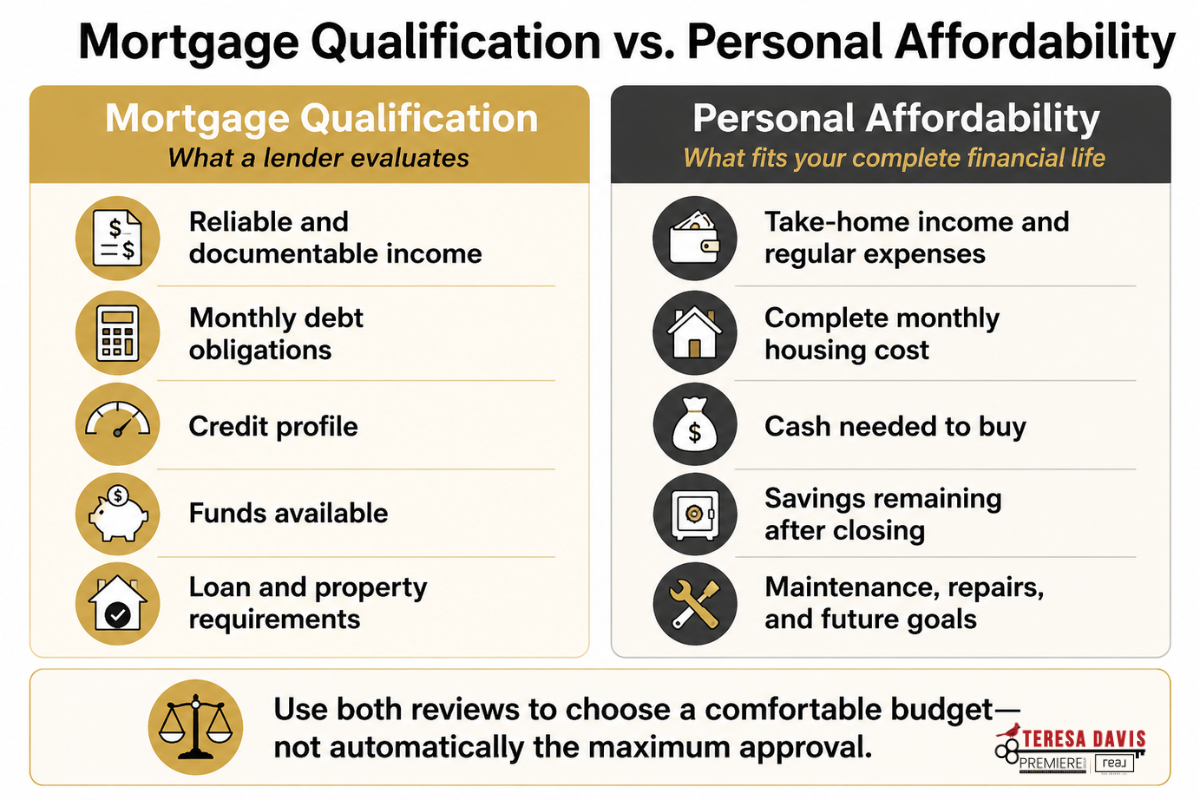
Mortgage qualification and personal affordability are related, but they are not the same. A lender determines whether you meet the applicable requirements for a mortgage. You decide whether the proposed payment and responsibilities of homeownership work for your lifestyle, priorities, and comfort level.
When reviewing affordability, consider:
- Your reliable and documentable income.
- Your current monthly debts and recurring expenses.
- The estimated mortgage principal and interest.
- Property taxes and homeowners insurance.
- Mortgage insurance when applicable.
- HOA or condominium dues when applicable.
- The money needed for the down payment, closing costs, inspections, and other transaction expenses.
- The savings you will retain after closing.
- Maintenance, repairs, utilities, and other ongoing ownership costs.
- The amount of financial flexibility you want each month.
A mortgage pre-approval can help you understand a potential financing range, but the maximum amount shown should not automatically become your spending target. A comfortable purchase budget may be lower than the maximum amount for which you qualify.
At a Glance
- Affordability is personal. Two buyers with similar incomes may choose different budgets because their debts, savings, expenses, priorities, and comfort levels are different.
- Approval does not establish your ideal budget. A lender evaluates mortgage eligibility, while you determine whether the payment works comfortably within your complete financial life.
- Use the complete housing payment. Include principal, interest, property taxes, homeowners insurance, possible mortgage insurance, and HOA dues when applicable.
- Plan for upfront expenses. Depending on the transaction, these may include a down payment, closing costs, a North Carolina due diligence fee, earnest money, inspections, an appraisal, moving costs, and prepaid expenses.
- Avoid using all your savings to close. Retaining funds for emergencies, repairs, insurance deductibles, and other unexpected expenses can make homeownership more manageable.
- Include ongoing ownership costs. Utilities, routine maintenance, appliance replacement, repairs, landscaping, and property-specific systems should be part of the affordability discussion.
- Test the payment against your real budget. Consider how the proposed housing expense would affect food, transportation, healthcare, childcare, debt payments, savings, retirement contributions, and discretionary spending.
- You do not have to spend your maximum approval amount. Choosing a lower purchase budget may help you maintain savings, reduce financial stress, and preserve room for future goals.
- Calculators provide estimates, not guarantees. A more accurate affordability review requires current income, debts, credit information, available funds, loan terms, interest rates, and property-specific expenses.
- Preparation can improve affordability. Paying down certain debts, increasing savings, improving credit, documenting income, or adjusting the target payment may create a stronger path toward buying.
Affordability and Mortgage Qualification Answer Different Questions
Mortgage qualification and personal affordability are closely connected, but they are not the same. A mortgage lender evaluates whether you meet the requirements for a particular loan. Depending on the mortgage program and your circumstances, that review may include:
- Income and employment history
- Monthly debt obligations
- Credit history and credit scores
- Funds available for the transaction
- The proposed down payment
- The estimated housing payment
- Property eligibility
- Other underwriting requirements
The lender’s decision helps establish whether financing may be available and how much you may be eligible to borrow. It does not determine how much you will personally feel comfortable spending each month.
Personal affordability asks a broader question: Can I manage the complete cost of this home while continuing to pay my other expenses, save for future goals, and handle unexpected costs?
A lender may not see every expense that matters to your household budget. For example, groceries, utilities, transportation, childcare, healthcare, retirement contributions, subscriptions, travel, family support, and discretionary spending may affect your comfort level even when they are not treated as qualifying debts.
This is why a mortgage approval amount should be viewed as a financing limit—not automatically as a recommended purchase price.
Start With Income You Can Reasonably Rely On
Your affordability review should begin with the income you regularly receive and can reasonably expect to continue. Income may come from sources such as:
- Salary
- Hourly employment
- Self-employment
- Commission
- Bonuses
- Overtime
- Part-time employment
- Retirement income
- Other eligible and documentable sources
Not every type of income is evaluated the same way for mortgage purposes. A lender may need to review how long the income has been received, whether it is likely to continue, and whether it can be documented under the applicable loan guidelines.
For your personal budget, it is also important to distinguish between gross income and take-home income.
Gross income is your income before taxes and other deductions. Mortgage qualification calculations commonly use gross monthly income.
Take-home income is the amount deposited into your account after taxes, insurance, retirement contributions, and other payroll deductions. Your day-to-day household budget is usually managed from this amount.
A mortgage payment may appear manageable when compared only with gross income but feel less comfortable when measured against the money actually available after deductions. Reviewing both numbers can provide a clearer picture.
If your income varies because of self-employment, commission, seasonal work, bonuses, or overtime, avoid building your personal budget around the highest month. A more conservative estimate may provide greater flexibility during lower-income periods.
Review Your Current Monthly Obligations
The next step is to identify the financial obligations you already manage each month. These may include:
- Auto loans
- Student loans
- Credit-card minimum payments
- Personal loans
- Installment accounts
- Child-support or alimony obligations when applicable
- Other recurring debts
Lenders commonly use a debt-to-income ratio when evaluating a mortgage application. This ratio compares certain monthly debt obligations with gross monthly income.
Debt-to-income calculations can be helpful, but there is no single ratio that guarantees approval or establishes the right budget for every buyer. Acceptable limits and calculation methods may vary based on:
- Loan program
- Credit profile
- Available funds
- Property type
- Compensating factors
- Automated underwriting findings
- Lender requirements
- Other details of the application
Your personal affordability review should go beyond the debts included in a lender’s calculation. For example, a recurring expense may affect your household budget even when it is not counted as a qualifying debt. Consider regular costs such as:
- Food
- Utilities
- Transportation
- Auto insurance
- Healthcare
- Childcare or dependent care
- Pet care
- Mobile phone and internet service
- Retirement contributions
- Savings deposits
- Memberships and subscriptions
- Education expenses
- Family support
- Discretionary spending
Creating a complete list can help you see how much income is already committed before adding a mortgage payment.
Estimate the Complete Monthly Housing Payment
One of the most common affordability mistakes is looking only at the principal-and-interest portion of a mortgage payment. The complete estimated housing payment may include several separate expenses.
Mortgage Principal
Principal is the portion of the payment that reduces the amount borrowed.
Mortgage Interest
Interest is the cost charged by the lender for borrowing the money. The interest rate, loan amount, loan term, and mortgage structure influence this portion of the payment.
Property Taxes
Property taxes vary by property and location. The amount may change over time because of tax-rate changes, reassessment, improvements, exemptions, or other factors.
When property taxes are escrowed, the lender generally collects part of the estimated annual amount with the monthly mortgage payment. Escrow shortages or changes in the tax bill may cause the required monthly payment to increase.
Homeowners Insurance
Homeowners insurance protects against covered risks subject to the policy’s terms, limits, deductibles, and exclusions.
Premiums vary based on the property, coverage, insurer, location, claims history, construction details, and other underwriting factors. Insurance costs may also change after the home is purchased.
Mortgage Insurance
Mortgage insurance may be required depending on the loan program, down payment, loan-to-value ratio, and other applicable requirements.
The structure, amount, and duration of mortgage insurance vary by mortgage type. It should be included in the payment estimate whenever it applies.
HOA or Condominium Dues
Some properties require homeowners association or condominium dues. These charges are separate from the mortgage and may be collected monthly, quarterly, or annually.
Buyers should also determine whether the association has:
- Planned increases
- Special assessments
- Transfer fees
- Capital contributions
- Other required charges
Association dues and assessments can affect both personal affordability and mortgage qualification.
Do Not Rely on an Incomplete Online Payment Estimate
Online mortgage calculators can be useful for exploring possibilities, but their results depend on the information entered.
An estimate may be misleading when it:
- Uses an outdated interest rate
- Assumes a larger down payment than you expect to make
- Excludes property taxes
- Excludes homeowners insurance
- Excludes mortgage insurance
- Excludes HOA dues
- Uses a tax or insurance estimate that does not match the property
- Does not reflect the selected loan program
- Omits other required costs
A calculator result should be treated as a starting point rather than a guaranteed payment or approval decision. For a more useful estimate, review current financing assumptions with a qualified mortgage professional and update the calculation when the property, interest rate, loan terms, insurance estimate, taxes, or association dues change.
Compare the Proposed Payment With Your Current Housing Expense
Your current rent or housing payment can provide a useful reference point, but the comparison should include the complete cost on both sides.
When renting, you may currently pay:
- Monthly rent
- Renters insurance
- Utilities
- Parking
- Pet fees
- Other recurring charges
When buying, you may pay:
- Mortgage principal and interest
- Property taxes
- Homeowners insurance
- Mortgage insurance when applicable
- HOA dues when applicable
- Utilities
- Maintenance
- Repairs
- Property-specific services
A proposed mortgage payment that is close to your current rent does not necessarily mean the complete cost of ownership will be the same. Conversely, a higher housing payment may still be manageable when the increase fits comfortably within your budget and other financial priorities remain protected.
The purpose of the comparison is not to prove that renting or buying is always better. It is to understand how the change would affect your actual monthly cash flow.
Plan for the Money Needed Before and at Closing
Monthly affordability is only one part of the decision. You must also consider the money that may be required during the transaction. Depending on the property, contract, loan, and negotiated terms, potential expenses may include:
- Due diligence fee
- Earnest money deposit
- Home inspection
- Specialized inspections or evaluations
- Appraisal
- Down payment
- Lender costs
- Attorney and settlement expenses
- Title-related costs
- Prepaid property taxes
- Prepaid homeowners insurance
- Initial escrow deposits
- Moving expenses
- Utility deposits or connection fees
- Immediate repairs or purchases
In a North Carolina residential transaction, the due diligence fee and earnest money deposit have different purposes and may be handled differently under the contract. The amount, timing, and potential refundability should be reviewed carefully before an offer is submitted.
Not every buyer will pay every expense listed above, and the exact amounts cannot be known from a general estimate alone. Some costs may be negotiated, paid outside closing, credited by another party when permitted, or structured differently depending on the transaction.
A mortgage professional can help estimate the financing-related funds needed, while your REALTOR® can help you understand property and contract considerations that may affect your transaction budget.
Separate the Down Payment From the Total Cash Needed
The down payment is only one part of the money you may need to purchase a home. A buyer who has saved enough for the planned down payment may still need additional funds for:
- Closing costs
- Prepaid expenses
- Initial escrow funding
- Inspections
- Appraisal
- Due diligence fee
- Earnest money
- Moving
- Immediate repairs
- Post-closing reserves
This distinction is especially important when reviewing low-down-payment or no-down-payment mortgage options. A lower required down payment may reduce one part of the upfront cost, but it does not automatically eliminate every other expense.
Loan-program eligibility, seller-paid costs, lender credits, assistance programs, and negotiated terms may affect the final amount needed. These possibilities should be evaluated individually rather than assumed.
Review Where the Purchase Funds Will Come From
A lender may need to verify the source of funds used for the transaction. Potential sources may include:
- Checking or savings accounts
- Proceeds from the sale of another asset
- Eligible gift funds
- Approved down payment assistance
- Retirement-account funds when permitted
- Other documented sources allowed by the loan program
Do not move large amounts of money, open new credit accounts, borrow funds, or make unusual deposits without first discussing the potential effect with your mortgage professional.
Documentation requirements vary, and a transaction that appears simple from a household-budget perspective may require additional explanation or records for mortgage underwriting. The goal is to understand both how much money may be needed and whether the planned source of those funds is acceptable for the selected mortgage.
Protect Savings After Closing
Being able to bring the required funds to closing does not automatically mean the purchase is comfortably affordable.
Homeownership is easier to manage when you retain money for expenses that may arise shortly after closing. Even a well-maintained home may require repairs, replacements, insurance deductibles, moving expenses, or purchases that were not part of the original estimate.
Post-closing savings may help you prepare for:
- Emergency repairs
- Appliance replacement
- Heating and cooling service
- Plumbing or electrical problems
- Insurance deductibles
- Utility deposits
- Moving expenses
- Immediate safety or maintenance needs
- Temporary income interruptions
- Other unexpected household expenses
There is no single reserve amount that is appropriate for every buyer. The amount you choose to retain may depend on:
- Income stability
- Household size
- Property age and condition
- Major systems and appliances
- Insurance deductibles
- Available credit
- Other savings
- Risk tolerance
- Upcoming financial obligations
A buyer purchasing a newer home with stable income may evaluate reserves differently from a buyer purchasing an older property with variable income. The important point is to consider what will remain after the transaction rather than focusing only on whether the current account balance is enough to close.
Include Maintenance and Repairs in the Budget
A mortgage payment does not cover every cost of owning a home. As an owner, you are generally responsible for maintaining the property and addressing repairs. The timing and amount of these expenses are difficult to predict, but they should still be part of the affordability review.
Potential ownership expenses may include:
- Heating and cooling maintenance or replacement
- Plumbing repairs
- Electrical repairs
- Roof maintenance or replacement
- Water-heater replacement
- Appliance repair or replacement
- Exterior maintenance
- Interior repairs
- Landscaping
- Pest treatment
- Gutter cleaning
- Driveway or walkway repairs
- Well or septic maintenance when applicable
- Homeowners association assessments when applicable
Some expenses occur regularly, while others may arise unexpectedly. A new homeowner may go several months without a major repair and then face more than one expense at the same time. Instead of trying to predict the exact timing of every repair, include a reasonable home-maintenance category in your budget and continue adding to it after closing.
Property condition also matters. A lower-priced home that needs immediate work may require more cash and monthly flexibility than a higher-priced home with fewer short-term repairs. The purchase price alone does not determine affordability.
Consider Property-Specific Ownership Costs
Two homes with similar prices can have different total monthly and long-term costs. Property-specific considerations may include:
- Property taxes
- Homeowners insurance
- HOA or condominium dues
- Special assessments
- Utility efficiency
- Heating fuel
- Water and sewer service
- Private well maintenance
- Septic-system maintenance
- Flood-insurance requirements
- Pest treatment
- Lawn and landscaping needs
- Road-maintenance agreements
- Repairs identified during inspections
- Age and condition of major systems
For example, one home may have lower property taxes but higher insurance or utility costs. Another may have association dues that include certain services. A rural property may have a well and septic system that require different planning from a property connected to municipal utilities.
This is why affordability should be revisited when you identify a specific property. A general pre-approval establishes a starting range, but the payment and ownership costs must be updated for each home under serious consideration.
Allow for Changes in Taxes, Insurance, and Other Expenses
Some homeownership costs can change after closing.
Potential changes may involve:
- Property-tax rates
- Property reassessments
- Homeowners insurance premiums
- Mortgage insurance
- HOA or condominium dues
- Special assessments
- Utility rates
- Maintenance needs
- Escrow requirements
If taxes and insurance are collected through an escrow account, the mortgage servicer periodically reviews the amount being collected. When projected expenses increase or an escrow shortage occurs, the required monthly payment may increase even when the mortgage interest rate and principal-and-interest payment remain unchanged.
A fixed-rate mortgage generally keeps the scheduled principal-and-interest portion stable, but it does not guarantee that the complete monthly payment will never change. A comfortable budget should allow some room for reasonable cost increases rather than assuming every expense will remain exactly the same.
Test the Proposed Payment Against Your Real-Life Budget
A practical affordability review compares the proposed complete housing cost with the money available after your other expenses and priorities are considered.
Begin by estimating your take-home income and listing your regular monthly expenses. These may include:
- Current debt payments
- Food
- Utilities
- Transportation
- Auto insurance
- Fuel
- Healthcare
- Childcare or dependent care
- Pet care
- Mobile phone and internet service
- Education
- Savings
- Retirement contributions
- Family support
- Entertainment
- Travel
- Other household priorities
Then add the proposed complete housing expense, including:
- Principal
- Interest
- Property taxes
- Homeowners insurance
- Mortgage insurance when applicable
- HOA or condominium dues when applicable
- Estimated utilities
- Maintenance savings
- Other property-specific costs
Review the amount that remains. Ask yourself:
- Can I continue saving?
- Can I maintain retirement contributions?
- Can I manage an unexpected repair?
- Can I handle normal changes in groceries, utilities, or insurance?
- Can I continue meeting my other obligations?
- Will the payment create ongoing stress?
- Do I have room for important personal or family goals?
- Would the budget still work during a lower-income month?
A payment does not need to feel effortless, especially when buying represents a meaningful financial change. However, the budget should be realistic and should not depend on every month going perfectly.
Try a Practice-Payment Exercise
One way to test affordability is to practice living with the proposed payment before purchasing. First, calculate the difference between your current monthly housing expense and the estimated complete cost of owning the type of home you are considering.
For example, include the estimated difference in:
- Mortgage payment
- Taxes
- Insurance
- HOA dues when applicable
- Utilities
- Maintenance savings
Then consider transferring that difference into savings each month for a trial period. A practice-payment exercise may help you:
- See how the proposed payment affects your regular budget
- Identify expenses that need adjustment
- Build additional savings
- Test whether the payment feels sustainable
- Prepare for future maintenance and repairs
- Gain confidence before committing
If repeatedly saving the difference is difficult, that does not necessarily mean buying is impossible. It may indicate that the target payment, timing, savings plan, or other expenses need to be adjusted.
This exercise is a personal budgeting tool. It does not replace mortgage qualification, underwriting, or advice from an appropriate financial professional.
Choose a Comfortable Budget Instead of Automatically Using the Maximum
A mortgage pre-approval may identify the upper end of a potential financing range. You are not required to shop at that maximum.
A buyer may intentionally choose a lower budget to:
- Preserve emergency savings
- Continue retirement contributions
- Prepare for repairs
- Reduce financial stress
- Maintain travel or lifestyle priorities
- Manage variable income
- Prepare for future household changes
- Pay down other debt
- Keep more flexibility each month
The highest approved amount may also change when property-specific costs are added. A home with higher taxes, insurance, or HOA dues may support a lower purchase price than another property under the same general pre-approval.
Before touring homes, decide on both:
- The maximum payment that appears possible
- The payment range that feels comfortable
These numbers may be different. Sharing the comfortable range with your REALTOR® and mortgage professional can help keep the home search aligned with your priorities.
Evaluate the Trade-Offs Within Your Purchase Plan
Affordability decisions often involve trade-offs. You may be able to adjust:
- Purchase price
- Down payment
- Property type
- Location
- Home size
- Condition
- HOA expenses
- Loan program
- Timing
- Debt balances
- Savings target
- Monthly payment preference
For example, a buyer may prefer a lower purchase price to preserve savings. Another may choose to wait while paying down a high-interest debt. Someone else may select a property with fewer immediate repair needs even when the purchase price is slightly higher.
There is not one correct affordability strategy for every buyer. The best approach is the one that fits your verified financing options, housing needs, timeline, and financial priorities.
Recognize Signs That Buying May Be Financially Manageable
Buying may be financially manageable when several factors are working together. Possible indicators include:
- Your income is reasonably stable and can be documented.
- Your existing obligations are manageable.
- The complete estimated housing payment fits your budget.
- You can cover the anticipated upfront costs.
- You expect to retain appropriate savings after closing.
- You can continue meeting other financial obligations.
- You can continue saving for future goals.
- You have considered maintenance and repair costs.
- You have reviewed property-specific expenses.
- The payment feels sustainable rather than dependent on perfect circumstances.
No single factor proves that you are ready. Affordability is stronger when the complete picture supports the decision.
Recognize Signs That More Preparation May Help
Additional preparation may be helpful when:
- Your current budget already feels strained.
- Your income is unstable or difficult to document.
- High-interest debt uses a substantial portion of your monthly income.
- You have not reviewed your credit.
- You do not yet know the complete estimated housing payment.
- Closing would use nearly all your available savings.
- You have no plan for repairs or emergencies.
- The proposed payment would require stopping important savings or obligations.
- You are relying on uncertain future income.
- Your purchase plan depends on costs being lower than current estimates.
These signs do not necessarily mean that you cannot become a homeowner. They may help identify the most useful next step.
That step could involve:
- Paying down selected debt
- Building savings
- Reviewing credit
- Documenting income
- Adjusting the target price
- Exploring another property type
- Comparing mortgage options
- Extending the timeline
- Creating a more detailed budget
A focused preparation plan can be more useful than waiting without knowing what needs to improve.
Understand How Affordability Can Change
Home affordability is not a permanent number. It may change when any of the following changes:
- Income
- Employment
- Monthly debt
- Credit profile
- Interest rates
- Down payment
- Loan program
- Home price
- Property taxes
- Homeowners insurance
- Mortgage insurance
- HOA dues
- Closing costs
- Seller-paid costs when permitted
- Assistance eligibility
- Property condition
- Required repairs
An estimate prepared today may need to be updated before you make an offer or close.
Avoid assuming that a previous calculator result, prequalification, or pre-approval will remain unchanged indefinitely. Consult your mortgage professional before making important financial changes and request updated figures when the property or financing assumptions change.
Use Online Calculators as Planning Tools
An affordability calculator can help you explore how different assumptions affect a potential price or payment. You may be able to compare:
- Different home prices
- Different down payments
- Different interest rates
- Different loan terms
- Estimated taxes
- Estimated insurance
- Mortgage insurance
- HOA dues
However, a calculator cannot fully evaluate:
- Whether your income meets documentation requirements
- How a lender will calculate your debts
- Your complete credit profile
- Loan-program eligibility
- Property eligibility
- Available assistance
- Underwriting findings
- The final interest rate
- Exact taxes and insurance
- Final closing costs
- Your personal comfort level
Use calculators to ask better questions—not to replace a mortgage review.
Build an Affordability Range Rather Than One Perfect Number
Instead of trying to find one exact purchase price immediately, consider developing a range. That range may include:
- A preferred monthly payment
- A maximum comfortable monthly payment
- A preferred amount of cash to use
- A minimum amount of savings to retain
- A general purchase-price range
- Property expenses that would require adjusting the price
For example, a home with no HOA dues may fit differently from a similarly priced home with substantial monthly dues. A property with lower taxes may support a different payment than another home at the same price. Creating a range makes it easier to adjust when you compare actual properties.
The next Academy lesson, How much house can I afford?, will examine how income, debts, available funds, interest rates, loan terms, taxes, insurance, mortgage insurance, and HOA dues can influence an estimated home-price range.
Create Your Personal Affordability Checklist
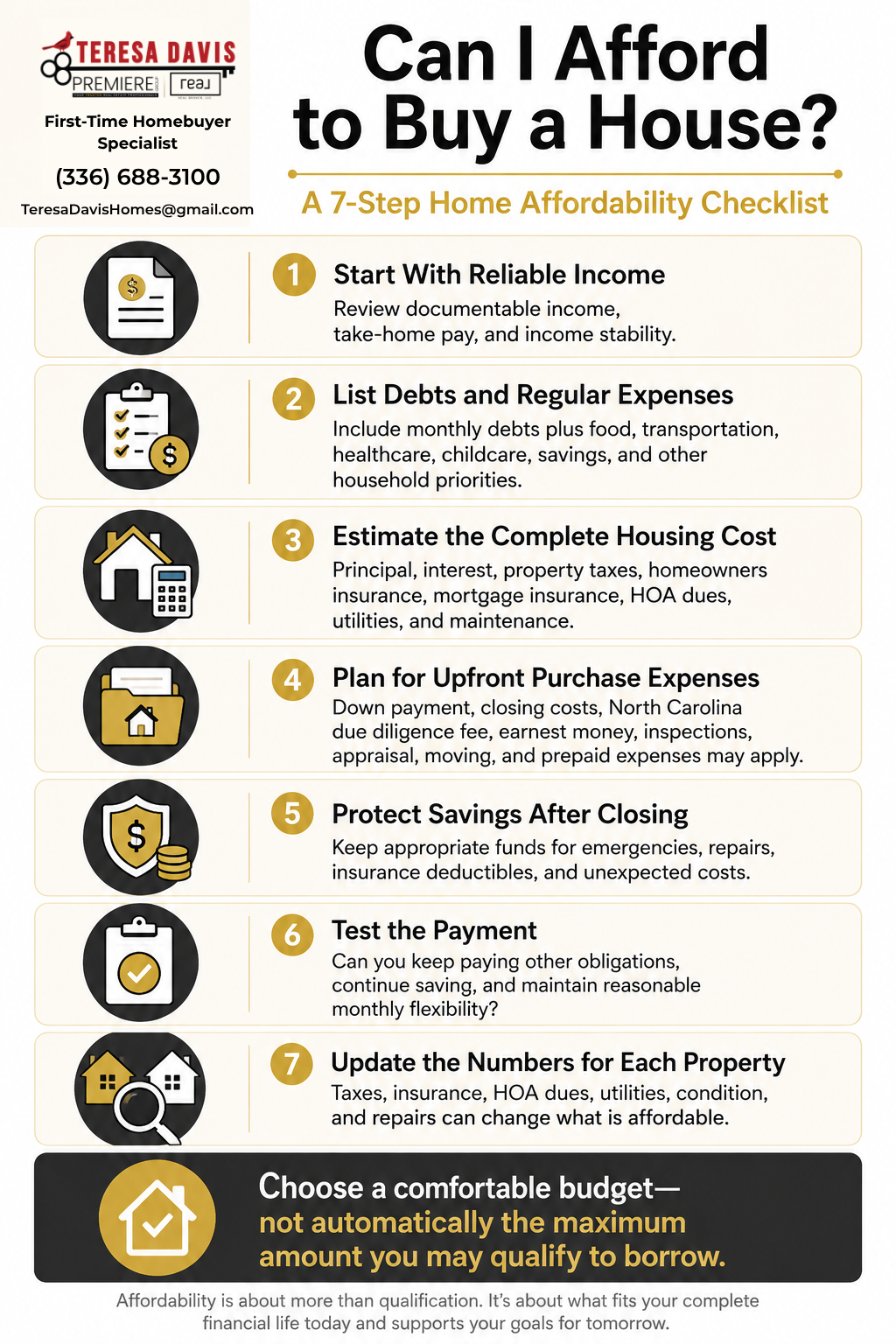
Before deciding that you can afford to buy a house, confirm that you have reviewed the following:
- Reliable income
- Take-home income
- Current monthly debts
- Regular household expenses
- Estimated complete housing payment
- Down payment
- Estimated closing costs
- Due diligence and earnest money considerations
- Inspection and appraisal expenses
- Moving expenses
- Savings remaining after closing
- Maintenance and repair planning
- Property-specific costs
- Other financial goals
- Payment changes that could occur over time
- Your personal comfort level
You do not need every answer before speaking with a REALTOR® or mortgage professional. An early conversation can help you identify missing information and develop a practical plan.
The purpose of this checklist is not to discourage you from buying. It is to help you move forward with clearer expectations and a budget that supports long-term homeownership.
REALTOR® Guidance: Connect Your Budget to the Actual Property
A general affordability estimate can help you begin planning, but the numbers should be reviewed again when you identify a specific home. Two properties with similar asking prices may have different total ownership costs because of differences in:
- Property taxes
- Homeowners insurance
- HOA or condominium dues
- Utility systems
- Property condition
- Required repairs
- Well or septic systems
- Road-maintenance agreements
- Special assessments
- Other property-specific expenses
A knowledgeable North Carolina REALTOR® can help you identify information that may affect the real-estate side of your affordability decision. This may include helping you:
- Review available property-tax information
- Identify disclosed HOA or condominium dues
- Request association documents when applicable
- Consider whether special assessments or additional charges may exist
- Review information about utilities, wells, septic systems, or shared roads
- Understand inspection and due diligence considerations
- Evaluate repairs or improvements that may affect your budget
- Compare properties based on their broader ownership costs rather than price alone
- Keep the home search aligned with the payment range you consider comfortable
- Coordinate property information with your mortgage professional
Your REALTOR® does not determine mortgage eligibility, calculate final loan approval, or replace advice from a qualified mortgage professional. The REALTOR®’s role is to help you understand the property, contract, and transaction factors that may influence the cost of buying and owning the home.
Review Affordability Before Making an Offer
Before submitting an offer, update the affordability discussion using the actual property whenever possible.
Review:
- The proposed purchase price
- Estimated property taxes
- Homeowners insurance information
- HOA or condominium dues
- Mortgage insurance when applicable
- Expected cash needed for the transaction
- Inspection and evaluation costs
- Known repair or maintenance considerations
- Estimated utilities or property services
- Savings expected to remain after closing
The due diligence fee, earnest money deposit, inspection expenses, and other transaction costs may also affect the amount of cash you need during the purchase process. In North Carolina, the amount and terms of a due diligence fee and earnest money deposit are established through the purchase contract and negotiation. Buyers should understand how those funds affect their available cash before making an offer.
Keep the Home Search Within Your Comfortable Range
It is easy to become focused on homes near the maximum amount shown on a pre-approval. A more useful approach is to establish a comfortable range before touring properties.
Your comfortable range may be based on:
- Preferred monthly payment
- Maximum monthly payment
- Amount available for the transaction
- Savings you want to retain
- Expected maintenance costs
- Other financial priorities
- Planned lifestyle expenses
- Household changes you anticipate
Sharing this range with your REALTOR® can help reduce time spent considering homes that may not support your broader financial plan.
When a property has higher taxes, insurance, association dues, or anticipated repairs, the appropriate purchase price may need to be adjusted. When another property has lower ongoing costs, the same monthly budget may support a different price. The payment—not simply the asking price—should remain central to the decision.
Teresa’s Professional Insight
One of the most important affordability conversations is the difference between what you may be approved to borrow and what you feel comfortable paying. You do not have to spend the maximum amount available to you.
A lower purchase budget may allow you to:
- Keep more money in savings
- Continue contributing toward retirement
- Prepare for maintenance and repairs
- Manage normal cost increases
- Preserve room for travel, family needs, or other priorities
- Reduce financial stress after closing
I encourage buyers to review both the estimated monthly payment and the total cash needed before becoming emotionally committed to a particular home. Once we identify a property, I can help you review the real-estate factors that may affect the purchase and ownership costs. These may include property taxes, HOA dues, inspections, due diligence considerations, disclosed repairs, utility systems, and other property-specific details.
Your mortgage professional can then evaluate the financing using the proposed purchase price, current loan terms, estimated taxes, insurance, and other applicable costs. Because I serve as both a REALTOR® / Professional Real Estate Advisor with the PREMIERE Group of Real Broker LLC and a Loan Originator NMLS #2597433 with One Real Mortgage, I understand how closely the property and financing sides of the transaction are connected. Those roles still have different responsibilities, and every buyer’s mortgage eligibility must be evaluated through the appropriate lending process.
The goal is not simply to determine whether you can complete the purchase. The goal is to help you understand whether the home and payment support your plans after closing.
Helpful Tip
Try a practice-payment exercise before you commit to buying. Estimate the difference between your current housing expense and the complete monthly cost of the type of home you are considering. Include more than principal and interest. Your estimate may need to account for:
- Property taxes
- Homeowners insurance
- Mortgage insurance when applicable
- HOA dues when applicable
- Utility changes
- Maintenance savings
- Other property-related expenses
Consider transferring that difference into savings each month for a trial period. For example, if your current housing expense is $1,300 per month and the estimated complete cost of owning would be $1,750 per month, the difference is $450. Setting aside that amount can help you experience how the proposed payment may affect your budget.
This exercise may help you:
- Test whether the payment feels manageable
- Identify spending adjustments
- Build additional savings
- Prepare for repairs or moving costs
- Establish a stronger financial cushion
- Gain confidence before purchasing
If the exercise is difficult, use the result as information—not as a reason to assume homeownership is impossible. You may decide to:
- Adjust the target payment
- Extend your preparation timeline
- Reduce selected debts
- Increase savings
- Explore a different price range
- Review other financing options
- Reconsider property expenses
A practice payment is a personal budgeting exercise. It does not determine mortgage eligibility or replace a formal review by a qualified mortgage professional.
Keep in Mind
Affordability is not a fixed number. Your estimated payment, cash needed, and possible home-price range may change when any important part of the transaction changes. These factors may include:
- Interest rate
- Purchase price
- Down payment
- Loan program
- Loan term
- Credit profile
- Income
- Employment
- Monthly debts
- Property taxes
- Homeowners insurance
- Mortgage insurance
- HOA or condominium dues
- Seller-paid costs when permitted
- Lender credits
- Assistance eligibility
- Closing costs
- Property condition
- Required repairs
A general affordability calculator or early prequalification can provide a starting point, but it should not be treated as a guaranteed purchase price, final payment, or loan approval. The numbers should be updated when:
- Interest rates change
- Your income or debts change
- You use part of your savings
- You open or close credit accounts
- You identify a specific property
- The proposed purchase price changes
- Taxes, insurance, or association dues become known
- The loan program changes
- Repair or inspection information affects the budget
Avoid making major financial changes during the mortgage process without first discussing them with your mortgage professional. This may include:
- Opening new credit
- Financing furniture or a vehicle
- Changing employment
- Moving money between accounts
- Making large cash deposits
- Co-signing for another borrower
- Increasing credit-card balances
- Borrowing money for the transaction
Even a change that appears manageable within your personal budget may affect documentation, underwriting, available funds, or loan eligibility.
General educational ratios and calculators can help organize your questions, but they are not individualized financial advice. Mortgage guidelines and property costs vary, and your final decision should be based on verified information from the appropriate real-estate, mortgage, insurance, legal, tax, and financial professionals.
Frequently Asked Questions
How do I know whether a mortgage payment is affordable for me?
A mortgage payment may be affordable when the complete housing cost fits within your actual monthly budget without preventing you from paying your other obligations, maintaining appropriate savings, and preparing for unexpected expenses.
Review more than principal and interest. Your estimate may also need to include:
• Property taxes
• Homeowners insurance
• Mortgage insurance when applicable
• HOA or condominium dues when applicable
• Utilities
• Maintenance
• Repairs
• Other property-specific costs
Compare the complete estimate with your take-home income, recurring expenses, savings goals, retirement contributions, household needs, and desired financial flexibility. The right payment is not simply the highest payment a lender may approve. It is a payment you believe you can manage responsibly over time.
Is the amount I am pre-approved for the amount I should spend?
No. A mortgage pre-approval can help establish a potential financing range, but it does not require you to spend the maximum amount shown.
A lender evaluates whether you may meet the applicable requirements for a mortgage. Your personal purchase budget should also consider:
• Your preferred monthly payment
• Savings you want to retain
• Maintenance and repair planning
• Other debts and expenses
• Retirement and savings goals
• Income stability
• Lifestyle priorities
• Anticipated household changes
You may choose a purchase price below your maximum pre-approval amount to preserve savings, reduce financial stress, or maintain more monthly flexibility. The pre-approval amount may also change when the taxes, insurance, HOA dues, and other costs of a specific property are included.
What monthly costs should I include when evaluating affordability?
Begin with the estimated principal-and-interest payment, and then add the other expenses that may be associated with the property and mortgage. Your complete monthly housing estimate may include:
• Mortgage principal
• Mortgage interest
• Property taxes
• Homeowners insurance
• Mortgage insurance when applicable
• HOA or condominium dues when applicable
• Utilities
• Maintenance savings
• Property-specific services or expenses
Some costs may be included in the monthly payment through an escrow account, while others will be paid separately. Taxes, insurance, association dues, utilities, maintenance, and repairs may change over time. Use property-specific estimates whenever possible rather than relying only on a general online mortgage calculator.
Can I afford to buy if I do not have a large down payment?
Possibly. A 20% down payment is not required for every mortgage, and some qualified buyers may be eligible for lower-down-payment or no-down-payment options. However, the down payment is only one part of affordability. You may also need to consider:
• Closing costs
• Prepaid expenses
• Initial escrow funding
• Due diligence fee
• Earnest money
• Inspections
• Appraisal
• Moving expenses
• Mortgage insurance when applicable
• Savings remaining after closing
Eligibility and costs vary by mortgage program, borrower, property, and current lending requirements. A mortgage professional can help you compare available options and estimate the complete payment and funds needed.
What should I do when buying feels close but my budget is not ready?
Identify the specific issue that is making the purchase feel uncomfortable or preventing you from moving forward. The primary gap may involve:
• High monthly debt
• Limited savings
• Credit concerns
• Variable or difficult-to-document income
• An uncomfortable estimated payment
• Insufficient post-closing reserves
• Uncertainty about purchase expenses
• A target price that does not fit the current budget
Once the gap is identified, create a focused preparation plan. Depending on your circumstances, that plan may include paying down selected debts, building savings, reviewing credit, documenting income, adjusting the target price, comparing mortgage options, or extending the timeline.
A REALTOR® and mortgage professional can help you understand which changes may have the greatest effect on your homebuying plan. Preparation does not mean that homeownership is out of reach. It means you are working toward a purchase that is better aligned with your finances.
What Happens Next?
Once you have determined that buying may fit within your overall financial life, the next step is to estimate the home-price and payment range that may be realistic for you.
The next Academy lesson is: How much house can I afford? That lesson will explain how the following factors work together:
- Reliable and documentable income
- Monthly debts
- Available funds
- Down payment
- Interest rate
- Loan term
- Mortgage program
- Property taxes
- Homeowners insurance
- Mortgage insurance when applicable
- HOA or condominium dues when applicable
You will learn why the same buyer may be able to afford different purchase prices depending on the property and financing assumptions. For example, a home with higher property taxes, insurance, or HOA dues may require a lower purchase price to remain within the same monthly budget. A change in the interest rate or down payment may also affect the payment and estimated price range.
The goal is not to produce one permanent or guaranteed number. It is to develop a useful range that can be updated as your finances, mortgage options, interest rates, and property-specific expenses become clearer.
Ready to Take the Next Step?
You do not need to have every affordability question answered before beginning a conversation. If you are considering buying a home in Davidson, Randolph, Guilford, Forsyth, or a surrounding North Carolina county, Teresa Davis can help you organize the real-estate side of your homebuying plan, understand property-specific expenses, and prepare for the steps ahead.
Contact Teresa Davis
You do not need to be ready to purchase immediately before asking questions. An early conversation can help your understand the process, identify preparation priorities, and decide what next step fits your circumstances.
Teresa Davis
REALTOR® and Professional Real Estate Advisor
PREMIERE Group of Real Broker LLC
Begin the One Real Mortgage Pre-Approval Process
A mortgage review can help you better understand potential financing options, estimated payments, and the funds that may be needed for your purchase. Using One Real Mortgage is optional and is not required in order to work with Teresa Davis as your REALTOR®.
Teresa Davis
Loan Originator NMLS #2597433
One Real Mortgage
When you are ready to evaluate potential financing options, you can begin the One Real Mortgage pre-approval process. Mortgage approval is subject to application, documentation, underwriting, property eligibility, and applicable loan-program requirements. Educational estimates are not guarantees of financing. Beginning a pre-approval process does not guarantee financing or require you to purchase a home. It is a practical way to learn more about your potential financing options, estimated payment, and possible next steps.
Ready for the next lesson? Use “Next Question” below to continue to "How much house can I afford?".
1:3 - How much house can I afford?

“How much house can I afford?” is one of the most important questions to answer before beginning a serious home search. The answer is not simply the highest purchase price shown by an online calculator or the maximum amount a lender may approve. A responsible homebuying budget should reflect the complete monthly housing payment, the cash needed to complete the purchase, the ongoing costs of owning the property, and the amount that feels manageable within your everyday life.
Your estimated price range may be influenced by your qualifying income, recurring monthly debts, down payment, loan terms, interest rate, property taxes, homeowners insurance, mortgage insurance when applicable, and homeowners association dues when applicable. The condition, size, age, location, systems, and land associated with a property may also affect utilities, maintenance, repairs, and other ownership expenses.
Two buyers with similar incomes may be comfortable with very different housing payments. One buyer may have significant vehicle or student-loan payments, while another may be prioritizing retirement savings, childcare, travel, education, or another financial goal. Your lender evaluates whether you meet the applicable mortgage qualification requirements, but only you can decide how a proposed payment fits with your household budget and priorities.
The same purchase price can also produce different monthly costs from one property to another. Property taxes, insurance premiums, association dues, mortgage insurance, and property-specific expenses can vary. Buyers comparing homes in Davidson, Randolph, Guilford, Forsyth, and surrounding North Carolina counties should review the estimated payment for each property rather than assuming that every home within the same price range will cost the same each month.
A practical affordability plan usually includes a preferred target range, an upper boundary, and enough flexibility to account for property-specific costs. Establishing this range before touring homes can help you focus your search, compare options more realistically, and avoid becoming financially or emotionally committed to a home that may place too much pressure on your budget.
Quick Answer
The amount of house you can afford depends on more than your income or the maximum amount you may be approved to borrow. A comfortable homebuying budget should account for your recurring debts, down payment, estimated loan terms, property taxes, homeowners insurance, mortgage insurance when applicable, homeowners association dues when applicable, cash needed for closing, emergency savings, maintenance expenses, and other financial priorities.
Your complete estimated monthly housing payment may include:
- Mortgage principal and interest.
- Property taxes.
- Homeowners insurance.
- Mortgage insurance, when applicable.
- Homeowners association dues, when applicable.
- Other recurring property-specific expenses.
You should also consider expenses that may not be included in the mortgage payment, such as utilities, maintenance, repairs, moving costs, and future replacements of appliances or major home systems.
A lender can help determine what you may qualify to borrow based on the financial information reviewed and the applicable loan requirements. That qualification amount is not automatically the amount you should spend. Your preferred price range may be lower if you want to preserve savings, maintain flexibility in your monthly budget, prepare for ownership expenses, or continue pursuing other financial goals.
The most useful approach is to compare several purchase-price and payment scenarios. Review the estimated monthly payment, estimated cash needed for closing, remaining savings, and expected ownership expenses for each scenario. Then select a working range that supports both homeownership and the rest of your financial life.
Affordability calculations are estimates until a qualified mortgage professional reviews your complete information and the costs associated with a specific property. This lesson provides general homebuyer education and is not individualized mortgage, financial, legal, tax, or insurance advice.
At a Glance
- Your maximum qualification and your comfortable budget are not necessarily the same. A lender evaluates mortgage eligibility, while you decide what payment fits your household priorities.
- Begin with the complete estimated monthly payment. Include principal, interest, property taxes, homeowners insurance, mortgage insurance when applicable, and association dues when applicable.
- Consider your recurring monthly obligations. Vehicle loans, student loans, credit-card payments, personal loans, and other qualifying debts may affect purchasing power.
- Plan for more than the down payment. You may also need funds for inspections, appraisal-related costs when applicable, closing costs, prepaid expenses, moving, immediate repairs, and post-closing reserves.
- Account for ongoing ownership expenses. Utilities, routine maintenance, unexpected repairs, and future replacements should be considered when evaluating affordability.
- Compare property-specific estimates. Homes with the same purchase price may have different taxes, insurance premiums, association dues, conditions, and maintenance needs.
- Review multiple price-and-payment scenarios. Comparing a conservative range, a comfortable target range, and a higher range can make the financial tradeoffs easier to understand.
- Protect your financial flexibility. A home payment should leave reasonable room for savings, emergencies, ordinary expenses, and other important goals.
- Set a preferred range and an upper boundary before touring homes. This can help you search efficiently and make decisions based on both the property and its total cost.
- Use qualified professionals for individualized estimates. A mortgage professional can review financing options, while a REALTOR® can help apply your working budget to the actual property search.
Start With the Complete Monthly Housing Payment
A home’s purchase price is important, but it does not tell you what owning that home may cost each month. When deciding how much house you can afford, begin with the complete estimated monthly housing payment rather than focusing only on the listing price or the principal-and-interest portion of the mortgage.
Depending on the property and financing, the complete estimated housing payment may include:
- Mortgage principal.
- Mortgage interest.
- Property taxes.
- Homeowners insurance.
- Mortgage insurance, when applicable.
- Homeowners association dues, when applicable.
- Other recurring property-related charges.
Mortgage principal is the portion of the payment applied to the amount borrowed. Mortgage interest is the cost charged for borrowing the money. Property taxes and homeowners insurance may be collected as part of the monthly mortgage payment when an escrow account is used, but the actual structure depends on the financing and closing arrangements.
Mortgage insurance may also be included when required by the loan program or financing structure. The amount and duration can vary, so it should not be estimated based on another buyer’s experience or a general online example.
Homeowners association dues are usually separate from the mortgage payment, even though they remain part of the buyer’s recurring housing expense. Some properties may also have additional association assessments or property-related charges that should be investigated before a buyer decides whether the home fits the budget.
A home that appears affordable based only on principal and interest may become less comfortable after taxes, insurance, mortgage insurance, association dues, and other expenses are included. This is why the complete estimated payment is more useful than a simple purchase-price estimate.
The Same Purchase Price Can Produce Different Monthly Costs
Two homes with the same purchase price can have noticeably different total monthly costs. For example, one property may have higher property taxes, while another may have higher homeowners insurance premiums. One home may require mortgage insurance based on the buyer’s financing, while another scenario may not. A property in a homeowners association may include monthly, quarterly, or annual dues that do not apply to a similar home outside an association.
The physical characteristics of the home can also influence the broader ownership budget. A larger home may require more energy to heat and cool. An older home may have systems or components that are closer to replacement. A property with acreage, extensive landscaping, a private well, a septic system, a pool, or additional structures may create ownership responsibilities that are not reflected in the mortgage payment.
Buyers considering homes in Davidson, Randolph, Guilford, Forsyth, and surrounding North Carolina counties may encounter different tax amounts, insurance estimates, association structures, utility arrangements, and property conditions. These differences do not make one property automatically better or worse. They simply mean that affordability should be evaluated using the specific home rather than the listing price alone.
Before becoming financially committed to a property, ask for an updated payment estimate that reflects the known characteristics of that property. A general pre-approval amount is useful for beginning the search, but a property-specific estimate provides a more realistic basis for comparing homes.
Mortgage Qualification and Personal Affordability Are Different
Mortgage qualification and personal affordability answer two related but different questions.
Mortgage qualification generally asks:
Based on the financial information reviewed and the applicable lending requirements, how much may this borrower be eligible to finance?
Personal affordability asks:
After considering the complete housing cost and the rest of the household budget, what payment feels manageable and sustainable?
A lender reviews qualifying income, credit history, recurring obligations, available funds, the proposed loan, and other information required for the mortgage process. The lender may also compare the buyer’s qualifying income with recurring monthly debts and the proposed housing expense. That review is essential, but it may not fully reflect every expense or goal that matters to the buyer.
A household budget may also include:
- Groceries.
- Utilities.
- Transportation and fuel.
- Childcare.
- Medical expenses.
- Insurance expenses not connected with the home.
- Retirement contributions.
- Education expenses.
- Family support obligations.
- Charitable giving.
- Travel.
- Hobbies and recreation.
- Planned vehicle purchases.
- Business expenses.
- Emergency savings.
- Other personal priorities.
Some of these expenses may not be treated as qualifying debts during the mortgage analysis, but they still affect how comfortable the housing payment will feel each month.
A buyer may qualify for a certain amount and reasonably decide to purchase below that amount. Choosing a lower price range may preserve room for savings, repairs, travel, retirement contributions, family expenses, or other goals.
The maximum approvable amount should therefore be viewed as a financing boundary—not a personal spending requirement.
Understand the Difference Between Gross Income and Spendable Income
Mortgage qualification commonly relies on qualifying income determined through the lender’s review. Consumers may hear this discussed in terms of gross monthly income, which generally refers to income before taxes and other deductions.
Your household budget, however, operates primarily on the income that is actually available after deductions.
Deductions may include:
- Federal and state taxes.
- Social Security and Medicare taxes.
- Health insurance premiums.
- Retirement contributions.
- Payroll deductions.
- Other employer-sponsored benefits or obligations.
This difference matters because a proposed mortgage payment may appear manageable when compared with gross income but feel very different when compared with the money available for monthly spending.
When evaluating affordability, compare the proposed housing payment with your actual take-home income and the expenses you regularly pay. This does not replace the lender’s qualification analysis. It gives you a separate personal-budget perspective that can help you select a more comfortable price range.
Income stability may also matter to your personal decision. Consider whether your earnings are consistent or variable, whether overtime or bonuses are dependable, and whether upcoming employment or household changes may affect future cash flow.
The lender will determine which income can be used for mortgage qualification. Your responsibility is to consider whether the proposed payment remains manageable if income or expenses change.
Recurring Debts Can Reduce Purchasing Power
Recurring monthly debts can affect both mortgage qualification and personal affordability. Common obligations may include:
- Vehicle loans or leases.
- Student loans.
- Credit-card minimum payments.
- Personal loans.
- Payments on financed furniture or equipment.
- Court-ordered obligations.
- Payments connected with other real estate.
- Other recurring liabilities identified during the lender’s review.
A lender may calculate a debt-to-income ratio by comparing qualifying monthly debt obligations and the proposed housing expense with qualifying monthly income. The acceptable result is not the same for every buyer, lender, or loan program. It may depend on the complete borrower profile, the financing being considered, underwriting requirements, and other factors. Because these requirements can vary, buyers should avoid relying on a universal online percentage as a final answer.
Debt also affects the household budget beyond mortgage qualification. Even when a debt payment is temporary, it still reduces available monthly cash while the obligation remains. A buyer expecting a vehicle loan or other debt to end soon should discuss the timing and documentation with the lender rather than assuming the payment will automatically be excluded.
Paying off debt may improve a buyer’s financial position in some circumstances, but using available savings to eliminate debt can also reduce the funds available for the down payment, closing expenses, reserves, repairs, or emergencies. Buyers should review the complete effect with an appropriately qualified mortgage or financial professional before moving money or changing accounts.
Do not open, close, transfer, or significantly increase credit obligations during the homebuying process without first discussing the potential effect with the lender. Changes to monthly debt, available credit, account balances, or credit history may affect financing.
Interest Rates and Loan Terms Affect the Payment
The mortgage interest rate affects the principal-and-interest portion of the monthly payment. In general, a higher interest rate produces a higher principal-and-interest payment for the same loan amount and term, while a lower rate produces a lower payment.
That does not mean a buyer should select a price range based on an assumed future interest rate. Rates can change, and the rate available to one borrower may differ from the rate available to another borrower.
The rate offered may be influenced by factors such as:
- Loan program.
- Loan term.
- Credit profile.
- Down payment.
- Occupancy.
- Property type.
- Market conditions.
- Discount points or lender credits.
- Other financing details.
A rate shown in an advertisement, online article, or national average may not represent the rate, fees, or terms available for a specific buyer.
The loan term also affects the payment. A shorter repayment term may create a higher monthly principal-and-interest payment but reduce the length of time interest is paid. A longer repayment term may lower the monthly principal-and-interest payment but extend repayment. Loan options involve tradeoffs and should be reviewed using actual estimates rather than general assumptions.
When comparing price scenarios, ask the mortgage professional to show the estimated payment using the same basic loan assumptions whenever possible. This makes it easier to see how a change in purchase price affects the payment. The buyer should also understand whether the estimate assumes:
- A fixed or adjustable interest rate.
- Discount points.
- Lender credits.
- Seller-paid costs.
- A particular down payment.
- Mortgage insurance.
- A specific property-tax estimate.
- A specific insurance estimate.
- Association dues.
- Other recurring charges.
A lower advertised rate does not automatically mean the lowest overall cost. The rate, fees, cash needed for closing, monthly payment, and expected time in the home should be considered together.
The Down Payment Is Only One Use of Your Cash
The down payment is the portion of the purchase price the buyer pays rather than finances. It can affect the loan amount, estimated payment, available financing options, and mortgage insurance requirements.
However, the down payment is not the only cash a buyer may need. Depending on the transaction, financing, and property, funds may also be needed for:
- A North Carolina due diligence fee when included in the contract.
- Earnest money.
- Home inspections.
- Specialized inspections or evaluations.
- Appraisal-related costs when applicable.
- Closing costs.
- Prepaid homeowners insurance.
- Prepaid property taxes or tax adjustments.
- Initial escrow funding.
- Moving expenses.
- Utility deposits or connection costs.
- Immediate repairs.
- Appliances, furnishings, or equipment.
- Emergency savings after closing.
The due diligence fee and earnest money are separate contract-related funds commonly discussed in North Carolina transactions. Their amounts, timing, handling, and potential risks depend on the contract and circumstances. Buyers should receive property-specific and contract-specific guidance from the appropriate real estate and legal professionals before making a decision.
Closing costs may include lender charges, settlement-related expenses, title-related expenses, government recording charges, prepaid expenses, escrow deposits, and other costs connected with the transaction. The exact amount varies.
A buyer may be able to use certain credits, concessions, assistance, or financing options when permitted, but these possibilities should not be assumed until the lender and real estate professionals evaluate the actual transaction.
It is possible to place a larger down payment on a home and still create financial strain if doing so leaves too little money for closing, moving, repairs, or emergencies. It is also possible to use a smaller down payment and create a higher monthly payment or mortgage-insurance expense.
The appropriate balance depends on the buyer’s financing, available cash, monthly budget, risk tolerance, and goals. Before selecting a price range, review both sides of the affordability decision:
- How much cash may be needed before and at closing?
- How much savings will remain after the purchase is complete?
A home may fit the estimated monthly budget but still be difficult to purchase if the cash requirement is too high. Conversely, a buyer may have sufficient cash for closing but find that the resulting monthly payment is not comfortable.
A responsible affordability plan considers the purchase price, total monthly payment, total estimated cash requirement, and remaining reserves together.
Property Taxes Affect the Complete Housing Payment
Property taxes are an important part of the cost of owning a home. When a lender or online calculator estimates affordability, the tax amount used in the calculation may be based on available records, general assumptions, or an initial estimate. The amount ultimately used for financing and budgeting should be reviewed for the specific property.
Property-tax amounts can vary between homes because of differences in:
- Assessed value.
- Tax jurisdiction.
- Applicable municipal or county tax rates.
- Special assessments when applicable.
- Property classification.
- Exemptions or exclusions that may have applied to a prior owner.
- Changes resulting from reassessment or new construction.
A prior owner’s tax bill may not always represent what a future owner will pay. An exemption, exclusion, assessment history, or ownership circumstance may change after the property transfers. Buyers should avoid assuming that the seller’s current tax amount will remain unchanged.
In North Carolina, property-tax information may be available through county or municipal records, but buyers should treat available records as a starting point rather than a guarantee of future taxes. Questions about assessments, tax rates, exclusions, or future tax treatment should be directed to the appropriate taxing authority or qualified tax professional.
When taxes are escrowed, the lender generally collects part of the estimated annual amount with each mortgage payment. Escrow amounts can change when taxes are reassessed or when the annual tax bill changes. A buyer should therefore consider both the initial estimate and the possibility that the escrow portion of the payment may increase later.
Homeowners Insurance Should Be Estimated for the Specific Property
Homeowners insurance is another significant component of affordability. The premium is not determined by the purchase price alone, and the seller’s premium may not represent the amount available to the buyer.
Insurance pricing and availability may be influenced by factors such as:
- Property location.
- Age and condition of the home.
- Roof age and material.
- Electrical, plumbing, heating, and cooling systems.
- Construction type.
- Replacement-cost estimates.
- Claims history associated with the property or applicant.
- Coverage limits and deductibles.
- Additional structures.
- Wood-burning systems.
- Pools or other property features.
- Flood, wind, or other location-specific risks.
- The insurance company’s underwriting guidelines.
A general calculator may use an insurance estimate that is too high, too low, or unrelated to the property under consideration. Before making a final affordability decision, the buyer should obtain an insurance quote from an appropriately licensed insurance professional.
Some properties may require or benefit from coverage beyond a standard homeowners policy. Depending on the location and property, this may include flood insurance or other specialized coverage. The lender may also have insurance requirements connected with the financing.
Insurance premiums can change over time. A payment that is comfortable based on the first-year estimate should still leave some flexibility for future premium increases, deductible expenses, and uninsured maintenance or repair costs.
Mortgage Insurance May Be Part of the Payment
Mortgage insurance may apply depending on the loan program, down payment, loan structure, and other financing details. It generally protects the lender or loan guarantor rather than the homeowner, but the borrower may pay the associated cost.
Mortgage insurance may be charged:
- Monthly.
- Upfront.
- Through a combination of upfront and recurring charges.
- Through another pricing structure permitted by the financing.
The rules for calculating, reducing, or ending mortgage insurance vary. Buyers should not assume that mortgage insurance will automatically disappear at a particular time or equity level without confirming the requirements for the specific loan.
When comparing down-payment options, review how each option affects:
- The amount financed.
- The principal-and-interest payment.
- Mortgage insurance.
- Cash needed for closing.
- Remaining savings.
- The complete estimated monthly payment.
A larger down payment may reduce the loan amount or mortgage-insurance expense, but it also uses more of the buyer’s available cash. A smaller down payment may preserve funds for closing, reserves, repairs, or other needs, but it may increase the loan amount and monthly payment.
The most appropriate choice depends on the complete financing scenario and the buyer’s priorities. It should not be determined by focusing on one cost in isolation.
Homeowners Association Dues and Assessments Matter
A property governed by a homeowners association may require regular dues. These may be collected monthly, quarterly, semiannually, or annually.
Association dues may support services or shared property such as:
- Common-area maintenance.
- Private roads.
- Exterior maintenance for certain property types.
- Landscaping.
- Amenities.
- Insurance for common elements.
- Management expenses.
- Reserve funding.
- Other association responsibilities.
The services included vary from one community or property to another. Buyers should not assume that dues cover utilities, exterior repairs, insurance, or maintenance unless the governing documents and current association information confirm it.
In addition to regular dues, an association may levy special assessments or change its dues. A buyer should review available association documents, budgets, financial information, meeting records, rules, and assessment information within the applicable transaction and legal framework.
Association dues affect personal affordability even when they are not collected through the mortgage payment. They may also be considered during mortgage qualification. A property with a lower purchase price but substantial association dues may have a higher total monthly cost than another property with a higher price and lower recurring charges.
The buyer should compare the complete housing expense and understand what responsibilities remain with the individual owner.
Utilities and Services Belong in the Affordability Plan
Utilities are generally not included in the mortgage payment, but they are part of the monthly cost of living in the home. Depending on the property, utility and service expenses may include:
- Electricity.
- Natural gas or propane.
- Water and sewer.
- Private well maintenance or testing.
- Septic-system maintenance.
- Trash collection.
- Internet and communication services.
- Pest control.
- Lawn or landscaping service.
- Security systems.
- Road or shared-maintenance expenses.
- Other property-specific services.
Utility expenses may vary based on the size, age, efficiency, systems, insulation, occupancy, usage habits, and condition of the home. A prior owner’s utility bill may provide context, but it does not guarantee what the buyer will pay.
Buyers should consider whether the property has features that may create additional service or maintenance needs. Examples may include a private well, septic system, propane tank, long driveway, extensive acreage, outbuildings, pool, mature landscaping, or specialized mechanical equipment.
These characteristics may be desirable, but they should be evaluated as part of the ownership budget rather than treated as financially neutral.
Maintenance and Repairs Continue After Closing
Homeownership includes routine maintenance, occasional repairs, and eventual replacement of components and systems.
Potential expenses may involve:
- Heating and cooling systems.
- Roof coverings.
- Water heaters.
- Plumbing.
- Electrical components.
- Appliances.
- Windows and doors.
- Exterior surfaces.
- Gutters and drainage.
- Foundation or crawl-space conditions.
- Septic or well components.
- Landscaping and tree care.
- Driveways, fences, decks, and other exterior improvements.
There is no single maintenance estimate that is appropriate for every home. The likely cost depends on the property’s age, size, condition, construction, systems, land, prior upkeep, and the owner’s ability or willingness to perform certain work.
A newly constructed home can still require maintenance, furnishings, landscaping, window coverings, appliances, or warranty-related follow-up. An older home may have durable components that remain functional, but it may also have systems closer to repair or replacement.
The inspection process can help the buyer learn more about the property’s observable condition, but an inspection cannot predict every future expense or eliminate the possibility of unexpected repairs.
A buyer who uses nearly all available cash for the down payment and closing may have limited flexibility when an appliance fails, a plumbing issue develops, or another unexpected expense occurs. Preserving reasonable reserves after closing can be as important as reaching the closing table.
Emergency Savings Protect the Homebuying Budget
Emergency savings can help a homeowner manage expenses that are difficult to predict. These may include:
- Urgent home repairs.
- Insurance deductibles.
- Medical expenses.
- Vehicle repairs.
- Temporary income disruption.
- Increased utility costs.
- Tax or insurance changes.
- Other unplanned household expenses.
The appropriate reserve amount is personal and may depend on income stability, household obligations, property condition, insurance deductibles, and comfort with financial risk. This lesson does not prescribe a universal emergency-fund amount.
Instead, the buyer should ask:
- How much savings will remain after the down payment and closing?
- Would an unexpected repair require new debt?
- Could the household manage the payment during a temporary income change?
- Are there known expenses expected soon after closing?
- Does the property have older systems or deferred maintenance?
- What level of remaining savings would provide reasonable peace of mind?
A buyer may decide that purchasing below the maximum qualification amount provides more room to rebuild or maintain savings. Another buyer may choose a different balance after reviewing the complete financial picture with qualified professionals. The objective is not to eliminate every financial risk. It is to avoid creating a purchase plan that depends on nothing going wrong.
Decide What a Comfortable Payment Means to You
Affordability is not only a mathematical calculation. It is also a decision about priorities and financial comfort. A payment may technically fit within a lender’s qualification analysis but still create pressure if it leaves little room for:
- Regular savings.
- Retirement contributions.
- Childcare or education.
- Healthcare.
- Transportation.
- Travel.
- Family responsibilities.
- Charitable giving.
- Hobbies or recreation.
- Future purchases.
- Ordinary changes in monthly expenses.
Consider how the proposed payment compares with your current housing expense. A substantial increase may require changes in spending or saving. Those changes may be acceptable, but they should be intentional.
A useful exercise is to estimate the difference between your current housing expense and the proposed complete housing payment. Before purchasing, consider directing that difference into savings for a period of time. This may help you evaluate how the higher payment affects monthly cash flow while also increasing available reserves.
This exercise is only a budgeting tool. It does not guarantee mortgage approval or prove that a payment will remain affordable under every circumstance. The buyer should also consider future changes that are reasonably foreseeable, such as:
- A job transition.
- Retirement.
- A change in household income.
- A vehicle replacement.
- Education expenses.
- Childcare changes.
- Planned business investment.
- Family support needs.
- Major travel or lifestyle goals.
The goal is to choose a payment that works with the life you expect to live—not simply the largest payment that can be approved today.
Compare Several Price-and-Payment Scenarios
One estimate rarely provides enough information to make a confident affordability decision. Ask the mortgage professional to prepare several scenarios using current information and clearly stated assumptions. The scenarios may include:
- A conservative purchase price.
- A comfortable target price.
- A higher price that illustrates the financial tradeoffs.
- Different down-payment amounts.
- Different loan options when appropriate.
- Properties with and without association dues.
- Different estimated tax or insurance amounts.
For each scenario, compare:
- Purchase price.
- Down payment.
- Estimated loan amount.
- Estimated interest rate and loan term.
- Principal-and-interest payment.
- Property-tax estimate.
- Homeowners insurance estimate.
- Mortgage insurance when applicable.
- Association dues when applicable.
- Estimated complete monthly housing payment.
- Estimated cash needed for closing.
- Estimated savings remaining after closing.
Use the same assumptions when comparing purchase prices whenever possible. If the loan program, rate assumptions, down payment, or other variables change between scenarios, identify those differences so the comparison remains meaningful.
The highest scenario can be useful even when the buyer does not intend to spend that amount. It shows what would need to change in the monthly budget, cash requirement, or savings plan.
The conservative scenario can show what additional financial flexibility may be preserved.
The target scenario should reflect the range that balances the buyer’s housing priorities with the complete household budget.
These figures remain estimates. They may change as interest rates, property details, insurance quotes, taxes, loan terms, and transaction expenses are updated.
Use Online Affordability Calculators Carefully
Online home-affordability calculators can provide a preliminary estimate, but the result depends entirely on the information and assumptions entered. A calculator may not accurately account for:
- The lender’s qualifying-income analysis.
- The treatment of specific debts.
- The buyer’s actual interest rate or loan program.
- Mortgage insurance.
- Property-specific taxes.
- Property-specific insurance.
- Association dues.
- Closing costs.
- North Carolina due diligence and earnest money considerations.
- The buyer’s personal spending and savings priorities.
- Maintenance and repair needs.
- Property-condition differences.
- Changes in income or expenses.
Some calculators begin with a general income percentage and produce a maximum purchase price. That result may be useful for education, but it is not a loan decision or a personalized budget.
A calculator may also create false precision by displaying a specific price even though several inputs are estimates. The result should be treated as a starting range for discussion—not proof that the buyer can qualify for or comfortably afford the amount shown.
The best use of an affordability calculator is to test how changing one assumption may affect the result. For example, a buyer can explore how a different down payment, monthly debt, tax estimate, or association fee changes the estimated price range.
The final working range should be based on verified financial information, current financing estimates, the buyer’s actual household budget, and property-specific expenses.
Establish a Preferred Range and an Upper Boundary
Before beginning a serious home search, establish more than one affordability number. A practical plan may include:
- Preferred target range: The price range expected to provide an acceptable payment while preserving reasonable monthly flexibility.
- Upper boundary: The price or payment level the buyer does not intend to exceed without reviewing the complete financial tradeoffs again.
- Property-specific conditions: Expenses that may require the target price to be adjusted, such as higher taxes, insurance, association dues, repairs, or maintenance needs.
The upper boundary should not be treated as an automatic offer price. A home should still be evaluated based on its condition, market information, property-specific costs, appraisal considerations, and the buyer’s goals.
A buyer may also choose a payment boundary instead of relying solely on a price boundary. This can be especially useful because the same purchase price may produce different payments.
For example, a buyer might decide that a property remains within the working range only when:
- The complete estimated payment stays below the buyer’s chosen limit.
- The cash needed for closing leaves sufficient reserves.
- Known repairs can be managed.
- Association dues and other recurring charges are acceptable.
- The updated financing estimate remains consistent with the buyer’s priorities.
This approach allows the search to respond to the actual cost of each property.
Apply the Budget to the Home Search
Once the preferred range and upper boundary are established, the REALTOR® can help apply them to the property search. A search can be organized around:
- Purchase-price range.
- Geographic preferences.
- Property type.
- Home size and features.
- Association dues.
- Property condition.
- Land or maintenance responsibilities.
- Tax and insurance considerations.
- Anticipated repairs or improvements.
- Other factors affecting the total ownership cost.
The working range may need to be adjusted as the buyer learns more. For example:
- A buyer may discover that homes near the upper end of the range frequently require association dues.
- Insurance quotes for a particular property type may affect the estimated payment.
- The buyer may decide that a smaller or lower-priced home provides more room for renovations or reserves.
- A property with a higher price may have lower anticipated repair needs than a lower-priced property.
- A buyer may revise priorities after seeing how different homes use space or require maintenance.
Changing the search range after receiving better information is not a failure. It is part of making an informed decision.
The REALTOR® and mortgage professional should communicate when a property’s known costs may affect the financing or payment estimate. Before an offer is made, the buyer should understand that final figures may still change as inspections, insurance, appraisal, underwriting, title work, and closing preparations proceed.
Recheck Affordability Before Making an Offer
The affordability discussion should be revisited when the buyer identifies a specific property. Before making an offer, review the available information concerning:
- Proposed purchase price.
- Estimated complete monthly payment.
- Property taxes.
- Insurance quote or updated estimate.
- Association dues and known assessments.
- Due diligence fee.
- Earnest money.
- Inspection expenses.
- Closing-cost estimate.
- Immediate repair or improvement plans.
- Remaining savings after closing.
The buyer should also consider how the proposed offer terms may affect cash needs and risk. In North Carolina, the amount of the due diligence fee, earnest money, inspection expenses, and other contract decisions can affect the funds committed during the transaction.
The appropriate professionals should explain the contract, financing, legal, tax, insurance, and property-specific issues within their respective roles. A strong affordability decision is not based on one number. It is based on the relationship among the purchase price, monthly payment, transaction cash, remaining savings, property condition, and the buyer’s priorities.
Affordability Is a Range, Not a Guarantee
A carefully prepared price range is still an estimate. The final amount a buyer can finance and the final cost of a particular home may be affected by:
- Verification of income, assets, credit, and debts.
- Loan-program requirements.
- Interest-rate changes.
- Property eligibility.
- Appraisal results.
- Insurance availability and cost.
- Property taxes.
- Association information.
- Inspection findings.
- Contract terms.
- Closing expenses.
- Changes in the buyer’s financial circumstances.
The buyer should avoid making significant financial changes without discussing them with the lender. New debt, large purchases, job changes, unexplained deposits, transfers, or changes to available funds may affect the mortgage process.
The working affordability range should be reviewed whenever important assumptions change. A thoughtful range gives the buyer a practical framework for making decisions. It does not guarantee approval, eliminate ownership expenses, or replace individualized guidance.
The most sustainable homebuying budget is generally the one that allows the buyer to purchase and maintain a suitable home while preserving reasonable flexibility for savings, emergencies, ordinary expenses, and future goals.
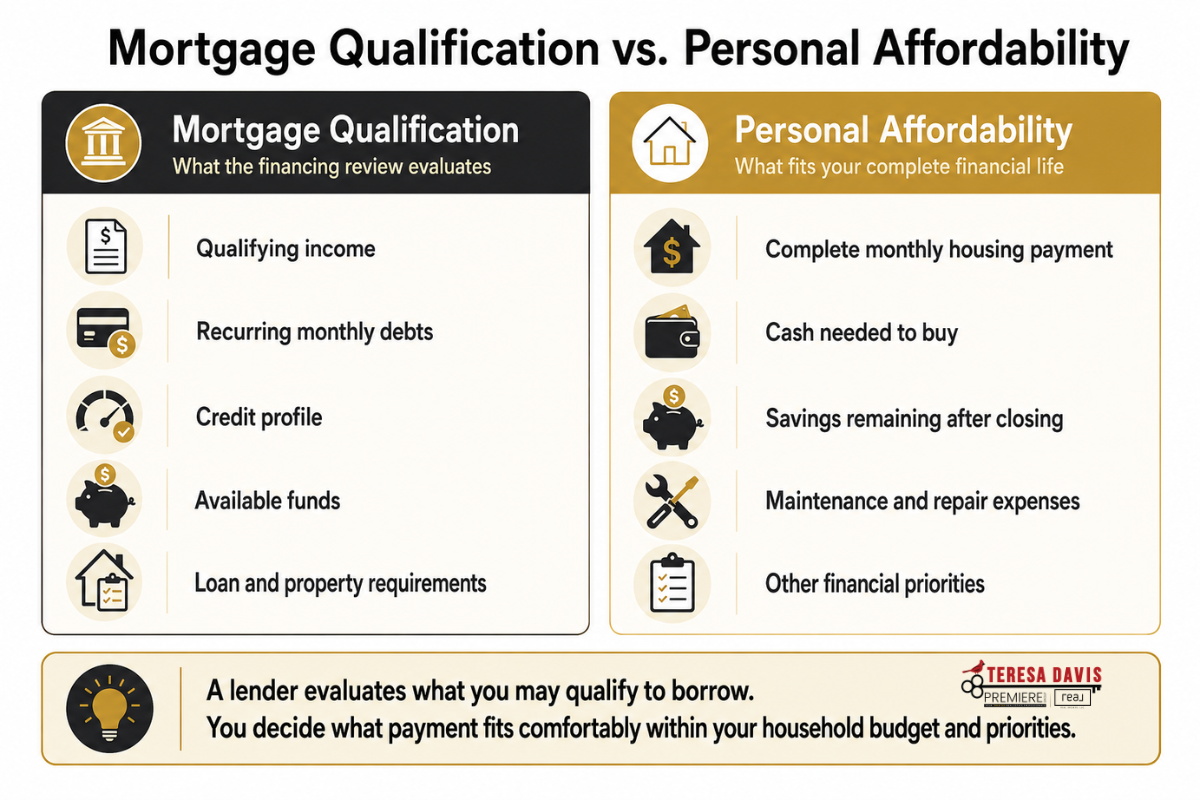
How a REALTOR® Helps You Shop Within a Realistic Budget
A mortgage professional helps determine whether you may qualify for financing and prepares estimates based on your financial information and the proposed property. A REALTOR® helps you apply that financing information to the actual home search.
Once you have established a preferred price range and upper boundary, your REALTOR® can help organize the search around both the purchase price and the property characteristics that may affect the total cost of ownership.
This guidance may include helping you:
- Focus on homes within the approved and personally comfortable price range.
- Compare properties with different taxes, association dues, conditions, sizes, systems, and land-maintenance responsibilities.
- Identify property information that should be shared with the mortgage professional for an updated payment estimate.
- Review available information about homeowners associations and recurring dues.
- Recognize when a property’s condition may create near-term repair or improvement expenses.
- Consider how North Carolina due diligence, earnest money, inspections, and other transaction expenses may affect available cash.
- Evaluate whether the proposed offer price and terms remain consistent with your budget.
- Adjust the search when financing estimates, insurance information, property costs, or personal priorities change.
Your REALTOR® can also help you avoid comparing homes solely by listing price. For example, one home may have a lower price but require significant repairs, association dues, or ongoing maintenance. Another property may have a higher price but fewer anticipated immediate expenses. Neither home is automatically the better financial choice. The complete payment, property condition, cash requirement, and expected ownership responsibilities should be considered together.
When a specific property is identified, your REALTOR® can coordinate with the mortgage professional so that the buyer can request an updated estimate based on available property information. This may include the proposed price, tax information, association dues, property type, planned concessions, and other details that may affect financing or cash needs.
Your REALTOR® does not determine:
- The amount you qualify to borrow.
- Your final mortgage interest rate.
- The loan program available to you.
- The final insurance premium.
- Future property taxes.
- The legal meaning of contract provisions.
- The tax consequences of purchasing or owning the property.
- The amount you should spend based on your complete personal financial circumstances.
Those matters should be addressed by the appropriately qualified mortgage, insurance, legal, tax, or financial professional. The REALTOR®’s role is to help you understand the real estate process, evaluate available property information, compare homes within your working range, and make informed decisions without encouraging you to exceed the budget you have chosen.
Teresa’s Professional Insight
Buyers sometimes assume that the highest amount shown on a pre-approval letter should become the target price for the home search. In practice, the maximum financing amount and the most comfortable purchase price are not always the same.
A buyer can be fully qualified for a particular payment and still decide that a lower payment better supports savings, travel, retirement contributions, childcare, education, family obligations, future repairs, or other priorities. That is not a sign that the buyer is purchasing too little. It is a sign that the buyer is making the decision based on the complete household budget rather than one qualification number.
I recommend identifying three figures before beginning a serious home search:
- A preferred target range. This is the range expected to provide a manageable payment while preserving reasonable financial flexibility.
- An upper boundary. This is the price or payment level you do not intend to exceed without reviewing the complete tradeoffs again.
- A property-specific payment limit. This recognizes that taxes, insurance, association dues, mortgage insurance, and other costs can make two similarly priced homes feel very different financially.
Buyers searching in Davidson, Randolph, Guilford, Forsyth, and surrounding North Carolina counties may encounter meaningful differences in property taxes, insurance estimates, association dues, utilities, property condition, lot maintenance, wells, septic systems, and other ownership responsibilities.
Because of those differences, I do not recommend assuming that every home within an approved price range will fit the budget equally well. When we identify a property you are seriously considering, we can review the available property information and coordinate with your mortgage professional so you can request an updated payment and cash estimate before making a decision.
A comfortable homebuying plan should help you reach closing with a payment you understand, enough cash to complete the transaction, and reasonable room to manage life after you receive the keys.
Helpful Tip
Ask your mortgage professional to prepare at least three price-and-payment scenarios before you begin seriously touring homes:
- A conservative scenario.
- A comfortable target scenario.
- A higher scenario that shows the financial tradeoffs.
For each scenario, request a breakdown that includes:
- Purchase price.
- Down payment.
- Estimated loan amount.
- Loan program and term.
- Estimated interest rate.
- Principal-and-interest payment.
- Estimated property taxes.
- Estimated homeowners insurance.
- Mortgage insurance when applicable.
- Homeowners association dues when applicable.
- Estimated complete monthly housing payment.
- Estimated cash needed for closing.
- Estimated savings remaining after closing.
Confirm whether the estimate includes all known recurring housing expenses. Ask which amounts are based on verified information and which are preliminary assumptions.
Keep the scenarios available during the home search. When you become interested in a specific property, request an updated estimate using the known property taxes, association dues, insurance information, proposed price, and financing assumptions.
This can help you compare homes based on their estimated total cost rather than relying only on the listing price. All figures remain estimates until the lender, insurance professional, closing professionals, and other appropriate parties complete their reviews.
Keep in Mind
A home-affordability range is a planning tool—not a guarantee of mortgage approval, a promise of final costs, or a substitute for individualized professional guidance. Important figures may change during the transaction, including:
- Interest rate.
- Loan terms.
- Mortgage insurance.
- Property-tax estimates.
- Homeowners insurance.
- Association dues or assessments.
- Closing costs.
- Due diligence fee.
- Earnest money.
- Inspection expenses.
- Appraisal-related costs.
- Required repairs.
- Cash needed for closing.
- Funds required to remain in reserve.
The property may also affect the financing. Property type, condition, appraisal results, insurance availability, association information, and other factors may influence loan eligibility or the final transaction.
Your financial circumstances must remain stable throughout the mortgage process. Before making a major purchase, opening or closing credit, moving money between accounts, changing employment, depositing unusual funds, or taking on new debt, discuss the potential effect with your mortgage professional.
Do not rely solely on:
- An online affordability calculator.
- A general mortgage-rate advertisement.
- Another buyer’s experience.
- The seller’s current tax or insurance amount.
- A preliminary payment estimate.
- A maximum pre-approval figure.
Use these items as starting information and confirm the details that apply to your circumstances and the specific property. This lesson provides general homebuyer education. It does not provide individualized mortgage, financial, legal, tax, insurance, appraisal, engineering, inspection, or investment advice.
Mortgage qualification and loan information should be reviewed with a qualified mortgage professional. Legal questions should be directed to a North Carolina attorney. Tax questions should be directed to a qualified tax professional. Insurance questions and property-specific coverage estimates should be reviewed with an appropriately licensed insurance professional.
Your final homebuying decision should reflect the verified financing information, the known costs and condition of the property, your available funds, and the monthly payment that fits comfortably within your household priorities.
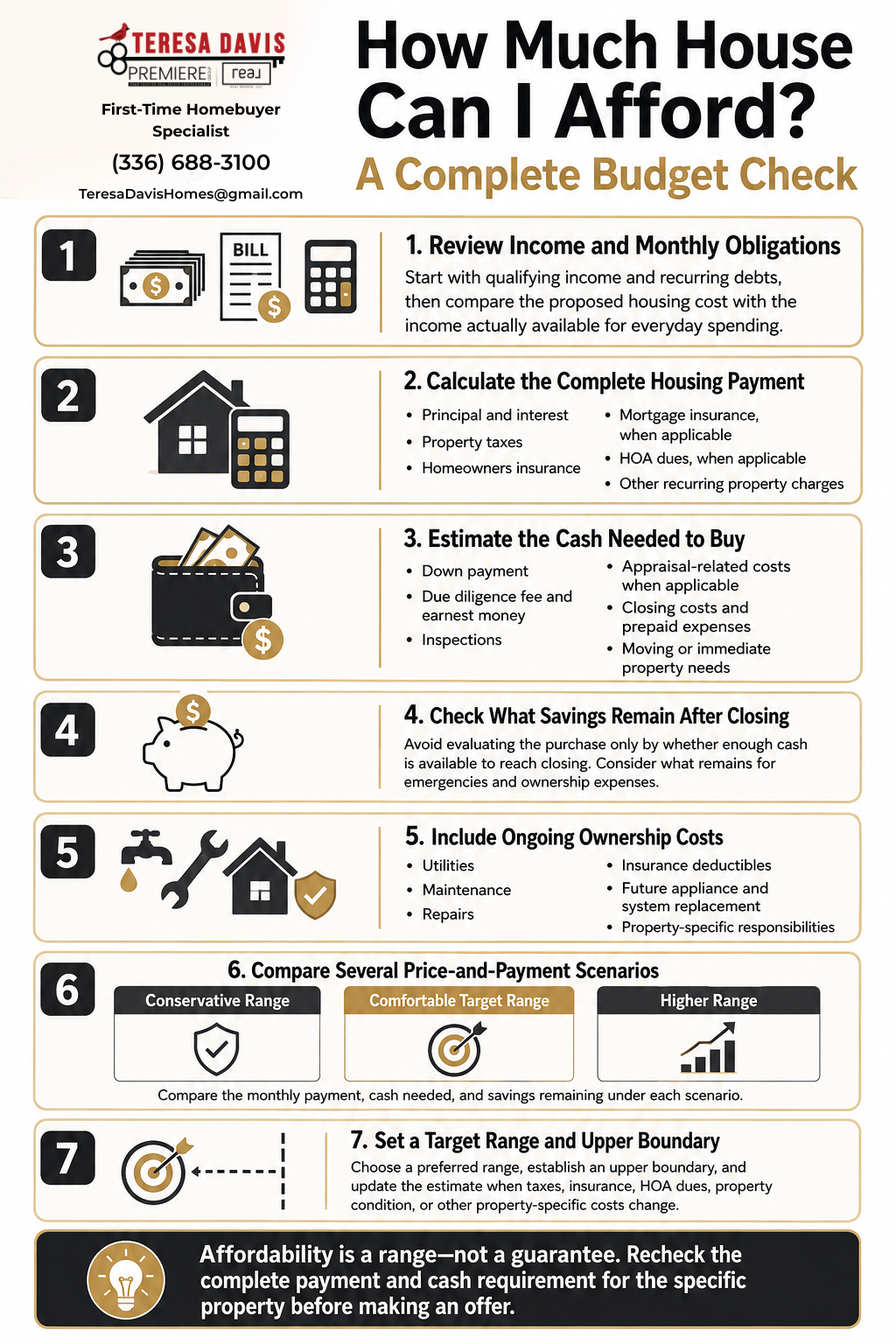
Frequently Asked Questions
Is the amount I am pre-approved for the same as the amount I should spend?
No. A mortgage pre-approval generally reflects an estimated financing amount based on the financial information reviewed by the lender and the applicable lending requirements. It does not require you to purchase at that amount.
Your preferred spending range may be lower after you consider your complete monthly budget, savings goals, emergency reserves, home-maintenance needs, lifestyle priorities, and other financial obligations. A buyer may qualify for a particular payment and still decide that a lower payment provides a more comfortable balance.
The pre-approval amount should be treated as a financing boundary. Your personal affordability range should reflect the complete estimated housing payment, cash needed for the transaction, remaining savings, and the amount that feels sustainable within your household budget.
What monthly costs should I include when deciding how much house I can afford?
Begin with the complete estimated housing payment, which may include:
• Mortgage principal and interest.
• Property taxes.
• Homeowners insurance.
• Mortgage insurance when applicable.
• Homeowners association dues when applicable.
• Other recurring property-related charges.
You should also consider expenses that may not be included in the mortgage payment, including utilities, maintenance, repairs, lawn or exterior care, pest control, private well or septic-system responsibilities, insurance deductibles, and future replacement of appliances or major home systems.
The appropriate estimate depends on the financing and the specific property. Two homes with the same purchase price can have different total monthly and ongoing ownership costs.
Why can two homes with the same price have different monthly payments?
Two similarly priced homes may have different property taxes, homeowners insurance premiums, association dues, mortgage-insurance costs, or other recurring expenses.
The financing may also differ because of the down payment, loan program, interest rate, loan term, property type, occupancy, or other loan details.
The properties themselves may create different ongoing expenses. One home may have older systems, more land, a private well, a septic system, extensive landscaping, or anticipated repairs. Another may have association dues or specialized insurance considerations.
For a meaningful comparison, review the complete estimated monthly payment and the broader ownership expenses for each specific property rather than comparing listing prices alone.
How does my down payment affect how much house I can afford?
The down payment affects the amount you need to finance and may affect the estimated principal-and-interest payment, available loan options, mortgage insurance, and cash needed for closing.
A larger down payment may reduce the loan amount or mortgage-insurance expense, but it also uses more of your available cash. A smaller down payment may preserve funds for closing, moving, repairs, reserves, or other needs, but it may create a larger loan balance or higher monthly payment.
The down payment should not be considered in isolation. Compare:
• The estimated loan amount.
• The complete monthly housing payment.
• Mortgage insurance when applicable.
• The total estimated cash needed for closing.
• The savings expected to remain after closing.
• The property’s anticipated maintenance and repair needs.
A down-payment choice is not appropriate simply because it produces the lowest loan balance. It should support both the transaction and your ability to manage homeownership after closing.
Should I use an online home-affordability calculator?
An online affordability calculator can provide a preliminary estimate and may help you understand how income, monthly debts, down payment, taxes, insurance, or interest-rate assumptions affect a possible price range.
However, a calculator may not accurately reflect:
• The lender’s qualifying-income analysis.
• The treatment of your specific debts.
• Your actual loan program or interest rate.
• Mortgage insurance.
• Property-specific taxes and insurance.
• Homeowners association dues.
• Closing costs.
• North Carolina due diligence and earnest money considerations.
• Maintenance and repair expenses.
• Your personal savings and lifestyle priorities.
Treat the result as a starting point for discussion rather than proof that you will qualify for or comfortably afford the displayed amount. A more reliable working range should be based on verified financial information, current financing estimates, your actual household budget, and the known costs of the property.
What Happens Next?
Begin by gathering the information needed to evaluate both mortgage qualification and personal affordability. This may include income documentation, recurring monthly debts, available savings, current housing expenses, regular household spending, and future financial priorities.
Next, review several estimated price-and-payment scenarios with a qualified mortgage professional. Compare the purchase price, down payment, loan amount, principal and interest, estimated taxes, estimated insurance, mortgage insurance when applicable, association dues when applicable, estimated cash needed for closing, and expected savings remaining after the transaction.
Choose a preferred target range and an upper boundary. The target range should reflect the payment you expect to manage comfortably. The upper boundary should identify the point at which you would pause and review the financial tradeoffs again before moving forward.
As you identify specific properties, update the affordability analysis. Taxes, insurance, association dues, property condition, repairs, utilities, land, wells, septic systems, and other ownership responsibilities may affect how a home fits your budget.
Before making an offer, review the proposed purchase price, complete estimated monthly payment, due diligence fee, earnest money, inspection expenses, closing-cost estimate, immediate property needs, and remaining savings.
Once you have a realistic understanding of what you may be comfortable spending, the next question is whether purchasing supports your current needs and longer-term plans. Continue to the next Academy lesson: Is it better to rent or buy a home?
Ready to Take the Next Step?
Understanding how much house you can afford requires more than selecting a price from an online calculator. A thoughtful plan connects your financing options, complete monthly payment, transaction expenses, remaining savings, property-specific costs, and personal priorities.
Teresa Davis serves consumers as both a REALTOR® / Professional Real Estate Advisor with PREMIERE Group of Real Broker LLC and a Licensed Loan Originator NMLS #2597433 with One Real Mortgage. Real estate representation and mortgage services are provided through their respective companies and professional roles.
Contact Teresa Davis
Contact Teresa Davis for homebuying guidance, help connecting your comfortable price range with a realistic property search, and assistance evaluating homes in Davidson, Randolph, Guilford, Forsyth, and surrounding North Carolina counties.
Teresa Davis
REALTOR® and Professional Real Estate Advisor
PREMIERE Group of Real Broker LLC
Begin the One Real Mortgage Pre-Approval Process
Begin or learn more about the One Real Mortgage pre-approval process so your income, debts, available funds, financing options, and estimated payment scenarios can be reviewed based on your individual circumstances. Using One Real Mortgage is optional and is not required in order to work with Teresa Davis as your REALTOR®.
Teresa Davis
Loan Originator NMLS #2597433
One Real Mortgage
Mortgage qualification, loan programs, terms, costs, and final approval depend on the borrower, property, transaction, documentation, underwriting, and applicable lending requirements. Beginning a pre-approval process does not guarantee financing or require you to purchase a home. It is a practical way to learn more about your potential financing options, estimated payment, and possible next steps.
Ready for the next lesson? Use “Next Question” below to continue to "Is it better to rent or buy a home?".
1:4 - Is it better to rent or buy a home?

Deciding whether to rent or buy a home is not simply a matter of comparing a rent payment with a mortgage payment. Both options provide a place to live, but they come with different costs, responsibilities, benefits, and levels of flexibility. The better choice depends on your financial readiness, how long you expect to stay, the amount of flexibility you need, and whether you are prepared for the ongoing responsibilities of homeownership.
For some first-time buyers, purchasing a home may provide greater housing stability, more control over the property, and an opportunity to build equity over time. For others, continuing to rent may be the more practical choice because it allows greater flexibility, requires fewer property-maintenance responsibilities, or provides additional time to build savings and prepare financially for homeownership.
If you are considering buying in Davidson, Randolph, Guilford, Forsyth, or another North Carolina county, the goal should not be to prove that buying is always better than renting. The goal is to understand the complete financial and practical picture so you can choose the housing option that best supports your current needs and longer-term plans.
Quick Answer
Neither renting nor buying is automatically better. Buying may make sense when you are financially prepared, expect to remain in the home or area for a meaningful period, want greater control over your living space, and are comfortable taking responsibility for maintenance, repairs, and other ownership expenses.
Renting may make more sense when flexibility is important, your future plans are uncertain, you want fewer property-maintenance responsibilities, or buying would use too much of your savings or stretch your monthly budget.
The most useful comparison is not simply rent versus mortgage payment. A better decision considers the complete cost of each option along with your savings, expected timeline, lifestyle priorities, need for flexibility, and readiness for the responsibilities that come with owning a home.
At a Glance
- There is no universal winner. Renting and buying can each be the right choice depending on your circumstances and goals.
- Compare complete costs. Homeownership can include principal and interest, property taxes, homeowners insurance, mortgage insurance when applicable, HOA dues when applicable, maintenance, repairs, utilities, and other property-specific expenses.
- Consider your timeline. Buying involves upfront and future transaction costs, so how long you reasonably expect to remain in the home or area can affect the decision.
- Think about flexibility. Renting can make relocating easier when a lease ends, while owning a home generally requires more planning if you decide to move.
- Understand the responsibility. Homeowners are responsible for maintaining and repairing their property rather than relying on a landlord for many property-related repairs.
- Equity is a potential benefit, not a guarantee of profit. Mortgage principal repayment can help build equity, and property values may change over time, but home appreciation is never guaranteed.
- Financial readiness matters beyond loan qualification. Being able to qualify for a mortgage does not automatically mean buying is the best choice for your overall budget and financial priorities.
- Renting can be a strategic choice. Continuing to rent may give you time to strengthen savings, improve financial readiness, or gain clarity about where and how long you want to live.
- Your personal priorities matter. Stability, control of the property, flexibility, maintenance responsibilities, savings, and future plans should all be part of your decision.
- The best choice is the one that fits your situation. A well-informed decision should support your finances and your life—not pressure you into buying simply because homeownership is considered the traditional next step.
There Is No Universal Winner
One of the most common homebuying myths is that owning a home is always financially better than renting. Another is that renting means you are “throwing money away.” Neither statement tells the whole story.
Renting and buying are two different ways of meeting the same basic need: having a place to live. Each comes with different financial obligations, responsibilities, benefits, and tradeoffs. The better choice depends on how well each option fits your current circumstances.
Buying may offer greater housing stability, more control over the property, and the opportunity to build equity over time. Renting may provide greater flexibility, fewer property-maintenance responsibilities, and the ability to avoid many of the upfront and ongoing expenses associated with ownership.
The right question is not simply, “Which one is better?”
A more useful question is: Which option makes the most sense for my finances, plans, priorities, and current stage of life?
That distinction matters because a decision that is appropriate for one person may not be appropriate for another. It can also change over time. Renting may make sense today while buying becomes the better fit later.
When Renting May Make More Sense
Renting can be a practical and intentional choice, particularly when flexibility or financial preparation is more important than owning a property right now. Renting may deserve serious consideration when:
- you expect your employment, household needs, or location to change;
- you may need to move within the foreseeable future;
- you want additional time to build savings;
- purchasing a home would use most of your available cash;
- you are still working toward a comfortable homebuying budget;
- you prefer not to take responsibility for major property repairs;
- you have not yet found a home that meets both your needs and your comfortable price range;
- you value the ability to relocate more easily when your lease ends.
Renting can also provide time to prepare for homeownership without rushing the decision. For example, a future buyer may use that time to strengthen savings, reduce other financial obligations, better understand monthly expenses, establish an emergency reserve, or decide where they expect to remain longer term.
That does not mean the person is “falling behind.” It means renting is serving a purpose within a larger housing plan.
When Buying May Make More Sense
Buying may become more attractive when your financial position, expected timeline, and housing priorities align with the responsibilities of ownership. Homeownership may be worth considering when:
- you want greater long-term housing stability;
- you reasonably expect to remain in the home or area for a meaningful period;
- your anticipated housing costs fit comfortably within your broader budget;
- you have funds available for the purchase without exhausting your savings;
- you can maintain appropriate reserves after closing;
- you are prepared for maintenance and unexpected repairs;
- you want more control over how you use or personalize the property, subject to applicable laws, restrictions, association rules, and other property limitations;
- building equity through mortgage principal repayment is important to your long-term plans.
Owning a home can provide benefits that renting generally does not, but those benefits come with responsibilities. A homeowner cannot simply compare an expected mortgage payment with current rent and assume that buying is automatically the better deal. The complete ownership picture must be considered.
Compare the Complete Cost of Renting
When evaluating renting, start with the actual cost of the rental arrangement rather than looking at monthly rent alone. Depending on the property and lease, renter expenses may include:
- monthly rent;
- renters insurance;
- utilities;
- deposits or other lease-related charges;
- parking fees;
- amenity charges;
- pet-related fees when applicable;
- moving expenses;
- other recurring charges identified in the lease.
Future rental costs can also change. A lease may renew at a different rental amount or under different terms, subject to the lease and applicable law.
At the same time, renters are generally not responsible for many of the major property expenses that owners must plan for. Responsibility for repairs and maintenance depends on the lease, the nature of the repair, and applicable requirements, but renters commonly rely on the property owner or property manager for many property-related repairs.
That difference has financial value and should be part of the comparison.
Compare the Complete Cost of Buying
Homeownership involves more than a mortgage payment. Depending on the property and financing, ownership expenses may include:
- mortgage principal and interest;
- property taxes;
- homeowners insurance;
- mortgage insurance when applicable;
- homeowners association dues when applicable;
- utilities;
- routine maintenance;
- repairs;
- replacement of aging systems or components;
- lawn, exterior, or property upkeep;
- other property-specific expenses.
Buying also usually requires money before and during the transaction. Depending on the purchase and financing, a buyer may need funds for items such as the down payment, inspections, appraisal-related expenses, lender or settlement charges, prepaid expenses, and other transaction costs.
The exact expenses vary by property, financing, contract, and individual circumstances.
This is why a first-time buyer should evaluate both:
What will it take financially to purchase the home?
and
What will it take financially to own and maintain the home afterward?
A home may fit within a lender's qualification guidelines and still create a monthly or savings commitment that feels uncomfortable to the buyer. Comfortable affordability and maximum qualification are not necessarily the same thing.
Why “My Rent Is the Same as a Mortgage” Can Be Misleading
A common reason renters begin considering homeownership is that an estimated mortgage payment appears similar to their current rent. That can be a useful reason to explore buying, but it is not enough information to determine whether buying will cost about the same.
An advertised or estimated mortgage figure may refer only to principal and interest. A homeowner's actual housing expense can also include property taxes, homeowners insurance, mortgage insurance when applicable, homeowners association dues when applicable, and other property-specific costs.
Homeowners must also plan for maintenance and repairs. A renter may receive a call from a property manager or landlord when a covered property repair is needed. A homeowner generally has to arrange the repair and pay the cost directly.
For that reason, this comparison: monthly rent versus mortgage principal and interest is usually incomplete.
A more useful comparison is: the complete cost of renting versus the complete cost of owning.
The comparison should also consider the cash required to purchase the home, the amount of savings that would remain afterward, and the financial responsibility of maintaining the property. Renting and buying may have similar monthly figures on paper while producing very different overall financial obligations.
Renting Pays for Housing, but It Does Not Build Ownership Equity for You
Rent is not wasted money. In exchange for rent, you receive something valuable: the right to live in the property without taking on many of the financial and maintenance responsibilities that come with ownership. At the same time, there is an important financial distinction between renting and owning.
When you pay rent, that money goes to the property owner in exchange for your use of the home. The property owner may use that income toward the mortgage, property taxes, insurance, maintenance, repairs, operating expenses, or profit. You receive housing, but you do not acquire an ownership interest in the property simply by making rent payments.
In that sense, your rent helps support someone else’s ownership of the property rather than building ownership equity for you. With homeownership, part of each mortgage payment may be applied toward mortgage principal. As principal is repaid, the homeowner’s equity can grow. That is one reason homeownership is often viewed as a form of long-term investment.
However, it is important to use the word investment carefully. A primary residence is first and foremost a place to live. It also has expenses, including interest, taxes, insurance, maintenance, repairs, and transaction costs. Property values can change over time, so future appreciation should never be assumed.
The potential investment value of homeownership comes primarily from two sources:
- Mortgage principal repayment. As principal is paid down, the homeowner may build equity in the property.
- Changes in property value. If the property increases in value over time, the homeowner’s equity may increase further.
Those benefits create an important difference between renting and owning. A renter makes payments for the use of someone else’s property. A homeowner may make payments toward a home they own while gradually building equity in that property. For a financially prepared consumer who expects to own long enough for the purchase to make sense, that distinction can be meaningful.
Understanding Equity
Equity is the difference between what a property is worth and what is owed against it. For example, equity may increase when a homeowner pays down mortgage principal. It may also increase if the property’s market value rises.
This is one of the reasons homeownership can become an important part of a person’s long-term financial picture. A simple way to think about it is: Owning a home can give you the opportunity to build equity over time as you pay down your mortgage and, if the home increases in value, potentially build even more equity.
Unlike rent payments, which pay for the use of someone else’s property, mortgage principal payments can help increase the portion of the home that you own.
That does not mean every dollar of a mortgage payment becomes equity. Interest, taxes, insurance, mortgage insurance when applicable, and other ownership expenses serve different purposes. But principal repayment is one way homeowners can gradually build equity while living in the home.
Your Expected Timeline Matters
The amount of time you expect to remain in a home can be an important part of the rent-versus-buy decision. Buying and later selling a home can involve transaction expenses. Those expenses may include costs associated with obtaining financing, completing the purchase, maintaining the property, and eventually selling it.
Because of those costs, buying a home and selling again after a relatively short period may produce a very different financial result than owning the same property for a longer period. This is why you may hear people discuss a “break-even point” when comparing renting with buying.
There is no universal number of years that applies to every buyer. The answer can depend on factors such as:
- the purchase price;
- the amount financed;
- the mortgage terms;
- upfront transaction costs;
- monthly ownership expenses;
- maintenance and repairs;
- comparable rental costs;
- changes in property value;
- future selling expenses;
- the amount of mortgage principal repaid;
- your individual circumstances.
Instead of relying on a rule such as “you must stay at least a certain number of years,” consider whether your expected timeline is long enough to justify the financial and practical commitment of purchasing the home.
If your plans are uncertain and you may need to relocate soon, renting may provide useful flexibility. If you expect to remain in the area and the home fits your longer-term needs, buying may deserve stronger consideration.
Flexibility Versus Stability
Renting and owning also provide different types of flexibility and stability.
Renting May Offer More Flexibility
Renting can make it easier to change locations after the lease term ends. That can be particularly useful if you:
- expect a job change;
- may relocate;
- are still deciding where you want to live longer term;
- anticipate changes in your housing needs;
- simply do not want to make a long-term property commitment yet.
A renter can still face lease obligations, moving costs, and availability constraints, but leaving a rental is generally different from selling or managing an owned property.
Ownership May Offer More Stability and Control
Owning a home may provide greater control over your housing situation. Subject to applicable laws, deed restrictions, homeowners association rules, zoning requirements, and other limitations, homeowners often have more ability to:
- make improvements;
- personalize the property;
- decide how long they want to remain;
- make changes without obtaining a landlord’s permission;
- establish longer-term plans around the property.
For some buyers, that stability and control are important benefits even apart from the financial considerations.

Maintenance and Repairs Become Your Responsibility
One of the largest practical differences between renting and owning is responsibility for the property. When renting, many repairs are typically handled by the property owner or property manager, depending on the lease, the type of repair, and applicable requirements.
When you own the home, those responsibilities generally become yours. A homeowner may need to plan and pay for:
- HVAC service or replacement;
- plumbing repairs;
- electrical repairs;
- appliance replacement;
- roof repairs or replacement;
- water heater replacement;
- exterior maintenance;
- landscaping and property upkeep;
- routine preventive maintenance;
- unexpected repairs.
These expenses do not occur on the same schedule for every property, and it is not realistic to predict them perfectly. That is why maintaining savings after closing is so important. Buying a home should not leave you financially unable to handle the responsibilities that begin after you receive the keys.
Financial Readiness Matters More Than Simply Qualifying
Mortgage qualification can tell you whether you may meet a lender’s requirements for a particular loan amount. It does not automatically tell you whether buying that home is the best choice for your household.
Your personal decision should also consider:
- how comfortable the full housing expense feels in your budget;
- how much cash you will need for the transaction;
- how much savings you will have remaining afterward;
- your other recurring obligations;
- your emergency reserves;
- your future financial priorities;
- your anticipated maintenance responsibilities;
- whether the purchase supports your broader plans.
This connects directly to the previous Academy lesson, How much house can I afford?
A lender may determine that you qualify for a certain mortgage amount, but your personal comfort level may be lower. Choosing a home within a comfortable range can give you more flexibility to handle repairs, savings goals, lifestyle expenses, and unexpected changes.
Buying works best when both pieces align: You can qualify for the financing, and the complete cost of ownership fits comfortably into your financial life.
A Practical Rent-vs.-Buy Decision Framework
If you are still unsure whether renting or buying is the better next step, work through the decision one question at a time.
Ask yourself:
- Am I financially prepared to buy?
Consider the money needed for the transaction as well as the expenses that continue after closing. - Would I still have appropriate savings after purchasing?
Avoid evaluating affordability based only on whether you can come up with the funds needed to close. - How long do I reasonably expect to stay?
Consider your employment, location, household needs, and other plans. - How important is flexibility to me right now?
Renting may provide greater mobility when your future plans are uncertain. - How important is stability and control of my home?
Ownership may provide greater long-term control over the property and your housing decisions. - Am I prepared for maintenance and repairs?
Consider both the financial cost and the responsibility of managing the property. - Does the complete cost of ownership fit comfortably within my budget?
Look beyond principal and interest to the entire ownership picture. - How important is building equity to me?
Rent provides housing, but rent payments do not build equity for the renter. With a financed home purchase, principal repayment can gradually increase the homeowner’s equity. - Does buying support my broader goals?
Homeownership should fit into your life rather than become a financial burden that interferes with other important priorities. - Would renting for now give me a meaningful advantage?
If renting allows you to strengthen savings, preserve needed flexibility, improve your financial readiness, or clarify your plans, waiting to buy may be a purposeful decision.
The goal is not to force the numbers to prove that buying or renting is superior. The goal is to understand what you receive in exchange for each housing payment. Renting provides housing and flexibility, but the payment supports the owner’s property rather than building equity for you.
Buying carries more responsibility and additional ownership expenses, but it also gives you the opportunity to put part of your housing payment toward a home you own, build equity through principal repayment, and potentially gain additional equity if the property increases in value.
For someone who is financially prepared and whose timeline and priorities support homeownership, those potential long-term benefits can make buying worth considering. For someone who needs flexibility or additional preparation, renting can still be the more appropriate choice for now.
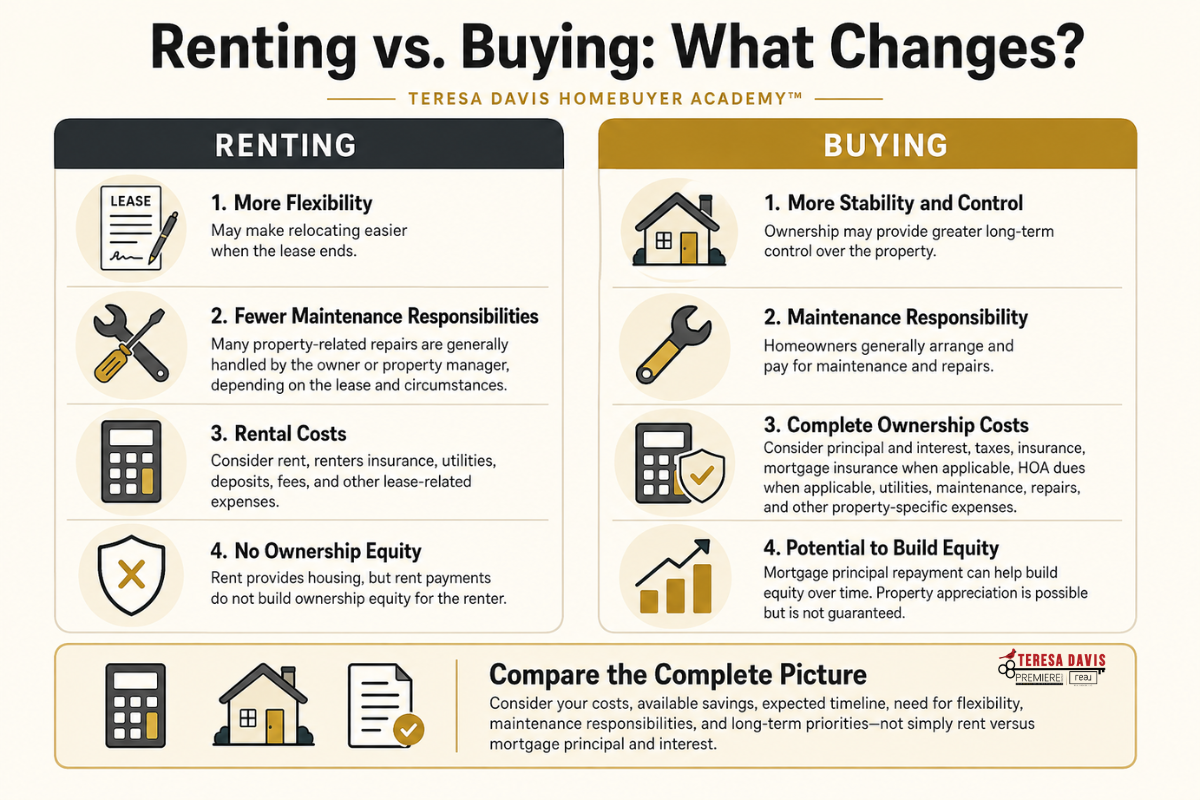
How a REALTOR® Can Help You Compare Renting and Buying
A rent-versus-buy decision becomes much more useful when you compare realistic housing options instead of relying only on general online estimates. A REALTOR® can help you understand what homes are actually available within a price range that feels comfortable to you and identify property-specific factors that could affect the overall cost of ownership.
That may include helping you evaluate:
- asking prices and recent market activity for homes you are considering;
- property condition and visible maintenance considerations;
- homeowners association dues when applicable;
- features that may affect ongoing maintenance or utility expenses;
- how well a property may fit your anticipated length of ownership;
- whether the home supports your needs without requiring you to stretch beyond your comfortable budget;
- how different homes compare when considering both purchase price and property condition.
The lowest-priced home is not always the least expensive home to own. For example, one property may have a lower purchase price but require significant repairs or improvements sooner. Another may cost more initially but have major systems or components that have been updated more recently. Those property-specific details can matter when comparing the practical cost of ownership.
A REALTOR® can also help you look beyond the idea of simply becoming a homeowner and focus on whether a particular property makes sense for you. The purpose of that guidance should be to help you make an informed housing decision—not to convince you to purchase before you are ready.
Teresa’s Professional Insight
When someone asks me whether it is better to rent or buy, I do not believe the answer should automatically be, “You should buy.” The better question is whether homeownership makes sense for you right now.
Renting provides housing and can offer valuable flexibility, but your monthly rent is ultimately paying for the use of a property someone else owns. Those payments may help the property owner cover their mortgage and other expenses, and they do not build equity for you.
Homeownership works differently. When you have a mortgage, part of your payment may go toward principal. As that principal is paid down, you can build equity in your own home. If the property also increases in value over time, that may create additional equity.
That is one reason I believe homeownership can be an important long-term investment when the buyer is financially prepared and the purchase fits their plans. But owning a home also means accepting the expenses and responsibilities that come with it. Repairs, maintenance, insurance, property taxes, and other costs become part of your financial picture.
As both a REALTOR® / Professional Real Estate Advisor with PREMIERE Group of Real Broker LLC and a Loan Originator NMLS #2597433 with One Real Mortgage, I can help consumers look at the homebuying decision from two different professional perspectives.
As your REALTOR®, I can help you understand the homes available, evaluate property-specific considerations, and determine whether a particular property fits your priorities.
In my mortgage role, I can help you explore financing possibilities and better understand what a potential mortgage scenario could look like based on your individual circumstances.
Those are separate professional roles, but both can help answer the larger question: Does buying a home make sense for me financially and practically at this point in my life?
Sometimes the answer will be yes. Sometimes continuing to rent while you strengthen your savings, prepare financially, or clarify your future plans will make more sense.
Either way, the goal should be for you to understand the decision well enough to make it confidently rather than feeling pressured to buy simply because someone tells you that you should.
Helpful Tip
Create a simple side-by-side comparison using your actual expected expenses rather than relying on a generic rent-versus-buy calculator alone.
For renting, consider items such as:
- monthly rent;
- renters insurance;
- utilities;
- recurring fees identified in the lease;
- expected moving expenses when applicable.
For buying, consider items such as:
- estimated principal and interest;
- property taxes;
- homeowners insurance;
- mortgage insurance when applicable;
- homeowners association dues when applicable;
- utilities;
- expected maintenance and repair responsibilities;
- cash needed for the purchase;
- savings you expect to have remaining after closing.
Then add two columns that have nothing to do with dollars: Flexibility and long-term plans.
A purely mathematical comparison can miss important questions such as whether you expect to relocate, how much control you want over your home, and whether you are comfortable taking responsibility for maintenance and repairs. The strongest rent-versus-buy comparison combines the numbers with the way you actually expect to live.
Keep in Mind
Renting does not have to be viewed as a failure to buy, and buying does not have to happen according to someone else’s timeline.
Renting may be the right decision during one stage of your life, while homeownership may become the better choice later. At the same time, it is reasonable to recognize the long-term financial difference between the two choices. When you rent, your payment provides housing but does not build equity for you.
When you own a financed home, part of your payment may reduce the mortgage principal and help you build equity in a property you own. That ability to build equity is one of the potential long-term financial advantages of homeownership.
The decision still needs to fit your complete financial picture. Future property values, future rent amounts, maintenance expenses, and individual financial outcomes cannot be predicted with certainty. Your goal should be to choose the option that works for your finances, your expected timeline, and your priorities today while keeping your longer-term goals in mind.
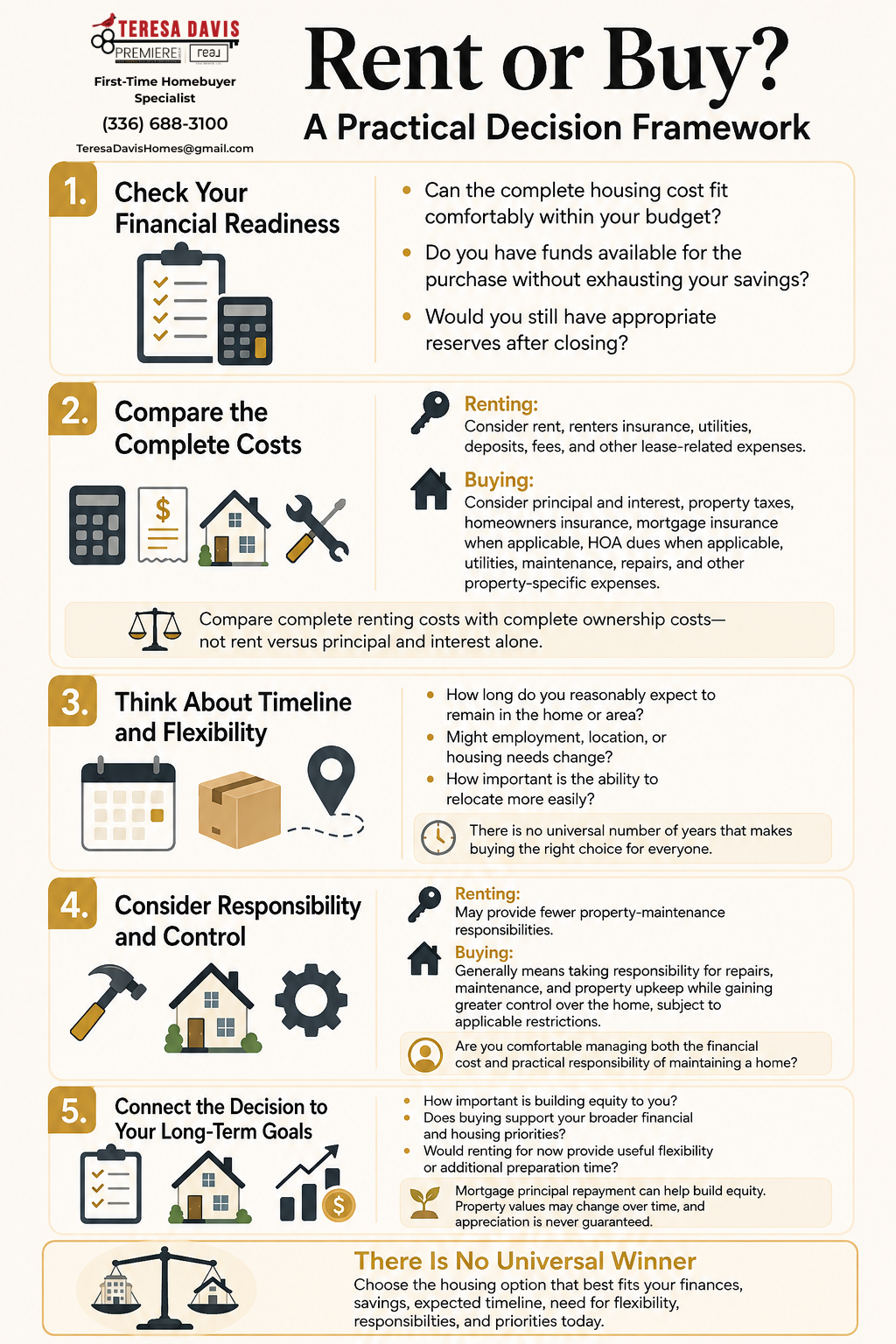
Frequently Asked Questions
Is buying a home always better than renting?
No. Buying and renting can each make sense depending on your finances, timeline, housing needs, and priorities.
Buying may offer the opportunity to build equity, create greater housing stability, and give you more control over a property you own. Renting may offer greater flexibility, fewer property-maintenance responsibilities, and additional time to prepare financially.
The better choice is the one that fits your circumstances rather than a general rule that says everyone should rent or everyone should buy.
Is renting really “throwing money away”?
Rent is not simply wasted money because you receive housing in exchange for your payment. Renting can also provide flexibility and relieve you of many ownership responsibilities.
There is, however, an important financial difference. Your rent is paid to the owner for the use of a property that belongs to them. Your rent payments do not build equity for you.
When you own a financed home, part of your mortgage payment may be applied toward principal. As principal is paid down, you can build equity in your own home. If the property increases in value over time, that may create additional equity. That opportunity to build equity is one of the potential long-term financial advantages of owning rather than renting.
Should I buy if my estimated mortgage payment is close to my rent?
Maybe, but the comparison should go beyond the estimated mortgage payment.
An estimated mortgage amount may show principal and interest without giving you the complete cost of owning the property. Depending on the home and financing, your ownership expenses may also include property taxes, homeowners insurance, mortgage insurance when applicable, homeowners association dues when applicable, utilities, maintenance, repairs, and other property-specific expenses.
You should also consider the funds needed to purchase the home and how much savings you expect to have remaining afterward. A similar rent and mortgage figure can be a good reason to explore your options, but it should not be the only reason you decide to buy.
How long should I plan to stay before buying makes sense?
There is no universal number of years that makes buying the right choice for everyone.
The answer depends on factors such as the purchase price, financing, upfront transaction expenses, monthly ownership costs, maintenance, comparable rent, changes in property value, the amount of mortgage principal repaid, future selling expenses, and your individual circumstances.
If you expect to move relatively soon, the flexibility of renting may be valuable. If you expect to remain in the home or area for a meaningful period and the purchase fits your finances and plans, buying may deserve stronger consideration. Instead of relying on a fixed number of years, evaluate whether your expected timeline supports the financial and practical commitment of owning the home.
Can I rent now and buy later?
Yes. Renting now does not prevent you from becoming a homeowner later.
Continuing to rent may give you time to build savings, strengthen your financial position, establish reserves, better understand your comfortable homebuying budget, or gain more clarity about where you want to live.
When you are ready, you can reevaluate the numbers and your goals. The important thing is to make homeownership fit your circumstances rather than buying simply because you feel that you are supposed to own a home by a certain point in your life.
What Happens Next?
If you decide that buying may be the better fit for your finances and future plans, the next question is not simply whether you want to own a home. It is whether you understand what owning one actually involves.
Homeownership can provide meaningful benefits. You may have the opportunity to build equity as you pay down mortgage principal, potentially gain additional equity if the property increases in value, have greater control over your living space, and establish greater long-term housing stability.
Those benefits also come with responsibilities. As a homeowner, you will need to plan for maintenance, repairs, insurance, property taxes, utilities, and other property-specific expenses. You also become responsible for taking care of the home and making financial decisions that renters can often leave to a landlord or property manager.
The next Academy lesson, What are the benefits and responsibilities of owning a home?, will help you understand those tradeoffs before moving further into the homebuying process.
Ready to Take the Next Step?
You do not have to decide whether to rent or buy based on a general rule, an online calculator, or someone else’s opinion. A better approach is to look at your actual numbers, expected timeline, housing priorities, available savings, and the complete responsibilities of homeownership.
If you are considering buying, I can help you explore the decision from both the real estate and mortgage sides while keeping those professional roles clearly defined.
Contact Teresa Davis
If you would like to discuss your homebuying goals, the types of homes available within a comfortable price range, or whether purchasing a home makes sense for your plans, you can contact Teresa Davis here:
Teresa Davis
REALTOR® and Professional Real Estate Advisor
PREMIERE Group of Real Broker LLC
Begin the One Real Mortgage Pre-Approval Process
If you are ready to explore financing possibilities, the mortgage pre-approval process can help you better understand potential loan options, qualification, and payment scenarios based on your individual circumstances. Using One Real Mortgage is optional and is not required in order to work with Teresa Davis as your REALTOR®.
Teresa Davis
Loan Originator NMLS #2597433
One Real Mortgage
Mortgage qualification, loan programs, terms, costs, and final approval depend on the borrower, property, transaction, documentation, underwriting, and applicable lending requirements. Beginning a pre-approval process does not guarantee financing or require you to purchase a home. It is a practical way to learn more about your potential financing options, estimated payment, and possible next steps.
Ready for the next lesson? Use “Next Question” below to continue to "What are the benefits and responsibilities of owning a home?".
1:5 - What are the benefits and responsibilities of owning a home?

Owning a home can offer meaningful benefits, but it also comes with responsibilities that renters may not have to manage directly. For many buyers, homeownership can provide greater control over their living space, an opportunity to build equity over time, and more stability in where and how they live.
Those benefits come with ongoing financial and practical obligations. Homeowners are responsible for their mortgage payments, property-related expenses, routine maintenance, repairs, and the overall care of the property. Costs such as property taxes, homeowners insurance, utilities, homeowners association dues when applicable, and unexpected repairs can also affect the true cost of owning a home.
Understanding both sides of homeownership can help you decide whether buying fits your finances, plans, and priorities. The goal is not simply to be able to purchase a home, but to be prepared to comfortably own and maintain it after closing.
Quick Answer
Owning a home can provide benefits such as greater control over the property, the opportunity to build equity, increased housing stability, and the ability to personalize your living space. A home may also become a valuable household asset over time, although property appreciation and financial gains are never guaranteed.
Homeownership also means taking responsibility for the mortgage, property taxes, homeowners insurance, maintenance, repairs, utilities, and other ongoing expenses associated with the property. Even when a homeowner has a fixed-rate mortgage, the total cost of owning the home can change as taxes, insurance, maintenance needs, and other expenses change.
The benefits of homeownership are most meaningful when the home fits your financial situation, expected timeline, and ability to manage the responsibilities that continue after you receive the keys.
At a Glance
- Homeownership can provide greater control. You generally have more flexibility to maintain, improve, and personalize your property, subject to applicable laws, recorded restrictions, HOA requirements, permits, and other property-specific limitations.
- You may build equity over time. Paying down mortgage principal can increase your ownership interest in the property, and rising property values may also increase equity. Property values can also decline, so appreciation is not guaranteed.
- A fixed-rate mortgage can provide some payment predictability. The principal-and-interest portion generally remains consistent during the fixed-rate term, but property taxes, homeowners insurance, HOA expenses, maintenance, and other housing costs can change.
- The homeowner becomes responsible for maintenance and repairs. Routine upkeep, aging systems, appliances, and unexpected repairs are generally the homeowner's responsibility rather than a landlord's.
- The mortgage payment is only part of the cost of ownership. A realistic homeownership budget should also consider taxes, insurance, utilities, maintenance, repairs, and HOA dues or assessments when applicable.
- Homeownership is an ongoing commitment. Maintaining the property, planning for expenses, and periodically reviewing your household budget are important parts of protecting your home and managing ownership responsibly.
- Buying should fit your broader plans. The potential benefits of owning a home should be weighed alongside your financial readiness, expected length of ownership, household priorities, and ability to handle ongoing responsibilities.
Understanding the Benefits of Homeownership
Owning a home changes more than where you live. It can change how much control you have over the property, how your housing payments contribute to an asset you own, and how you plan for your future. These potential benefits are important, but they should be viewed realistically. Homeownership does not guarantee appreciation, profit, or lower housing costs.
Greater Control Over the Property
One of the most noticeable differences between renting and owning is the amount of control you generally have over the property. As a homeowner, you may have more freedom to make decisions about your home, such as:
- painting or decorating;
- replacing flooring or fixtures;
- improving outdoor spaces;
- renovating rooms;
- making energy-efficiency improvements; or
- changing the property to better fit your needs over time.
That freedom is not unlimited. A property may be subject to zoning rules, building codes, permit requirements, recorded covenants or restrictions, homeowners association requirements, historic-district requirements, or other limitations. Before making a significant change to a property, it is important to determine whether approvals, permits, or other requirements apply.
The benefit is not that homeowners can do anything they want with a property. The benefit is that ownership generally gives you considerably more decision-making authority over the home than you would typically have as a renter.
The Opportunity to Build Equity
Homeownership also provides an opportunity to build equity. In simple terms, home equity is generally the difference between the market value of your home and the amount you still owe against it.
For example, if a home were worth $300,000 and the outstanding mortgage balance were $240,000, the homeowner would have approximately $60,000 in equity before considering selling costs, other liens, or similar expenses.
Equity can change in more than one way.
Paying Down Mortgage Principal
With an amortizing mortgage, part of the scheduled payment generally goes toward reducing the loan principal. As the principal balance decreases, your ownership interest in the property may increase.
Early in many mortgage schedules, a larger portion of the principal-and-interest payment goes toward interest and a smaller portion goes toward principal. The allocation changes over time according to the loan's amortization schedule.
The important distinction for a first-time buyer is that paying rent and paying a mortgage are not financially identical. When you rent, your payment gives you the right to occupy the property under the terms of the lease. When you own a home with a mortgage, part of the payment may reduce the debt secured by an asset you own.
That does not mean every mortgage payment immediately creates significant equity. The amount of principal reduction depends on the loan terms and payment schedule.
Changes in Property Value
Equity may also increase when a property's market value rises. However, appreciation is never guaranteed.
Real estate values can:
- increase;
- remain relatively stable; or
- decline.
Changes in value may be influenced by many factors, including property condition, supply and demand, broader economic conditions, financing conditions, and the characteristics of the local real estate market. This is why homeownership should not be presented as an automatic path to profit. A homeowner may build equity over time, but future market value cannot be guaranteed.
A Home Can Become a Significant Household Asset
For many homeowners, their residence eventually becomes an important part of their overall financial picture. As mortgage principal is reduced and equity potentially grows, the homeowner may accumulate a larger ownership interest in the property.
That can create long-term financial value, particularly when the home is owned for an extended period and the homeowner manages the property and mortgage responsibly. However, the home's market value is only one part of the financial picture.
Homeowners also incur costs such as:
- mortgage interest;
- property taxes;
- homeowners insurance;
- maintenance;
- repairs;
- improvements;
- transaction costs; and
- HOA dues or assessments when applicable.
For that reason, the purchase price and eventual selling price alone do not determine whether owning a particular home was financially beneficial. Homeownership is better understood as ownership of a significant asset that also carries significant expenses and responsibilities.
Greater Housing Stability
Owning a home may also provide greater control over your housing situation. Renters generally occupy a property according to the terms of a lease. At the end of a lease term, rental rates may change, lease terms may change, or the property owner may decide not to offer another lease, subject to applicable law and the rental agreement.
A homeowner does not have a landlord determining whether a lease will be renewed. Provided the homeowner continues meeting the financial and legal obligations associated with the property, ownership can offer more control over how long the household remains there. This can make homeownership appealing to buyers who value establishing a longer-term home base.
However, ownership should not be interpreted as absolute permanence. A homeowner still needs to:
- make required mortgage payments when financing is involved;
- pay applicable property taxes;
- maintain appropriate insurance;
- comply with applicable laws and property restrictions; and
- manage the other obligations associated with the property.
The stability benefit comes from having greater control over the housing decision, not from being free of housing obligations.
Some Mortgage Payments Can Be More Predictable
Another potential advantage of homeownership is greater predictability in part of the monthly housing payment when a buyer uses a fixed-rate mortgage. With a traditional fixed-rate mortgage, the interest rate remains fixed according to the loan terms, which generally keeps the scheduled principal-and-interest payment consistent during the fixed-rate term.
That can provide a level of predictability that may not exist with rent, which can change when a lease is renewed. However, a fixed-rate mortgage does not mean the homeowner's total monthly housing expense can never change. Depending on the property and financing arrangement, the total monthly cost may include expenses such as:
- property taxes;
- homeowners insurance;
- mortgage insurance when applicable;
- homeowners association dues; and
- other property-related costs.
Taxes and insurance can change over time. HOA dues or assessments can also change when applicable. Maintenance and repair expenses may vary significantly from year to year. For first-time buyers, this distinction is important: the principal-and-interest portion of a fixed-rate mortgage may remain predictable while the total cost of owning the home continues to change.
The Ability to Make the Home Your Own
Homeownership can also provide something that is difficult to measure strictly in dollars: the ability to shape the property around your preferences and changing needs.
A homeowner may decide to:
- update a kitchen;
- create a home office;
- improve storage;
- replace landscaping;
- add accessibility features;
- improve energy efficiency; or
- make other changes that improve how the property functions.
Some improvements may affect market value, while others may primarily improve the homeowner's enjoyment or use of the property. Not every improvement produces a financial return equal to what it costs. Buyers should avoid assuming that money spent on a renovation will automatically be recovered when the property is sold.
Before completing major improvements, homeowners may also need to consider permits, contractor requirements, HOA approval, recorded restrictions, financing considerations, and other property-specific requirements. The broader benefit is the opportunity to make long-term decisions about a property you own rather than being limited primarily by the terms of a rental agreement.
The Benefits Work Best When Ownership Fits Your Plans
The benefits of owning a home should not be evaluated in isolation. Building equity, gaining greater control, creating housing stability, and personalizing a property can all be meaningful advantages. But whether those advantages make sense for a particular buyer depends on the complete picture.
A buyer should also consider:
- how long they expect the home to meet their needs;
- whether the total housing expense fits comfortably within their budget;
- whether they have resources available for maintenance and unexpected repairs;
- whether they are comfortable taking responsibility for the property; and
- whether buying supports their broader financial and personal plans.
Homeownership can provide valuable opportunities, but those opportunities come with responsibilities that continue long after closing.
Understanding the Responsibilities of Homeownership
The benefits of owning a home come with responsibilities that continue after the purchase is complete. Once you own the property, there is no landlord responsible for maintaining the home, arranging most repairs, or absorbing many of the costs associated with keeping the property in usable condition.
Preparing for these responsibilities before buying can make the transition to homeownership more manageable.
Making the Mortgage Payment
For buyers who finance their purchase, the mortgage becomes one of the most important ongoing financial obligations associated with the home. The homeowner is responsible for making required payments according to the terms of the loan. Depending on the mortgage and servicing arrangement, the monthly payment may include more than principal and interest.
A mortgage payment may include:
- principal;
- interest;
- property taxes through an escrow account;
- homeowners insurance through an escrow account; and
- mortgage insurance when applicable.
The exact payment structure depends on the loan and property. It is important for buyers to understand the difference between the mortgage's principal-and-interest payment and the total monthly housing expense they may actually need to budget for. Even when the principal-and-interest portion is fixed, other expenses associated with homeownership may change.
Paying Property Taxes
Property taxes are an ongoing responsibility of homeownership. Depending on the mortgage arrangement, property taxes may be collected as part of the monthly mortgage payment and held in an escrow account until the tax bill is due. In other situations, the homeowner may be responsible for paying property taxes directly.
Property taxes can change over time. A buyer should not assume that the tax amount associated with a property today will remain the same indefinitely. Changes in assessed value, tax rates, exemptions, property improvements, or other factors may affect future tax obligations.
Property taxation can involve property-specific and individual circumstances. Buyers who need tax guidance should consult the appropriate tax or government professional.
Maintaining Homeowners Insurance
Homeowners also need to consider insurance as an ongoing ownership expense. When a property is financed, the lender will generally require appropriate property insurance as a condition of the loan. Even after a mortgage is paid off, maintaining suitable coverage can remain an important part of protecting the homeowner and the property.
Insurance premiums can change over time. The cost and availability of coverage may depend on factors such as:
- the property;
- the home's age and condition;
- construction characteristics;
- coverage choices;
- deductibles;
- claims history;
- insurer underwriting requirements; and
- broader insurance-market conditions.
A real estate professional can help buyers identify when insurance information should be investigated during the transaction, but questions about coverage, premiums, exclusions, and policy suitability should be addressed with a qualified insurance professional.
Maintaining the Property
One of the biggest changes from renting to owning is responsibility for maintenance. If you rent and the HVAC system stops working, a plumbing problem develops, or a major appliance provided by the landlord fails, you generally contact the property owner or property manager according to the lease.
As a homeowner, those responsibilities usually become yours. Routine maintenance may include tasks such as:
- servicing heating and cooling equipment;
- replacing filters;
- cleaning gutters;
- maintaining plumbing fixtures;
- monitoring the roof and exterior;
- maintaining exterior surfaces;
- caring for landscaping;
- addressing moisture or drainage concerns;
- servicing appliances and systems; and
- performing other preventive maintenance appropriate for the property.
The exact maintenance needs depend on the home's age, construction, systems, features, lot, and condition. Preventive maintenance does not eliminate the possibility of repairs, but regular attention to the property can help identify some issues before they become more significant.
Preparing for Unexpected Repairs
Not every home expense can be scheduled in advance. A water heater may fail. An HVAC system may need repair. Plumbing problems may develop. An appliance may stop working. A roof, exterior component, or other system may eventually need attention.
These expenses can happen even in a home that appeared to be in good condition when it was purchased. That is why buyers should think beyond the money needed to reach the closing table.
A homeowner may also benefit from maintaining financial reserves that can help manage repairs and other unexpected property expenses. There is no single reserve amount that is appropriate for every homeowner. A reasonable amount depends on factors such as:
- the home's age;
- the age and condition of major systems;
- the homeowner's budget;
- insurance coverage and deductibles;
- the presence of warranties when applicable; and
- the homeowner's overall financial situation.
The goal is not to predict every repair. It is to recognize that repairs are a normal part of ownership and prepare for them before they become an emergency.
Paying Utilities and Other Ongoing Expenses
The mortgage payment is only one part of the cost of living in a home. Depending on the property, homeowners may also be responsible for expenses such as:
- electricity;
- natural gas or other fuel;
- water and sewer service;
- well or septic maintenance when applicable;
- trash service;
- internet and communications services;
- lawn care;
- pest control;
- HOA dues;
- special assessments when applicable; and
- routine home maintenance.
Some expenses may be predictable from month to month, while others may be seasonal or occasional. A buyer comparing homes should therefore consider more than the purchase price and mortgage payment. Different properties can have different operating and maintenance costs even when their purchase prices are similar.
Understanding HOA Responsibilities When Applicable
Some homes are located within homeowners associations or other planned communities. When an HOA applies, the homeowner may have additional obligations that can include:
- regular dues;
- compliance with recorded covenants and restrictions;
- architectural or exterior-change approval requirements;
- community rules; and
- possible assessments.
The specific responsibilities vary by community. Buyers considering property governed by an HOA should review the applicable documents and obtain appropriate professional guidance when questions arise about legal rights, restrictions, financial obligations, or interpretation of governing documents.
Protecting the Condition of the Home
Maintaining a home is not only about responding when something breaks. Regular care can help protect the condition and function of the property. For example, addressing a small leak early may help prevent more extensive moisture damage. Servicing equipment may help identify developing problems. Maintaining exterior components can help protect the structure from weather exposure.
A well-maintained property may also be more appealing to future buyers than a comparable property with significant deferred maintenance. However, maintenance does not guarantee that a property will increase in value. Market value is influenced by many factors beyond the homeowner's control.
The purpose of maintenance is primarily to care for the property, preserve its usefulness, address safety or condition concerns, and reduce avoidable deterioration where possible.
Planning for Major Systems and Components
Homes contain systems and components that do not last forever. Depending on the property, these may include:
- roofing;
- heating and cooling systems;
- water heaters;
- electrical components;
- plumbing components;
- appliances;
- windows;
- exterior materials; and
- septic or well components when applicable.
A system does not automatically require replacement merely because it reaches a particular age, and remaining useful life cannot always be predicted precisely. Still, understanding the approximate age and observed condition of major components can help homeowners plan for future expenses.
During the buying process, inspections and property information may help identify issues that deserve further evaluation, but they cannot guarantee that a component will continue operating for a particular length of time.
Reviewing Your Homeownership Budget Over Time
A budget that worked when you purchased the home may need to change later. Homeowners should periodically review their housing expenses and consider whether adjustments are needed for:
- insurance;
- property taxes;
- HOA expenses;
- utilities;
- maintenance;
- repairs;
- future replacements; and
- emergency reserves.
This does not require predicting every future expense. It means recognizing that ownership costs evolve and adjusting your financial planning as circumstances change. A homeownership budget should therefore be treated as an ongoing planning tool rather than something created only during the buying process.
Balancing the Benefits With the Responsibilities
Homeownership can offer important benefits. You may gain:
- greater control over the property;
- an opportunity to build equity;
- more housing stability;
- the ability to personalize the home; and
- ownership of an asset that may become an important part of your long-term financial picture.
At the same time, you assume responsibility for:
- mortgage obligations when financing is involved;
- property taxes;
- homeowners insurance;
- utilities;
- maintenance;
- repairs;
- HOA obligations when applicable; and
- the ongoing condition of the property.
Neither side should be ignored. Focusing only on the benefits can make homeownership appear easier or more financially predictable than it really is. Focusing only on the responsibilities can overlook the control, stability, and equity-building opportunities that make ownership worthwhile for many people.
The better question is whether the benefits and responsibilities together fit your finances, priorities, expected timeline, and willingness to manage a property. Being ready to buy a home means more than being able to complete the purchase. It also means being prepared for what comes after closing.
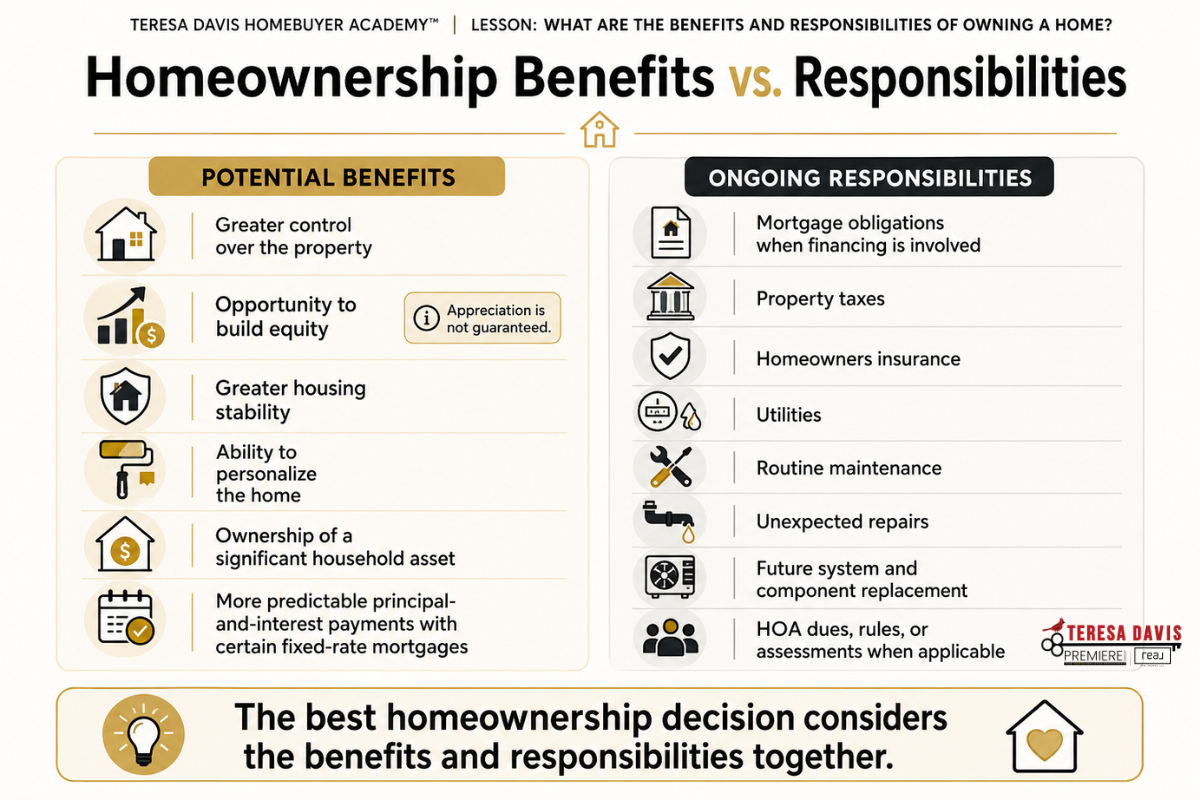
How a REALTOR® Can Help You Prepare for Homeownership
A REALTOR® can help you look beyond whether you like a home and consider what owning that particular property may involve after closing. During the homebuying process, your REALTOR® can help you:
- evaluate how a property's features and observed condition relate to your stated needs and priorities;
- identify questions about the property that deserve further investigation;
- review available property information and disclosures with you;
- coordinate inspections and help you understand when additional evaluation by an appropriate specialist may be warranted;
- identify homeowners association requirements, recorded restrictions, or other property-specific considerations that should be reviewed;
- consider how the age and condition of major systems may affect your future planning;
- compare properties based on more than purchase price alone; and
- coordinate with lenders, inspectors, closing attorneys, insurance professionals, contractors, and other specialists involved in the transaction.
A REALTOR® does not replace the professionals who provide specialized legal, tax, lending, insurance, engineering, inspection, or contractor advice. Instead, your REALTOR® can help you recognize the questions that matter, gather available information, and navigate the real estate process so you can make a more informed decision.
For first-time buyers, this perspective can be especially helpful because the best home is not simply one you can purchase. It should also be a property whose ongoing costs, condition, maintenance expectations, and responsibilities make sense for your plans.
Teresa’s Professional Insight
First-time buyers naturally spend a lot of time asking, “Can I buy this home?” I encourage buyers to also ask, “Am I prepared to own this home after closing?” Those are two different questions.
Qualifying for a mortgage and having enough money for the transaction are important, but homeownership continues long after the closing appointment. I want buyers to think about the complete picture: the monthly housing expense, utilities, routine upkeep, future maintenance, possible repairs, and whether they have room in their budget for expenses that may not happen on a predictable schedule.
I also encourage buyers to look at the property itself. Two homes with similar prices can create very different ownership experiences depending on their age, systems, condition, lot, HOA obligations, utilities, and maintenance needs.
My role as your REALTOR® and Professional Real Estate Advisor with the PREMIERE Group of Real Broker LLC is to help you understand the property and the transaction, ask better questions, and connect you with the appropriate professionals when specialized information is needed. As a Loan Originator NMLS #2597433 with One Real Mortgage, I can also help explain the mortgage side of the process when appropriate. The goal is not simply to get you to closing. It is to help you approach homeownership with a clearer understanding of what comes afterward.
Helpful Tip
Create a homeownership budget, not just a mortgage-payment budget. When you estimate what owning a home may cost each month, consider expenses beyond principal and interest. Depending on the property, your planning may include property taxes, homeowners insurance, utilities, HOA dues when applicable, routine maintenance, and money available for unexpected repairs or future replacements.
There is no single maintenance or emergency-reserve amount that works for every homeowner. A newer home with newer systems may present different planning considerations than an older property with major components approaching the later stages of their useful lives.
Before buying, look at the home, your budget, and your available reserves together. Leaving some financial breathing room can make it easier to handle the normal expenses that come with ownership without treating every repair as a financial crisis.
Keep in Mind
Homeownership can create opportunities to build equity and own an asset over time, but neither appreciation nor financial profit is guaranteed. Property values can rise or fall. Maintenance and repairs can be unpredictable. Property taxes, homeowners insurance, HOA expenses, utilities, and other ownership costs can change. Even a fixed-rate mortgage does not freeze every component of your total housing expense.
Your experience will also depend on the specific property you purchase. The age and condition of the home, major systems, insurance needs, utilities, HOA obligations when applicable, and your own financial circumstances can all affect the responsibilities of ownership.
Use general homebuyer education as a starting point, then evaluate the actual property and your individual circumstances. When you need specialized guidance about financing, insurance, taxes, legal matters, inspections, repairs, or other technical issues, consult the appropriate qualified professional.
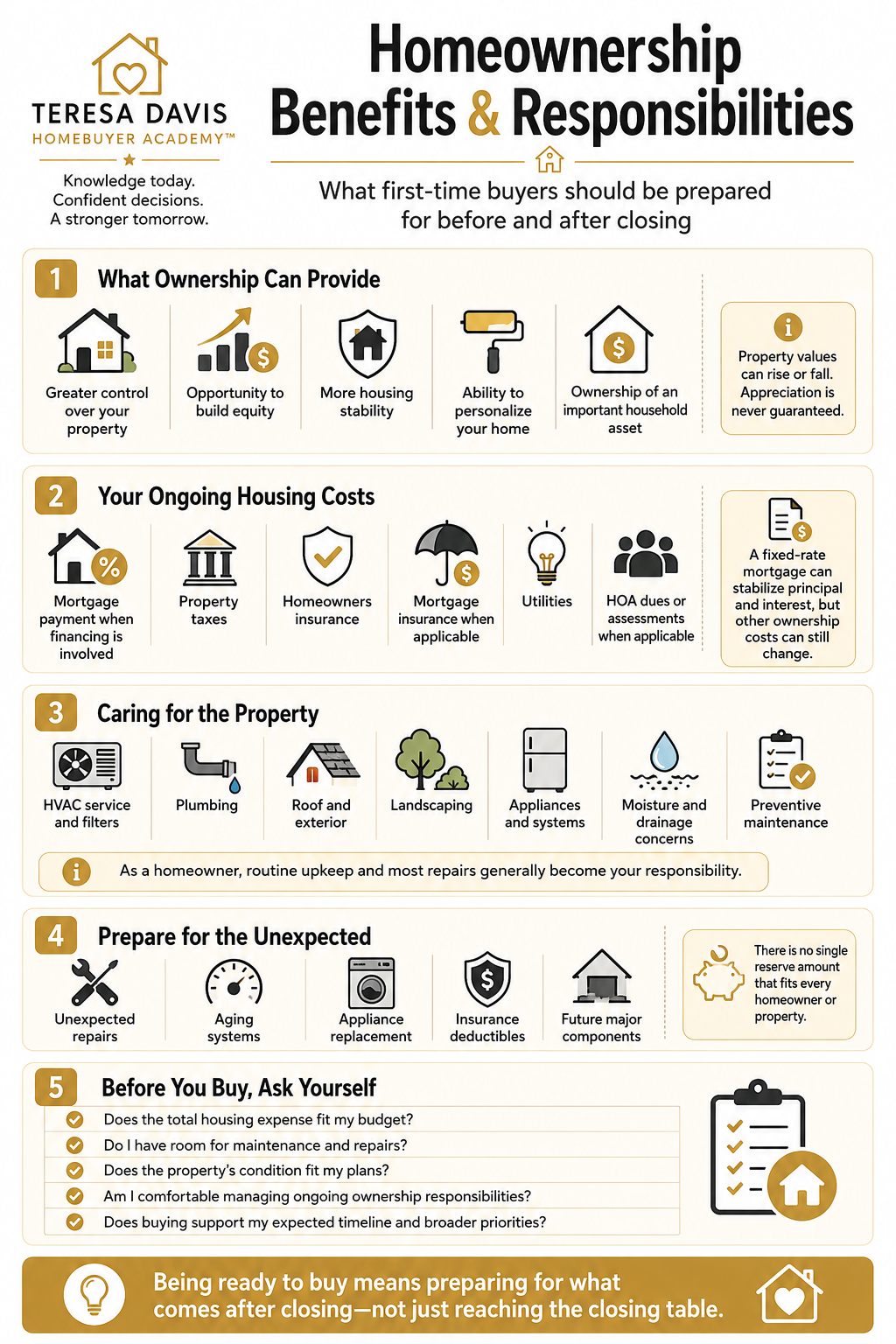
Frequently Asked Questions
What are the biggest benefits of owning a home?
Owning a home can provide greater control over the property, the opportunity to build equity, more stability in your housing situation, and the ability to personalize the home to better fit your needs. A home may also become a significant household asset over time. However, appreciation and financial profit are not guaranteed, and the benefits should always be considered alongside the ongoing costs and responsibilities of ownership.
What responsibilities come with owning a home?
Homeowners are generally responsible for their mortgage obligations when financing is involved, property taxes, homeowners insurance, utilities, maintenance, repairs, and the overall care of the property. Additional responsibilities may apply when the property is governed by an HOA or has other property-specific requirements. Unlike renting, there is usually no landlord responsible for arranging or paying for routine property maintenance and most repairs.
Does owning a home always build equity?
No. Homeowners may build equity as mortgage principal is paid down and may gain additional equity if the property's market value increases, but neither outcome guarantees a profit. Property values can rise, remain relatively stable, or decline. Equity is also affected by the outstanding debt secured by the property and can be reduced by additional borrowing against the home or decreases in market value.
How should homeowners prepare for maintenance and unexpected repairs?
Homeowners can prepare by including maintenance and repair expenses in their overall homeownership budget and maintaining financial reserves when possible. There is no single reserve amount that is appropriate for every household or property. Planning should consider factors such as the age and condition of the home, major systems and components, insurance deductibles, available warranties when applicable, and the homeowner's broader financial situation.
Can property taxes, homeowners insurance, and other ownership costs change over time?
Yes. Property taxes, homeowners insurance premiums, HOA dues or assessments when applicable, utilities, maintenance costs, and repair expenses can change over time. Even with a fixed-rate mortgage, the principal-and-interest portion may remain consistent while the homeowner's total housing expense changes because other ownership costs increase or decrease.
What Happens Next?
Now that you understand both the potential benefits and the ongoing responsibilities of owning a home, the next step is to understand what it means to be considered a first-time homebuyer.
The term can be less straightforward than it sounds. In some situations, a person may potentially meet a particular program's definition of a first-time homebuyer even if that person has owned a home before. The exact definition can depend on the program, loan, assistance option, or other requirement being considered.
The next Academy lesson explains the concept in plain language and helps you understand why first-time buyer status should be evaluated based on the specific program or situation rather than assumed from the name alone.
Next Question: What qualifies someone as a first-time homebuyer?
Ready to Take the Next Step?
You do not need to have every part of homeownership figured out before asking questions. If you are considering buying in North Carolina, you can take the next step that best matches where you are in the process.
Contact Teresa Davis
If you would like to talk through your homeownership goals, questions, property considerations, or the North Carolina homebuying process, you can contact Teresa Davis for personalized real estate guidance.
Teresa Davis
REALTOR® and Professional Real Estate Advisor
PREMIERE Group of Real Broker LLC
Begin the One Real Mortgage Pre-Approval Process
If you are ready to learn more about the financing side of buying a home, you can explore the One Real Mortgage pre-approval process and provide information for an individualized mortgage review. Using One Real Mortgage is optional and is not required in order to work with Teresa Davis as your REALTOR®.
Teresa Davis
Loan Originator NMLS #2597433
One Real Mortgage
Pre-approval, loan eligibility, available programs, rates, terms, and final loan approval depend on the borrower's circumstances and applicable lending requirements. Beginning a pre-approval process does not guarantee financing or require you to purchase a home. It is a practical way to learn more about your potential financing options, estimated payment, and possible next steps.
Ready for the next lesson? Use “Next Question” below to continue to "What qualifies someone as a first-time homebuyer?"
1:6 - What qualifies someone as a first-time homebuyer?

The phrase “first-time homebuyer” can be misleading because it does not always mean someone who has never owned a home. Depending on the mortgage, housing, or assistance program, a person who owned a home in the past may still meet that program’s definition of a first-time homebuyer.
Many programs use a three-year lookback period when evaluating prior homeownership. For example, current Fannie Mae and FHA definitions generally consider whether the buyer held a qualifying ownership interest during the preceding three years. However, the details are not identical across every program, and certain circumstances—such as previous joint ownership with a spouse—may be treated differently.
Understanding this distinction is important because being considered a first-time homebuyer and qualifying for a particular loan or assistance program are two separate questions. A program may have additional requirements related to occupancy, income, property eligibility, homebuyer education, financing, or other criteria. Before making plans around a first-time-buyer benefit, the specific program requirements should be confirmed.
Quick Answer
Yes, you may qualify as a first-time homebuyer even if you have owned a home before.
Many mortgage and housing programs use a three-year lookback when determining first-time-homebuyer status. Under those definitions, someone who has not held the type of ownership interest specified by the program during the applicable three-year period may be treated as a first-time homebuyer again. Current Fannie Mae guidance, for example, uses a three-year period and also requires the buyer to purchase and occupy the new property as a principal residence. FHA’s current definition likewise uses a three-year ownership-interest test.
The key is that there is no single definition that applies to every mortgage, assistance, tax, or housing program. Your previous ownership history and the rules of the specific program must be considered together.
At a Glance
- You do not necessarily have to be buying your first home ever. Previous homeownership does not automatically prevent you from being considered a first-time homebuyer.
- A three-year lookback is common. Many mortgage and housing programs consider whether you held a qualifying ownership interest during the previous three years.
- The type of prior ownership can matter. Sole ownership, joint ownership, principal-residence ownership, and other circumstances may be treated differently depending on the program.
- Marriage, divorce, separation, or previous joint ownership may require a closer review. Some program definitions contain specific provisions addressing these situations.
- First-time-buyer status does not guarantee program eligibility. A mortgage or assistance program may have additional requirements.
- The specific program controls the definition. Confirm the current requirements before relying on first-time-homebuyer status when planning your purchase.
“First-Time Homebuyer” Does Not Always Mean You Have Never Owned a Home
One of the most common misunderstandings about first-time homebuyer programs comes from the name itself. It is reasonable to assume that a first-time homebuyer must be someone purchasing a home for the very first time. In practice, many mortgage and housing programs use a broader definition.
Depending on the program, you may be considered a first-time homebuyer even if you owned a home in the past. What matters is usually your recent ownership history and the specific definition used by the program you are considering.
For example, Fannie Mae currently defines a first-time homebuyer as someone purchasing and occupying the property as a principal residence who has not had an ownership interest, either solely or jointly, in residential property during the three years before the purchase. Fannie Mae also includes specific provisions for qualifying displaced homemakers and single parents.
FHA also uses a three-year ownership-interest concept when identifying first-time homebuyers. HUD’s current FHA resources describe a first-time homebuyer as someone purchasing for the first time, someone who has not owned a home during the applicable three-year period, or someone who meets certain other qualifying conditions.
That means a previous homeowner should not automatically assume, “I owned a house before, so I can never be considered a first-time buyer again.”
The better question is: “Under the specific program I am considering, does my ownership history meet its current first-time homebuyer definition?”
Understanding the Common Three-Year Lookback
A three-year lookback is commonly used when determining first-time homebuyer status.
In simple terms, the program looks backward from a specified point—such as the purchase date, note date, or FHA case-number assignment—and evaluates whether the buyer held the type of ownership interest addressed by that program during the preceding three years. The exact measuring date and definition can differ, which is another reason the applicable program guidelines matter.
A Simple Example
Suppose someone owned and lived in a home several years ago, later sold it, and has been renting since then. If that person's prior ownership falls outside the applicable three-year lookback period, the person may meet the first-time homebuyer definition used by certain programs, assuming the program's other requirements are also satisfied.
This does not mean that waiting three years automatically qualifies someone for a mortgage, down payment assistance, or another homebuyer benefit. It means only that the person's previous homeownership may no longer prevent them from satisfying that particular first-time-buyer definition.
That distinction matters.
First-Time Status and Program Qualification Are Different
Think of first-time homebuyer status as one eligibility question among potentially several. A program may ask: Does the buyer meet our definition of a first-time homebuyer?
Then it may separately evaluate requirements involving matters such as:
- occupancy;
- income;
- property eligibility;
- mortgage qualification;
- purchase-price limits;
- homeownership education or counseling;
- geographic eligibility;
- available program funding; or
- other program-specific requirements.
Not every program uses all of these requirements, and the limits or conditions can vary considerably. As a result, hearing that you “qualify as a first-time buyer” should not be interpreted as an approval for a particular mortgage or assistance program.
Why the Type of Previous Ownership Can Matter
Determining first-time homebuyer status may involve more than remembering the date you last moved out of a house. Programs can look at whether you actually held an ownership interest in property, and the type of ownership addressed by the applicable definition may matter.
Questions that can become relevant include:
- Did you own the property by yourself?
- Did you own it jointly with another person?
- Was the property your principal residence?
- When did your ownership interest end?
- What type of residential property was involved?
- Does the particular program contain an exception or special provision that applies to your circumstances?
For example, Fannie Mae's current definition considers whether an individual had sole or joint ownership in residential property during the preceding three years. It also contains a specific provision for a displaced homemaker or single parent whose ownership circumstances meet the requirements stated in the definition.
Because these details can affect eligibility, buyers should avoid making assumptions based only on whether their name once appeared on a deed or whether they previously lived in a home with a spouse or another owner.
The goal is not for you to interpret title history or program rules on your own. Instead, gather the facts about your previous ownership so the lender, housing agency, program administrator, attorney, or other appropriate professional can evaluate your circumstances under the current rules.
Marriage, Divorce, Separation, and Previous Joint Ownership
Previous homeownership can become more complicated when a home was owned with a spouse or when a buyer has experienced divorce or legal separation. The important point is that you should not assume that previous joint ownership automatically disqualifies you from every first-time homebuyer program. Some programs contain specific rules addressing these circumstances.
For example, current FHA guidance defines a first-time homebuyer to include an individual who is divorced or legally separated and who had no ownership interest in a principal residence during the three years before the FHA case number assignment other than a joint ownership interest with a spouse.
Federal law also provides protections for certain displaced homemakers and single parents participating in covered federal first-time homebuyer assistance programs. Under those provisions, qualifying individuals cannot be denied first-time-homebuyer eligibility solely because they previously owned or resided in a home with a spouse under the circumstances described by the statute.
These rules are specific, however. They should not be interpreted to mean that every divorced, separated, or previously married buyer automatically qualifies as a first-time homebuyer.
If your previous ownership involved a spouse, divorce, legal separation, or another type of joint ownership, provide the relevant details to the lender or program administrator so the correct definition can be applied.
Not Every Program Uses the Same Definition
One of the most important lessons to remember is that “first-time homebuyer” is not a universal definition. The term can appear in many different contexts, including:
- mortgage programs;
- down payment or closing-cost assistance programs;
- federal, state, or local housing programs;
- tax-related provisions; and
- retirement-account rules.
Different programs can use different time periods, ownership tests, and eligibility requirements.
For example, many mortgage and housing definitions use a three-year ownership lookback, but the IRS currently uses a different standard for the first-home exception associated with certain IRA distributions. Under current IRS guidance, a person generally meets that particular first-time-homebuyer definition if they had no present interest in a main home during the two-year period ending on the date of acquisition. If married, the spouse must also satisfy that no-ownership requirement.
That tax-related definition does not replace mortgage or housing-program definitions. It simply illustrates why consumers should avoid applying one program's definition to another program.
When you hear the phrase “first-time homebuyer,” ask: “First-time homebuyer according to which program?” That question can prevent a great deal of confusion.
First-Time Homebuyer Status Does Not Automatically Mean You Qualify for Assistance
Being classified as a first-time homebuyer can be helpful because some mortgage and assistance programs offer benefits or eligibility pathways specifically for qualifying first-time buyers.
However, meeting the first-time-homebuyer definition is usually only one part of the qualification process. Depending on the program, additional requirements may address:
- household or borrower income;
- purchase price;
- property location;
- occupancy;
- property type;
- credit or mortgage underwriting;
- homebuyer education;
- available assistance funds;
- repayment or recapture provisions; or
- other program-specific conditions.
A buyer could therefore meet a program's definition of a first-time homebuyer but still not meet another eligibility requirement.
The opposite can also occur. A buyer who does not qualify as a first-time homebuyer may still have mortgage or homeownership options that do not require first-time-buyer status.
This is why the goal should not simply be to obtain a “first-time buyer” label. The goal is to identify the financing and homebuying options that fit your actual circumstances.
What to Gather Before Checking Your Eligibility
You do not need to memorize mortgage guidelines or interpret program rules yourself. What you can do is gather accurate information about your ownership history before speaking with the appropriate professional.
Consider writing down:
- whether you have ever owned residential property;
- the approximate dates you acquired and disposed of any previous property;
- whether you owned the property individually or jointly;
- whether the property was your principal residence;
- when your ownership interest ended;
- whether previous ownership involved a spouse;
- whether divorce or legal separation may be relevant;
- the type of property previously owned; and
- the particular mortgage or assistance program you are considering.
Having these details available can make the eligibility conversation more productive. If you are unsure about ownership dates or how a prior property was titled, supporting documents such as closing records or recorded ownership documents may help the appropriate professional verify the facts. Questions involving legal ownership or title interpretation should be addressed with a qualified attorney when necessary.
The Most Important Question Is the Program-Specific One
For first-time homebuyers in North Carolina—including buyers in Davidson, Randolph, Guilford, and Forsyth counties—the safest approach is to avoid making assumptions based solely on the phrase “first-time homebuyer.”
Instead, separate the process into two questions:
1. Does the specific program consider me a first-time homebuyer?
2. If it does, do I meet the rest of that program's eligibility requirements?
Those are different questions, and both matter.
If you owned a home before, that history may or may not affect the options available to you. Knowing when you owned the property, how you owned it, and which program you are considering provides a much better starting point than simply assuming you are—or are not—a first-time homebuyer.
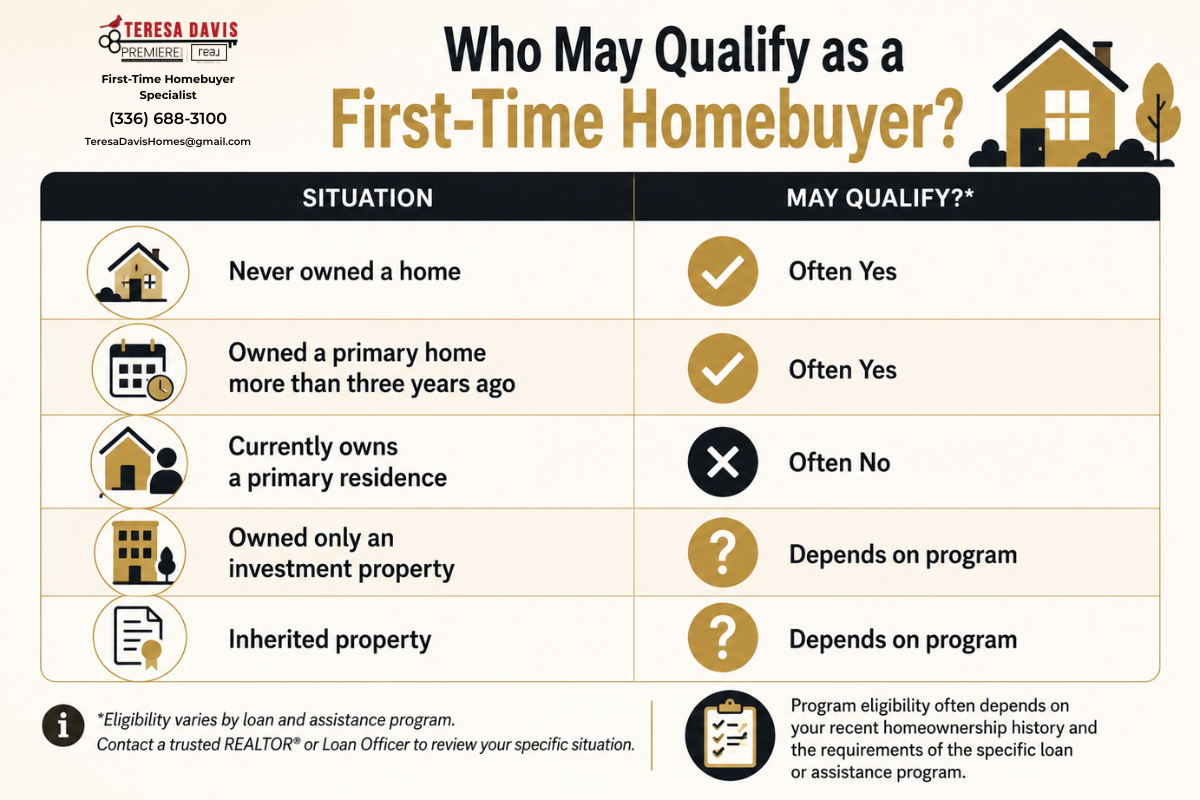
How Your REALTOR® Can Help You Navigate First-Time Buyer Options
Your REALTOR® can help you understand how your home search may connect with your financing and first-time homebuyer options, but your REALTOR® does not determine whether you qualify for a particular mortgage or assistance program.
If you previously owned a home, sharing that information early can help your real estate and lending professionals identify questions that should be addressed before you become deeply involved in the home search. Useful information to discuss may include:
- when you last owned a home;
- whether you owned it individually or jointly;
- whether it was your principal residence;
- when your ownership interest ended;
- whether a previous marriage, divorce, or legal separation affects the ownership history; and
- whether you are considering a particular mortgage or homebuyer assistance program.
Your lender, housing agency, or program administrator can then evaluate the applicable eligibility requirements. When legal questions involving ownership or title arise, an attorney may also need to provide guidance.
For buyers in Davidson, Randolph, Guilford, Forsyth, and surrounding North Carolina counties, coordinating these questions early can help create a clearer homebuying plan. It can also reduce the chance of building a home search around a financing or assistance option before confirming that the program actually fits your circumstances.
A REALTOR® can then use the information confirmed by the appropriate professionals to help you focus your search on homes and purchase strategies that better align with your approved financing and overall goals.
Teresa’s Professional Insight
One of the most important things I want previous homeowners to understand is this: do not rule yourself out simply because you have owned a home before. Many people hear “first-time homebuyer” and immediately assume the term cannot apply to them. That assumption may cause them to overlook a mortgage or homebuyer program worth discussing.
Instead of deciding for yourself that you either qualify or do not qualify, tell your lender the complete story. When did you own the property? How was it owned? Was it your primary residence? When did that ownership end? Were there circumstances involving joint ownership, divorce, or legal separation that may be relevant? Those details give the appropriate professional something concrete to evaluate.
As both a REALTOR® / Professional Real Estate Advisor with the PREMIERE Group of Real Broker LLC and a Loan Originator NMLS #2597433 with One Real Mortgage, I can help you identify the questions that should be addressed as you prepare to buy. That does not mean every buyer will qualify for a first-time homebuyer program. It means we can start with your actual circumstances instead of making assumptions based on a label.
Helpful Tip
Before asking whether you qualify as a first-time homebuyer, create a short timeline of your previous homeownership. Write down:
- when you acquired the property;
- when your ownership ended;
- whether you owned it alone or with someone else; and
- whether it was your principal residence.
If your situation involved a spouse, divorce, legal separation, inherited ownership, or another unusual ownership arrangement, make a note of that as well. You do not need to determine the legal effect yourself. Having accurate information available simply makes it easier for the lender, program administrator, attorney, or other appropriate professional to evaluate the correct rules.
Keep in Mind
First-time homebuyer status is not the same thing as mortgage approval or assistance-program approval.
Even when a program considers you a first-time homebuyer, you may still have to satisfy additional requirements related to financing, income, occupancy, property eligibility, education, program availability, or other program-specific criteria.
Definitions can also differ from one program to another and may change over time. A rule used for one mortgage, housing-assistance, tax, or retirement-account provision should not automatically be applied to another.
Before making a purchase decision based on a particular first-time-homebuyer benefit, verify the current requirements of the specific program you plan to use.
The purpose of this lesson is general education. It is not legal, tax, or individualized financial advice. When your circumstances involve questions about ownership rights, taxes, program eligibility, or other specialized matters, consult the appropriate qualified professional.
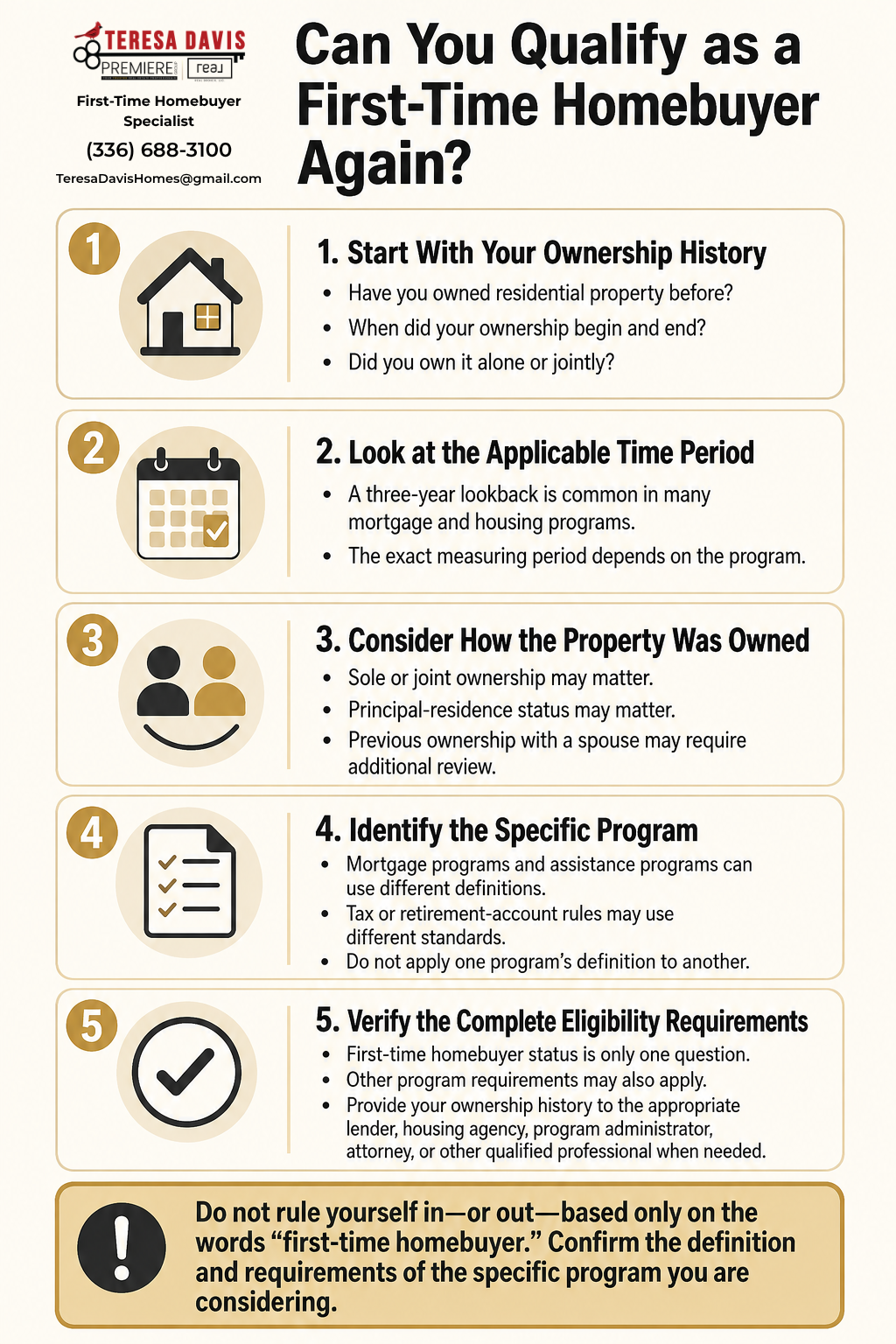
Frequently Asked Questions
Can I qualify as a first-time homebuyer if I owned a home before?
Yes, potentially. Many mortgage and housing programs use a three-year lookback when determining first-time homebuyer status, so previous ownership does not necessarily disqualify you permanently. The exact ownership test and measuring period depend on the specific program, so your previous ownership history should be evaluated under the current rules of the program you are considering.
Does owning a home with a spouse affect first-time homebuyer status?
It can. Some programs consider joint ownership when determining first-time homebuyer status, while certain programs also contain specific provisions involving marriage, divorce, legal separation, displaced homemakers, or single parents. Because these rules are program-specific, provide the complete details of your previous ownership to the lender or program administrator rather than assuming that joint ownership either qualifies or disqualifies you.
Does every first-time homebuyer program use the three-year rule?
No. A three-year lookback is common in mortgage and housing programs, but there is no single first-time homebuyer definition that applies everywhere. Mortgage programs, housing-assistance programs, tax provisions, and other programs can use different definitions, time periods, and eligibility tests. Always verify the definition used by the specific program you are considering.
If I qualify as a first-time homebuyer, will I automatically qualify for down payment assistance?
No. Meeting a program's definition of a first-time homebuyer does not automatically mean you qualify for down payment or closing-cost assistance. Assistance programs may have additional requirements involving income, purchase price, property location, occupancy, financing, homebuyer education, available funding, or other program-specific criteria.
How can I find out whether I qualify as a first-time homebuyer?
Start by gathering accurate information about your previous homeownership, including when you owned the property, when your ownership ended, whether you owned it individually or jointly, and whether it was your principal residence. Then identify the mortgage or assistance program you are considering and ask the appropriate lender, housing agency, or program administrator to apply that program's current definition to your circumstances.
What Happens Next?
Now that you understand why “first-time homebuyer” does not always mean someone who has never owned a home, the next step is to address another common homebuying misconception: the belief that you must have a 20% down payment to purchase a home.
A 20% down payment can be appropriate for some buyers, but it is not a universal requirement. Different mortgage programs can have different minimum down payment requirements, and the amount that makes sense for you depends on your financing, available funds, monthly-payment goals, property, and overall financial picture.
In the next Academy lesson, Do I need a 20% down payment to buy a home?, you will learn why the 20% rule is often misunderstood and what buyers should consider when comparing down payment options.
Ready to Take the Next Step?
You do not have to determine first-time homebuyer eligibility or navigate program terminology on your own. If you are preparing to buy in Davidson, Randolph, Guilford, Forsyth, or a surrounding North Carolina county, the next step can simply be getting clear information about your specific situation.
Contact Teresa Davis
If you have questions about how previous homeownership may affect your homebuying plans, contact Teresa Davis to discuss your goals and identify the questions that should be addressed as you prepare for your next purchase.
Teresa Davis
REALTOR® and Professional Real Estate Advisor
PREMIERE Group of Real Broker LLC
Begin the One Real Mortgage Pre-Approval Process
If you are ready to discuss mortgage qualification, available financing options, or whether a particular mortgage program may apply to your circumstances, you can begin the One Real Mortgage pre-approval process. Using One Real Mortgage is optional and is not required in order to work with Teresa Davis as your REALTOR®.
Teresa Davis
Loan Originator NMLS #2597433
One Real Mortgage
Mortgage qualification, loan programs, terms, costs, and final approval depend on the borrower, property, transaction, documentation, underwriting, and applicable lending requirements. Beginning a pre-approval process does not guarantee financing or require you to purchase a home. It is a practical way to learn more about your potential financing options, estimated payment, and possible next steps.
Ready for the next lesson? Use “Next Question” below to continue to "Do I need 20% down payment to buy a home?"
1:7 - Do I need a 20% down payment to buy a home?

For many first-time buyers, one number can make homeownership seem farther away than it really is: 20%.
You may have heard that you need to save 20% of a home's purchase price before you can buy. On a $300,000 home, that would mean a $60,000 down payment before accounting for other transaction expenses. It is understandable why someone who believes that is an absolute requirement might decide to postpone buying.
The important distinction is that a 20% down payment is not a universal requirement for buying a home. The minimum down payment that may be required depends on the mortgage program, borrower qualifications, property and occupancy requirements, underwriting, and other applicable lending guidelines. Some qualified buyers may have financing options that permit considerably less than 20% down.
That does not mean a smaller down payment is automatically the better choice. Some buyers intentionally put 20% or more down because doing so reduces the amount they borrow and, with many conventional mortgages, may eliminate the need for private mortgage insurance. Other buyers may prefer to make a smaller permitted down payment so they can preserve more of their savings for closing expenses, moving, repairs, emergencies, or other financial priorities.
The better question is not simply, “Can I reach 20%?” It is, “What down payment does my financing require, and what amount makes sense within my overall homebuying plan?”
This lesson explains why 20% is not a universal requirement and how different down-payment amounts can affect the financial picture. The next Academy lesson, “Can I buy a home with little or no down payment?”, will take a closer look at low-down-payment options, eligible no-down-payment possibilities, and down-payment assistance.
Quick Answer
No. You do not automatically need a 20% down payment to buy a home.
Twenty percent is one possible down-payment strategy, not a universal homebuying requirement. The minimum amount you may be required to put down depends on the mortgage program and the requirements that apply to you and the property.
Choosing to put 20% down can have advantages. It reduces the amount you need to finance and, with many conventional mortgages, can help you avoid private mortgage insurance. However, putting more money into the home also means using more of your available savings upfront.
For that reason, your down-payment decision should consider both sides of the equation: how much you will borrow and how much financial flexibility you want to preserve after the purchase.
At a Glance
- Twenty percent is not universally required. Qualified buyers may have financing options that allow a down payment below 20%.
- Minimum and chosen down payments are different. Your mortgage may establish a minimum, while you may choose to contribute more if your financing permits it.
- A larger down payment reduces the amount financed. Borrowing less can reduce principal-and-interest costs when comparing otherwise similar loan terms.
- Mortgage insurance can matter. With many conventional mortgages, putting less than 20% down may mean paying private mortgage insurance.
- Your remaining savings matter too. Money used for the down payment is no longer readily available for moving expenses, repairs, emergencies, or other priorities.
- More down is not automatically better for every buyer. The appropriate strategy depends on your financing, available funds, payment goals, and broader financial circumstances.
- Low- and no-down-payment possibilities are a separate topic. The next Academy lesson explains those options in greater detail and why a small or zero required down payment does not necessarily mean no other money will be needed for the transaction.
Why Is 20% Such a Common Down-Payment Number?
The idea that buyers need 20% down has been repeated so often that it can sound like a rule. It is not.
Twenty percent is an important benchmark in some mortgage situations, particularly with conventional financing, but it should not be confused with a universal minimum down payment. Current consumer guidance from the Consumer Financial Protection Bureau confirms that mortgage options can require considerably less than 20% down, depending on the loan and borrower.
One reason 20% receives so much attention is mortgage insurance. With many conventional mortgages, a buyer who puts less than 20% down will typically need private mortgage insurance, commonly called PMI. PMI protects the lender if the borrower stops making mortgage payments; it does not protect the homeowner.
That distinction matters. Twenty percent may affect the structure and cost of a particular mortgage, but that is very different from saying every buyer must have 20% before purchasing a home.
For a first-time buyer, replacing the question “Have I saved 20%?” with “What does my financing actually require?” can provide a much more accurate starting point.
Minimum Down Payment and Chosen Down Payment Are Not the Same Thing
There are two separate numbers to understand when planning a down payment.
Minimum Required Down Payment
The minimum required down payment is the least amount a particular mortgage option permits for a borrower and transaction that meet its requirements.
That minimum can depend on factors such as:
- the mortgage program;
- the borrower's qualifications;
- how the property will be occupied;
- the type and eligibility of the property;
- underwriting requirements; and
- lender requirements that apply to the transaction.
This is why there is no single down-payment percentage that applies to every homebuyer.
Some current conventional financing options, for example, permit qualified borrowers to purchase with down payments as low as 3%. That does not mean every buyer or every transaction qualifies for a 3% down payment; it demonstrates why 20% should not be treated as a universal minimum.
Chosen Down Payment
The chosen down payment is the amount a buyer decides to contribute when the financing allows more than one possible amount.
For example, a buyer might qualify for financing that does not require 20% down but still decide to contribute 20% because that strategy better fits the buyer's goals. Another buyer might qualify for the same general financing category and choose a smaller permitted down payment because preserving more savings is important.
Neither choice should be evaluated by percentage alone. A down payment is part of a larger financing decision involving the mortgage amount, monthly housing costs, cash required for the purchase, and the amount of savings the buyer expects to have remaining afterward.
Why Would a Buyer Choose to Put 20% Down?
Although 20% is not universally required, there are legitimate reasons some buyers intentionally choose that amount.
A Larger Down Payment Reduces the Amount Borrowed
The down payment reduces the portion of the purchase price that must be financed. All else being equal, contributing more upfront means borrowing less. A smaller mortgage balance generally means a lower principal-and-interest payment than financing a larger balance under otherwise identical loan terms.
That can make 20% attractive to a buyer whose priority is reducing the amount borrowed or lowering the monthly principal-and-interest obligation.
Twenty Percent May Help a Conventional Borrower Avoid PMI
For many conventional mortgages, putting at least 20% down can eliminate the need for private mortgage insurance at the beginning of the loan. Conversely, conventional borrowers putting less than 20% down will typically need mortgage insurance.
Because mortgage insurance adds to the cost of financing, this can be an important factor when comparing down-payment scenarios. However, mortgage insurance rules differ among mortgage types. PMI is specifically associated with conventional financing and should not be used as a general term for every type of mortgage insurance.
A Larger Down Payment Creates More Initial Equity
A larger down payment also means the buyer begins ownership with a larger difference between the home's purchase price and the amount financed.
That can be meaningful to someone who has sufficient funds and intentionally wants to finance a smaller portion of the purchase. But more initial equity does not automatically mean that putting the largest possible amount down is the best overall decision.
The Tradeoff: Using More Cash Now Versus Keeping More Cash Available
Every additional dollar placed into the down payment is a dollar that is no longer readily available in the buyer's savings after closing.
That is an important part of the decision. A buyer may also need or want funds available for:
- moving expenses;
- utility setup;
- immediate repairs or maintenance;
- furnishings or appliances;
- insurance deductibles;
- unexpected homeownership expenses;
- emergency savings; and
- other financial priorities.
Current CFPB homebuying guidance specifically recommends considering expenses beyond the down payment and preserving money for needs such as moving costs and an emergency cushion when determining how much cash to use for a purchase. This creates a genuine tradeoff.
Putting more down can reduce the amount financed, while putting less down—when permitted—can allow the buyer to retain more cash.
The better strategy depends on the complete financial picture rather than the assumption that one percentage is automatically right for everyone.
What Can Change When You Put Less Than 20% Down?
Putting less than 20% down can be a perfectly valid financing strategy when the mortgage permits it, but the decision changes more than the amount of cash brought to closing.
A smaller down payment generally means financing a larger portion of the purchase price. That can affect:
- the mortgage balance;
- the principal-and-interest portion of the monthly payment;
- whether mortgage insurance applies;
- the total amount of cash used upfront; and
- the amount of savings the buyer retains after the purchase.
For many conventional mortgages, putting less than 20% down will typically mean paying private mortgage insurance. Mortgage insurance adds to the cost of the mortgage, so it should be included when comparing financing scenarios rather than looking only at the down-payment percentage. Current Consumer Financial Protection Bureau guidance similarly advises buyers to consider how their down payment affects mortgage insurance, monthly costs, and the overall financing structure.
At the same time, using a smaller permitted down payment may leave more of the buyer's funds available for other purposes. That retained cash can be important when the buyer is also planning for expenses associated with moving into and maintaining a home.
This is why the choice is not simply “more down is good” or “less down is good.” Each option changes the financial picture differently.
Mortgage Insurance Depends on the Type of Mortgage
Mortgage insurance is one of the most misunderstood parts of the 20% conversation. With many conventional mortgages, a borrower who puts less than 20% down will typically need private mortgage insurance, or PMI.
However, PMI is not a universal name for all mortgage insurance. Government-backed and other mortgage programs can have their own insurance or guarantee structures and their own rules.
For that reason, a buyer should not assume:
- every mortgage with less than 20% down uses PMI;
- every form of mortgage insurance works the same way;
- every mortgage-insurance charge is calculated the same way; or
- putting 20% down affects every mortgage program in exactly the same manner.
The relevant question is how mortgage insurance or a comparable program cost applies to the specific financing being considered. That is another reason the 20% figure should not be treated as a universal rule.
Compare Down-Payment Scenarios Instead of One Percentage
A useful way to evaluate a down payment is to compare more than one permitted scenario side by side. For each scenario, consider:
- Down Payment
How much cash would be used toward the purchase price?
- Mortgage Amount
How much of the purchase price would remain to be financed?
- Estimated Principal and Interest
How would financing a smaller or larger amount affect the estimated principal-and-interest payment under the particular loan terms being evaluated?
- Mortgage Insurance or Similar Financing Costs
Would mortgage insurance apply, and how would it affect the monthly or overall cost?
- Total Estimated Housing Payment
The principal-and-interest payment is only part of the housing expense. Depending on the property and financing, other costs may include property taxes, homeowners insurance, homeowners association assessments when applicable, and mortgage insurance.
- Cash Needed for the Transaction
How much money would need to be available for the down payment and other required transaction expenses?
- Savings Remaining After the Purchase
What funds would remain available after closing for moving, repairs, maintenance, emergencies, and other priorities?
The Consumer Financial Protection Bureau specifically encourages buyers to test different down-payment scenarios and consider the savings they want to preserve for other expenses. Looking at these factors together provides a more useful comparison than simply asking whether one scenario reaches 20%.
A Larger Down Payment Does Not Automatically Make a Buyer More Qualified
Putting 20% down does not guarantee mortgage approval. Mortgage qualification involves more than the down-payment amount. Depending on the mortgage and transaction, underwriting may consider factors such as:
- income and employment documentation;
- debts and debt obligations;
- credit history and credit scores;
- available assets;
- the source of funds;
- the property;
- occupancy;
- appraisal or valuation requirements; and
- the standards of the mortgage program and lender.
A buyer with 20% available still must satisfy the applicable requirements. Likewise, a qualified buyer putting less than 20% down should not automatically be considered financially unprepared simply because the down payment is smaller.
The size of the down payment is one part of mortgage qualification and homebuying readiness—not the entire picture.
The Down Payment Is Not the Same as Total Cash Needed
Another important distinction is that the down payment is only one category of money involved in buying a home. Even when a buyer makes a relatively small down payment, other transaction expenses may still need to be considered.
Depending on the transaction, those expenses can include items such as:
- lender and settlement-related closing costs;
- prepaid taxes or insurance;
- inspections;
- appraisal-related costs when applicable;
- moving expenses;
- repairs or immediate property needs; and
- other transaction-specific expenses.
In a North Carolina purchase, buyers may also encounter funds associated with the offer and contract process, including due diligence fees or earnest money deposits when those terms are negotiated and included in the contract. The existence and amount of those funds depend on the particular transaction and agreement.
Some amounts paid earlier in the transaction may ultimately be credited or applied according to the contract and closing documents, but buyers should not assume that the down-payment percentage represents every dollar they may need during the purchase.
This distinction becomes especially important when discussing low- or no-down-payment financing. “No down payment” does not mean “no money needed.”
The next Academy lesson will explore that issue more fully.
Should You Put 20% Down If You Can?
There is no universal answer. If a buyer has sufficient funds, putting 20% down may support goals such as:
- reducing the mortgage balance;
- reducing principal-and-interest expense compared with borrowing more under otherwise similar terms;
- avoiding PMI on many conventional mortgages; and
- starting with more equity.
But another buyer may reasonably place a higher priority on retaining funds for:
- emergency savings;
- repairs or maintenance;
- moving expenses;
- planned improvements;
- other financial obligations; or
- greater liquidity after closing.
Current CFPB guidance emphasizes that money placed into the home is not readily available for other needs and recommends considering other savings goals and an emergency cushion when deciding how much to put down.
A down-payment strategy should therefore be evaluated in the context of the buyer's complete financing and financial position rather than against an arbitrary target.
What If You Do Not Have 20% Saved?
Not having 20% saved does not, by itself, establish that you cannot buy a home. Current mortgage options include financing structures that may permit qualified borrowers to purchase with less than 20% down, and some eligible buyers may have access to options requiring little or no down payment.
The important word is eligible. Availability can depend on the mortgage program, borrower qualifications, property requirements, occupancy, underwriting, and current lending guidelines.
Rather than assuming you must continue saving until you reach 20%, a more useful next step is to learn what financing possibilities may actually apply to your circumstances and compare them carefully.
That is the focus of the next Academy lesson: Can I buy a home with little or no down payment?
It will explain the general role of low-down-payment mortgages, eligible no-down-payment financing, and down-payment assistance while also addressing the other expenses that can still be part of buying a home.
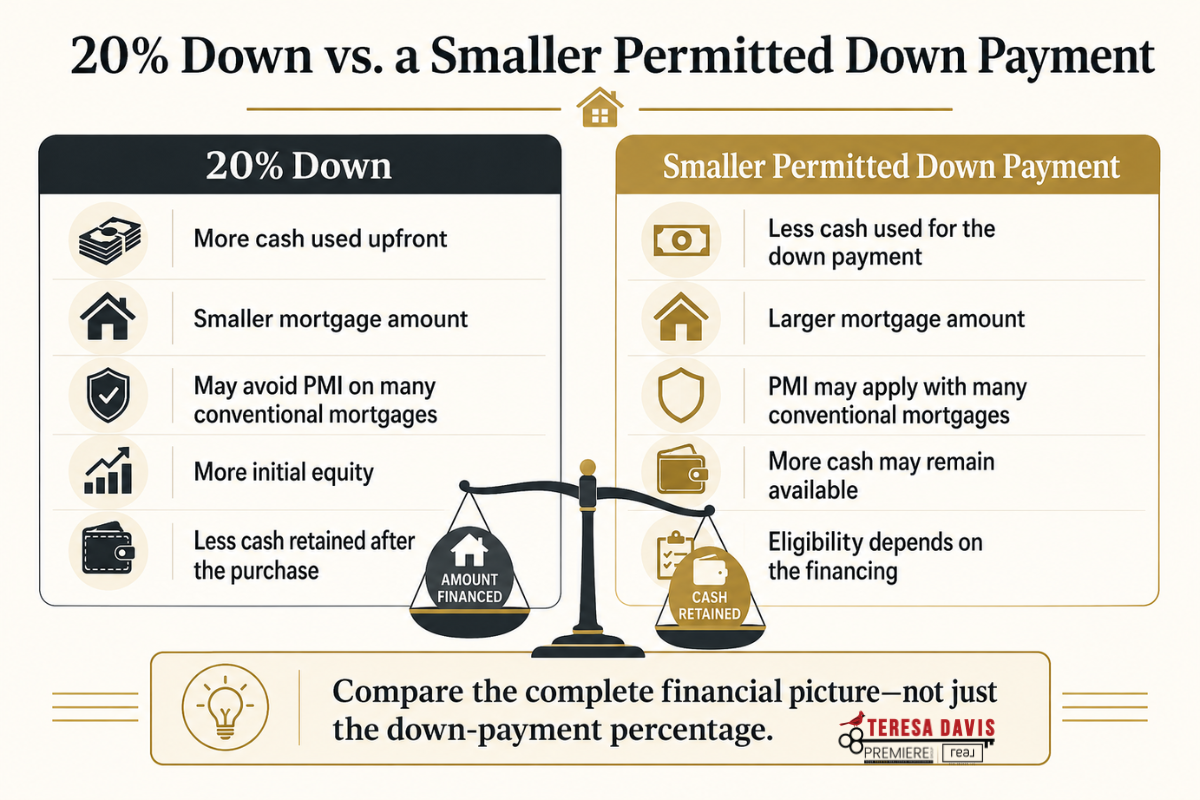
How Your Down Payment Can Affect Your Home Search
Your down-payment strategy is not only a mortgage decision. It can also influence practical decisions during your home search.
Before focusing on a particular price range, it is helpful to understand how different permitted down-payment amounts could affect your estimated monthly housing costs, cash needed for the transaction, and savings remaining after closing.
For example, preserving some savings may become important when you are considering a home that could need:
- repairs after closing;
- appliances or furnishings;
- moving expenses;
- routine maintenance;
- homeowners insurance deductibles; or
- other immediate ownership expenses.
The condition of the property can therefore be relevant when evaluating how much cash you are comfortable committing to the down payment.
Your financing also needs to work with the property you choose. Mortgage programs can have different requirements involving occupancy, property type, appraisal or valuation, condition, and other eligibility considerations. A home that works for one financing structure may not necessarily work the same way for another.
Coordinating your home search with your financing plan can help you evaluate homes based on the complete transaction, rather than assuming that the largest down payment automatically creates the strongest plan.
As your REALTOR®, I can help you consider the real estate side of that decision—including property condition, offer terms, anticipated transaction expenses, and how the home fits your priorities—while your mortgage review determines the financing requirements that apply to your situation.
Teresa’s Professional Insight
One of the most important things I want first-time buyers to understand is that 20% should not become an arbitrary barrier between you and learning whether homeownership is possible.
I would rather have you understand your actual options than assume you need to keep saving until you reach a number that may not be required for the financing available to you.
At the same time, being able to put more money down does not automatically mean you should use every available dollar for the down payment. The better approach is to look at the complete picture:
- What does your financing require?
- How would different down-payment amounts affect the amount you borrow?
- How could mortgage insurance affect the comparison?
- What would your estimated housing payment look like?
- How much money would you need for the transaction?
- What savings would you have left after closing?
Those questions can tell you much more than simply asking whether you have reached 20%.
Because I work with buyers both as a REALTOR® / Professional Real Estate Advisor with PREMIERE Group of Real Broker LLC and as a Loan Originator NMLS #2597433 with One Real Mortgage, I believe it is especially important to connect the financing decision with the realities of owning the property afterward.
The goal is not simply to get through closing. The goal is to understand the choices available to you and make an informed decision that supports both the purchase and the responsibilities that come with homeownership.
Helpful Tip
Ask your mortgage professional to show you more than one down-payment scenario when your financing allows it. For example, instead of reviewing only one percentage, compare how different permitted down payments could affect:
- your mortgage amount;
- estimated principal and interest;
- mortgage insurance when applicable;
- estimated monthly housing costs;
- estimated cash needed for the transaction; and
- savings remaining after closing.
Seeing the numbers side by side can make the tradeoffs much easier to understand. Remember that financing examples are estimates until the actual mortgage terms, property, underwriting, insurance, taxes, and other transaction details are known. A comparison should help you understand your choices rather than be treated as a guarantee of final loan terms or approval.
Keep in Mind
A smaller down payment is not automatically the best strategy, and a larger down payment is not automatically the best strategy. The appropriate amount depends on the financing available to you and the larger financial picture surrounding the purchase.
Factors can include:
- mortgage-program requirements;
- borrower qualifications;
- available savings;
- estimated monthly housing costs;
- mortgage insurance when applicable;
- property and occupancy requirements;
- other transaction expenses;
- money you want to retain after closing; and
- your broader financial priorities.
Also remember that your down payment is not the same as the total amount of money you may need to complete a home purchase. Closing costs, prepaid expenses, inspections, appraisal-related expenses when applicable, North Carolina due diligence fees or earnest money deposits when negotiated, moving expenses, and other transaction-specific costs may also need to be considered.
That distinction becomes particularly important when evaluating financing with a small required down payment—or no required down payment for an eligible borrower. The next lesson will explore those possibilities in detail.
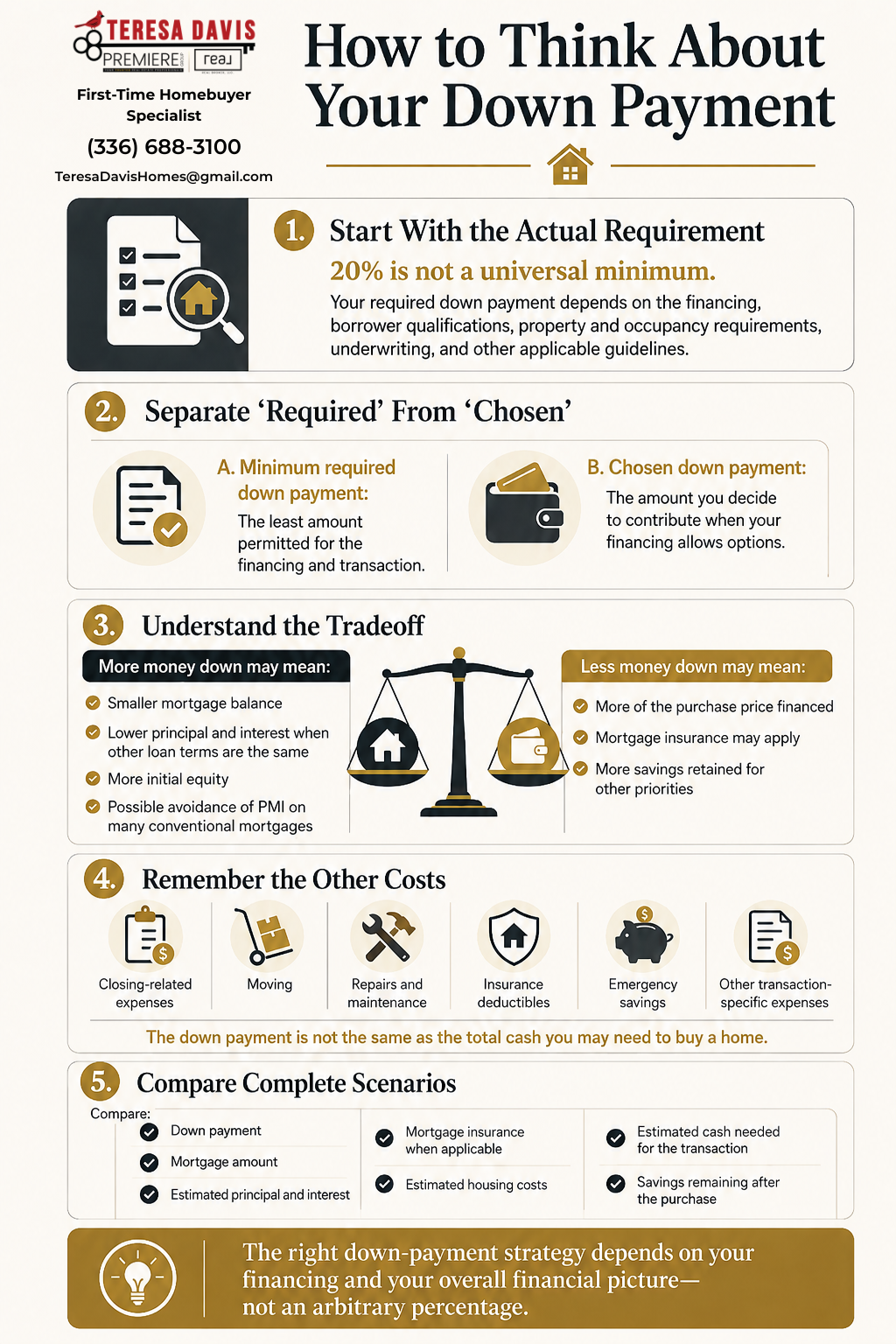
Frequently Asked Questions
Is a 20% down payment required to buy a home?
No. A 20% down payment is not a universal requirement for buying a home.
The amount required depends on the mortgage program, borrower qualifications, lender requirements, occupancy, property eligibility, underwriting, and other applicable guidelines. Current consumer guidance from the Consumer Financial Protection Bureau confirms that buyers may have mortgage options requiring considerably less than 20% down, depending on the financing and borrower. Twenty percent should therefore be viewed as one possible down-payment strategy rather than a rule that applies to every buyer.
Why do so many buyers hear that they should put 20% down?
Twenty percent is a familiar benchmark partly because of how conventional mortgage insurance works. With many conventional mortgages, a borrower who puts less than 20% down will typically need private mortgage insurance, or PMI. PMI protects the lender rather than the borrower if the borrower stops making mortgage payments.
Putting 20% down can also reduce the amount financed and increase the buyer's initial equity. Those can be meaningful benefits, but they do not make 20% a universal minimum requirement.
What can happen if I put less than 20% down?
If your mortgage permits a down payment below 20%, you will generally finance more of the purchase price than you would with a larger down payment. That can affect the mortgage balance, estimated principal-and-interest payment, mortgage insurance when applicable, and total financing costs. With many conventional mortgages, putting less than 20% down will typically mean paying PMI.
The tradeoff is that using less cash for the down payment may allow you to retain more savings for other purchase expenses, moving, repairs, emergencies, or other financial priorities.
Is putting 20% down always the better financial choice?
No. There is no single down-payment percentage that is automatically best for every buyer. A larger down payment can reduce the mortgage balance and may provide financing benefits, while a smaller permitted down payment can preserve more cash after closing.
The Consumer Financial Protection Bureau advises buyers to consider other upfront expenses and the savings they want to retain when determining how much to put down. The appropriate strategy depends on the mortgage available, the buyer's qualifications, available funds, estimated housing expenses, transaction costs, and broader financial priorities.
Does putting 20% down guarantee that I will qualify for a mortgage?
No. Having a 20% down payment does not guarantee mortgage approval. The down payment is only one part of mortgage qualification. Depending on the financing, lenders and underwriting may also evaluate income, debts, credit, assets, source of funds, occupancy, the property, and other program-specific requirements.
A larger down payment may strengthen certain aspects of a financing application, but the borrower and transaction still must satisfy the applicable mortgage and underwriting requirements. CFPB guidance likewise explains that down-payment size can affect loan terms and approval likelihood without making it a guarantee of approval.
What Happens Next?
Now that you know 20% is not a universal down-payment requirement, the next question is more practical: What financing possibilities might allow you to buy with less?
The next Academy lesson, “Can I buy a home with little or no down payment?”, will explore low-down-payment mortgages, eligible no-down-payment possibilities, and the general role of down-payment assistance.
It will also explain an important distinction that every buyer should understand: a low or zero required down payment does not necessarily mean no money will be needed for the transaction.
Inspections, closing costs, prepaid expenses, North Carolina due diligence fees or earnest money deposits when negotiated, reserves when required, and other transaction expenses may still need to be considered.
The goal of the next lesson is not to promise that a particular program will work for every buyer. It is to help you understand the types of possibilities that may exist and the eligibility factors that determine whether one of those options could apply to you.
Ready to Take the Next Step?
If the 20% down-payment assumption has been keeping you from exploring homeownership, you do not have to guess about what may be required.
Contact Teresa Davis
If you would like help understanding how your available savings, home-search goals, property considerations, and timing fit together, contact Teresa. She will talk through where you are now and identify the questions that should be answered before you decide what your next step should be.
Teresa Davis
REALTOR® and Professional Real Estate Advisor
PREMIERE Group of Real Broker LLC
One Real Mortgage — Pre-Approval
If you are ready for an individualized mortgage review, you can explore the One Real Mortgage pre-approval process to learn what financing structures and down-payment requirements may apply to your circumstances. Using One Real Mortgage is optional and is not required in order to work with Teresa Davis as your REALTOR®.
Teresa Davis
Loan Originator NMLS #2597433
One Real Mortgage
Qualification, mortgage availability, rates, mortgage insurance, required funds, and final approval depend on the applicable program requirements, property, underwriting, and borrower qualifications. Beginning a pre-approval process does not guarantee financing or require you to purchase a home. It is a practical way to learn more about your potential financing options, estimated payment, and possible next steps.
Ready for the next lesson? Use “Next Question” below to continue to "Can I buy a home with little or no down payment?".
1:8 - Can I buy a home with little or no down payment?

One of the biggest concerns many first-time homebuyers have is how much money they need before they can buy a home. If saving a large down payment feels like the main thing standing between you and homeownership, it is important to know that some qualified buyers may have financing options that require a relatively small down payment—and certain eligible buyers may have access to financing with no required down payment.
That does not mean every buyer will qualify for the same option. Mortgage programs have different requirements, and eligibility can depend on factors such as your finances, the property you are purchasing, how you plan to occupy the home, and the specific guidelines that apply to the loan. Down-payment assistance may also be available to some qualified buyers, including through programs offered in North Carolina, but assistance has its own eligibility requirements and terms.
Just as important, a small or zero required down payment does not mean you can necessarily buy a home with no money of your own. Your down payment is only one part of the financial picture. Closing costs and other transaction expenses may still apply, and a North Carolina buyer may also need to plan for inspections, negotiated due diligence money, earnest money when used, moving expenses, reserves, and other costs associated with the purchase.
If your main question is whether buyers are required to put 20% down, see Do I need a 20% down payment to buy a home?. This lesson focuses on a different question: what low- or no-down-payment possibilities may be available and what else should you be prepared to pay?
Quick Answer
Yes, you may be able to buy a home with a relatively small down payment or, if you meet the requirements of an eligible mortgage program, with no required down payment.
The options available to you depend on the loan program, your qualifications, the property, occupancy requirements, and current lending guidelines. Some buyers may also qualify for down-payment assistance that can help with eligible upfront costs.
However, “no down payment” does not mean “no money needed.” Even when a mortgage requires little or nothing toward the purchase price as a down payment, you may still need funds for closing costs and other expenses connected with buying the home.
The better question is not simply, “What is the smallest down payment I can make?” It is, “What financing options do I qualify for, what will my total cash needs be, what will my monthly payment look like, and how much savings will I have left after closing?”
At a Glance
- Low-down-payment financing may be available. Some mortgage programs allow qualified buyers to purchase with a relatively small percentage of the purchase price as their required down payment.
- No-down-payment financing may be available to eligible buyers. Certain mortgage programs can permit qualified borrowers to purchase without a required down payment, but eligibility and property requirements apply.
- Down-payment assistance may help some buyers. Assistance programs can sometimes help eligible buyers with qualifying upfront costs, but availability, terms, repayment provisions, and eligibility requirements vary.
- Your down payment and your total cash needed are not the same thing. Closing costs and other transaction expenses can still apply even when the required down payment is small or zero.
- North Carolina buyers should plan for transaction-related expenses. Depending on the transaction, these may include inspections, a negotiated due diligence fee if one is agreed upon, earnest money when used, and other costs before or at closing.
- The property can affect your financing options. Property type, condition, location, occupancy, and other program requirements may affect whether a particular financing option can be used.
- Qualification is individual. A program that works well for one buyer may not be available or appropriate for another buyer.
- The smallest down payment is not automatically the best financial choice. Consider your complete monthly payment, cash needed for the transaction, financing costs, available savings, and overall financial flexibility when comparing options.
A Smaller Down Payment May Be More Realistic Than You Think
If you have been assuming that buying a home requires years of saving for a very large down payment, it is worth learning what financing options may actually be available to you. Some mortgage programs allow qualified buyers to purchase with a relatively small down payment, while certain programs may allow eligible borrowers to purchase with no required down payment at all.
That does not mean every buyer can choose any down-payment amount they want. The mortgage program, your qualifications, the home you are purchasing, how you will occupy the property, and other underwriting requirements all help determine what options are available.
This lesson is about how low- and no-down-payment possibilities work. If you want a deeper explanation of why 20% is not a universal requirement—and why some buyers still choose to put 20% down—see Do I need a 20% down payment to buy a home?.
Low-Down-Payment Mortgage Options
Several types of mortgage financing can allow qualified buyers to purchase with less money down than they may have expected.
The important point is not to memorize every program or percentage. Instead, understand that the required down payment depends on the financing you qualify for and the specific transaction.
Conventional Financing Can Include Low-Down-Payment Options
Some conventional mortgage options permit qualified buyers to purchase with a relatively small down payment. For example, Fannie Mae's HomeReady® mortgage currently permits down payments as low as 3% for qualifying borrowers. Eligibility requirements apply, including program-specific income and underwriting requirements.
A conventional loan with a small down payment may also involve private mortgage insurance, depending on the loan structure and loan-to-value ratio. That cost should be considered as part of the complete monthly housing payment rather than looking only at the amount required upfront.
Conventional financing is not one single loan program with one universal set of requirements. Your lender can help determine which conventional options, if any, fit your circumstances.
FHA Financing Can Reduce the Required Down Payment
FHA-insured financing is another commonly used low-down-payment option. HUD currently states that an FHA down payment can be as low as 3.5% of the purchase price for qualifying borrowers. FHA financing also has its own credit, property, mortgage-insurance, and underwriting requirements.
An FHA loan is not automatically the best choice simply because the required down payment may be relatively small. The complete financing picture—including mortgage insurance, monthly payment, closing costs, available savings, and property eligibility—should be considered.
These conventional and FHA examples are meant to show that low-down-payment financing exists. They are not a complete list of mortgage options, and they are not a promise that a particular buyer will qualify.
Some Eligible Buyers May Have No-Down-Payment Financing Options
A required down payment of zero is possible under certain mortgage programs, but eligibility is specific to the borrower and the transaction. Two important examples are VA-backed purchase loans and USDA Rural Development financing.
VA-Backed Purchase Loans
For eligible Veterans, service members, and certain surviving spouses, a VA-backed purchase loan can offer a no-down-payment option. VA currently states that no down payment is generally required when the sales price does not exceed the home's appraised value, although lender requirements and a borrower's entitlement circumstances can affect the transaction.
The buyer must still qualify for the mortgage, and the home must meet applicable VA requirements.
Most importantly, a VA loan with no required down payment does not mean the buyer will necessarily need no money for the transaction. Closing costs and other homebuying expenses may still need to be addressed.
USDA Rural Development Financing
USDA's Single Family Housing Guaranteed Loan Program is another potential no-down-payment option. USDA currently describes the program as providing qualifying rural homebuyers access to 100% financing with no required down payment.
USDA eligibility involves more than the buyer's finances. The property must also be located in an eligible area, and the borrower and transaction must satisfy applicable program requirements.
This can be especially important for North Carolina buyers who are considering homes outside larger urban areas. A property should not be assumed to qualify merely because it appears rural; actual program eligibility should be verified for the specific address.
Down-Payment Assistance May Create Another Path
A buyer who does not qualify for a no-down-payment mortgage may still have another possibility: down-payment assistance.
Down-payment assistance programs can help eligible buyers with qualifying upfront expenses. Depending on the program, assistance may be structured as a grant, subordinate loan, deferred loan, forgivable loan, or another form of assistance.
The details matter. Assistance may have:
- income limits;
- sales-price limits;
- property requirements;
- occupancy requirements;
- approved-lender requirements;
- homebuyer-education requirements;
- repayment provisions;
- forgiveness schedules; or
- other program-specific conditions.
For that reason, down-payment assistance should not automatically be described as “free money.” Buyers should understand exactly how the assistance works, whether repayment could become due, and what conditions must be satisfied.
A Current North Carolina Example
North Carolina buyers may have access to assistance through programs offered by the North Carolina Housing Finance Agency, subject to current program requirements.
The Agency currently states that its NC Home Advantage Mortgage™ can provide qualified first-time and move-up buyers with down-payment assistance of up to 3% of the mortgage loan amount. It also currently offers the NC 1st Home Advantage Down Payment, which can provide $15,000 in assistance to qualifying first-time buyers, military veterans, and certain other eligible buyers.
These assistance options have eligibility requirements and specific terms. For example, the NC 1st Home Advantage assistance is currently structured as a 0% deferred second mortgage with a forgiveness schedule beginning after year 10, and repayment can be triggered if the home is sold, refinanced, or transferred before the applicable forgiveness period is completed.
Programs can change, and availability at the time you are ready to buy should always be verified. A buyer should never assume that being a first-time homebuyer automatically qualifies them for assistance.
The more useful approach is to ask a lender to evaluate all financing and assistance possibilities you may qualify for together, so you can compare the required down payment, total cash needed, monthly payment, program costs, eligibility requirements, and remaining savings before deciding which path makes the most sense.
Your Down Payment Is Not the Same as Your Total Cash Needed
One of the most important distinctions for a first-time homebuyer is the difference between a down payment and the total amount of money needed to complete the purchase. Your down payment is the portion of the purchase price that you contribute rather than finance through the mortgage. Your total transaction cash needs can be broader.
For mortgage transactions, the Consumer Financial Protection Bureau explains that the Estimated Cash to Close on the Loan Estimate includes the down payment and closing costs, then accounts for items such as deposits already paid to the seller, seller credits, and other adjustments.
That is why a mortgage advertised as requiring a small down payment—or even no required down payment—should never be interpreted as meaning that you will need little or no money throughout the entire homebuying process.
What Closing Costs Can Include
Closing costs are separate from the amount you put down toward the home's purchase price. Depending on the mortgage and transaction, closing costs can include expenses associated with obtaining the loan and transferring ownership of the property. The CFPB identifies examples such as appraisal fees, title-related charges, government taxes, lender-related fees, and prepaid expenses such as homeowners insurance, property taxes, and interest.
The exact amount varies from one transaction to another, which is why an estimate based only on the down-payment percentage does not tell you how much money you may ultimately need. Before deciding that a particular financing option is affordable, look at both:
- the amount required before and at closing; and
- the monthly housing cost you will carry after closing.
Some Homebuying Expenses May Occur Before Closing
Not every dollar associated with buying a home waits until closing day. Depending on your North Carolina transaction and the choices you make, you may have expenses or cash commitments earlier in the process.
These can include:
- home inspection fees;
- specialized inspections or evaluations when you choose or need them;
- appraisal-related costs when applicable;
- a negotiated due diligence fee, if one is included in the contract;
- earnest money, when included in the contract; and
- other transaction-specific expenses.
These amounts should be considered when determining how much money you are comfortable using for the purchase.
Understanding Due Diligence and Earnest Money in North Carolina
For North Carolina buyers, it is especially important not to confuse contract funds with the mortgage down payment.
Due Diligence Fee
Under the commonly used North Carolina Offer to Purchase and Contract, the buyer and seller may negotiate a due diligence fee. The North Carolina Real Estate Commission specifically notes that no due diligence fee is required by law.
If the parties agree to a due diligence fee, it is paid to the seller according to the contract. Buyers should understand the consequences before agreeing to the amount because the fee is generally nonrefundable except in limited circumstances.
A due diligence fee is therefore not the same thing as a down payment and should not be described as part of a mortgage program's minimum down-payment requirement.
Earnest Money
Earnest money is also separate from the mortgage down payment. When earnest money is included in a North Carolina contract, it is handled according to the terms of that contract and can ultimately be credited as part of the transaction when the purchase closes.
The amount, if any, is negotiated as part of the offer rather than being determined by the mortgage program itself. This distinction matters when comparing low-down-payment financing. You may qualify for a mortgage with a small required down payment while still deciding to commit funds through the purchase contract.
“No Down Payment” Should Never Be Read as “No Money Needed”
A zero-down mortgage addresses one specific part of the transaction: the amount of the purchase price the mortgage program requires you to contribute as a down payment.
It does not automatically eliminate:
- closing costs;
- prepaid expenses;
- inspection expenses;
- negotiated contract funds;
- moving expenses;
- immediate homeownership expenses; or
- reserve requirements when applicable.
Some of those expenses may be paid from allowable assistance, seller credits, lender credits, gifts, or other permitted sources depending on the financing and transaction. But those possibilities have rules of their own and should be verified before you rely on them.
The goal is to understand where every dollar needed for the transaction is expected to come from before you make financial commitments.
Why the Property You Choose Can Affect the Financing
Qualifying as a borrower is only part of the mortgage equation. The property itself can affect whether a particular low- or no-down-payment option can be used.
Depending on the mortgage program, factors can include:
- whether the home will be your primary residence;
- property type;
- property condition;
- appraisal results;
- location;
- program-specific property standards; and
- other eligibility requirements.
For example, some programs are tied to eligible geographic areas, while others have property or occupancy requirements that must be satisfied.
This is one reason it is helpful to have your lender and REALTOR® working from the same financing plan. A home that looks like a good fit from a price standpoint should also be evaluated for compatibility with the financing you intend to use.
Eligibility Matters More Than the Headline Down-Payment Percentage
A mortgage advertisement or program description may emphasize a low percentage or “zero down,” but that headline does not tell you whether you personally qualify. Your available options can depend on factors such as:
- income and employment documentation;
- credit history and credit profile;
- debts and overall mortgage qualification;
- available assets;
- acceptable sources of funds;
- occupancy;
- property eligibility;
- program-specific income or geographic requirements;
- military-service eligibility for applicable VA benefits;
- underwriting findings; and
- current lender and mortgage-program guidelines.
Requirements can change, and different mortgage programs evaluate borrowers differently. Instead of beginning with, “Which program has the lowest down payment?” a more useful question is: “Which programs do I qualify for, and how do the complete costs and requirements compare?”
Keep Some Attention on the Money You Will Have Left
Being able to produce enough money to close does not necessarily mean using every available dollar is the best approach. Homeownership can bring expenses soon after closing. A buyer may need money for moving, utilities, furnishings, maintenance, repairs, insurance-related expenses, or other needs.
Some mortgage transactions may also require documented reserves. In mortgage underwriting, reserves generally refer to eligible assets remaining after closing that can be available for future housing obligations. Freddie Mac's current guidance, for example, defines reserves as a borrower's assets remaining after the mortgage closing and establishes reserve requirements for certain transactions.
Even when your particular mortgage does not require reserves, keeping some financial cushion can be an important part of evaluating your overall readiness.
Compare the Complete Financing Picture
When several financing possibilities are available, do not compare them only by asking which requires the least money down.
A more complete comparison can include:
- required down payment;
- estimated closing costs;
- estimated cash to close;
- mortgage insurance or program-specific financing charges when applicable;
- interest rate and loan terms;
- estimated monthly principal and interest;
- estimated taxes and homeowners insurance;
- homeowners association dues when applicable;
- assistance terms and possible repayment requirements;
- property eligibility;
- funds needed before closing; and
- savings expected to remain afterward.
The CFPB recommends considering closing costs when determining how much available cash can reasonably be devoted to a down payment, reinforcing why the two amounts need to be evaluated together.
A low required down payment can make homeownership more accessible for some buyers, but the best financing strategy is the one that works with your qualifications, the property, your complete transaction costs, your monthly budget, and your financial position after closing.
If you want to compare the broader advantages and tradeoffs of putting more or less money down—not just learn which low- or no-down-payment pathways may exist—return to Do I need a 20% down payment to buy a home?.
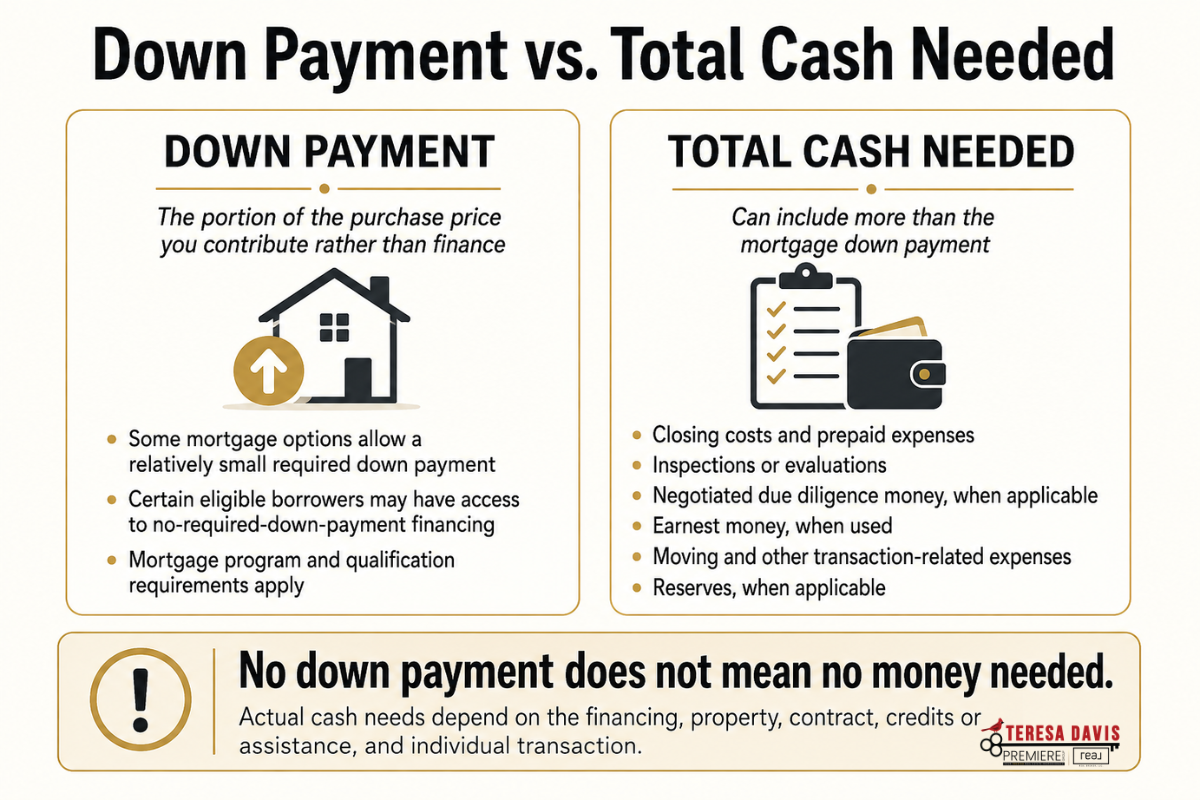
Coordinate Your Financing With the Home You Choose
A low- or no-down-payment mortgage option does not exist separately from the home you are buying. The property itself, the purchase contract, and the timing of the transaction can all affect whether a particular financing strategy works.
Your REALTOR® can help you coordinate the real estate side of the purchase with the financing plan you have discussed with your lender. That can include helping you understand when factors such as property type, condition, location, occupancy plans, contract timing, and negotiated terms may need to be discussed with your lender before you make a commitment.
This coordination is especially important when you are considering financing with specific property requirements. For example, a home that fits comfortably within your price range may still need to satisfy the eligibility standards of the mortgage program you plan to use.
In a North Carolina transaction, your REALTOR® can also help you understand that money committed through the purchase contract is separate from the mortgage down-payment requirement. A negotiated due diligence fee, earnest money deposit, inspections, and other transaction expenses may require funds before closing even when your mortgage requires a very small—or no—down payment.
Your REALTOR® does not determine whether you qualify for a mortgage or down-payment assistance program. Those decisions belong to the lender and applicable program administrators. The REALTOR®'s role is to help make sure your property search, offer strategy, contract obligations, and financing plan are working together rather than being treated as separate decisions.
Teresa’s Professional Insight
As both a REALTOR® / Professional Real Estate Advisor with PREMIERE Group of Real Broker LLC and a Loan Originator with One Real Mortgage, NMLS #2597433, I often encourage first-time buyers to find out what their actual financing possibilities look like before assuming they need to save a very large down payment.
Sometimes the biggest obstacle is not the buyer's actual financing situation—it is the assumption that homeownership cannot even be explored until a certain savings target has been reached.
At the same time, I do not want a buyer to focus only on the smallest possible down payment. A useful financing conversation should look at the entire picture: the mortgage options you may qualify for, the required down payment, estimated cash to close, anticipated transaction expenses, estimated monthly payment, property eligibility, assistance requirements when applicable, and how much savings you may have left after the purchase.
My goal is to help you understand the options and the questions to ask so that you can make an informed decision based on your actual circumstances—not on a headline percentage or a common assumption about how much money every buyer needs.
Helpful Tip
When you talk with a lender, do not stop at: “How much do I need for the down payment?” Ask for a more complete estimate of the transaction.
Useful questions can include:
- What mortgage options do I currently appear to qualify for?
- What down payment would each option require?
- What are my estimated closing costs?
- What is my estimated cash to close?
- Are there mortgage-insurance or program-specific financing costs I should understand?
- Could I qualify for any down-payment or closing-cost assistance?
- If assistance is available, what are its repayment, forgiveness, occupancy, or other requirements?
- Are there restrictions on the type, condition, location, or occupancy of the property?
- Will reserves be required for the financing I am considering?
- What funds may I need before closing for inspections, contract deposits or fees, appraisal-related expenses, or other transaction costs?
- Approximately how much savings could I have remaining after closing?
- How would the complete estimated monthly payment compare among the financing options?
Comparing those answers can give you a much clearer picture than comparing down-payment percentages alone.
Keep in Mind
A low down payment does not automatically mean a low monthly housing cost.
Putting less money down generally means financing more of the purchase price, and some financing options may include mortgage insurance or other program-specific charges. Compare the complete estimated payment and loan terms rather than assuming the option with the lowest required down payment will also have the lowest overall cost.
No down payment does not mean no money needed.
Even when an eligible mortgage program requires no down payment, closing costs and other transaction expenses may still apply. In North Carolina, you may also decide to spend money on inspections or negotiate due diligence money or earnest money as part of the purchase contract.
Down-payment assistance does not automatically mean unrestricted or obligation-free money.
Assistance programs can have income limits, property requirements, occupancy requirements, approved financing requirements, repayment provisions, forgiveness schedules, or other conditions. Understand the actual terms before relying on assistance as part of your purchase plan.
Mortgage and assistance guidelines can change. Eligibility depends on the borrower, property, financing, and transaction. Verify current requirements with the appropriate lender or program administrator before making financial or contractual decisions.
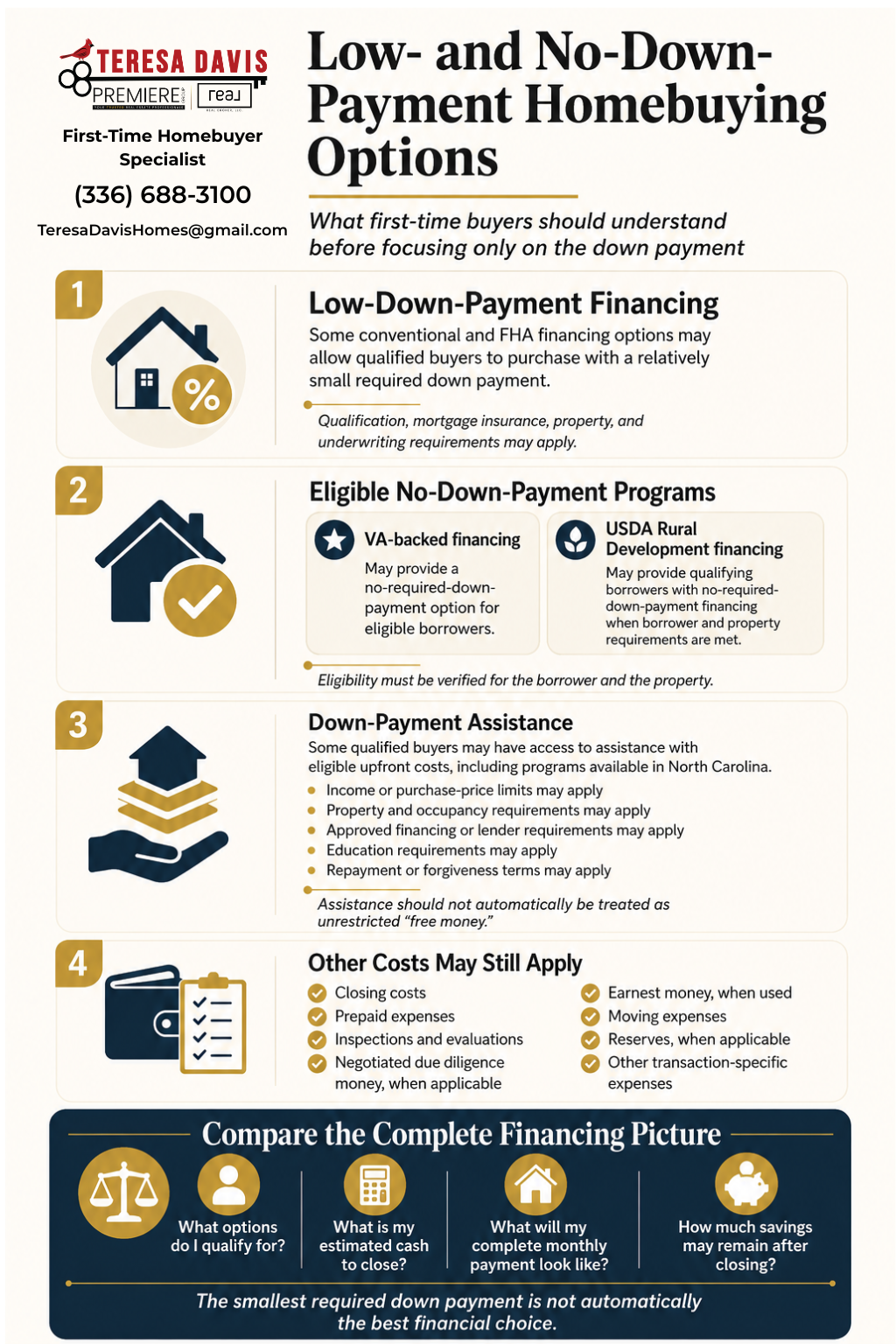
Frequently Asked Questions
Can I really buy a home with no down payment?
Possibly. Certain mortgage programs can allow eligible borrowers to purchase without a required down payment. For example, eligible borrowers may have access to a VA-backed purchase loan or qualifying USDA Rural Development financing. These programs have borrower, property, occupancy, and other requirements, so a zero-down option should never be assumed until your eligibility and the property have been evaluated.
Does no down payment mean I need no money to buy the home?
No. A mortgage that requires no down payment addresses only the portion of the purchase price that you are required to contribute as a down payment. Closing costs and other transaction expenses may still apply. Depending on your North Carolina transaction, you may also need or choose to spend money on inspections, appraisal-related expenses, negotiated due diligence money, earnest money, moving costs, or other items. Some costs may be covered through permitted credits, gifts, or assistance, but those possibilities have their own requirements.
What is the difference between my down payment and cash to close?
Your down payment is the portion of the purchase price you contribute rather than finance. Your cash to close is the amount you are expected to bring to closing after the down payment, closing costs, deposits already paid, credits, and other transaction adjustments are taken into account. The Consumer Financial Protection Bureau's Loan Estimate guidance explains this calculation. That is why knowing your required down-payment percentage alone does not tell you exactly how much money you will need to complete the purchase.
How does down-payment assistance work for North Carolina homebuyers?
Down-payment assistance can help eligible buyers with qualifying upfront expenses, but every program has its own rules and terms. The North Carolina Housing Finance Agency currently offers down-payment assistance through qualifying NC Home Advantage Mortgage™ transactions and also offers the NC 1st Home Advantage Down Payment for certain eligible first-time buyers and military veterans. Eligibility, assistance amounts, repayment or forgiveness terms, property requirements, income limits, and program availability should be verified when you are ready to buy. Being a first-time buyer does not automatically mean you will qualify.
Can the property I choose affect whether I qualify for a low- or no-down-payment loan?
Yes. Mortgage eligibility is not based only on the borrower. Depending on the program, the home's property type, condition, occupancy, appraisal, location, and other program-specific requirements can affect whether the financing can be used. USDA financing, for example, includes geographic property eligibility requirements, while other mortgage programs may have their own property standards. Before making an offer, make sure the property appears compatible with the financing you plan to use and confirm any questions with your lender.
What Happens Next?
Learning that you may not need a large down payment can change how you think about the timing of homeownership. But qualifying for a lower-down-payment option does not automatically mean that buying immediately is the right decision.
The next step is to look at the larger picture: your income, debts, savings, monthly budget, expected transaction expenses, future plans, housing needs, and how financially comfortable you would be after closing.
You may discover that you are closer to being ready than you thought. You may also decide that waiting while you strengthen your finances or build additional savings would put you in a better position. Both conclusions can be reasonable depending on your circumstances.
Continue to the next Academy lesson, Should I buy a house now or wait?, to think through the financial and personal factors that can help you evaluate your timing.
Ready to Take the Next Step?
You do not have to guess how much money you need before you can begin exploring homeownership. A useful starting point is understanding which financing options you may qualify for, what those options could require upfront, what your estimated monthly payment may look like, and what other transaction expenses you should plan for.
Contact Teresa Davis
If you have questions about buying a home in Davidson County, Randolph County, Guilford County, Forsyth County, or surrounding North Carolina communities, I am happy to help you understand the homebuying process and think through your next steps.
Teresa Davis
REALTOR® and Professional Real Estate Advisor
PREMIERE Group of Real Broker LLC
Begin the One Real Mortgage Pre-Approval Process
If you are ready to explore your financing, you can begin the One Real Mortgage pre-approval process. Mortgage approval, loan terms, down-payment requirements, assistance eligibility, and property requirements depend on your individual qualifications and the specific transaction. Using One Real Mortgage is optional and is not required in order to work with Teresa Davis as your REALTOR®.
Teresa Davis
Loan Originator NMLS #2597433
One Real Mortgage
Mortgage qualification, loan programs, terms, costs, and final approval depend on the borrower, property, transaction, documentation, underwriting, and applicable lending requirements. Beginning a pre-approval process does not guarantee financing or require you to purchase a home. It is a practical way to learn more about your potential financing options, estimated payment, and possible next steps.
Ready for the next lesson? Use “Next Question” below to continue to "Should I buy a house now or wait?".
1:9 - Should I buy a house now or wait?

Deciding whether to buy a house now or wait is rarely as simple as deciding whether the housing market is “good” or “bad.” The better question is whether buying makes sense for you right now based on your finances, housing needs, future plans, and the homes actually available within your budget.
Market conditions matter, but they are only part of the decision. Home prices, available inventory, buyer competition, and mortgage rates can affect what you can buy and what your monthly costs may look like. At the same time, your income, savings, debts, employment stability, current housing situation, and anticipated plans can be even more important to determining whether you are prepared to become a homeowner.
For some first-time buyers, purchasing now may make sense because their finances are stable, the payment is comfortable, they have savings remaining after the purchase, and they can find a home that meets their needs within a realistic budget. For others, waiting may provide valuable time to strengthen savings, reduce debt, stabilize income, prepare for an upcoming life change, or better understand what they need from a home.
The goal is not to predict the perfect moment to buy. No one can reliably promise what home prices, inventory, competition, or mortgage rates will do next. Instead, the goal is to evaluate the factors you can understand today and decide whether moving forward would support your financial comfort, housing needs, and longer-term plans.
Mortgage rates are an important part of affordability, but they are only one factor in this broader decision. If your main concern is whether you should postpone buying specifically because you believe mortgage rates may fall, the next Academy lesson, Should I wait for mortgage rates to go down before buying?, takes a closer look at that question.
Quick Answer
There is no universally right time to buy a house. Buying now may make sense when your finances are reasonably stable, you can comfortably afford the expected costs of homeownership, you will still have appropriate savings after the purchase, the home fits your foreseeable needs, and suitable properties are available within your realistic budget.
Waiting may make more sense if buying would stretch your finances, substantially reduce your savings, your income or employment situation is uncertain, a significant move or life change may be approaching, or the homes currently available do not reasonably fit your needs and budget.
Rather than trying to time the housing market perfectly, focus on whether your readiness, your housing needs, and the opportunities available to you today support buying.
At a Glance
- Start with your financial readiness. Stable income, manageable obligations, comfortable affordability, and adequate savings can matter more than trying to identify the perfect market.
- Consider what you will have left after buying. Being able to complete a purchase is different from being financially comfortable afterward. Homeowners also need room in their budgets for maintenance, repairs, and unexpected expenses.
- Think about why you want to buy now. Your current housing needs, desire for stability, space requirements, location considerations, and foreseeable plans should be part of the decision.
- Consider how long the home may fit your plans. If a relocation or significant change is likely in the near future, that may affect whether buying now makes sense.
- Evaluate the homes you can actually buy. Inventory, prices, property condition, competition, and available choices can vary by location, property type, and price range.
- Do not assume waiting guarantees a better market. Home prices, inventory, competition, and other conditions can change in either direction.
- Mortgage rates matter, but they are not the entire decision. Rates affect borrowing costs and affordability, but Question 10 examines separately whether waiting specifically for lower mortgage rates makes sense.
- Waiting can be productive when you have a purpose. Building savings, reducing debt, improving financial preparedness, or resolving an upcoming life change can give waiting a clear objective.
- You do not have to choose only between “buy now” and “wait indefinitely.” Sometimes the best approach is to prepare, establish specific goals, and reassess your readiness after reaching them.
There Is No Single “Best” Time to Buy a House
When people ask whether they should buy a house now or wait, it is tempting to look for one market indicator that will provide the answer. You may hear about home prices, mortgage rates, inventory, or whether the market favors buyers or sellers. Those factors can matter, but none of them can determine whether you personally should buy a home right now.
A better decision comes from looking at several factors together:
- your financial preparedness;
- your current and anticipated housing needs;
- how comfortably homeownership fits your budget;
- how long the home may reasonably fit your plans;
- the homes actually available within your price range; and
- the market conditions affecting the properties and locations you are considering.
This is why two buyers looking in the same market can reasonably make different decisions. One buyer may have stable income, strong savings, comfortable affordability, and a home available that fits their needs. Another buyer may need additional time to strengthen savings, reduce financial obligations, or work through an upcoming move or other significant change.
Neither decision is automatically right or wrong. The goal is to determine whether buying fits your circumstances rather than trying to identify a universally perfect time to enter the housing market.
It is also important not to base the decision on predictions. Waiting does not guarantee that home prices will fall, inventory will increase, competition will decrease, or financing conditions will become more favorable. Likewise, buying now does not guarantee that a home's value will increase or that today's market conditions will prove better than future conditions.
The most useful question is not simply, “Is this a good market?” It is: “Does buying a home under the conditions available to me today make sense for my finances, housing needs, and plans?”
Start With Your Financial Foundation
Before focusing heavily on the housing market, take an objective look at your financial foundation. You do not need perfect finances to become a homeowner, but buying a home generally works better when the purchase fits comfortably within your overall financial situation rather than requiring you to stretch simply to make the transaction happen.
Important areas to consider include:
- Income and employment stability. Consider whether your current income appears reasonably dependable and whether you anticipate significant changes that could affect your ability to manage housing expenses.
- Existing financial obligations. Monthly debts and other ongoing commitments affect how much room you have in your budget for housing and other priorities.
- Savings. Buying a home can require money for more than the down payment. Depending on the transaction, buyers may also need funds for inspections, due diligence, earnest money, closing costs, moving expenses, immediate household needs, and other expenses.
- Emergency reserves. Consider whether you will retain savings after the purchase rather than using nearly everything available simply to become a homeowner.
- Comfortable monthly affordability. A payment that a buyer can technically qualify for is not necessarily the same as a payment the buyer will feel comfortable carrying along with other expenses and financial goals.
If you are still working through these questions, the Academy lessons Can I afford to buy a house? and How much house can I afford? explore affordability in greater detail. For this lesson, the important point is that financial readiness is one of the strongest indicators of whether buying now deserves serious consideration.
Consider What Buying Would Leave You With After Closing
One of the easiest mistakes to make is focusing entirely on whether you have enough money to complete the purchase.
A better question is: What will my financial position look like after I become the homeowner?
Owning a home introduces expenses that may not occur on a predictable schedule. A water heater can fail. An appliance may need to be replaced. Routine maintenance can become necessary. Insurance, taxes, utilities, homeowners association expenses when applicable, and other ownership costs also need to fit within the household budget.
For that reason, a buyer should consider not only the money required to purchase the home but also whether the transaction leaves reasonable financial flexibility afterward. There is no single reserve amount that is appropriate for every buyer. The appropriate level of savings depends on the buyer's circumstances, the property, financing, anticipated expenses, and personal financial needs.
However, if purchasing a home would leave you with little ability to manage an unexpected expense, that may be a reason to examine whether additional preparation would make homeownership more comfortable. Waiting in that situation does not necessarily mean abandoning the goal of buying. It may mean giving yourself a specific objective—such as building additional savings—before reassessing the decision.
Look at Your Current Housing Needs
Financial readiness is important, but buying a house is also a housing decision. Ask yourself what is prompting you to consider buying now.
Perhaps your current housing situation no longer meets your practical needs. You may want a different amount of space, a different property type, a different location, or greater control over your living environment. Your work arrangements, commute, household needs, or other circumstances may also have changed.
On the other hand, your current housing arrangement may still work well while other parts of your life remain uncertain.
Questions that can help include:
- What problem would buying a home solve for me?
- What do I need from my next home that I do not have now?
- Are those needs likely to remain important for the foreseeable future?
- Am I comfortable committing to the responsibilities that come with ownership?
- Is the type of home I need realistically available within my budget?
Buying should not be treated as something you must do simply because you reach a certain age, income level, or stage of life. Renting can remain an appropriate housing choice when it provides needed flexibility or better fits a person's current circumstances.
Likewise, a buyer who is financially prepared and has a meaningful housing need does not necessarily need to postpone purchasing simply because market conditions are not perfect. The decision should reflect what works for your actual situation.
Think About How Long the Home May Fit Your Plans
You cannot know exactly what the future will bring, but it is still useful to consider how well purchasing a home fits your foreseeable plans. Buying and later selling a home can involve transaction expenses. Because of that, a potential near-term move may deserve careful consideration before purchasing.
For example, think about whether you are reasonably likely to:
- relocate for employment;
- move to another area;
- experience a significant change in housing needs;
- need substantially more or less space;
- or face another foreseeable circumstance that could make another move likely.
There is no universal rule requiring every buyer to own a home for a particular number of years. The appropriate timeline depends on the buyer, the property, the transaction costs, market conditions, and what happens during the period of ownership.
Instead of relying on a rigid number, consider whether the home you are purchasing has a reasonable opportunity to serve your expected needs and whether you are comfortable with the possibility that circumstances could change.
If you expect a major transition soon and buying would reduce the flexibility you need, waiting may be reasonable. If your plans are relatively stable, the home fits your anticipated needs, and the purchase works financially, your expected ownership timeline may support moving forward.
The purpose is not to predict your life several years into the future. It is to avoid making a major housing decision without considering the changes you already know may be approaching.
Evaluate the Homes Actually Available to You
You can be financially prepared to buy and still discover that the homes currently available do not reasonably fit your needs, priorities, or budget. That is why the decision to buy now should include more than an evaluation of your finances. It should also include a realistic look at what you can actually purchase.
Consider questions such as:
- Are there homes within my realistic price range?
- Do those homes meet the needs that are most important to me?
- Am I comfortable with the property types, locations, sizes, and conditions available within my budget?
- Would buying require compromises I can reasonably accept?
- Am I considering homes based on what I can comfortably afford, or am I feeling pressure to stretch beyond my preferred budget?
Inventory can vary significantly by location, price range, property type, and even by the specific features a buyer needs. Conditions in one part of North Carolina may differ from conditions in another, and the choices available at one price point may look very different from those available at another.
That is particularly important when considering communities throughout Davidson, Randolph, Guilford, and Forsyth counties and surrounding areas. A broad statement about the housing market does not necessarily describe what is happening with the particular homes you would realistically consider. Instead of asking only whether homes are available, ask whether appropriate homes are available to you.
If you are financially prepared and suitable homes exist within a comfortable budget, that may support moving forward. If the only available options require you to exceed your budget, accept compromises that do not work for your needs, or purchase a property you would not otherwise choose, waiting and reassessing may be reasonable.
Understand the Role of Home Prices and Buyer Competition
Home prices and buyer competition can influence whether buying now feels attractive, but neither factor should be viewed in isolation. When considering a particular home, the important issue is not simply whether prices in general seem high or low. The more useful question is whether the property's value can be reasonably supported by relevant market information and whether the purchase makes sense within your budget and plans.
A REALTOR® can help you evaluate recent comparable sales, current competing properties, property condition, location, and other factors that may affect how a particular home compares with the local market.
Competition also matters. In some situations, buyers may have more negotiating flexibility. In others, attractive properties may receive strong interest from multiple buyers. Those conditions can influence:
- how quickly decisions may need to be made;
- how much negotiating leverage may exist;
- whether seller concessions may be available;
- and how closely an offer needs to reflect current comparable market activity.
However, competition should never become a reason to abandon your financial boundaries. Feeling that you must “buy something before prices go higher” or “win this house at any cost” can lead to decisions based more on fear than on whether the property is appropriate for you.
Waiting also carries uncertainty. No one can reliably promise that waiting will result in:
- lower home prices;
- more homes for sale;
- less buyer competition;
- greater negotiating power;
- or a property that better fits your needs.
Likewise, buying today does not guarantee that a home's value will increase. The goal is not to predict which market will ultimately prove more favorable. The goal is to determine whether a particular purchase makes sense based on the information available when you are making the decision.
Mortgage Rates Matter—But They Are Only One Part of the Decision
Mortgage rates can affect the cost of borrowing, your estimated principal-and-interest payment, and how much home may fit comfortably within your budget. That makes rates an important consideration.
They are not, however, the only factor that determines whether buying now makes sense. A buyer's overall decision may also depend on:
- financial readiness;
- savings;
- current housing needs;
- expected ownership timeline;
- home prices;
- available inventory;
- buyer competition;
- and the specific properties available within the buyer's budget.
Mortgage rates can also change over time, which means future borrowing costs cannot be known with certainty. For this reason, Question 9 should not be reduced to the question, “Are mortgage rates low enough for me to buy?”
If you are otherwise prepared to purchase but your primary concern is whether you should postpone buying specifically because mortgage rates might decline, continue to the next Academy lesson: Should I wait for mortgage rates to go down before buying?
That lesson examines the mortgage-rate timing question separately and in greater detail.
Waiting Works Best When You Know What You Are Waiting For
Waiting can be a sound decision when it serves a specific purpose. For example, you may decide to wait because you want time to:
- build additional savings;
- reduce certain debts;
- stabilize your income or employment situation;
- improve your overall financial preparedness;
- better understand a comfortable housing budget;
- resolve an anticipated relocation or significant life transition;
- clarify which housing features are most important;
- or reassess your options after completing another specific preparation goal.
Those are measurable reasons for waiting because they focus on changes you can work toward or circumstances you expect to clarify. Waiting simply because you hope “the market gets better” is different.
A better market could mean many things:
- lower prices;
- more inventory;
- less competition;
- different mortgage rates;
- greater negotiating leverage;
- or some combination of those conditions.
There is no reliable way to know whether all—or even any—of those changes will occur together. If you decide to wait, define what you are waiting for. Instead of saying: “I will buy when the market is better,” you might identify a more specific goal such as:
- “I want to increase my available savings before buying.”
- “I need more certainty about whether I will remain in this area.”
- “I want to reduce a monthly debt obligation before adding a housing payment.”
- “I need to understand what price range feels comfortable before beginning a serious home search.”
A specific goal gives you something meaningful to reassess later.
Use a Buy Now, Wait, or Prepare and Reassess Framework
The decision does not have to be limited to two choices: buy immediately or postpone homeownership indefinitely. A more useful framework is to consider three possibilities.
Buying Now May Make Sense When
Buying now may deserve serious consideration when:
- your income and overall financial situation are reasonably stable;
- the expected housing costs fit comfortably within your budget;
- you can complete the purchase without substantially depleting the savings you need for financial security;
- your current housing needs support becoming a homeowner;
- the home is likely to fit your foreseeable plans;
- suitable properties are available within your realistic budget;
- and you are comfortable making the decision based on today's conditions rather than depending on a specific future market outcome.
This does not mean every buyer who meets these conditions should purchase immediately. It means the buyer may have a reasonable foundation for evaluating individual properties and deciding whether an appropriate opportunity exists.
Waiting May Make More Sense When
Waiting may deserve consideration when:
- the expected housing costs would stretch your budget;
- completing the purchase would leave you without sufficient financial flexibility for your circumstances;
- income or employment is uncertain;
- you expect a significant relocation or other major change that could affect your housing needs;
- you are unsure what you actually need from the home;
- or the homes available within your current budget do not reasonably meet your priorities.
Waiting is not failure. Sometimes it is part of becoming better prepared.
Prepare and Reassess May Be the Best Next Step
Many first-time buyers fall somewhere between “ready now” and “not ready.” You may be interested in buying and have several parts of your financial picture in place while still having one or two goals to address.
In that situation, consider creating a preparation plan and setting a point to reassess. Your plan might focus on:
- identifying the specific issue that is keeping you from feeling ready;
- determining what improvement would meaningfully change the situation;
- working toward that goal;
- checking your housing and financing options again after meaningful progress; and
- making a new decision using the circumstances available at that time.
This approach helps replace uncertainty with a practical next step.
Focus on a Decision You Can Support—Not a Market You Cannot Predict
You do not need to know what the housing market will do next year to make a thoughtful decision today. You need enough information to evaluate:
- your financial position;
- your housing needs;
- your expected plans;
- the costs you would be taking on;
- the homes currently available;
- and whether a particular purchase works for you.
There may never be a moment when every part of the market lines up perfectly. Home prices, inventory, competition, and financing conditions can move in different directions, and personal circumstances can change at the same time.
A well-considered home purchase is therefore less about finding a perfect market and more about making sure the buyer, budget, property, and timing make sense together.
That is the standard to use when deciding whether buying now deserves serious consideration—or whether waiting with a clear purpose would better support your homeownership goals.
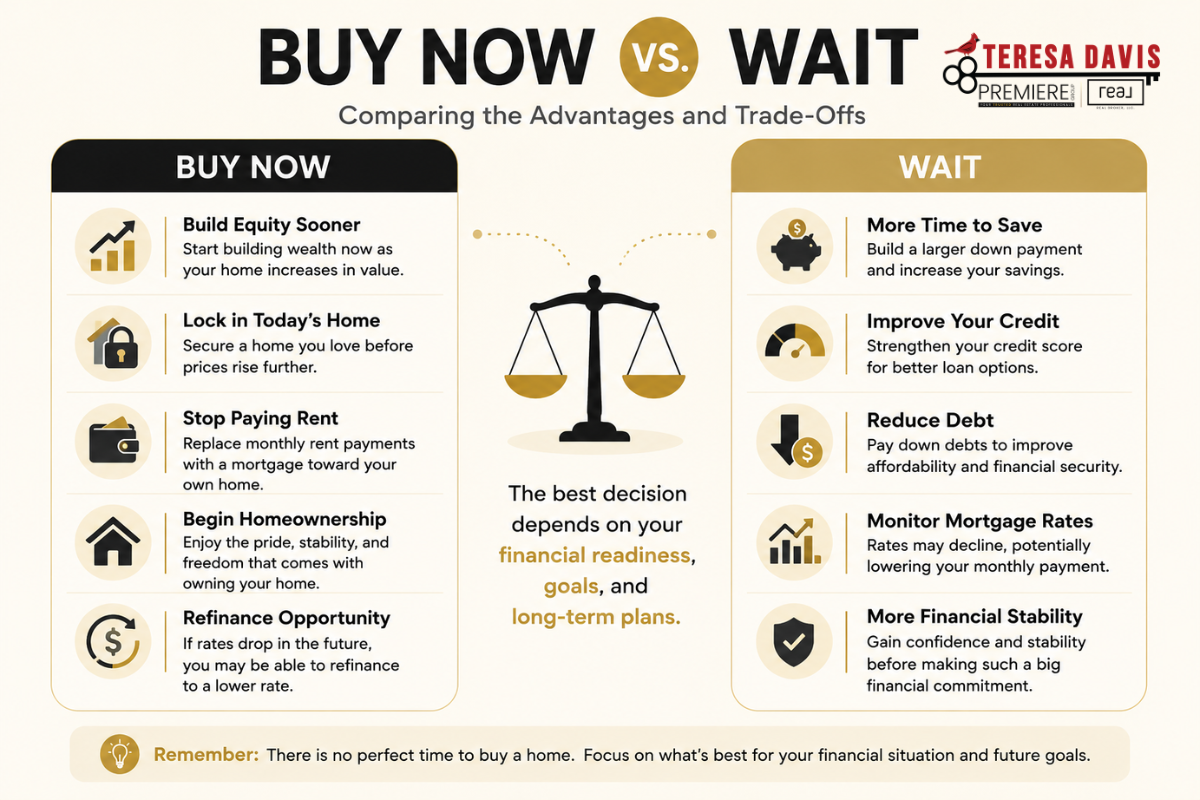
How a REALTOR® Can Help You Evaluate Whether Buying Now Makes Sense
Deciding whether you are personally ready to buy is only one part of the timing decision. You also need to understand what your budget can realistically purchase in the market where you want to live. That is where working with a knowledgeable REALTOR® can add important context.
General housing headlines may describe national, statewide, or regional conditions, but they do not tell you what is happening with the specific homes you would consider. Market conditions can vary by community, price range, property type, condition, and even from one neighborhood or search area to another.
A REALTOR® can help you evaluate factors such as:
- the homes currently available within your realistic price range;
- recent comparable sales for properties you are considering;
- how long relevant properties have been available;
- current competing listings;
- property condition and how it compares with nearby alternatives;
- whether a home's asking price appears reasonably supported by available market information;
- the level of buyer competition surrounding a particular property;
- possible negotiating opportunities;
- and the compromises that may come with different price points, locations, property types, or conditions.
This information can help turn the broad question “Is now a good time to buy?” into a much more useful question: “Do the homes and opportunities available to me right now make sense for my needs and budget?”
A REALTOR® can also help you avoid making a decision based primarily on pressure or fear. For example, you should not feel that you must purchase a home simply because someone tells you prices may rise, inventory may disappear, or you may “miss your chance.” Future market conditions cannot be guaranteed.
Likewise, deciding to wait solely because you assume prices will fall or more homes will become available is also based on an uncertain future outcome. The goal is to evaluate the information that exists today and determine whether an individual property represents a reasonable opportunity for you.
When you are considering a specific home, a REALTOR® can help you look beyond the asking price and evaluate relevant comparable sales and market activity. That can help you make a more informed offer and reduce the risk of making a decision based primarily on emotion or competition.
Your REALTOR® should help you understand the real estate side of the decision. Your lender or loan originator should help you understand your financing options and qualification. Those professional roles work together, but they address different parts of the homebuying decision.
Teresa’s Professional Insight
One of the most common questions first-time buyers ask is, “Is now a good time to buy?” I believe a more useful starting point is, “Would buying now make sense for you?”
The housing market matters, but your personal circumstances matter just as much. I would rather see a buyer purchase a home because the payment is comfortable, the property fits their needs, their savings remain in a reasonable position, and the decision supports their plans than because they feel pressured by a headline or prediction.
I also would not want a buyer to automatically put homeownership on hold simply because market conditions are not perfect. Perfect conditions may never arrive, and different parts of the market can move in different directions at the same time.
As a REALTOR® / Professional Real Estate Advisor with PREMIERE Group of Real Broker LLC, I can help you understand the homes available within your budget, review comparable sales, evaluate local market activity, and look carefully at the property you are considering.
I am also a Loan Originator with One Real Mortgage, NMLS #2597433. In that separate professional role, I can help you explore financing information and better understand how potential loan scenarios may relate to your homebuying plans.
The purpose is not to tell you that you should buy simply because you are able to qualify. It is to help you gather the information you need to decide whether buying fits your finances, housing needs, available options, and timing.
Helpful Tip
Create a simple three-column decision list:
1. Reasons to Buy Now
Write down the specific reasons buying currently makes sense for you.
Examples might include:
- your finances feel reasonably stable;
- the expected housing costs fit comfortably within your budget;
- you have savings beyond the money needed for the purchase;
- your current housing no longer meets your needs;
- your plans are reasonably stable;
- and homes you would genuinely consider are available within your price range.
2. Reasons to Wait
Identify the specific circumstances that may make waiting more appropriate.
Examples might include:
- you want to build additional savings;
- you need to reduce a financial obligation;
- your employment or income situation is changing;
- you expect to relocate;
- your housing needs may change soon;
- or the homes currently available do not reasonably meet your needs and budget.
3. What Would Need to Change?
This may be the most useful column.
Instead of simply writing “wait,” identify the specific condition that would cause you to reassess.
For example:
- reach a particular savings goal;
- reduce a specific debt;
- gain greater income or employment stability;
- determine a comfortable monthly housing budget;
- resolve an anticipated relocation;
- or better understand what type of home fits your needs.
A defined goal turns waiting into preparation and gives you something concrete to evaluate later.
Keep in Mind
No REALTOR®, lender, economist, website, news report, or housing forecast can identify a universally perfect date for you to buy a home.
Housing conditions can change.
Home prices can change. Inventory can change. Buyer competition can change. Mortgage rates can change.
Your circumstances can change too.
Your income, employment, savings, debts, financing options, housing needs, future plans, and the homes available within your budget may all look different several months from now.
That uncertainty is why this decision should not depend on predicting exactly what happens next.
Instead, focus on what you can evaluate:
- whether you are financially prepared;
- whether the expected costs are comfortable;
- whether you will retain appropriate financial flexibility;
- whether homeownership fits your current and foreseeable needs;
- whether suitable homes are available;
- and whether a particular purchase makes sense based on the information available today.
Mortgage rates are one part of that evaluation, but they should not take over this broader decision. If you are otherwise prepared to buy and your primary concern is whether you should wait specifically because you expect mortgage rates to decline, the next Academy lesson addresses that question separately.
This lesson provides general homebuyer education and is not individualized financial, legal, tax, or investment advice. Your circumstances, financing options, property choices, and professional guidance should be considered before making a purchase decision.
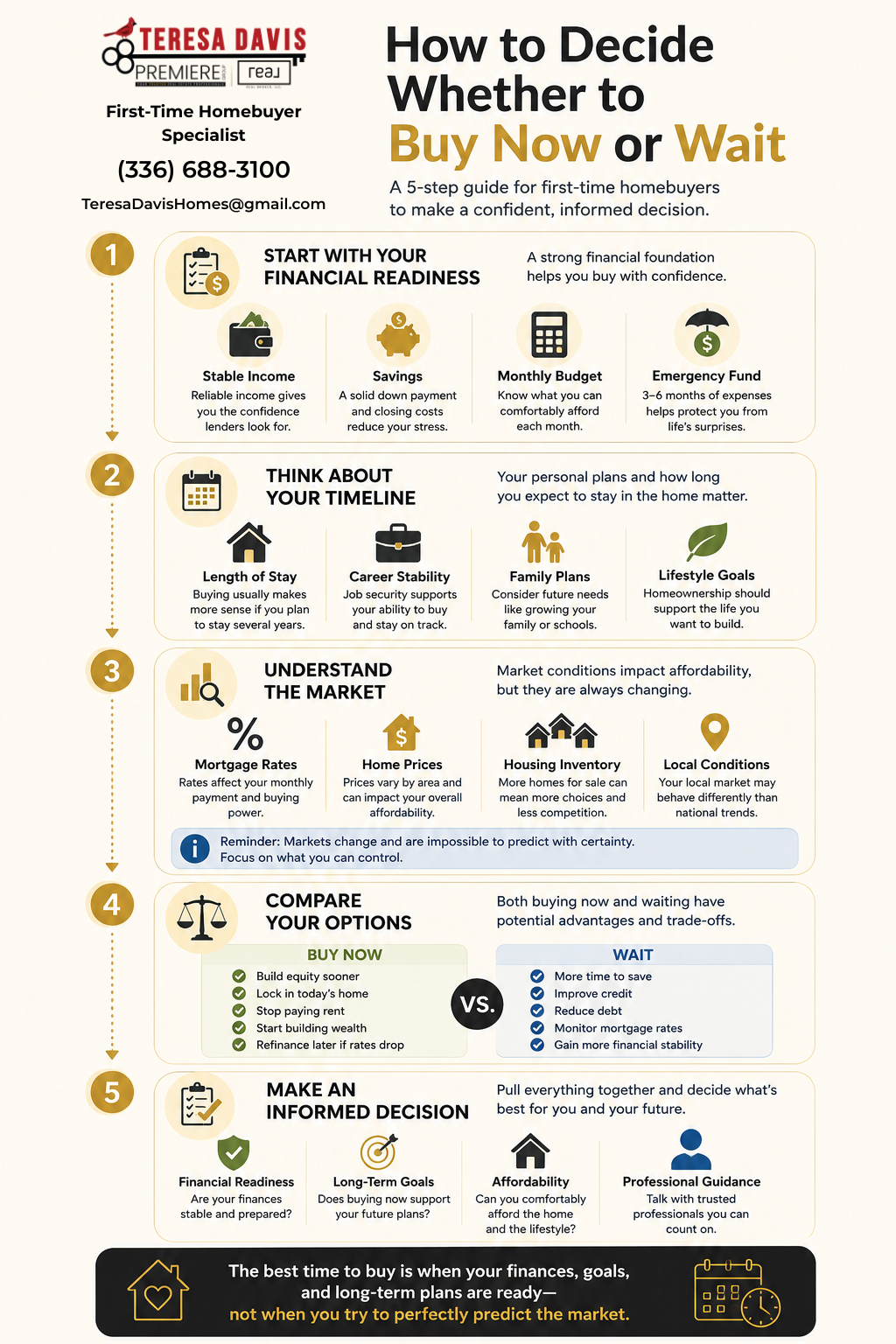
Frequently Asked Questions
How do I know if now is the right time for me to buy a house?
There is no single market condition that determines whether now is the right time for you to buy. Consider your financial preparedness, income and employment stability, comfortable monthly affordability, available savings, current housing needs, foreseeable plans, and whether suitable homes are available within your realistic budget.
Buying now may deserve serious consideration when those factors work together in a way that supports homeownership. Waiting may make more sense when buying would stretch your finances, reduce needed financial flexibility, conflict with an anticipated move or major change, or require you to purchase a home that does not reasonably fit your needs.
The goal is not to identify a perfect housing market. It is to determine whether buying under the circumstances available to you now makes sense for your situation.
Should I wait if I would not have much money left after buying the home?
It may be worth reconsidering the timing if completing the purchase would leave you with very limited financial flexibility.
Owning a home can involve maintenance, repairs, moving expenses, household purchases, and unexpected costs in addition to the expenses required to complete the transaction. The amount of savings that is appropriate after closing varies by buyer, property, financing, and individual circumstances, so there is no universal reserve amount that applies to everyone.
If buying now would require using most of the money you depend on for emergencies or other important needs, building additional savings before purchasing may be a productive reason to wait and reassess.
Should I buy a house if I may move again in a few years?
A possible future move should be part of your decision because purchasing and later selling a home can involve transaction expenses, and future market conditions are uncertain.
There is no universal rule that every buyer must own a home for a specific number of years. Instead, consider how likely the move is, whether the home would reasonably fit your needs during the time you expect to own it, how much flexibility you may need, and whether you are comfortable with the costs and uncertainty associated with potentially selling again.
If a significant relocation or other major change is likely in the near future, waiting may deserve consideration. If your plans are reasonably stable and the purchase otherwise makes sense, the possibility of a future move does not automatically mean you should not buy.
Should I wait for home prices to come down before buying?
Future home prices cannot be predicted with certainty. Waiting may result in lower prices in some situations, but prices could also remain similar or increase. Inventory, buyer competition, financing conditions, and your personal circumstances can change at the same time.
Instead of basing your entire decision on an assumption about future prices, evaluate whether homes available today fit your needs, whether the price of a particular property is reasonably supported by relevant market information, and whether the purchase works within your budget and plans.
Waiting can make sense when you have a specific reason to wait, but there is no guarantee that postponing a purchase will result in a lower home price later.
What if I am financially ready but I am worried about current mortgage rates?
Mortgage rates can affect borrowing costs, estimated principal-and-interest payments, and purchasing power, so they are an important part of affordability. However, rates are only one factor in the broader decision about whether buying now makes sense.
If your finances, housing needs, expected ownership timeline, and available home choices otherwise support purchasing, the rate question deserves its own evaluation rather than automatically determining the answer.
The next Academy lesson, Should I wait for mortgage rates to go down before buying?, explains the mortgage-rate timing question in greater detail, including the uncertainty of future rates and the tradeoffs involved in waiting specifically for lower rates.
What Happens Next?
Once you have considered your financial readiness, housing needs, foreseeable plans, and the homes available within your budget, you may feel more confident about whether buying now deserves serious consideration or whether waiting with a specific preparation goal makes more sense.
For many buyers, however, one question remains: “What if I am ready to buy, but mortgage rates might go down?” That is different from the broader decision covered in this lesson.
The next Academy lesson, Should I wait for mortgage rates to go down before buying?, focuses specifically on how mortgage rates affect principal-and-interest payments and affordability, why future mortgage rates cannot be predicted with certainty, and the tradeoffs of postponing a purchase solely because you hope borrowing costs will decline.
It will also help you consider mortgage rates alongside other factors such as home prices, inventory, and buyer competition rather than assuming that a future lower rate would automatically create a better overall buying opportunity.
Ready to Take the Next Step?
You do not have to decide today simply because you are exploring your options. If you are trying to determine whether buying now makes sense, gathering accurate information about your finances, financing possibilities, and the homes available within your budget can help you make a more informed decision without unnecessary pressure.
Contact Teresa Davis
If you would like help understanding the real estate side of your decision—including available homes, comparable sales, property values, local market activity, and how your housing priorities fit the options available to you—I would be glad to help.
Teresa Davis
REALTOR® / Professional Real Estate Advisor
PREMIERE Group of Real Broker LLC
Begin the One Real Mortgage Pre-Approval Process
If you are ready to better understand your individual financing position, estimated purchasing options, and how potential loan scenarios may relate to your homebuying plans, you can begin the One Real Mortgage pre-approval process. Using One Real Mortgage is optional and is not required in order to work with Teresa Davis as your REALTOR®.
Teresa Davis
Loan Originator NMLS #2597433
One Real Mortgage
Pre-approval or loan qualification does not mean you are required to purchase a home or that buying immediately is the right decision for you. Financing availability, qualification, loan terms, and costs depend on individual circumstances and current program requirements. Beginning a pre-approval process does not guarantee financing or require you to purchase a home. It is a practical way to learn more about your potential financing options, estimated payment, and possible next steps.
Ready for the next lesson? Use “Next Question” below to continue to "Should I wait for mortgage rates to go down before buying?".
1:10 - Should I wait for mortgage rates to go down before buying?

Mortgage rates can have a noticeable effect on the cost of financing a home, so it is understandable to wonder whether you should postpone buying until rates come down. A lower mortgage rate can reduce the principal-and-interest portion of a monthly payment for the same loan amount, but waiting for a lower rate involves an important unknown: no one can know with certainty what mortgage rates will be when you are ready to purchase.
The decision becomes more complicated because mortgage rates are not the only thing that may change while you wait. Home prices, available inventory, buyer competition, seller negotiating conditions, and the financing available to you could also be different in the future. A lower future mortgage rate therefore does not automatically mean the overall buying opportunity will be better.
If you may otherwise be ready to purchase, a more practical approach is to evaluate whether a home is comfortably affordable using the financing actually available to you now. That means looking beyond the interest rate alone and considering the estimated payment, loan terms, cash needed, and other housing expenses. You can then compare those known numbers with the uncertainties involved in waiting.
This lesson focuses specifically on whether expected changes in mortgage rates should cause you to delay buying. If your bigger question is whether you are personally, financially, or practically ready to become a homeowner at all, the previous Academy lesson, Should I buy a house now or wait?, addresses that broader decision.
Quick Answer
You do not necessarily need to wait for mortgage rates to go down before buying a home. If you are otherwise ready to purchase, the better question is whether the home and financing available to you today create a payment and overall housing cost that you can comfortably manage.
Waiting may make sense if today's financing does not fit your budget or if the available loan terms do not support a sustainable purchase. However, waiting solely because you expect mortgage rates to fall means making a decision based on something that cannot be predicted with certainty.
While you wait, mortgage rates could change, but so could home prices, inventory, competition, and the financing options available to you. For that reason, compare the complete buying opportunity rather than assuming that a lower future mortgage rate will automatically produce a better financial outcome.
A future refinance may sometimes become an option if rates and your circumstances make it beneficial and you qualify at that time, but refinancing is never guaranteed. It can involve new loan costs, qualification requirements, loan terms, property-value or equity considerations, and future market conditions. You should not buy a home today that is unaffordable based on the assumption that you will be able to refinance later.
At a Glance
- Mortgage rates matter because they affect the principal-and-interest portion of your mortgage payment and the cost of borrowing.
- Future mortgage rates cannot be predicted with certainty, so an expected lower rate should not be treated as a guaranteed future opportunity.
- Evaluate affordability using financing that is actually available to you now rather than assuming a particular future mortgage rate.
- A lower future rate does not automatically mean a better overall purchase because home prices, inventory, competition, and other market conditions may also change.
- If today's payment is not comfortably affordable, waiting can be reasonable. You should not depend on a future rate decrease or refinance to make an unaffordable purchase work.
- If you are otherwise ready and today's numbers work comfortably, consider the complete current buying opportunity instead of making the decision solely around mortgage-rate predictions.
- Refinancing may sometimes be available later, but future qualification, costs, loan terms, equity or property value, and market conditions will determine whether it is possible and worthwhile.
- For the broader question of whether your finances, housing needs, life circumstances, and overall readiness support buying now, refer to Should I buy a house now or wait?
Why Waiting for a Lower Mortgage Rate Can Sound Like a Good Idea
It is easy to understand why a homebuyer might want to wait for mortgage rates to come down. When the interest rate on a mortgage is lower, the principal-and-interest payment is generally lower for the same loan amount and loan term. A lower rate can also reduce the amount of interest paid over time.
That can make waiting seem straightforward: if rates are lower later, perhaps the home will be more affordable. The difficulty is that this comparison assumes everything else will remain the same while only the mortgage rate changes. In the real world, several parts of the buying opportunity can change at the same time.
While you wait for a possible lower mortgage rate:
- the price of the home you want could change;
- the number and type of homes available could change;
- buyer competition could increase or decrease;
- sellers may become more or less willing to negotiate;
- your available loan options and costs could change; and
- the particular home you would have purchased today may no longer be available.
Because those variables can move independently, a lower future mortgage rate does not automatically mean you will have a better overall buying opportunity.
The goal is not to predict which direction each factor will move. The goal is to understand that waiting for a mortgage rate involves more than waiting for one number to change.
Mortgage Rates Matter, but Future Rates Cannot Be Known With Certainty
Mortgage rates change over time. They can move higher, lower, or remain within a relatively narrow range for a period of time.
Economic reports, inflation trends, Federal Reserve policy, bond-market conditions, employment data, investor expectations, and other financial-market factors can influence mortgage pricing. However, knowing that these factors matter does not make future mortgage rates predictable for an individual buyer.
You may see forecasts suggesting that rates could rise or fall. Those forecasts can provide general market context, but they should not be treated as a promise about the rate that will be available when you eventually purchase a home.
There is another important distinction: a national mortgage-rate average is not the same thing as your individual mortgage rate.
The financing available to a particular borrower can depend on factors such as:
- the loan program;
- loan term;
- credit profile;
- down payment or loan-to-value ratio;
- occupancy;
- property type;
- discount points or lender credits;
- rate-lock timing; and
- other underwriting and pricing considerations.
For that reason, the most useful rate for your homebuying decision is not simply the rate you see in a headline. It is the rate and loan terms actually available to you for the financing scenario you are considering.
Do Not Build a Purchase Plan Around a Rate Prediction
Suppose you can afford a particular home today, but you decide to wait because you expect mortgage rates to be lower six months from now. There are several possible outcomes:
- rates could be lower;
- rates could be similar;
- rates could be higher; or
- rates could be lower, but the home price or other costs could be different enough to offset some or all of the payment benefit.
None of those outcomes should be presented as certain. That is why a sound homebuying decision should not depend on statements such as:
- “Rates will definitely be lower next year.”
- “Rates are about to drop.”
- “You should buy before rates go back up.”
- “You should wait because rates are coming down.”
Those statements attempt to turn an uncertain future event into a decision-making fact. A more useful question is: What does buying with the financing available to me now actually look like?
Once you understand that answer, you have a real scenario to evaluate instead of a prediction.
Start With the Financing That Is Actually Available Today
If you are otherwise considering a purchase, begin with the numbers you can evaluate now. That does not mean you should buy simply because financing is available. It means your decision should begin with an actual financing scenario rather than an assumed future rate.
Depending on the property and loan, your housing-cost evaluation may include:
- the purchase price;
- down payment;
- loan amount;
- interest rate;
- loan term;
- principal-and-interest payment;
- mortgage insurance, when applicable;
- estimated property taxes;
- homeowners insurance;
- homeowners association dues, when applicable;
- closing costs;
- lender fees or credits;
- discount points, when applicable; and
- other property- or loan-specific expenses.
This distinction matters because the mortgage interest rate affects only part of the financial picture. For example, a lower rate can reduce principal and interest on the same loan amount, but it does not automatically reduce property taxes, homeowners insurance, HOA dues, maintenance costs, or every other expense associated with owning the property.
That is why buyers should avoid asking only: “What is the rate?”
A more complete set of questions is:
- What is the estimated payment?
- What is included in that payment?
- How much cash will I need?
- What are the loan costs?
- What are the loan terms?
- Is this financing comfortably affordable without depending on future changes?
The Interest Rate and the Monthly Payment Are Connected—but They Are Not the Same Thing
Mortgage-rate discussions often focus heavily on the monthly payment, and for good reason. The interest rate helps determine the principal-and-interest portion of a fixed-rate mortgage payment.
If the loan amount and loan term remain exactly the same, a lower interest rate generally results in a lower principal-and-interest payment. But that comparison can become misleading when buyers assume that a future home purchase will involve the exact same:
- property price;
- loan amount;
- taxes;
- insurance;
- mortgage insurance;
- loan fees;
- seller concessions;
- down payment; and
- market conditions.
A future purchase is rarely a laboratory experiment where every factor remains unchanged except the interest rate. That is why the question is not simply whether a lower rate would be desirable. Of course a buyer would generally prefer a lower borrowing cost when all other terms are equal.
The more important question is: Will waiting for that possible lower rate actually create a better overall buying opportunity?
That answer cannot be known in advance.
Compare the Complete Buying Scenario, Not Just the Mortgage Rate
A useful way to think about the decision is to separate known current information from unknown future assumptions.
Buying With Today's Available Financing
If you are looking at a real property and a current financing option, you may be able to estimate or determine:
- the home's current asking or negotiated price;
- your expected loan amount;
- your available loan program;
- your estimated interest rate and terms;
- your estimated principal-and-interest payment;
- estimated taxes and insurance;
- expected cash needed;
- current seller concessions or negotiating opportunities, if any;
- current inventory; and
- the current competitive environment for that property.
Not every number will be final until the transaction progresses, but you are working with an identifiable home and a financing scenario that exists today.
Waiting for a Possible Lower Rate
A future scenario contains more assumptions. You would need to make assumptions about:
- the future mortgage rate;
- the future price of the type of home you want;
- the future loan amount;
- future property taxes and insurance;
- future inventory;
- future seller negotiating conditions;
- future buyer competition;
- the financing programs and pricing available to you at that time; and
- whether the same type of property will still be available within your desired price range.
The problem with a simple “current rate versus future rate” comparison is that it often changes the rate while pretending all of these other variables will remain frozen. They may not.
A Lower Future Mortgage Rate Does Not Automatically Mean a Lower-Cost Home Purchase
Consider a simplified example. A buyer sees a home that fits the their needs today, but the buyer decides not to pursue it because mortgage rates feel higher than desired. Several months later, mortgage rates may be lower. That sounds like an automatic improvement—but the buyer still has to answer several questions:
- Is a comparable home available?
- What does that home cost now?
- How much would need to be borrowed?
- Has competition changed?
- Are sellers offering the same negotiating opportunities?
- What are the new loan costs and terms?
- What is the total estimated monthly housing expense?
A lower rate could help. But if the purchase price, loan amount, or other costs are higher, part of that benefit could be reduced.
The opposite could also happen. A buyer might wait and later find both favorable financing and a favorable property opportunity. The important lesson is that mortgage-rate movement is only one variable in a future home-purchase equation.
Home Prices Can Change While You Wait
If you postpone buying solely because of mortgage rates, the price of the home you eventually purchase may not be the same as the price available today. Prices can:
- rise;
- fall;
- remain relatively stable; or
- behave differently depending on location, price range, property type, and local supply and demand.
For buyers in Davidson, Randolph, Guilford, Forsyth, and surrounding North Carolina counties, market conditions can also differ from one community or price point to another. This is why broad statements such as “prices will rise if rates fall” or “prices will drop if rates stay high” should not be treated as guarantees.
Instead, current local market information can help you understand what is happening now, while future pricing should remain an uncertainty in the rate-waiting calculation.
Inventory Can Change While You Wait
Mortgage rates do not determine which homes will be available when you decide to buy. The number of homes for sale, the types of properties available, their condition, locations, features, and price ranges can all change over time.
A buyer waiting for a lower mortgage rate could later have:
- more choices;
- fewer choices; or
- simply different choices.
This matters because the goal is not merely to obtain a mortgage. The goal is to find a property that works for your needs and finances. If a suitable property is available today, that current opportunity has value that should be evaluated alongside the financing—not ignored solely because you hope a future rate might be lower.
Likewise, if today's available homes do not meet your needs or budget, there is no reason to force a purchase simply because you are concerned that rates might change later. The focus is not “buy now” or “wait.” It is evaluate the complete opportunity that actually exists.
Buyer Competition May Be Different if Rates Change
Another variable is buyer demand. When financing conditions become more attractive, some buyers who previously delayed purchasing may return to the market. In some circumstances, that could increase competition for certain homes.
But that should not be presented as an automatic consequence of falling rates. Competition depends on many factors, including:
- available inventory;
- price range;
- location;
- property condition;
- seasonality;
- local buyer demand;
- broader economic conditions; and
- seller pricing.
A buyer should therefore avoid assuming either: “If I wait, I will definitely face more competition.” or: “If I wait, buying will definitely become easier.” Both are predictions.
The proper takeaway is simpler: The competitive environment you encounter in the future may not be the same one you see today. That uncertainty belongs in your comparison when deciding whether waiting solely for a lower mortgage rate makes sense.
When Waiting Because of Mortgage Rates May Be Reasonable
The purpose of this lesson is not to suggest that every buyer should move forward regardless of current mortgage rates. Sometimes waiting is a reasonable choice.
The important distinction is why you are waiting. If the financing available today would create a payment that is too high for your comfort level or would leave too little room in your budget for other priorities and unexpected expenses, postponing a purchase may be appropriate.
Waiting may also make sense when:
- the available financing does not support a sustainable monthly payment;
- the amount you would need to borrow is more than you are comfortable carrying;
- current loan costs or terms do not work well for your situation;
- you need additional time to strengthen the financial factors that affect your financing options; or
- purchasing today would require you to depend on a future refinance to make the payment manageable.
Those are different circumstances from saying: “I can comfortably afford the purchase now, but I am waiting only because I believe mortgage rates will be lower later.”
The first situation is primarily about current affordability. The second is primarily about trying to time mortgage rates. That distinction is important.
Do Not Stretch Your Budget Because You Expect to Refinance
One of the most important safeguards in a rate-focused homebuying decision is this: A home should be affordable based on the financing you are accepting today—not based on the hope that you can replace that financing later.
If the current mortgage payment would place too much pressure on your budget, an expected future refinance should not be used to justify the purchase. Mortgage rates may decline later, but they may not decline when you expect or by the amount you hope.
Even if market rates fall, refinancing will depend on the circumstances that exist at that future time. A sustainable purchase should therefore work without requiring a future event that has not happened yet.
If Today's Numbers Work, Waiting Solely for a Lower Rate Becomes a Different Decision
Now consider a different buyer. This buyer may otherwise be prepared to purchase, has reviewed the available financing, and finds that the estimated payment and overall housing expense fit comfortably within the buyer's planned budget.
The buyer is not postponing because the current purchase is unaffordable. The buyer is postponing because: “I think I might get a better mortgage rate later.” That is where the decision becomes less about affordability and more about speculation.
There is nothing wrong with hoping borrowing costs improve. A lower mortgage rate can certainly be beneficial. But a buyer should recognize what is being exchanged for that possibility.
By waiting, the buyer keeps the possibility of obtaining a lower future mortgage rate—but gives up the certainty of today's specific combination of:
- available property;
- current price;
- current financing;
- current inventory;
- current seller circumstances; and
- current competitive environment.
Neither choice is automatically right. The key is to understand that waiting has tradeoffs just as buying has tradeoffs.
Ask Whether You Are Waiting for Affordability or Waiting for a Prediction
This is one of the simplest ways to clarify the decision. Ask yourself: “Would I still want to wait if I knew mortgage rates were going to stay about the same for a while?”
If the answer is yes because the payment is too high, the available loan terms do not work, or the current purchase does not fit your finances, then waiting may be based on affordability.
If the answer is no—and the only reason you are delaying is your belief that a lower rate is just around the corner—then your decision is depending more heavily on a rate prediction.
That does not mean you must buy. It means you should understand what assumption is driving the decision. Being clear about that assumption makes it easier to compare your choices realistically.
Do Not Confuse “A Lower Rate Would Be Better” With “Waiting Will Be Better”
These statements sound similar, but they are not the same.
A lower mortgage rate, with every other factor unchanged, is generally more favorable to the borrower than a higher mortgage rate on the same loan amount and term.
But: Waiting for a lower mortgage rate does not guarantee a more favorable home-purchase opportunity.
That second conclusion would require knowing what happens to multiple variables between now and the future purchase date.
For example, suppose a future buyer receives a lower mortgage rate but needs to borrow more because the chosen home costs more. The buyer may still benefit from the lower rate, but the final payment difference may not be what the buyer expected when originally deciding to wait. Or perhaps the future home costs about the same, the mortgage rate is lower, and the available property is a strong fit. In that case, waiting may look favorable in hindsight.
Another buyer could experience a completely different outcome. The point is not to create hypothetical examples until one side appears better. The point is that the future purchase scenario is unknown today.
Use Scenario Comparisons Carefully
Mortgage calculators can be useful educational tools, but buyers should understand what the calculation is—and is not—showing them.
For example, you might compare the principal-and-interest payment on the same hypothetical loan amount using two different interest rates. That can show how the interest rate affects the payment when other variables are held constant.
What it cannot tell you is:
- what mortgage rate you will actually qualify for in the future;
- what the future home will cost;
- what your future loan amount will be;
- how much inventory will be available;
- whether competition will be stronger or weaker;
- what future taxes or insurance may be;
- what loan costs or credits will be available; or
- whether your financial circumstances will be the same.
A payment comparison is therefore a scenario, not a forecast. Use it to understand how mortgage financing works—not to prove what your future purchase will cost.
What If Mortgage Rates Drop Soon After You Buy?
This is a common concern. A buyer may worry about purchasing a home and then seeing mortgage rates decline shortly afterward.
That possibility can feel frustrating, but a later rate change does not automatically mean the original purchase decision was a mistake. A homebuying decision should be evaluated based on the circumstances and information available when the decision was made.
At the time of purchase, you may have evaluated:
- the property;
- the negotiated price;
- the financing available to you;
- the estimated payment;
- the cash required;
- the current market;
- your housing goals; and
- whether the purchase worked financially without relying on future changes.
If those factors supported a reasonable decision at the time, a later change in mortgage rates does not erase that analysis. Markets change after virtually every major financial decision.
The goal is not to make a decision that could only be considered correct if nothing changes afterward. The goal is to make a well-informed decision using the information you can actually evaluate.
Could You Refinance Later if Mortgage Rates Fall?
Possibly. Refinancing generally means replacing an existing mortgage with a new mortgage.
If mortgage rates are lower in the future, some homeowners may choose to investigate whether refinancing could reduce their borrowing cost, change their monthly payment, adjust their loan term, or otherwise improve their financing.
However, the important word is may. A future refinance is not guaranteed. At the time you consider refinancing, factors may include:
- the mortgage rates then available;
- your eligibility and qualification for the new loan;
- your credit and financial circumstances;
- the remaining balance on your existing mortgage;
- the property's value;
- your equity position;
- the type and terms of the new loan;
- lender requirements;
- closing costs and other loan expenses; and
- how long you expect to keep the new mortgage.
A lower advertised interest rate by itself does not establish that refinancing is worthwhile. The costs of obtaining the new loan must also be considered.
Refinancing Is a Future Option to Evaluate—Not a Homebuying Strategy to Depend On
There is an important difference between these two statements: “If rates fall later, I can evaluate whether refinancing makes sense and whether I qualify.” and “I can afford this payment because I will refinance when rates fall.”
The first statement recognizes refinancing as a possible future financial decision. The second depends on a future rate movement and a future loan approval that are not guaranteed. The first statement is the better approach. A buyer should be comfortable with the mortgage being accepted today even if refinancing never becomes advantageous or available.
A Lower Rate Does Not Automatically Mean You Should Refinance
Even if mortgage rates decline after you purchase, refinancing should still be evaluated carefully. A homeowner may need to compare:
- the current mortgage;
- the proposed new mortgage;
- the difference in interest rate;
- the difference in monthly payment;
- closing costs;
- points or lender credits;
- changes in loan term;
- the amount of time expected to keep the property or mortgage; and
- other financial consequences of replacing the existing loan.
For example, a lower payment does not always mean the new loan is automatically the better choice if significant costs are required to obtain it or if the loan term changes substantially. The decision depends on the complete refinancing scenario.
This is another reason buyers should avoid reducing the original homebuying decision to: “I will buy now and refinance later.”
The better approach is: “Does this purchase make sense with the mortgage I can obtain today?”
If a beneficial refinancing opportunity becomes available later and you qualify, it can be evaluated at that time.
Should You Buy Before Mortgage Rates Fall?
There is no universal answer. For a buyer who may otherwise be ready, purchasing before a future rate decline may be worth considering when:
- the current mortgage payment is comfortably manageable;
- the loan terms are acceptable;
- the cash required fits the buyer's plan;
- a suitable property is available;
- the purchase does not depend on refinancing later; and
- the primary reason for delaying would be speculation that mortgage rates will soon be lower.
This is not a recommendation to ignore mortgage rates. Rates are an important part of financing and should be evaluated carefully.
It simply means that an otherwise workable home purchase should not automatically be dismissed because the buyer is trying to identify the lowest possible future rate. Perfect market timing is not something a buyer can verify in advance.
Should You Wait if Today's Mortgage Payment Does Not Work?
Yes, waiting can be appropriate when the available financing does not produce a payment you are comfortable carrying.
Buying a home should not require forcing a payment into a budget that cannot reasonably support it. If the current numbers do not work, possible next steps may include:
- considering a different purchase price;
- increasing savings;
- reviewing other financing options for which you may qualify;
- working on financial factors that may affect mortgage pricing or qualification;
- adjusting the planned down payment when appropriate; or
- allowing additional time before purchasing.
Those possibilities should be evaluated based on the buyer's circumstances and available financing. The lesson should not imply that waiting itself guarantees better mortgage rates. Waiting gives the buyer more time. What the financial markets do during that time remains uncertain.
Keep the Broader “Should I Buy Now?” Decision Separate
Mortgage-rate timing is only one part of a larger homebuying decision. If your hesitation involves questions such as:
- whether your income is stable enough;
- whether you have sufficient savings;
- whether you expect to remain in the area;
- whether homeownership fits your current life circumstances;
- whether you are prepared for the responsibilities of owning a home; or
- whether buying fits your broader financial priorities,
Those questions are addressed in the Academy lesson Should I buy a house now or wait?
This lesson addresses the narrower question: If I may otherwise be ready, should I delay specifically because I am waiting for mortgage rates to decline?
Keeping those questions separate helps you solve the right problem instead of using mortgage rates as a stand-in for every concern about buying a home.
A Practical Rate-Focused Decision Framework
When deciding whether to purchase now or wait specifically because of mortgage rates, work through these questions.
1. What financing is actually available to me now?
Review the mortgage options for which you may currently qualify. Look at more than an advertised interest rate.
Consider the loan type, rate, loan term, estimated payment, lender costs, points or credits when applicable, and other relevant financing terms.
2. What would the complete estimated housing cost look like?
Consider more than principal and interest. Depending on the property and financing, your housing expense may also include:
- property taxes;
- homeowners insurance;
- mortgage insurance when applicable;
- HOA dues when applicable; and
- other property-specific expenses.
Question 11 of the Academy will explore the broader costs of buying and owning a home in more detail.
3. Does the payment work without a future refinance?
This is one of the strongest tests.
Ask: “Would I still be comfortable purchasing this home if I kept this mortgage longer than I originally expected?”
If the answer is no because your plan depends on refinancing quickly, reconsider whether the current purchase is financially comfortable.
4. Am I waiting because today's numbers do not work—or because I am predicting lower rates?
These are different reasons for waiting. If today's payment does not work, address the affordability issue.
If today's payment works and the only concern is a predicted rate decrease, recognize that the decision depends on an uncertain future event.
5. What else could change while I wait?
Consider:
- home prices;
- inventory;
- competition;
- seller negotiating conditions;
- available financing;
- the specific homes available; and
- your own future circumstances.
Do not assume those factors will remain unchanged while the mortgage rate improves.
6. What if rates do not decline soon?
Ask yourself whether your decision still makes sense if rates:
- remain near current levels;
- decline more slowly than expected; or
- move higher before moving lower.
A decision that only works under one predicted future scenario may deserve another look.
7. What if rates fall after I purchase?
Recognize that this possibility does not automatically make buying today the wrong decision. If circumstances later support refinancing, you can investigate that option then. But today's purchase should make sense without requiring that future refinance.
The Better Goal Is Not to “Win” the Mortgage-Rate Market
It is natural to want the lowest possible mortgage rate. But homebuying is not simply an exercise in identifying the lowest point on an interest-rate chart. You are making a decision that involves:
- a specific property;
- a purchase price;
- a loan amount;
- financing costs;
- a monthly housing expense;
- available inventory;
- market conditions; and
- your own goals.
The lowest future mortgage rate is unknowable today. A more useful goal is to make a purchase decision that is financially sustainable and well supported by the facts available when you make it.
If today's financing does not work comfortably, you do not need to force the purchase. If today's financing does work and you are otherwise ready, you do not necessarily need to postpone solely because someone predicts that mortgage rates will be lower later.
The decision should be based on affordability and the complete buying opportunity—not on trying to perfectly predict the next move in mortgage rates.
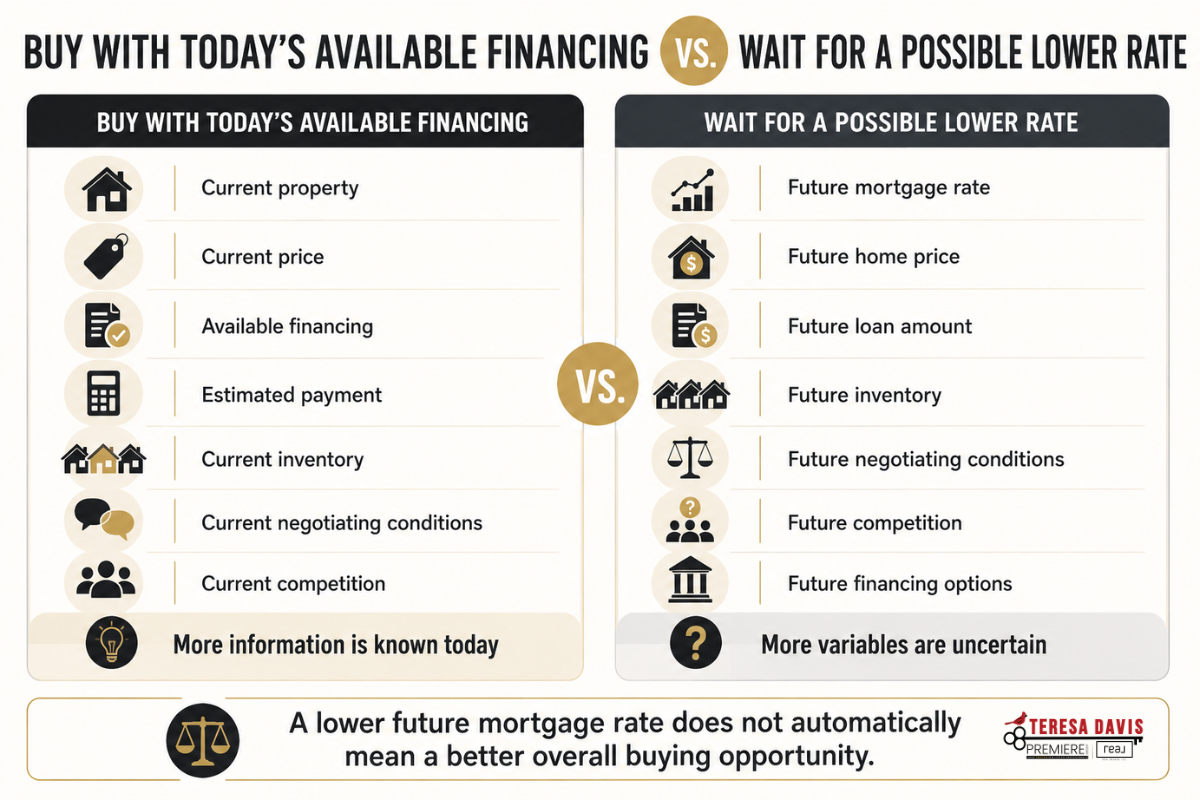
How a REALTOR® Can Help You Evaluate the Market Side of the Decision
A REALTOR® cannot predict where mortgage rates will go, and the decision to buy should not depend on a promise about future rates. What a REALTOR® can do is help you understand the real estate side of the decision using the market information available today.
That may include helping you evaluate:
- the homes currently available within your price range;
- how current asking prices compare with recent sales;
- how long relevant properties have been on the market;
- whether sellers appear to have more or less negotiating flexibility;
- whether seller concessions may be available in a particular transaction;
- the level of buyer competition for the types of homes you are considering;
- property-specific advantages, limitations, and costs; and
- how a particular home fits your goals and planned budget.
This information does not tell you what mortgage rates will be in the future. It gives you something different—and often more useful: a clearer picture of the homebuying opportunity that actually exists today.
For example, if you find a home that fits your needs and budget, your REALTOR® can help you evaluate the property's pricing and market position while your loan professional helps you evaluate the financing available to you.
Together, those two sides of the transaction can help you answer a more complete question: “Does this particular home, at this particular price, with the financing available to me now, make sense for me?” That is much more informative than considering the mortgage rate by itself.
Your REALTOR® and Loan Professional Have Different but Complementary Roles
Mortgage-rate timing sits at the intersection of real estate and financing. Your loan professional can help you understand matters such as:
- the mortgage programs you may qualify for;
- available interest-rate and pricing options;
- estimated principal-and-interest payments;
- mortgage insurance when applicable;
- lender fees;
- discount points or lender credits when applicable;
- estimated cash needed for the financing; and
- how different financing scenarios may affect your payment.
Your REALTOR® can help you understand matters such as:
- property values and comparable sales;
- current inventory;
- asking-price strategy;
- market competition;
- seller negotiating conditions;
- property-specific considerations; and
- the terms of a potential purchase offer.
Neither professional should promise what future mortgage rates, home prices, or market conditions will be. Instead, they can help you evaluate the facts available now so that you can make an informed decision without relying on a prediction.
Teresa’s Professional Insight
One of the questions I hear from buyers is whether they should wait for mortgage rates to come down before purchasing a home. I understand why that question matters. The mortgage rate affects the cost of financing, and even a relatively small rate difference can change the principal-and-interest payment.
But when I help a buyer work through this decision, I do not want the conversation to stop with: “What is today's rate?” I want us to look at the whole picture.
As both a REALTOR® / Professional Real Estate Advisor with PREMIERE Group of Real Broker LLC and a Loan Originator with One Real Mortgage, NMLS #2597433, I can help you look at the real estate opportunity and the financing considerations together.
That may mean asking:
- What type of home are you considering?
- What does that home cost in today's market?
- What financing may currently be available to you?
- What would the estimated payment look like?
- What other housing costs should you consider?
- Does that payment work comfortably without depending on a future refinance?
- What inventory and negotiating conditions exist right now?
- What assumptions would you have to make if you decide to wait?
My goal is not to convince you that buying now is always better or that waiting is always better. It is to help you understand the difference between facts you can evaluate today and assumptions about what might happen later.
If today's numbers do not make sense for you, there is nothing wrong with waiting and continuing to prepare.
If today's numbers do make sense and the right property is available, you may decide that waiting solely for a predicted mortgage-rate decline is not necessary.
Either way, the decision should be based on your actual options—not pressure, headlines, or promises about what mortgage rates will do next.
Helpful Tip
Before deciding to wait for a lower mortgage rate, ask your loan professional to help you review a complete current financing scenario. Do not compare only an advertised interest rate.
Look at:
- the estimated purchase price;
- down payment;
- loan amount;
- available interest rate;
- loan term;
- estimated principal and interest;
- mortgage insurance when applicable;
- estimated property taxes;
- estimated homeowners insurance;
- HOA dues when applicable;
- lender fees;
- discount points or lender credits when applicable;
- estimated cash needed; and
- the overall estimated monthly housing expense.
Then, if you want to explore a hypothetical lower-rate scenario for educational purposes, change the rate while clearly recognizing that the other future variables are unknown. This can help you see how much of your decision is based on today's actual affordability and how much depends on assumptions about the future.
A useful question to ask yourself is: “Would I still be comfortable with this purchase if I kept the mortgage I am accepting today longer than I originally expected?”
If the answer is yes, you know the purchase is not dependent on an immediate future refinance.
If the answer is no, that is an important signal to revisit the affordability of the current financing before moving forward.
Keep in Mind
Mortgage rates are important, but they should not be viewed in isolation. A lower future rate could improve the financing side of a purchase, but the property price, loan amount, inventory, competition, seller negotiating conditions, and your available financing could also be different when that future rate arrives.
Most importantly: Do not make an unaffordable home purchase today based on the assumption that you will refinance into a lower rate later.
Refinancing may sometimes become available in the future, but it is a new mortgage transaction. Whether it is available or beneficial will depend on factors that exist at that time, which may include:
- future mortgage rates;
- qualification requirements;
- your credit and financial circumstances;
- property value and equity;
- the terms of the new loan;
- closing costs and other financing expenses; and
- how long you expect to keep the mortgage or property.
A future refinance should therefore be treated as a possible option to evaluate, not as a guaranteed solution.
Also remember that published mortgage-rate averages and advertised rates provide general market information. They are not guarantees of the rate or terms that will be available to an individual borrower.
If the broader issue is whether you are personally, financially, and practically ready to purchase a home at all, return to the previous Academy lesson, Should I buy a house now or wait?
For this lesson, keep the question narrow: “If I may otherwise be ready to buy, should I delay specifically because I expect mortgage rates to go down?”
That distinction will help you make the decision based on the actual issue you are trying to solve.
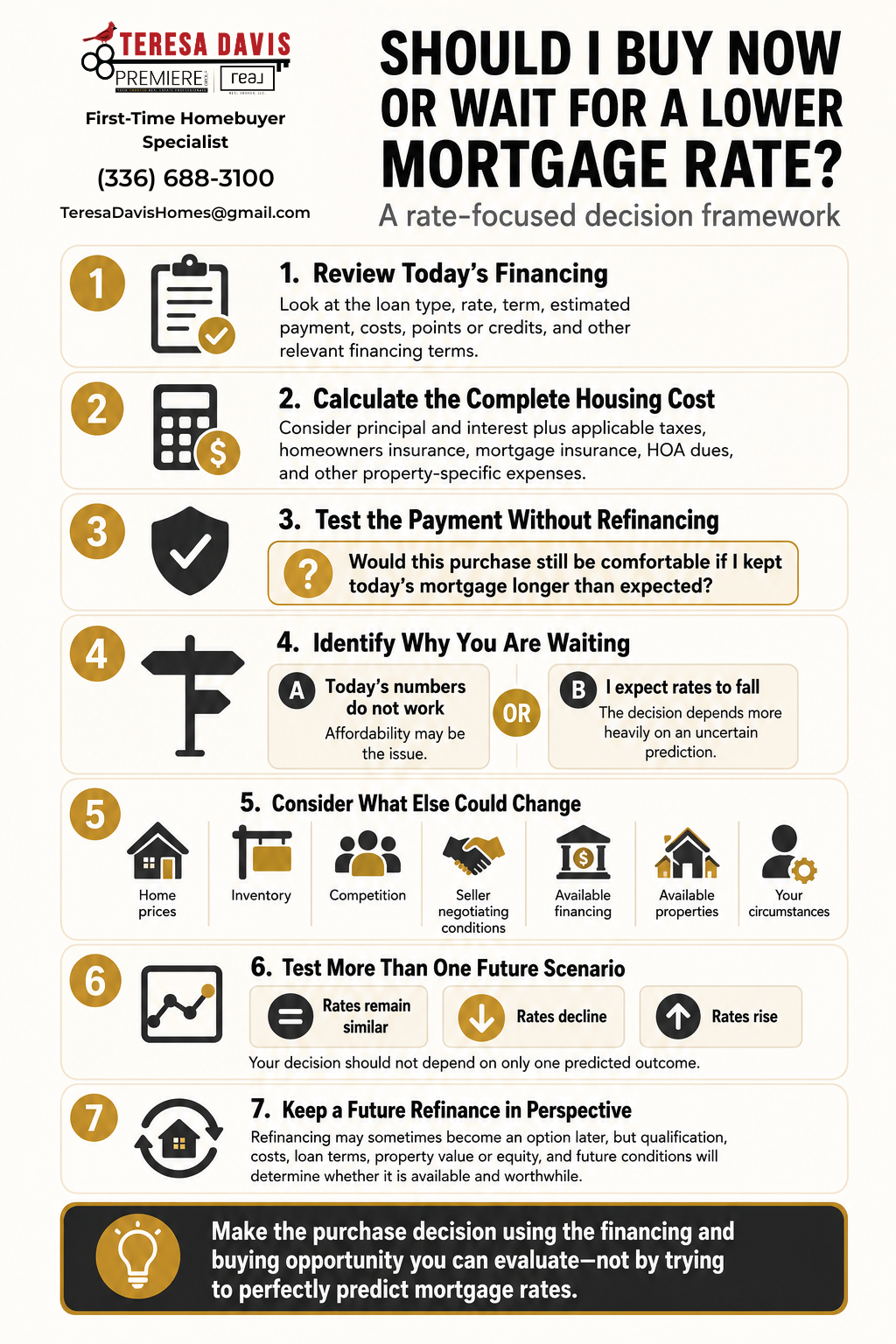
Frequently Asked Questions
Should I wait to buy a house until mortgage rates go down?
Not necessarily. If you may otherwise be ready to buy, start by determining whether the home and financing available to you today create a payment and overall housing cost that you can comfortably manage. Waiting can be reasonable when today's financing does not fit your budget, but waiting solely because you expect mortgage rates to fall means depending on a future rate movement that cannot be predicted with certainty. Home prices, inventory, buyer competition, and available financing may also be different when you eventually purchase.
How much difference can a lower mortgage rate make in my monthly payment?
With the same loan amount and loan term, a lower mortgage rate generally reduces the principal-and-interest portion of the mortgage payment. The actual difference depends on the loan amount, interest rate, term, and financing structure. Your complete housing expense may also include property taxes, homeowners insurance, mortgage insurance when applicable, HOA dues when applicable, and other costs that are not determined solely by the mortgage interest rate.
What if mortgage rates drop right after I buy a home?
A mortgage-rate decline after you purchase does not automatically mean you made the wrong decision. Your original decision should be evaluated based on the property, price, financing, estimated payment, market conditions, and other information available when you purchased. If rates later decline, you may be able to evaluate refinancing, but a future refinance is not guaranteed and should not be required for the original purchase to be affordable.
Can I just refinance if mortgage rates go down later?
Possibly, but you should not assume that refinancing will automatically be available or beneficial. Refinancing is a new mortgage transaction and may depend on future rates, qualification requirements, your credit and financial circumstances, property value and equity, loan terms, closing costs, and other factors that exist at that time. A future refinance should be treated as an option you may evaluate later—not as a guaranteed way to make today's mortgage affordable.
Could home prices or buyer competition increase if mortgage rates fall?
They could, but that outcome is not guaranteed. Home prices, inventory, buyer demand, seller negotiating conditions, and competition can move differently across markets, price ranges, and property types. The important point is that you should not assume everything else will remain unchanged while only the mortgage rate improves. A lower future rate does not automatically mean the complete future buying opportunity will be better.
What Happens Next?
Understanding mortgage-rate timing is only one part of understanding what a home may cost you.
Once you know why a purchase decision should be based on the complete financing and property opportunity rather than a prediction about future mortgage rates, the next step is to identify the expenses that may come with buying and owning a home.
In the next Academy lesson, What costs come with buying and owning a home?, you will learn about costs that may arise before closing, during the transaction, and throughout homeownership. That includes understanding why the mortgage payment is only one part of the financial picture.
Knowing these costs can help you build a more realistic homebuying budget and evaluate affordability with fewer surprises.
Ready to Take the Next Step?
If you are trying to decide whether today's mortgage rates should change your homebuying plans, you do not have to make that decision from headlines or rate predictions alone.
I can help you look at the real estate side of the opportunity while also helping you understand the mortgage considerations that may affect your decision. The goal is not to pressure you to buy now or tell you to wait. It is to help you understand the options that actually exist so you can make an informed decision that feels sustainable for you.
Contact Teresa Davis
If you would like help understanding the real estate side of your decision—including available homes, comparable sales, property values, local market activity, and how your housing priorities fit the options available to you—I would be glad to help.
Teresa Davis
REALTOR® / Professional Real Estate Advisor
PREMIERE Group of Real Broker LLC
Begin the One Real Mortgage Pre-Approval Process
If you are ready to better understand your individual financing position, estimated purchasing options, and how potential loan scenarios may relate to your homebuying plans, you can begin the One Real Mortgage pre-approval process. Using One Real Mortgage is optional and is not required in order to work with Teresa Davis as your REALTOR®.
Teresa Davis
Loan Originator NMLS #2597433
One Real Mortgage
Pre-approval or loan qualification does not mean you are required to purchase a home or that buying immediately is the right decision for you. Financing availability, qualification, loan terms, and costs depend on individual circumstances and current program requirements. Beginning a pre-approval process does not guarantee financing or require you to purchase a home. It is a practical way to learn more about your potential financing options, estimated payment, and possible next steps.
Ready for the next lesson? Use “Next Question” below to continue to "What costs come with buying and owning a home?".
1:11 - What costs come with buying and owning a home?

Buying a home involves more than the purchase price and down payment. As you move through the homebuying process, you may encounter expenses before closing, money needed to complete the purchase, and ongoing costs that continue after you become a homeowner.
Some expenses are connected directly to the transaction, such as inspections, appraisal-related charges, closing costs, prepaid expenses, and other property- or loan-specific items. Others are part of owning the home over time, including property taxes, homeowners insurance, utilities, maintenance, repairs, and association expenses when applicable.
Not every buyer will have the same expenses or pay the same amounts. Your actual costs can depend on the home you purchase, your financing, insurance, contract terms, property location, inspections or evaluations you choose or need, and other transaction-specific circumstances. Understanding the different categories ahead of time can help you create a more realistic homebuying budget and avoid focusing only on the amount of your down payment.
Quick Answer
The costs of buying and owning a home generally fall into three categories: expenses that may arise before closing, money needed at closing, and ongoing expenses after closing.
Before closing, you may have transaction-related expenses or funds associated with inspections, an appraisal, property evaluations, and other steps in the purchase process. At closing, your financial responsibility may include your down payment, applicable closing costs, prepaid expenses, escrow-related amounts, and other transaction-specific charges or adjustments.
After you own the home, your budget may need to account for your mortgage payment, property taxes, homeowners insurance, utilities, maintenance, repairs, and homeowners association or other property-specific expenses when applicable.
The important point is that your down payment is only one part of the overall financial picture. A complete homebuying budget should consider what you may need before closing, what you may need to complete the purchase, and what it will realistically cost to maintain the home afterward.
At a Glance
- The purchase price is not the total cost of buying a home. Your budget may also need to include transaction expenses, closing-related costs, prepaid items, and other property- or financing-specific amounts.
- Some money may be needed before closing. Depending on the transaction, this can include funds or expenses associated with the offer, inspections, appraisal, property evaluations, and other due-diligence activities.
- Your down payment and closing costs are different. Both can affect the amount of money needed to complete the purchase, but they serve different purposes.
- Cash needed to close can include more than closing costs. Down payment, prepaid expenses, escrow-related funds, credits, deposits, and transaction adjustments can all affect the final amount.
- Homeownership creates ongoing expenses. Property taxes, homeowners insurance, utilities, maintenance, repairs, and association expenses when applicable should be considered along with the mortgage payment.
- Some costs are predictable, while others are irregular. Monthly obligations may be easier to estimate, but repairs and major maintenance can occur unexpectedly.
- Not every expense applies to every buyer or property. The actual costs depend on the financing, property, contract terms, insurance, location, and other circumstances.
- A strong homebuying budget looks beyond closing day. Planning for the purchase and for the responsibilities of ownership can help you preserve financial flexibility after you receive the keys.
Start With More Than the Purchase Price
When buyers think about the cost of purchasing a home, the purchase price usually gets most of the attention. But the purchase price is only one part of the financial picture.
A more useful way to prepare is to think about the money connected with the purchase in separate categories. Depending on the transaction, you may need money for a down payment, contract-related funds, inspections or other property evaluations, appraisal-related expenses, closing costs, prepaid expenses, escrow-related amounts, and other items.
Some of these expenses may be paid before closing. Others may appear on your closing documents or affect the total amount you need to complete the purchase. Because the timing and purpose of these costs are different, it is important not to treat every expense as simply a “closing cost.”
The exact combination will vary from one buyer and property to another. Your financing, contract terms, property type, insurance, inspections, negotiated terms, and other circumstances can all affect what you ultimately pay.
Your Down Payment Is One Part of the Purchase
The down payment is the portion of the purchase price that you pay from your own funds rather than finance through the mortgage.
The amount you need or choose to put down depends on your financing and overall financial strategy. Some buyers choose to make a larger down payment, while others may qualify for financing that requires a smaller amount. A larger down payment may affect the amount financed and other aspects of the loan, but using more cash for the down payment also means having less cash available for other expenses.
That is why it is helpful to consider the down payment within your complete homebuying budget rather than viewing it as the only savings goal.
For example, a buyer who has saved a certain amount toward purchasing a home may also need money for inspections, closing-related expenses, prepaid items, moving, initial repairs, or reserves after closing. The best allocation of those funds depends on the buyer’s actual financing, transaction, and financial circumstances.
If you want a deeper explanation of down-payment choices, the Academy’s separate down-payment lessons address those options in more detail. For this lesson, the key point is simple: the down payment is not the same thing as the total amount of money you may need to buy the home.
Money You May Need During the Contract Period
Some expenses or funds may be required before you ever reach the closing table. In a North Carolina purchase, the offer and contract may include a due diligence fee, an earnest money deposit, or both, depending on the negotiated terms of the transaction. These are different from inspection fees, appraisal charges, or other service expenses, and their treatment is governed by the applicable contract.
A buyer may also choose or need to pay for property-related evaluations during the transaction. Depending on the property and circumstances, these can include a general home inspection and additional inspections or evaluations involving items such as the roof, HVAC system, plumbing, electrical system, pests, septic system, well, structural concerns, or other property-specific issues.
Not every property requires every type of evaluation. The appropriate inspections and investigations depend on the home, the buyer’s concerns, professional recommendations, and the terms and timing of the transaction.
If the purchase is being financed, an appraisal may also be required as part of the lender’s process. An appraisal serves a different purpose from a home inspection: the appraisal is generally connected with the lender’s evaluation of the property for the mortgage, while an inspection is primarily intended to help the buyer understand the property’s condition.
These costs can occur before closing, which is one reason buyers should avoid planning as though every dollar they have saved can automatically be reserved for the down payment.
What Are Closing Costs?
Closing costs are expenses associated with obtaining the mortgage, completing the real estate transaction, and transferring ownership of the property. Depending on the transaction, closing-related charges may include lender fees, appraisal-related charges, title-related services, recording charges, settlement or attorney-related expenses, and other loan- or transaction-specific items.
The exact charges vary. A cash purchase will not have the same financing expenses as a mortgage purchase, and two buyers using different loan products or service providers may not have identical costs even when purchasing similarly priced homes.
For that reason, it is better to review the actual estimates and disclosures for your transaction than to rely on a universal percentage found online. When financing a home, your lender will provide disclosures that help you understand estimated and final mortgage-related costs. Review those documents carefully and ask questions when an amount is unclear or changes during the transaction.
Prepaid Expenses and Escrow-Related Amounts
Not everything collected at closing is a fee for obtaining the loan or completing the transaction. Some amounts are prepaid expenses—costs associated with homeownership that are paid in advance. Depending on the transaction and financing, these may include items such as homeowners insurance premiums, property taxes, or prepaid mortgage interest.
If your mortgage includes an escrow account, money may also be collected to establish that account so the servicer can pay certain property-related expenses, such as taxes and insurance, when they become due.
This distinction matters because a buyer may see a sizable amount included in the money needed for closing and assume that the entire amount represents lender or settlement fees. In reality, a portion may be money being collected in advance for future homeownership expenses. Your lender and closing documents should provide transaction-specific information showing how these amounts are categorized.
Closing Costs and Cash to Close Are Not the Same Thing
One of the most useful distinctions for a first-time buyer is the difference between closing costs and cash to close.
Closing costs are the fees and expenses associated with the mortgage and real estate closing. Cash to close is the broader calculation of the money you need to bring to complete the transaction after the applicable amounts, credits, deposits, and adjustments have been accounted for.
Your cash-to-close calculation may be affected by several items, including your down payment, closing costs, prepaid expenses, escrow funding, deposits or other amounts you previously paid, lender credits when applicable, seller credits or concessions when permitted and negotiated, and transaction-specific adjustments.
This is why hearing an estimate of “closing costs” does not necessarily tell you how much money you will ultimately need to complete the purchase. As your transaction progresses, the estimates should become more specific. Rather than relying on an early rule of thumb, review the actual numbers provided for your loan and transaction and ask your lender, real estate professional, or closing professional to explain any item you do not understand.
The goal is not simply to reach closing with enough money. It is to understand where your money is going, why it is needed, and how much financial flexibility you will have left after the purchase is complete.
Your Mortgage Payment May Include More Than Principal and Interest
After closing, one of the largest recurring homeownership expenses is usually the mortgage payment. But the amount you pay each month may include more than repayment of the money you borrowed.
Depending on your loan and escrow arrangement, your mortgage payment may include:
- Principal, which reduces the amount you owe on the loan.
- Interest, which is the cost of borrowing the money.
- Property taxes, when collected through an escrow account.
- Homeowners insurance, when collected through an escrow account.
- Mortgage insurance, when required by the loan or financing arrangement.
- Other loan-specific amounts, when applicable.
Even when taxes and insurance are included in the monthly payment through escrow, they remain separate homeownership expenses. The mortgage servicer is collecting money for those obligations and paying them according to the applicable arrangement.
This is important because buyers sometimes focus only on principal and interest when estimating affordability. A more complete comparison considers the expected total housing payment and the ownership expenses that may be paid separately.
Property Taxes and Homeowners Insurance Can Change
Property taxes and homeowners insurance are important parts of the ongoing cost of owning a home.
Property taxes are generally based on the property, its assessed value, applicable tax rates, and the taxing jurisdictions involved. The amount can change over time as assessments, tax rates, exemptions, property characteristics, or other applicable factors change.
Homeowners insurance premiums can also change. The cost may be influenced by the property, coverage selected, deductible, claims history, insurance market conditions, and other underwriting factors.
If taxes and insurance are paid through an escrow account, a change in either expense may cause the amount collected with the mortgage payment to change. That means a homeowner's monthly payment can change even when the interest rate and principal-and-interest portion of a fixed-rate mortgage have not changed.
When evaluating a home, use current property-specific estimates when available, but recognize that taxes and insurance are ongoing expenses rather than permanently fixed numbers.
Homeowners Association and Other Property-Specific Fees
Some properties have additional recurring expenses that are not part of every home purchase. A home may be subject to:
- homeowners association dues;
- condominium association assessments;
- maintenance-related association charges;
- special assessments when applicable;
- or other property-specific obligations.
Before purchasing a property that is subject to an association, review the available information about the applicable dues and assessments and understand what those payments do—and do not—cover.
An association fee should not automatically be viewed as an additional cost with no corresponding services. Depending on the property and association, certain maintenance, amenities, insurance, or common-area expenses may be included. The important issue is to understand the actual obligation and factor it into the overall ownership budget.
Association expenses can also change over time, so the current amount should not be assumed to remain unchanged indefinitely.
Utilities and Household Services
Utilities are another part of the cost of owning and occupying a home. Depending on the property, your household expenses may include:
- electricity;
- natural gas, propane, or another energy source;
- public water and sewer charges;
- well or septic-related maintenance when applicable;
- trash or recycling service;
- internet;
- lawn or landscaping services;
- pest control;
- security or monitoring services;
- and other property-specific services.
Utility costs can vary considerably based on the home's size, age, construction, energy efficiency, systems, location, weather, rates charged by service providers, and how the household uses the property.
When possible, gathering property-specific information can be more useful than relying on a generic estimate. However, a previous owner's utility history is not a guarantee of what a new owner's expenses will be because household usage can be very different.
Plan for Routine Maintenance
Owning a home also means becoming responsible for routine maintenance that a landlord may have handled when you were renting. Maintenance needs vary by property, but common responsibilities may include:
- servicing heating and cooling systems;
- replacing filters;
- cleaning gutters;
- maintaining exterior surfaces;
- maintaining plumbing fixtures;
- monitoring roofs and drainage;
- caring for landscaping;
- maintaining appliances;
- servicing wells or septic systems when applicable;
- and addressing normal wear before it becomes a larger problem.
Some maintenance costs are small and predictable. Others occur only periodically.
There is no single maintenance percentage that accurately predicts what every homeowner will spend. A newer home with recently replaced systems may have different near-term needs than an older property with aging components. Property size, construction, condition, climate exposure, previous maintenance, and the owner's ability to perform certain tasks can also influence the cost.
A better approach is to learn about the specific property you are buying and create room in your budget for ongoing upkeep.
Repairs and Unexpected Expenses Are Part of Homeownership
Even a well-maintained home can eventually need repairs. Over time, homeowners may face expenses involving:
- heating and cooling equipment;
- plumbing;
- electrical components;
- roofing;
- water heaters;
- appliances;
- exterior materials;
- windows or doors;
- drainage;
- septic or well components when applicable;
- and other systems or features of the property.
A home inspection can help you learn more about the property's visible condition before closing, but it cannot guarantee that nothing will fail after you purchase the home. The purpose of planning for repairs is not to assume something will immediately go wrong. It is to recognize that buildings and mechanical systems require maintenance and eventually wear out.
Keeping some financial flexibility after closing can make it easier to handle future repairs without treating every unexpected expense as a financial emergency.
Required Repairs and Optional Improvements Are Different
First-time buyers may also want to personalize the home after moving in. New flooring, paint, furniture, appliances, landscaping, renovations, and other improvements can quickly add to the amount spent during the first months of ownership.
It helps to separate these expenses into two categories:
- Necessary maintenance or repairs that protect the home, address safety or functionality, or prevent further deterioration.
- Optional improvements or upgrades that reflect personal preferences or long-term plans.
Not every cosmetic change needs to happen immediately. Keeping this distinction in mind can help buyers protect cash reserves after closing and prioritize expenses based on the property's actual needs rather than the excitement of making everything feel finished at once.
Build Your Budget in Three Stages
One of the simplest ways to understand the total cost of buying and owning a home is to organize expenses into three stages.
1. Before Closing
This category may include money connected with:
- negotiated contract deposits or fees;
- inspections;
- specialized property evaluations;
- appraisal-related charges;
- insurance preparation;
- and other transaction-specific expenses.
Some of these amounts may later receive specific treatment within the transaction, while others are payments for services already performed.
2. At Closing
This category may include:
- your down payment;
- closing costs;
- prepaid expenses;
- initial escrow-related amounts;
- transaction adjustments;
- and other amounts needed to complete the purchase.
The final amount depends on the actual loan and transaction.
3. After Closing
This category can include:
- mortgage payments;
- property taxes;
- homeowners insurance;
- mortgage insurance when applicable;
- association expenses when applicable;
- utilities;
- routine maintenance;
- repairs;
- and other property-specific ownership expenses.
Thinking in these three stages helps prevent one common budgeting mistake: preparing enough money to purchase the home without considering the financial responsibilities that begin immediately afterward.
Leave Room in the Budget for Life After Closing
A home purchase should not be evaluated only by asking, “Can I get to the closing table?”
A better question is: “Can I complete the purchase and still have a workable financial plan after I become the homeowner?”
Moving expenses, utility deposits or activation costs, basic household purchases, maintenance, repairs, and other needs can arise soon after closing.
That does not mean every buyer must maintain the same amount of savings. Financial circumstances vary. The principle is simply to consider what money will remain available after the transaction instead of automatically treating every available dollar as money that should be committed to the purchase.
Your Estimates Should Become More Specific as You Move Forward
Early in the homebuying process, many expenses are estimates because you may not yet know:
- which home you will purchase;
- the final purchase price;
- the loan program and terms;
- the property taxes;
- the insurance premium;
- the condition of the property;
- whether an association applies;
- what inspections or evaluations will be appropriate;
- or what terms will ultimately be negotiated.
As the transaction develops, you should receive more property-specific and loan-specific information.
Your lender can provide mortgage disclosures and financing-related figures. Your insurance professional can provide coverage and premium information. Your REALTOR® can help you identify property- and transaction-related questions and coordinate with the appropriate professionals. Closing professionals can explain applicable settlement information within their role.
This allows your budget to evolve from a general planning estimate into a more complete picture based on the actual home and transaction.
Look at the Complete Cost, Not Just One Number
There is no single number that tells you whether a home fits comfortably into your budget.
The purchase price matters.
The down payment matters.
The cash needed to complete the transaction matters.
The monthly housing payment matters.
And the ongoing costs of maintaining and operating the home matter.
Looking at those pieces together gives you a more realistic view of what buying the home could mean financially.
For a first-time buyer, understanding these costs before making a purchase can make the process easier to evaluate and can help reduce financial surprises after closing. The goal is not to predict every future expense perfectly. It is to enter homeownership with a clearer understanding of the responsibilities you are taking on and a plan for managing them.
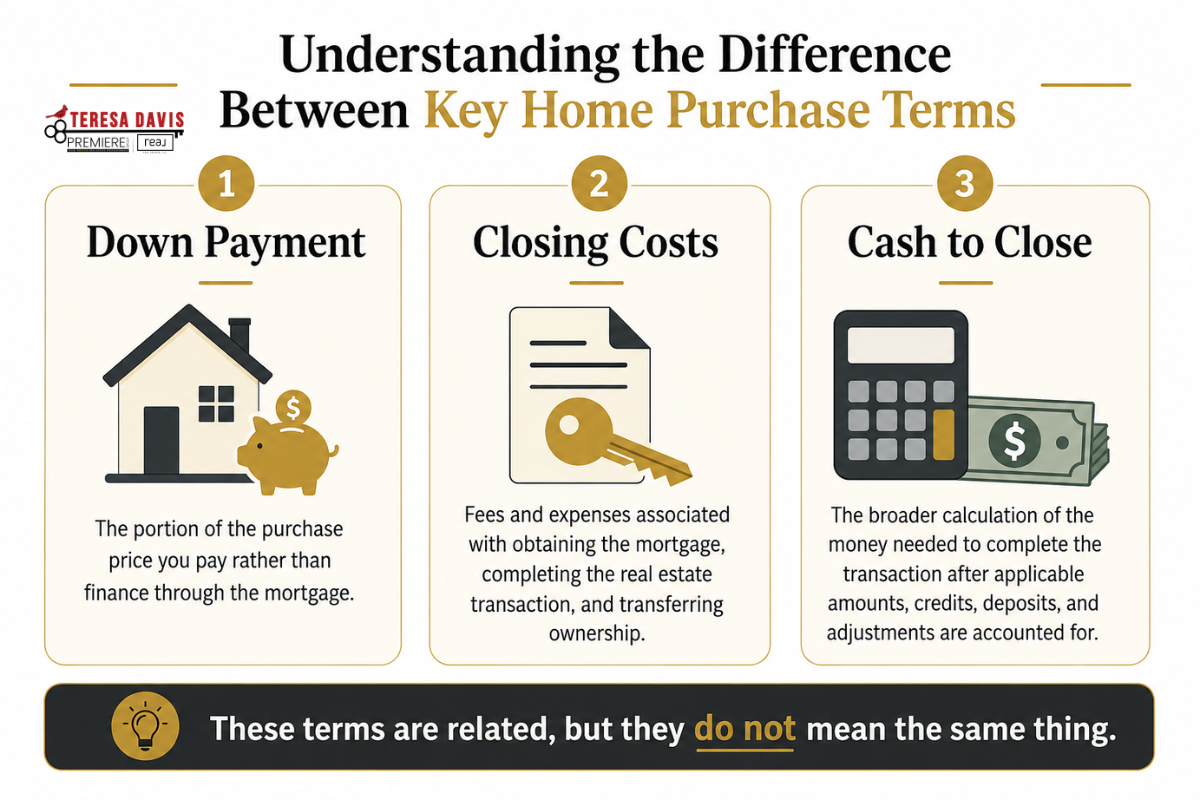
How a REALTOR® Can Help You Prepare for Homebuying Costs
A REALTOR® can help you understand when different property- and transaction-related expenses may arise and help you identify questions to ask before you make financial commitments.
During the homebuying process, your REALTOR® can help you:
- understand when negotiated contract funds may be due;
- plan for inspections and other property evaluations that may be appropriate;
- identify property features that could affect future maintenance or ownership expenses;
- review available information about homeowners association or condominium expenses when applicable;
- recognize property-specific questions that should be investigated before closing;
- coordinate with your lender, inspectors, insurance professional, closing professional, and other specialists involved in the transaction; and
- keep track of important transaction deadlines and steps that may affect when funds or services are needed.
Your REALTOR® is also an important resource for helping you look beyond the asking price when comparing properties.
For example, two homes with similar prices may have different ownership considerations because of their condition, utilities, association obligations, property characteristics, or anticipated maintenance needs. Those differences do not necessarily make one property better than another, but they may affect your overall budget and should be considered before you make a decision.
A REALTOR® should not replace the professionals responsible for providing specialized advice. Your lender is the appropriate source for loan-specific costs and financing requirements. An insurance professional can provide coverage and premium information. Inspectors and other property professionals can evaluate areas within their expertise. Closing and legal professionals can explain matters within their professional roles.
The goal is to bring the right information together so you can make a better-informed decision about both purchasing and owning the property.
Teresa’s Professional Insight
One of the most important budgeting conversations I have with first-time buyers is about looking beyond the amount needed for the down payment. Getting the keys is an exciting milestone, but closing day is not the end of the financial planning. It is the beginning of homeownership.
I encourage buyers to think about their money in three separate stages:
- What might I need before closing?
- What will I need to complete the purchase?
- What do I need to remain financially comfortable after I own the home?
That third question deserves just as much attention as the first two.
If putting additional money toward the purchase would leave you with very little flexibility for moving expenses, maintenance, repairs, utility costs, or other normal needs after closing, that is worth discussing before you decide how to structure your purchase.
There is no single amount of savings that is right for every buyer. The goal is to understand your choices and avoid making a decision based on only one number.
As both a REALTOR® / Professional Real Estate Advisor with the PREMIERE Group of Real Broker LLC and a Loan Originator NMLS #2597433 with One Real Mortgage, I can help you understand how the real estate and financing pieces fit together while keeping the roles of the appropriate professionals clear. Loan qualification, costs, terms, and available options depend on your individual circumstances and the specific transaction.
A well-prepared buyer does not need to know every exact expense months in advance. What matters is knowing which categories to plan for, asking the right questions, and updating the budget as real numbers become available.
Helpful Tip
Create a simple homebuying cost worksheet with three columns:
Before Closing | At Closing | After Closing
As you receive estimates or learn about expenses, place each item into the appropriate column.
For example:
- An inspection would generally go under Before Closing.
- Your down payment and applicable closing-related amounts would generally go under At Closing.
- Utilities, routine maintenance, and future repairs would generally go under After Closing.
Then add one more note beside each item identifying whether it is:
- a one-time expense;
- a recurring expense;
- an amount that may be credited or adjusted within the transaction;
- or an irregular future expense.
This simple exercise can make a complicated list of costs easier to understand and can help you recognize where you still need a more precise estimate.
Keep in Mind
There is no universal dollar amount or percentage that accurately represents the total cost of buying and owning a home for every buyer.
Your actual expenses can vary based on factors such as:
- the purchase price;
- the property itself;
- the condition and type of home;
- your financing;
- insurance coverage and premiums;
- property taxes;
- the inspections or evaluations performed;
- negotiated contract terms;
- lender or seller credits and concessions when applicable and permitted;
- prepaid expenses;
- escrow requirements;
- homeowners association or condominium obligations when applicable;
- utilities;
- maintenance needs; and
- future repairs.
Some amounts that appear at closing are transaction fees. Others may be prepaid future expenses or funds placed into an escrow account. Some money paid earlier in the transaction may also affect the final calculation of the amount needed to close. For those reasons, generic online estimates can be helpful for early planning but should not replace the actual figures for your transaction.
As you move closer to purchasing a specific property, use the information provided by your lender, REALTOR®, insurance professional, inspectors, closing professional, and other appropriate specialists to refine your budget.
This lesson provides general homebuyer education and is not legal, tax, insurance, or individualized financial advice. Your specific obligations, costs, loan terms, and transaction requirements depend on your circumstances and the property you purchase.
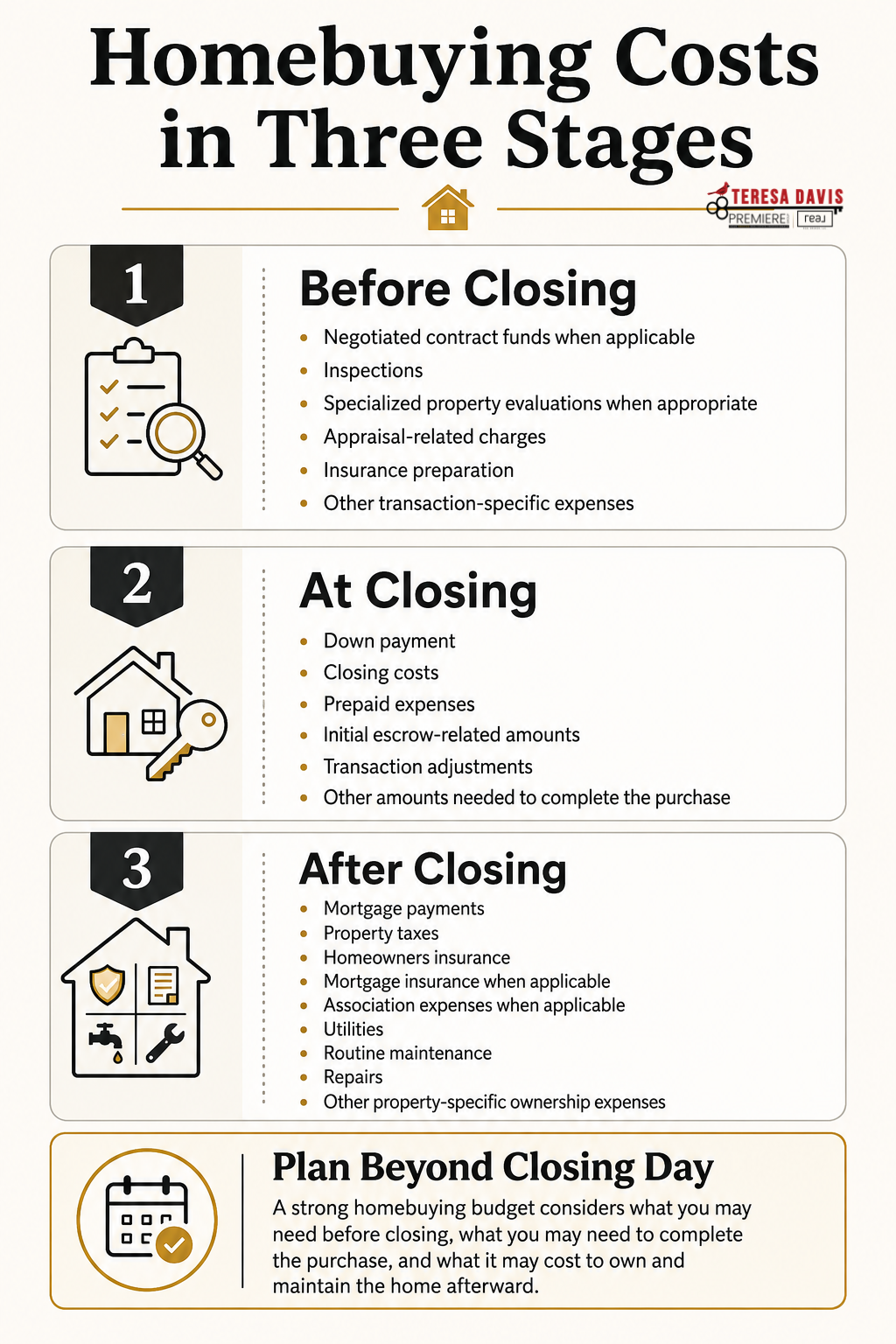
Frequently Asked Questions
Are closing costs separate from my down payment?
Yes. Your down payment and your closing costs are different parts of the home purchase. The down payment is the portion of the purchase price that you pay rather than finance through the mortgage. Closing costs are the fees and expenses associated with obtaining the mortgage, completing the real estate transaction, and transferring ownership.
Both can affect how much money you need to complete the purchase, but they serve different purposes. Your total cash needed to close may also be affected by prepaid expenses, escrow-related amounts, deposits or other funds previously paid, lender credits when applicable, seller credits or concessions when permitted and negotiated, and transaction-specific adjustments. For that reason, an estimate of your closing costs alone does not necessarily tell you the total amount of money you will need to complete the purchase.
What costs might I have to pay before closing?
Depending on the transaction, you may have expenses or funds due before closing. In a North Carolina purchase, this can include a negotiated due diligence fee, an earnest money deposit, or both when included in the contract. Those contract-related funds are different from fees paid to professionals for services.
You may also pay for a general home inspection, specialized inspections or evaluations, appraisal-related expenses, or other property investigations depending on the property, financing, and circumstances. Not every buyer will pay every type of expense. The property, contract, financing, inspections selected, and other transaction details determine which costs apply and when they are due.
Because some of these expenses occur before closing, it is important not to plan as though all available savings can automatically be reserved for the down payment.
What expenses continue after I buy the home?
Homeownership creates expenses that continue after closing. Depending on the property and financing, these may include:
- mortgage principal and interest;
- property taxes;
- homeowners insurance;
- mortgage insurance when applicable;
- homeowners association or condominium expenses when applicable;
- electricity and other utilities;
- water and sewer or private well and septic-related expenses when applicable;
- routine maintenance;
- repairs;
- landscaping or exterior upkeep;
- household services; and
- other property-specific ownership costs.
Some expenses may be included in the amount collected with your mortgage payment through an escrow arrangement, while others are paid separately. You should also plan for irregular expenses. A roof, HVAC system, appliance, plumbing component, or other part of the property may eventually need maintenance, repair, or replacement even when the home has been well cared for.
Are all homebuying and homeownership costs included in my mortgage payment?
No. A mortgage payment does not necessarily include every cost associated with owning the home. Depending on your loan and escrow arrangement, the payment may include principal, interest, property taxes, homeowners insurance, mortgage insurance, and other applicable loan-related amounts.
Other expenses are commonly paid separately. These can include utilities, homeowners association expenses in some situations, maintenance, repairs, landscaping, pest control, internet, private well or septic-related expenses, and other household or property-specific costs.
The exact structure depends on your loan and property. When comparing homes, look beyond the advertised principal-and-interest payment and consider the complete estimated housing payment plus the ownership expenses that will be paid outside the mortgage.
Can some of my closing costs be reduced or paid another way?
Possibly. How particular closing costs are handled depends on the financing, transaction terms, applicable requirements, and what is permitted and negotiated. Depending on the circumstances, a buyer may have access to lender credits, negotiated seller credits or concessions, assistance programs, or other permitted options that affect certain transaction costs.
Those options are not automatic, and they can involve tradeoffs, eligibility requirements, financing limits, property requirements, or other conditions. For example, a lender credit may affect the loan's pricing or terms, and an assistance program may include qualification, occupancy, repayment, forgiveness, or other requirements.
Do not assume that a particular credit or assistance option will be available until it has been evaluated for your actual transaction. Your lender can explain financing-related options and requirements, while your REALTOR® can help you understand how negotiated terms may fit into the purchase offer and transaction.
What Happens Next?
Once you understand that buying a home involves more than the purchase price and down payment, the next step is learning how to organize the process.
You do not need every final cost figured out before you begin. Early estimates are useful for planning, and those numbers can become more specific as you explore financing, choose a property, receive insurance information, complete inspections or evaluations, and move toward closing.
The next Academy lesson, What are the first steps to buying a house?, will help you move from: “What should I financially expect?” to: “What should I actually do first?”
That lesson will help you organize the beginning of the process so you can approach homebuying in a logical order rather than trying to solve every question at once.
Ready to Take the Next Step?
You do not need to memorize every possible homebuying expense before you start. What matters is understanding the major cost categories, knowing which questions to ask, and replacing general estimates with property- and loan-specific information as you move forward.
Contact Teresa Davis
If you are trying to understand how the different costs of buying and owning a home may fit together, I can help you organize the real estate side of the process, identify the questions that need answers, and coordinate with the appropriate professionals as your plans become more specific.
Teresa Davis
REALTOR® / Professional Real Estate Advisor
PREMIERE Group of Real Broker LLC
Begin the One Real Mortgage Pre-Approval Process
If you are ready to explore financing, a pre-approval conversation can help replace generic mortgage assumptions with information based on your actual financial circumstances, available financing, estimated payment, and potential cash needs. Using One Real Mortgage is optional and is not required in order to work with Teresa Davis as your REALTOR®.
Teresa Davis
Loan Originator NMLS #2597433
One Real Mortgage
Mortgage qualification, loan programs, terms, costs, and final approval depend on the borrower, property, transaction, documentation, underwriting, and applicable lending requirements. Beginning a pre-approval process does not guarantee financing or require you to purchase a home. It is a practical way to learn more about your potential financing options, estimated payment, and possible next steps.
Ready for the next lesson? Use “Next Question” below to continue to "What are the first steps to buying a house?"
1:12 - What are the first steps to buying a house?

Buying your first home can feel exciting and overwhelming at the same time. You may be wondering whether you should talk with a lender first, find a REALTOR®, start looking at houses, work on your credit, save more money, or figure out how much you can afford. The good news is that you do not have to understand the entire homebuying process before you begin—and you do not have to figure it out by yourself.
A strong beginning is less about completing one perfect first step and more about getting the right information in the right order. Before you become focused on a particular house, it helps to understand your goals, take an honest look at your finances, explore your financing options, establish professional guidance, and determine what kind of home search makes sense for you.
The Teresa Davis Homebuyer Academy™ gives you detailed information because I want you to feel informed—not because I expect you to become a homebuying expert or handle the process on your own. You are always welcome to ask questions, including questions about something you have already read here. If something does not make sense, you want it explained differently, or you simply want to know what happens next, please ask.
I specialize in working with first-time homebuyers in Davidson County, Randolph County, Guilford County, Forsyth County, and surrounding North Carolina communities. As your REALTOR®, I am willing to spend the time necessary to help you understand the real estate side of the process, talk through your questions, and help you know which professional to turn to when a question involves lending, legal matters, inspections, insurance, taxes, or another specialized area.
You do not need to complete every step in this lesson before contacting me. In fact, one of your first steps can simply be having a conversation with me about where you are now, what you hope to accomplish, and what questions you already have. We can work from there.
Quick Answer
The first steps to buying a house are usually to clarify your homebuying goals, review your finances and savings, understand the costs involved, explore mortgage financing, connect with a REALTOR®, define realistic home-search priorities, and then begin seriously looking at homes.
Those steps do not always happen in exactly the same order. You might speak with me as your REALTOR® before talking with a lender, or you may begin with a financing conversation first. What matters is that your financial picture, real estate strategy, and home search become coordinated before you get too far into shopping for a home.
A practical starting sequence is:
- Clarify why you want to buy and your general timeframe.
- Review your income, recurring debts, credit, savings, and overall budget.
- Understand that buying a home involves more than the down payment.
- Explore mortgage financing and obtain a pre-approval when appropriate.
- Connect with Teresa Davis as your REALTOR® so we can discuss your goals, questions, representation, and home-search strategy.
- Separate your housing needs from your preferences and establish realistic search priorities.
- Begin looking at homes with a clearer understanding of your budget, financing, priorities, and next steps.
You do not have to know all the answers before taking the first step. The purpose of these early conversations is to replace assumptions with useful information and give you professionals you can turn to as questions come up.
At a Glance
- Start with your situation, not a listing. Think about why you want to buy, your expected timing, and what you need from your next home before becoming focused on a particular property.
- Get familiar with your financial picture. Review your income, recurring debts, credit, savings, and the amount you believe you could comfortably devote to housing within your overall budget.
- Plan for more than the down payment. Homebuyers may encounter closing costs, inspections, deposits, moving expenses, ongoing ownership costs, and other expenses depending on the property, financing, and transaction.
- Explore financing before serious shopping. A mortgage professional can help you better understand potential financing, estimated payments, cash requirements, and whether pre-approval is appropriate for your situation. Pre-approval is a planning tool and is not a guarantee of final loan approval.
- Establish REALTOR® guidance early. First-time buyers do not need to wait until they find a house to contact me. As your REALTOR®, I can help you understand the real estate process, organize your search, explain unfamiliar steps, and prepare you for the decisions ahead.
- Define needs, preferences, and boundaries. Knowing what is important, what is flexible, and what fits your financial plan can make the home search more focused and productive.
- Ask questions whenever you have them. You are not expected to memorize the Academy or manage the homebuying process alone. Helping first-time buyers understand what they are doing and why they are doing it is an important part of how I work with my clients.
- Then begin the home search. Once your goals, financing direction, professional guidance, and search priorities are better defined, you can evaluate homes with more context and confidence.
Start With Your Goals Before You Start With Listings
It is easy to think that buying a home begins by searching online for houses. Looking at listings can be useful for learning what is available, but your actual homebuying plan should begin with you.
Before becoming focused on a particular property, spend some time thinking about what you are trying to accomplish. You do not need a perfect five-year plan or a final list of every feature you want. You simply need enough direction to begin making informed decisions.
Some useful questions include:
- Why do I want to buy a home?
- When would I ideally like to move?
- What do I need my next home to provide?
- How long do I reasonably expect this home to meet my needs?
- Are there upcoming changes in my job, household, finances, or location that could affect my timing?
- Which parts of my plan are important, and which parts could change?
Your answers may evolve as you learn more about financing, available homes, property costs, and the local real estate market. That is normal.
The purpose of this step is not to lock yourself into a decision. It is to give you a starting point.
For example, someone hoping to move within the next few months may need a different preparation timeline from someone who hopes to buy next year. A buyer who needs a specific type of property may approach the search differently from someone who has more flexibility. Understanding your circumstances helps the professionals working with you give you more useful guidance.
If you are still trying to determine whether buying a home makes sense for you at all, that is also okay. Earlier lessons in the Teresa Davis Homebuyer Academy™ address questions such as readiness, affordability, renting versus buying, and whether now is the right time to purchase. You do not have to force yourself into the next stage before you are comfortable moving forward.
Review Your Financial Picture
Once you have a general sense of your goals, the next step is to understand your financial starting point.
You do not have to perform your own mortgage underwriting, calculate every lending ratio, or determine exactly how much a lender will approve. That is the lender's job. However, becoming familiar with your own finances can help you have a more productive conversation when you begin exploring financing.
Start by looking at the major pieces of your financial picture, including:
- your household income;
- recurring monthly debt obligations;
- your general credit situation;
- money you currently have saved;
- money you may want to keep in savings rather than use toward a purchase;
- possible down-payment funds;
- expected homebuying expenses; and
- the amount you believe you could comfortably devote to housing within your overall monthly budget.
This is about awareness, not perfection. You may discover that you are more prepared than you expected. You may also discover that there are areas you want to work on before buying. Either result is useful because it gives you information you can use to make a plan.
Your Maximum Approval and Your Comfortable Budget Are Not Always the Same Thing
One important distinction for first-time buyers is the difference between what you may qualify to borrow and what you personally feel comfortable paying each month.
A mortgage qualification is based on lending criteria and the information evaluated for your application. Your personal budget includes considerations that may extend beyond the lender's underwriting calculation.
For example, you may want room in your budget for:
- savings;
- transportation;
- childcare;
- travel;
- hobbies;
- home maintenance;
- future purchases;
- emergency expenses; or
- other personal priorities.
That is why the goal should not simply be to ask, “What is the highest-priced home I can buy?”
A better question is: “What housing payment and overall cost of homeownership fit comfortably within the life I want to maintain?” That answer is personal.
A lender can help you understand financing and qualification. I can help you understand the real estate side of the purchase, what different price ranges may look like in the areas where you are searching, and how property choices can affect the decisions you make. You remain the person who decides what feels financially comfortable for you.
Remember That the Purchase Price Is Only Part of the Cost
Another common first-time-buyer mistake is focusing almost entirely on the home's purchase price or down payment. Buying and owning a home can involve several different categories of expenses. Depending on the property, financing, and transaction, these may include items such as:
- down payment;
- closing costs;
- lender-related expenses;
- inspections;
- due diligence or earnest money deposits when applicable;
- homeowners insurance;
- property taxes;
- moving expenses;
- utility setup;
- immediate repairs or improvements;
- routine maintenance; and
- other ownership expenses.
Not every buyer will have the same costs, and the timing of those expenses can vary. That is why Question 11 of the Academy—What costs come with buying and owning a home?—is an important companion lesson to this one. Understanding the larger cost picture can help you avoid building your entire plan around the down payment alone.
You do not need to calculate all of these expenses by yourself before asking for help. One reason to begin the process early is so the appropriate professionals can help you identify the expenses that may apply to your circumstances.
Online Calculators Can Be a Starting Point, Not the Final Answer
Online mortgage and affordability calculators can be useful for exploring general scenarios. They may help you see how changing a purchase price, down payment, or interest rate can affect an estimated payment.
However, an online calculator does not know your complete financial situation. Depending on the calculator, its estimate may not fully reflect items such as:
- property taxes;
- homeowners insurance;
- mortgage insurance when applicable;
- homeowners association dues;
- loan-specific costs or requirements; or
- other expenses associated with a particular property or financing scenario.
Use calculators as educational tools rather than treating the result as a final homebuying budget or loan decision. When you are ready for more personalized information, a conversation with a qualified mortgage professional can help you move from general estimates to financing information based on your individual circumstances.
Explore Mortgage Financing Before You Become Too Focused on a House
You do not have to know which mortgage program you want before you talk with a lender. In fact, that conversation is partly how you learn what financing possibilities may be worth exploring.
A mortgage professional may ask you for information and documentation related to your income, employment, assets, debts, credit, and other financial circumstances. The exact information needed can vary.
The purpose of the financing conversation is to help answer practical questions such as:
- What purchase range may be realistic?
- What might the estimated monthly payment look like?
- How much cash may be needed?
- What financing options may be available based on my circumstances?
- Are there financial issues I should address before purchasing?
- Am I ready for a pre-approval?
Having these answers before you become emotionally attached to a particular house can make the home search much more useful. Instead of asking whether you can somehow make a specific home work after you find it, you can begin shopping with a clearer understanding of what may fit your financial plan.
What Does Pre-Approval Do?
A mortgage pre-approval can be an important step when you are getting ready to shop seriously for a home. The process generally involves a lender reviewing information about your finances to determine whether you appear to meet requirements for a potential mortgage up to certain parameters, subject to the lender's conditions and additional review.
A pre-approval can help provide a more informed starting point for conversations about:
- purchase price;
- estimated payment;
- financing structure;
- possible cash requirements; and
- the home-search range.
It can also become important when you are ready to make an offer because the seller may want information showing that a financed buyer has taken steps toward obtaining financing.
However, pre-approval is not final loan approval and is not a guarantee that a mortgage will close. Final financing can depend on many factors, including continued borrower qualification, verification of information, underwriting, the property, appraisal when required, title and transaction matters, loan terms, and other applicable requirements.
Your circumstances can also change between pre-approval and closing. That is why it is important to continue communicating with your mortgage professional throughout the transaction and to ask before making significant financial changes while you are preparing to purchase.
You Do Not Have to Choose Between Asking Me and Asking a Lender
First-time buyers sometimes wonder whether they are supposed to contact a REALTOR® first or a lender first. There is no reason to feel stuck on that question.
If you contact me first, we can talk about where you are in the process, what you are hoping to accomplish, and what questions you have. If financing is one of the next areas you need to explore, we can discuss that step and the importance of working with an appropriate mortgage professional.
If you have already spoken with a lender or obtained a pre-approval before contacting me, that is perfectly fine too. We can use the information you have to begin building your real estate strategy.
The important point is that the real estate side and financing side of your purchase should begin working together before you get too far into serious home shopping.
As a REALTOR® who specializes in helping first-time homebuyers in Davidson, Randolph, Guilford, and Forsyth Counties, I do not expect you to arrive with everything figured out. You can contact me while you are still asking basic questions, comparing possibilities, or trying to understand what your first step should be.
My job is not to hand you a list and send you away to complete it by yourself. My role on the real estate side is to help you understand the process, prepare for the decisions ahead, explain unfamiliar steps, and help coordinate the real estate portion of your purchase with the other professionals involved.
If you do not know what to ask yet, that is okay too. Sometimes the first conversation is simply about figuring out which questions we need to answer next.
Connect With Teresa Before You Feel “Ready Enough”
A common mistake first-time buyers make is waiting to contact a REALTOR® until they believe they have completed all of the preparation on their own. You do not need to do that.
You do not have to know exactly what you want, understand every real estate term, have every document organized, or know whether you are completely ready to buy before contacting me.
Part of my work with first-time buyers is helping you determine where you are in the process and what should happen next. If you contact me early, our first conversation can be about questions such as:
- What are you hoping to accomplish?
- What general timeframe are you considering?
- Have you already spoken with a mortgage professional?
- What concerns do you have about buying?
- What parts of the process are confusing?
- What do you think you need in a home?
- Which decisions need to be made now, and which ones can wait?
Sometimes a buyer comes to me with a pre-approval and a detailed list of homes they want to see.
Another buyer may come to me and simply say: “I want to buy a home someday, but I have no idea where to begin.”
Both are appropriate starting points.
I specialize in helping first-time homebuyers in Davidson County, Randolph County, Guilford County, Forsyth County, and surrounding North Carolina communities. I do not expect first-time buyers to know how the process works before we meet. Explaining the process is part of how I help.
Understand Who Is Representing You
Before you move too far into the home search, it is important to understand the role of the real estate professional you are working with and who that professional represents. That conversation should include the services being provided, how representation works, the responsibilities involved, compensation, and any agreements that apply to the relationship.
Do not be afraid to ask questions before signing something you do not understand. Questions may include:
- Who do you represent in this transaction?
- What services will you provide?
- What will you expect from me as a buyer?
- How does your compensation work?
- What does this agreement mean?
- How long does the agreement last?
- Are there circumstances in which the representation could change?
- What should I do if I have questions later?
When I work with you as your REALTOR®, I want you to understand our working relationship rather than simply signing documents because someone tells you they are required. Real estate transactions involve important decisions. You should feel comfortable asking what a document means, why it is being used, and how it affects your responsibilities.
There may also be situations in which another professional—such as a North Carolina real estate attorney—should answer a legal question. When that happens, part of good professional guidance is recognizing the limits of the REALTOR®'s role and directing you to the appropriate professional instead of pretending to provide advice outside that role.
Your REALTOR® and Your Lender Have Different Jobs
Your REALTOR® and mortgage professional may work closely together during your purchase, but they are responsible for different parts of the process.
Your mortgage professional generally helps you understand the financing side, which may include:
- mortgage qualification;
- loan options;
- documentation requirements;
- estimated payments;
- lending costs;
- underwriting requirements; and
- the progress of your mortgage application.
As your REALTOR®, I focus on the real estate side of your purchase, which may include:
- understanding your homebuying goals;
- helping you define a realistic property search;
- identifying and evaluating available properties;
- arranging property showings;
- helping you review relevant property information;
- providing comparable-market context when appropriate;
- helping you prepare and negotiate an offer;
- helping you understand real estate transaction steps and deadlines;
- coordinating with the other professionals involved in the transaction; and
- helping you stay informed as the purchase moves toward closing.
Those roles overlap in communication, but they should not be confused. For example, I can help you understand how the price of a particular home fits into your search strategy, but your mortgage professional determines how that property and purchase price affect your financing.
Likewise, your lender may tell you the maximum amount for which you appear to qualify, but that does not determine which home you should buy or what price you should offer. The strongest process is usually one in which the buyer, REALTOR®, and mortgage professional communicate appropriately while each professional stays within their area of responsibility.
Turn Your Goals Into a Home-Search Plan
Once you have a clearer idea of your financial direction and have established your real estate guidance, you can begin translating your goals into an actual property search. One of the most useful things we can do together is separate what you need from what you prefer. Those categories are different.
A need may be something that directly affects whether the home can reasonably work for you. A preference may be something you would enjoy having but could reconsider for the right property.
For example, depending on your circumstances, your priorities might involve:
- number of bedrooms;
- number of bathrooms;
- property type;
- lot size;
- home condition;
- accessibility considerations;
- space for working from home;
- storage;
- parking;
- commute or travel considerations;
- proximity to places that matter to you;
- maintenance expectations;
- renovation tolerance; or
- other property characteristics.
There is no universal list of what should matter most. Your priorities should reflect your own housing needs, finances, plans, and preferences.
Use Three Categories: Need, Prefer, and Flexible
A simple way to organize your home-search priorities is to divide them into three categories.
1. Need - These are items that are difficult or impractical for you to compromise on.
2. Prefer - These are features that matter to you but may be negotiable depending on the home, price, location, condition, or other advantages.
3. Flexible - These are areas where you are willing to consider several possibilities.
This approach can prevent a home search from becoming unnecessarily narrow. It can also help when two homes require different compromises.
For example, one property may offer more interior space but require more maintenance. Another may have less space but better match another important priority. A third may provide most of your preferred features but be located farther from places you regularly travel.
The goal is not to find a house that wins every category. The goal is to identify a property whose overall combination of price, condition, location, features, and tradeoffs makes sense for you.
Let Your Search Criteria Change as You Learn
Your first search does not have to be your final search. Many buyers learn what matters to them by seeing actual homes. Something you initially considered essential may become less important once you understand the cost or tradeoff involved. Something you did not think much about may become a priority after seeing several properties.
You may also discover that homes within your financial plan look different from what you expected when you were casually browsing online. That does not mean your original plan was wrong. It means you are learning.
Part of my role as your REALTOR® is to help you evaluate what you are seeing and adjust the search when appropriate—not to pressure you to select a property simply because it matches the first list we created.
Be Careful About Falling in Love With a Listing Before You Understand It
Online listings are useful, but they are marketing presentations of properties. Photos, descriptions, and online estimates cannot tell you everything you may need to know about a home.
A property that looks perfect online may feel very different in person. Likewise, a home you might overlook based on one photograph could turn out to fit your priorities surprisingly well.
When we begin evaluating homes, I can help you look beyond the listing presentation and consider questions such as:
- How does this property compare with your priorities?
- Does the price fit the financing plan you have established?
- How does the property compare with relevant market information?
- What information is available about the home's condition or history?
- Are there features or potential concerns that deserve further investigation?
- What questions should we ask before deciding whether to pursue the property?
That does not mean a REALTOR® replaces an inspector, appraiser, attorney, surveyor, contractor, insurance professional, or other specialist. It means I help you recognize when additional information or professional evaluation may be appropriate.
A Showing Is for Learning, Not Just Choosing
When you begin touring homes, every showing does not have to result in a potential offer. Early showings often help buyers understand the market and clarify their own preferences.
You may learn:
- how much space you actually need;
- whether a particular layout works for you;
- which property conditions you are comfortable with;
- whether certain features are worth paying more for;
- what tradeoffs appear within your price range; or
- whether your original search needs to be adjusted.
Those lessons are valuable. I would rather have you ask questions and learn from the homes we see than feel pressured to make a decision simply because we have spent time looking.
Buying a home is a significant decision. The purpose of the search is not to find a house as quickly as possible. It is to help you make a thoughtful decision based on the information available to you.
Do Not Assume You Are Bothering Me by Asking Questions
First-time buyers sometimes apologize for asking questions. You do not need to do that.
- If I use a real estate term you do not understand, ask me what it means.
- If I explain something and it still does not make sense, ask me to explain it differently.
- If you read something in the Teresa Davis Homebuyer Academy™ and want to know how it relates to your situation, ask.
- If you are worried that a question is too basic, ask it anyway.
I created the Academy to give you a strong educational resource, but I never want the amount of information here to send the opposite message and make you think: “Teresa has already explained all of this online, so I probably should not bother her with my questions.”
That is not what I want you to take away from the Academy. The information is here so you can learn at your own pace, return to topics when you need them, and have better conversations with the professionals helping you.
It is not a test. You are not expected to memorize it. You are not expected to complete it before contacting me. And you are not expected to navigate your first home purchase alone.
Then You Are Ready to Begin Shopping With a Plan
Once you have worked through these early steps, your home search becomes more purposeful. You should have a clearer understanding of:
- why you want to buy;
- your approximate timing;
- your financial starting point;
- the broader costs of buying and owning a home;
- your financing direction;
- your relationship with your REALTOR®;
- your housing priorities; and
- the questions that still need to be answered.
You may not have every answer. You do not need every answer. The goal is to have enough information and professional support to move into the next stage intelligently. From there, the process begins to shift from preparing to buy to actively buying. That may include:
- searching for available properties;
- touring homes;
- comparing options;
- researching individual properties;
- evaluating price and market context;
- deciding whether to make an offer;
- negotiating;
- completing inspections and due diligence;
- progressing through financing and appraisal when applicable; and
- preparing for closing.
Each of those stages will introduce new questions, and the Teresa Davis Homebuyer Academy™ will continue walking you through them. You do not need to learn all of those stages today.
For now, your job is simply to begin with a plan, ask questions, and build the right professional support around you. Once you have done that, the next question is usually: How long does it take to buy a house?
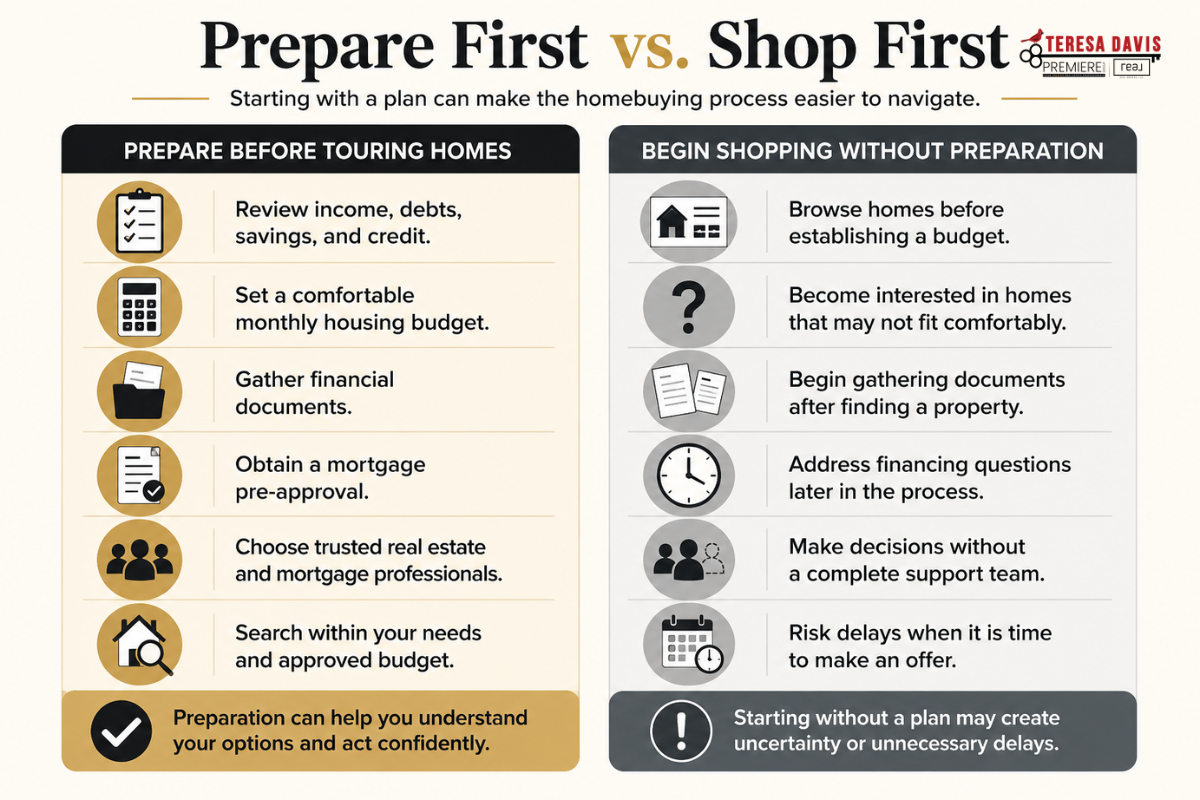
You Don’t Have to Figure Out the Homebuying Process Alone
One of the most important things I want first-time buyers to understand is this: You are not supposed to know how to buy a house before you begin working with me.
There are many steps, unfamiliar terms, documents, deadlines, financial decisions, and professionals involved in a real estate transaction. If this is your first home purchase, much of that may be completely new to you. That is normal.
As your REALTOR®, part of my role is to help you understand the real estate side of the process as we move through it—not simply tell you what to do next. When we work together, I can help you:
- understand the general sequence of the homebuying process;
- identify which steps should come next based on where you are now;
- talk through your homebuying goals and concerns;
- develop realistic property-search criteria;
- understand real estate terminology that may be unfamiliar;
- review property information with you;
- explain the purpose of real estate documents and transaction steps within my professional role;
- discuss comparable-market information when appropriate;
- prepare for showings and property evaluations;
- understand the offer and negotiation process;
- keep track of important real estate dates and responsibilities;
- coordinate with your lender and other professionals involved in the transaction; and
- help you recognize when a question should be directed to an attorney, lender, inspector, appraiser, insurance professional, tax professional, contractor, or another specialist.
I specialize in working with first-time homebuyers throughout Davidson County, Randolph County, Guilford County, Forsyth County, and surrounding North Carolina communities.
That specialization is important because first-time buyers often need something different from someone who has purchased several homes before.
- You may need more explanation.
- You may need to stop and ask why something is happening.
- You may want to talk through a decision more than once.
- You may need a real estate term explained without industry jargon.
- You may want to understand what could happen before deciding what you are comfortable doing.
That does not make you difficult to work with. It means you are learning a process you have never gone through before. When the transaction timeline allows, I am more than willing to spend the time necessary to help you understand what is happening and why.
You Can Contact Me Before You Have Everything Figured Out
You do not have to wait until you:
- know exactly how much house you can afford;
- have selected a mortgage program;
- know which city or community you want;
- have a perfect list of home features;
- understand buyer representation;
- have studied every Academy lesson; or
- feel completely confident about buying.
You can contact me much earlier than that. Sometimes the most valuable first conversation is simply: “Teresa, I think I want to buy a home. What should I do next?” From there, we can identify what you already know, what still needs to be explored, and which professional should help with each part of the process.
If financing is the next question, we can talk about taking that step. If you already have financing direction, we can begin focusing more closely on your real estate plan.
If you are not sure whether you are ready at all, we can start there. The goal is not to rush you into looking at homes. The goal is to help you understand your path forward.
The Academy Is a Resource—Not Homework You Must Finish Before Calling Me
The Teresa Davis Homebuyer Academy™ contains a lot of information intentionally. I want you to have a place where you can learn about the homebuying process on your own schedule, return to topics later, and prepare questions before important conversations.
But I never want you to see all of this information and conclude: “Teresa has already explained everything, so I should not contact her unless I already understand it.” The opposite is true.
The Academy gives us a stronger starting point for conversations. You might read a lesson and understand most of it but still have one question. Ask me.
You might read something that does not seem to match what you are experiencing. Ask me.
You might not understand a term at all. Ask me.
You might understand the explanation but want to know how the issue relates to the particular home you are considering. Ask me.
And if you have not read the related Academy lesson yet, you can still ask me. You do not have to earn the right to ask questions by studying first.
Professional Guidance Also Means Knowing When Another Professional Is Needed
No single professional handles every part of a home purchase. Although I can help you understand and coordinate many aspects of the real estate transaction, there are areas that belong to other professionals.
Depending on the question, you may need guidance from a:
- mortgage professional for lending and qualification matters;
- North Carolina real estate attorney for legal questions;
- licensed home inspector or other qualified specialist for property-condition evaluations;
- appraiser for an independent appraisal when applicable;
- insurance professional for coverage questions;
- tax professional for tax matters;
- surveyor for survey-related matters; or
- contractor or other qualified specialist for repair or improvement questions.
You do not necessarily need to know which professional to call every time. If a question falls outside my role, I can help you recognize that and direct you toward the type of professional who should address it. You are still supported even when the answer needs to come from someone else.
Teresa’s Professional Insight
First-time buyers sometimes believe they should wait to contact me until they are completely prepared. I would rather you contact me before you reach that point.
One of the reasons I created the Teresa Davis Homebuyer Academy™ is because I believe buyers make better decisions when they understand what is happening around them. But education does not mean I expect you to become your own REALTOR®, lender, attorney, inspector, or transaction coordinator. It means I want you to be an informed participant in your own home purchase.
There is an important difference. As a REALTOR® / Professional Real Estate Advisor with PREMIERE Group of Real Broker LLC and a Loan Originator NMLS #2597433 with One Real Mortgage, I understand how closely the real estate and financing sides of a purchase can affect one another.
When I am serving as your REALTOR®, however, I keep the roles clear and help coordinate appropriately with the mortgage professional handling your financing. My specialty is working with first-time buyers, particularly throughout Davidson, Randolph, Guilford, and Forsyth Counties and surrounding North Carolina communities. That means I expect questions.
- I expect that some things may need to be explained more than once.
- I expect your priorities to change as you learn.
- I expect you may occasionally feel unsure about what comes next.
Those are not problems we need to avoid. They are part of the process we work through together.
If you remember only one thing from this lesson, I hope it is this: The first step is not learning how to do everything yourself. The first step is beginning to understand the process and surrounding yourself with professionals who will help you through it. And if you are wondering whether it is too early to contact me, it probably is not.
Helpful Tip
Keep a Running Homebuying Question List
Create a note on your phone, a document, or a small notebook specifically for your homebuying questions. Whenever something comes to mind, write it down. Your list might include questions such as:
- What does this term mean?
- Why do I need this?
- Who handles this part?
- What happens after this?
- When do I need to make this decision?
- Is this something my REALTOR® handles or my lender handles?
- What should I be paying attention to?
- What questions should I ask about this property?
- What happens if something changes?
- Can you explain this another way?
You do not have to decide whether a question is important before writing it down. Bring the list to conversations with me, your lender, your attorney, your inspector, or whichever professional is appropriate for the subject.
This simple habit can make a complicated process feel much more manageable because you are not relying on yourself to remember every question at the exact moment you speak with someone. And when you are working with me as your REALTOR®, please do not worry about asking “too many” questions. Questions help me understand what you need explained so I can better guide you through the process.
Keep in Mind
The first steps in buying a home are important, but they do not always happen in one rigid order.
- You may contact me before talking with a mortgage professional.
- You may already have a pre-approval when we meet.
- You may begin learning about financing and realize you want more time to prepare.
- You may start with one set of home-search priorities and change them after seeing actual properties.
Your path does not have to look exactly like someone else's. What matters is that you gradually build a clearer understanding of:
- your goals;
- your financial direction;
- the costs involved;
- your financing;
- your professional relationships;
- your property priorities; and
- the next decisions in front of you.
Also remember that the Teresa Davis Homebuyer Academy™ is designed to support your education throughout the process. You are not expected to:
- memorize every lesson;
- complete the entire Academy before contacting me;
- understand every real estate document before we discuss it;
- know exactly which questions to ask;
- make important decisions without professional guidance; or
- manage the transaction by yourself.
Mortgage qualification, loan terms, property conditions, legal issues, taxes, insurance, inspections, appraisals, and individual transaction circumstances can vary. The appropriate professional should provide guidance within their area of expertise.
My role as your REALTOR® is to help you navigate the real estate side of the journey, understand the process, coordinate with the other professionals involved, and make sure you have opportunities to ask questions along the way. You do not have to do this alone.
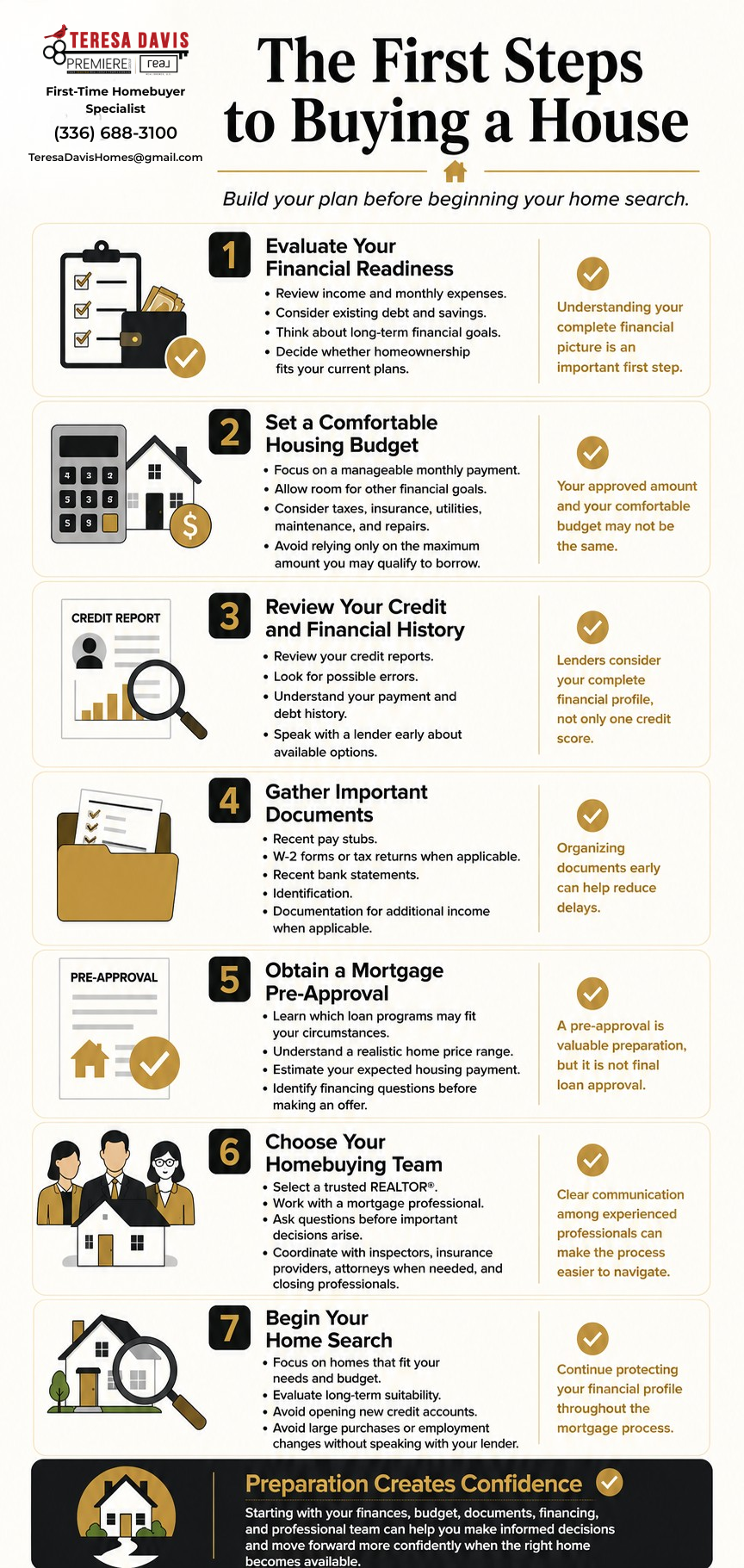
Frequently Asked Questions
What should I do first if I want to buy a house?
Start by getting a clearer picture of your goals, timing, finances, savings, and questions. You do not have to complete every homebuying step before asking for help. You can contact Teresa Davis while you are still trying to understand where to begin.
From there, the early process may include reviewing your financial picture, understanding the costs of buying, exploring mortgage financing, establishing REALTOR® representation, and defining realistic home-search priorities. The exact order can vary. The important point is to begin gathering reliable information before you become too focused on a particular house.
Should I get pre-approved before looking at houses?
A mortgage pre-approval can be very useful before you begin serious home shopping because it can provide a more personalized understanding of potential financing, estimated payment ranges, cash requirements, and the purchase range that may be realistic based on the information reviewed by the lender.
You do not necessarily have to wait until you have a pre-approval to contact Teresa or begin learning about the real estate process. However, having financing direction before you become deeply involved in the home search can help you shop with better information.
A pre-approval is not final loan approval or a guarantee that financing will close. Final approval depends on continued borrower qualification, documentation, underwriting, the property, the transaction, and applicable loan requirements.
Should I contact a REALTOR® or a lender first?
Either can be an appropriate first contact. If you contact Teresa Davis first, you can begin by discussing your goals, questions, expected timing, and where you are in the process. If financing should be one of your next steps, that can then be addressed with an appropriate mortgage professional.
If you speak with a lender first or already have a pre-approval, you can bring that information into your conversation with Teresa so the real estate search can be coordinated with your financing direction. The goal is not to follow one rigid order. It is to make sure the real estate and financing sides of your purchase begin working together before you move too far into serious home shopping.
Do I need to know exactly what kind of house I want before I start?
No. It helps to think about your most important housing needs, preferences, budget boundaries, location considerations, and property characteristics, but those priorities often change as buyers learn more.
You may discover that a feature you originally considered essential is less important once you understand the tradeoff involved. You may also discover that something you had not considered becomes important after seeing several homes.
Teresa can help you organize your priorities into what you need, what you prefer, and where you are flexible so your search can evolve as you learn.
How much money should I save before starting the homebuying process?
There is no single savings amount that is right for every first-time buyer. The amount you may need can depend on your financing, down payment, closing costs, inspections, due diligence or earnest money deposits when applicable, moving expenses, reserves, property-specific expenses, and other transaction or ownership costs.
You also may not want to use every dollar of your savings toward the purchase. Instead of waiting until you believe you have reached a universal savings number, begin learning what expenses may apply to your circumstances. The Academy lesson What costs come with buying and owning a home? provides a more detailed explanation of the cost categories first-time buyers should consider.
What Happens Next?
Once you have begun clarifying your goals, reviewing your financial picture, exploring financing, establishing professional guidance, and defining your home-search priorities, you have completed much of the early preparation that helps turn the idea of buying a home into an actual plan. You do not need every question answered before moving forward.
As you begin looking at homes, new questions will naturally come up. You may refine your priorities, reconsider your budget, learn more about particular properties, or need additional guidance from your REALTOR®, lender, attorney, inspector, insurance professional, or another specialist.
The important thing is that you are no longer trying to navigate the process without a framework or without support. The next Academy lesson answers another question first-time buyers commonly ask once they begin planning: How long does it take to buy a house?
That lesson will explain why the homebuying timeline varies and how preparation, financing, the property search, negotiations, inspections, appraisal, underwriting, and closing can affect how long the overall process takes.
Ready to Take the Next Step?
You do not need to complete every item in this lesson before contacting Teresa Davis. If you are a first-time buyer in Davidson County, Randolph County, Guilford County, Forsyth County, or a surrounding North Carolina community, you are welcome to reach out whether you are ready to begin immediately or are still months away and simply trying to understand the process.
Teresa specializes in working with first-time homebuyers and is willing to spend the time necessary to help explain the real estate process, answer questions, and help you understand what your next step may be. The Academy is here to educate you. It is not meant to make you feel that you have to figure everything out by yourself before asking for help.
Contact Teresa Davis
If you would like to talk through where you are in the process, what you are trying to accomplish, or what questions you have, contact Teresa Davis.
Teresa Davis
REALTOR® / Professional Real Estate Advisor
PREMIERE Group of Real Broker LLC
Begin the One Real Mortgage Pre-Approval Process
If you are ready to explore mortgage financing, the One Real Mortgage pre-approval process can help you begin reviewing potential financing based on your individual circumstances. Using One Real Mortgage is optional and is not required in order to work with Teresa Davis as your REALTOR®.
Teresa Davis
Loan Originator NMLS #2597433
One Real Mortgage
Mortgage qualification, loan programs, terms, costs, and final approval depend on the borrower, property, transaction, documentation, underwriting, and applicable lending requirements. Beginning a pre-approval process does not guarantee financing or require you to purchase a home. It is a practical way to learn more about your potential financing options, estimated payment, and possible next steps.
Ready for the next lesson? Use “Next Question” below to continue to "How long does it take to buy a house?"
1:13 - How long does it take to buy a house?

Buying a house is not a single event. It is a series of stages that may include preparing your finances, obtaining a mortgage pre-approval, searching for the right property, negotiating an offer, completing inspections and other due-diligence investigations, securing final loan approval, and preparing for closing.
The complete process may take several weeks or several months. A buyer who is financially prepared and finds a suitable home quickly may move through the process faster, while another buyer may need additional time to improve credit, save money, compare financing options, or find a property that fits their needs and budget.
The home search is usually the least predictable part of the timeline. Available inventory, price range, location, property condition, financing requirements, and the buyer’s priorities can all affect how quickly a home is found. A buyer may also need to submit more than one offer before reaching an agreement with a seller.
After an offer is accepted, the transaction enters a more structured period. Inspections, due diligence, mortgage processing, underwriting, appraisal, title work, homeowners insurance, closing preparation, funding, and recording must all be coordinated. Because several professionals and third parties are involved, no REALTOR®, lender, attorney, or other participant can guarantee an exact completion date.
Understanding the full timeline can help first-time buyers plan more realistically, meet important deadlines, and avoid making moving arrangements too early. Preparation and prompt communication can reduce preventable delays, but every North Carolina home purchase has its own circumstances.
Quick Answer
It may take several weeks or several months to buy a house from start to finish. The total timeline depends on how prepared you are, how long it takes to find a suitable property, whether your offer is accepted, the type of financing you use, the property’s condition, and whether any issues arise during inspections, appraisal, underwriting, title work, or closing.
The time between an accepted offer and closing is only one part of the process. A financed purchase commonly requires additional time for lender approval and appraisal, while a cash purchase may eliminate some lender-related steps. However, cash buyers may still need time for inspections, title work, attorney coordination, insurance decisions, and other property investigations.
The most reliable approach is to treat every estimated date as a planning target rather than a guarantee. Buyers can help keep the transaction moving by preparing documents early, responding promptly, scheduling inspections quickly, avoiding major financial changes, and staying in close communication with their REALTOR®, lender, closing attorney, and other professionals.
At a Glance
- Financial preparation may take days, weeks, or longer. The timeline depends on your credit, income documentation, available funds, debts, employment, and financing needs.
- The home search has no fixed duration. Some buyers find a suitable home quickly, while others search for several months because of budget, location, inventory, condition, or property requirements.
- An accepted offer begins the more structured transaction period. Contract deadlines, due diligence, inspections, financing, appraisal, title work, insurance, and closing preparation must then be coordinated.
- Financed purchases usually involve more steps than cash purchases. Mortgage processing, underwriting, appraisal, and final loan conditions can add time to the transaction.
- Property-related issues can affect the schedule. Inspection findings, repairs, appraisal concerns, title defects, insurance requirements, wells, septic systems, surveys, homeowners’ association documents, and new-construction completion may require additional time.
- Buyer responsiveness matters. Promptly providing documents, scheduling appointments, reviewing information, and answering professional requests can help prevent avoidable delays.
- The closing date should be treated as a coordinated target. Signing documents does not necessarily mean the purchase is complete until required funds are received and the transaction is properly recorded.
- Moving plans should remain flexible. Avoid scheduling movers, deliveries, contractors, or irreversible lease changes solely because a closing date appears in the contract.
- Every transaction is different. Your REALTOR®, loan originator, closing attorney, inspectors, insurance provider, and other professionals can explain the timing of the responsibilities they handle.
Understanding the Full Homebuying Timeline
When people ask how long it takes to buy a house, they are often thinking only about the period between an accepted offer and closing. That is an important part of the process, but it is not the entire homebuying timeline.
The process usually begins before you tour homes. You may need time to review your finances, gather documents, speak with a loan originator, understand your estimated purchasing power, and decide what type of property fits your needs. After that, you still need to find a suitable home, prepare an offer, negotiate with the seller, complete the requirements of the contract, obtain final loan approval when financing is involved, and prepare for closing.
For planning purposes, it helps to divide the process into two broad phases:
- Preparation and home search: This phase may be relatively short or may continue for several months, depending on your circumstances and the homes available to you.
- Under contract through closing: This phase follows a more structured schedule, but inspections, financing, appraisal, title work, insurance, repairs, and other issues can still affect the closing date.
Neither phase comes with a guaranteed timeline. The overall process is influenced by the buyer, the property, the seller, the financing, the contract, and the professionals coordinating the transaction.
Stage 1: Preparing Financially Before You Shop
Financial preparation can be one of the most important factors affecting your timeline. A buyer who has already organized the necessary information may be able to move forward more efficiently than someone who begins gathering documents after finding a home.
Preparation may include:
- Reviewing your income, debts, assets, and monthly budget.
- Checking your credit and addressing any errors or concerns.
- Gathering recent income and employment documentation.
- Documenting funds available for the down payment, closing expenses, due-diligence expenses, inspections, and reserves.
- Discussing loan options and estimated payments with a qualified loan originator.
- Understanding which property types may be eligible for the financing you are considering.
- Identifying financial changes that should be avoided while preparing to buy.
Some buyers can complete this stage quickly. Others may need more time to build savings, reduce debt, improve credit, establish an acceptable employment history, document self-employment income, or resolve questions about the source of their funds.
Taking additional time to prepare is not necessarily a setback. Addressing financial questions before making an offer may reduce the likelihood of preventable problems during underwriting.
Pre-Approval Is an Important Beginning, Not Final Loan Approval
A mortgage pre-approval can help you understand an estimated price range and demonstrate to sellers that a lender has completed an initial review of your financial information. It may also identify documentation or eligibility issues that should be addressed before you enter into a contract.
However, a pre-approval is not a guarantee that the loan will close. Final approval generally depends on continued verification of the borrower’s financial qualifications, an acceptable property, satisfactory underwriting, completion of lender conditions, and other loan requirements.
Buyers should continue responding promptly to lender requests even after receiving a pre-approval. Updated bank statements, pay information, employment verification, explanations, insurance documentation, and other items may be requested as the transaction progresses.
Stage 2: Searching for the Right Home
The home search is usually the most difficult stage to predict. One buyer may find an appropriate property during the first week of searching, while another may look for several months.
The length of the search may be affected by:
- The buyer’s price range.
- The monthly payment the buyer considers comfortable.
- Available homes in the preferred area.
- Property type, size, condition, and features.
- Financing requirements.
- Competition from other buyers.
- The buyer’s willingness to consider different locations or property characteristics.
- Whether repairs or renovations are acceptable.
- Work, family, travel, or lease obligations that limit the buyer’s schedule.
A narrowly defined search may take longer because fewer homes will satisfy every requirement. A broader search may provide more options, but buyers should not compromise on needs that are essential to their finances, safety, or long-term plans merely to speed up the process.
Available Inventory Can Change the Search Timeline
Buyers cannot control how many suitable properties are listed for sale. In some price ranges or locations, several homes may be available. In others, buyers may need to wait for new listings or reconsider certain preferences.
Inventory may also change from week to week. A search that appears limited at the beginning may improve as new properties enter the market. Conversely, a home that seems promising may go under contract before the buyer is prepared to act.
This is one reason financial preparation matters. A buyer who has already discussed financing, identified a practical budget, and gathered the necessary documents may be better positioned to evaluate a suitable property when it becomes available.
You May Need to Make More Than One Offer
Finding a home you want to purchase does not mean the seller will accept your offer. The seller may reject it, make a counteroffer, select another buyer, or decide not to proceed.
In a competitive situation, a buyer may submit offers on more than one property before successfully entering into a contract. Each attempt can add time to the overall process.
An unsuccessful offer is not necessarily evidence that the buyer handled the situation incorrectly. Price, terms, closing date, financing, requested concessions, contingencies, and the seller’s personal priorities may all influence the seller’s decision.
Stage 3: Preparing and Negotiating an Offer
Once you identify a property, your REALTOR® can help you review available information and prepare an offer based on your goals, financing, the property, and current circumstances. The offer process may involve:
- Reviewing comparable sales and available property information.
- Deciding on the offered price.
- Choosing proposed contract dates.
- Evaluating due-diligence and earnest-money terms.
- Determining whether to request seller-paid expenses or other concessions.
- Considering personal-property requests or exclusions.
- Reviewing financing and appraisal-related concerns.
- Deciding how to address known property issues.
- Signing and submitting the offer.
- Waiting for the seller’s response.
- Reviewing and responding to a counteroffer.
Some negotiations are resolved quickly. Others require several rounds of communication. An offer can also expire, be rejected, or remain unanswered.
Until the buyer and seller reach a complete agreement and the contract becomes effective, the property is not secured for the buyer. The homebuying timeline remains uncertain during this stage.
Faster Negotiation Is Not Always Better Negotiation
Buyers may feel pressure to make immediate decisions, especially when other offers are possible. Prompt action can be important, but the goal is not simply to create the fastest offer.
The buyer should understand the proposed price, dates, funds at risk, due-diligence responsibilities, financing terms, and other material provisions before signing. Questions about the legal meaning or effect of contract language should be directed to a qualified North Carolina real estate attorney.
Stage 4: The More Structured Period Begins After Contract Formation
After the contract becomes effective, the transaction enters a more structured phase. Important dates and responsibilities are established, and multiple parties begin working toward closing. This phase may include:
- Delivering required funds.
- Scheduling inspections and specialized evaluations.
- Completing other property investigations.
- Reviewing inspection findings.
- Negotiating repairs, credits, or other solutions when appropriate.
- Providing updated information to the lender.
- Completing appraisal and underwriting requirements.
- Securing homeowners insurance.
- Completing title work and closing preparation.
- Reviewing final loan and closing information.
- Conducting the final walkthrough.
- Signing closing documents.
- Completing funding and recording requirements.
Although this portion of the transaction is more structured, it is not automatic. Each step depends on timely action, accurate information, professional scheduling, and resolution of any problems that arise.
Due Diligence and Property Investigations
The due-diligence period gives the buyer an opportunity to investigate the property and evaluate whether to continue with the purchase under the terms of the contract. Depending on the property and the buyer’s concerns, investigations may include:
- A general home inspection.
- Termite or other pest inspections.
- Radon testing.
- Well-water testing.
- Septic-system evaluation.
- HVAC, roof, structural, plumbing, electrical, or other specialized evaluations.
- A survey.
- Homeowners’ association or condominium document review.
- Insurance-availability research.
- Permit or repair-history questions.
- Estimates for repairs or improvements.
Not every property requires every type of investigation. The appropriate evaluations depend on the home, its systems, the property type, the buyer’s concerns, and professional recommendations.
Inspection Scheduling Can Affect the Timeline
Inspectors and specialized contractors may have limited availability. Buyers should generally begin scheduling appropriate investigations promptly after entering into a contract rather than waiting until the end of the applicable period.
The inspection itself is only one part of the process. The buyer may also need time to:
- Receive and review the report.
- Ask the inspector questions.
- Obtain specialist opinions.
- Request repair estimates.
- Discuss concerns with the REALTOR®.
- Decide whether to request repairs, financial concessions, or another solution.
- Evaluate the seller’s response.
Significant findings may lengthen the decision-making and negotiation process. Some concerns may also affect financing, appraisal, or insurance.
Inspections Do Not Automatically Require the Seller to Make Repairs
An inspection identifies observed conditions, but it does not automatically obligate the seller to repair every item. Any repair request or negotiated solution depends on the contract, the issue, the buyer’s priorities, the seller’s response, and the remaining timeline.
The buyer should focus on understanding the property and making informed decisions rather than expecting an inspection report to produce a completely repaired home. Legal questions about the buyer’s rights, obligations, deadlines, or available remedies should be directed to a qualified North Carolina real estate attorney.
Mortgage Processing and Underwriting
When a buyer is financing the purchase, mortgage processing and underwriting continue after the contract becomes effective. Even if the buyer received a pre-approval before making an offer, the lender must complete a more detailed review of both the borrower and the property.
The lender may request updated or additional information concerning:
- Income and employment.
- Bank, investment, and retirement accounts.
- Funds needed for closing.
- Deposits or transfers appearing on account statements.
- Existing debts and monthly obligations.
- Credit inquiries or newly opened accounts.
- Gifts or other permitted sources of funds.
- Homeowners insurance.
- The purchase contract and any amendments.
- Property-related documents.
- Explanations for information that requires clarification.
The exact requirements depend on the buyer, the loan program, the lender, and the property. Two buyers purchasing similarly priced homes may have different documentation requirements because their income, employment, assets, credit profiles, and financing structures are different.
Prompt Responses Can Help Prevent Avoidable Delays
A lender request does not necessarily mean something is wrong. Underwriters frequently require additional documentation to confirm that loan guidelines have been satisfied.
Buyers can help keep the process moving by:
- Reading lender requests carefully.
- Providing every requested page of a document.
- Submitting clear and legible copies.
- Explaining unusual deposits or transfers when requested.
- Avoiding incomplete screenshots when formal statements are required.
- Asking questions promptly when a request is unclear.
- Responding as soon as reasonably possible rather than waiting until the deadline.
Submitting only part of a requested item may cause the lender to ask for it again. A complete response is generally more helpful than sending several incomplete pieces over multiple days.
Financial Changes Can Affect the Timeline
The lender may continue monitoring the buyer’s financial qualifications through closing. Changes that appear manageable in everyday life can create additional underwriting questions or affect loan eligibility.
Before making a significant financial change, buyers should consult their loan originator. Examples include:
- Changing jobs or compensation structure.
- Reducing work hours.
- Becoming self-employed.
- Opening or closing credit accounts.
- Financing furniture, appliances, or a vehicle.
- Co-signing a loan.
- Increasing credit-card balances.
- Moving large amounts of money between accounts.
- Depositing cash that cannot be documented.
- Using funds that were intended for closing.
- Missing or paying bills late.
A financial change does not automatically end the transaction, but it may require additional documentation, underwriting review, or a change in the financing plan.
The Appraisal Process
When a mortgage is involved, the lender commonly requires an appraisal to help evaluate the property being used as collateral for the loan. The appraisal is generally ordered through the lender’s process and completed by an independent licensed or certified appraiser. The appraisal timeline may include:
- Ordering the appraisal.
- Assigning an appraiser.
- Scheduling access to the property.
- Inspecting or observing the property as required for the assignment.
- Researching market data.
- Completing the appraisal report.
- Reviewing the report through the lender’s process.
- Addressing any questions, corrections, conditions, or additional requirements.
Scheduling may be affected by appraiser availability, the property’s location, the complexity of the assignment, and the type of financing.
An Appraisal Is Not a Home Inspection
An appraisal and a home inspection serve different purposes.
A home inspection helps the buyer learn more about the property’s visible systems and condition. An appraisal primarily supports the lender’s valuation and collateral review.
An appraiser may identify property conditions that require additional review or correction for certain financing, but the appraisal should not be treated as a substitute for the buyer’s own inspections and due-diligence investigations.
Appraisal Concerns May Add Time
The transaction may require additional work when:
- The appraised value is lower than the contract price.
- Repairs or property conditions must be addressed.
- The lender requests clarification or corrections.
- Comparable sales are limited.
- The property is unusual or complex.
- A completion or final inspection is required.
- The buyer and seller need to renegotiate terms.
A low appraisal does not produce one automatic outcome. The buyer, seller, lender, and applicable contract terms all affect what options may be available. Legal questions about contractual rights or obligations should be directed to a qualified North Carolina real estate attorney.
Homeowners Insurance
Buyers who are obtaining a mortgage generally need acceptable homeowners insurance before closing. Cash buyers should also consider insurance needs as part of their planning. Insurance availability and cost may be affected by:
- The home’s age and condition.
- Roof age or condition.
- Electrical, plumbing, heating, or structural concerns.
- Prior insurance claims associated with the property.
- Location-specific risks.
- The proposed coverage and deductible.
- The insurance company’s underwriting requirements.
Buyers should begin contacting insurance professionals early enough to compare coverage, obtain an acceptable policy, and address property-related questions. Waiting until immediately before closing may create unnecessary pressure, especially if an insurer requests additional information, photographs, inspections, repairs, or documentation.
Title Work and the Closing Attorney
North Carolina real estate transactions commonly involve a closing attorney who coordinates legal and settlement-related responsibilities. The attorney’s work may include examining title, preparing or reviewing closing documents, coordinating required funds, handling applicable payoffs, and completing steps associated with recording the transaction.
The closing attorney represents legal interests according to the attorney-client relationship established for the transaction. A REALTOR® or loan originator cannot provide legal advice or replace the closing attorney’s legal review.
Title Issues Can Affect the Schedule
Title work may uncover matters that require attention before the transaction can be completed, such as:
- Existing mortgages or liens.
- Unreleased prior liens.
- Ownership or estate-related questions.
- Judgments.
- Easements or restrictions.
- Boundary or survey concerns.
- Errors in prior deeds or legal descriptions.
- Homeowners’ association claims.
- Divorce, bankruptcy, probate, or other legal complications.
Many title matters can be resolved, but resolution may require documents, signatures, payments, legal research, or cooperation from people who are not directly involved in the current purchase.
The buyer may have little control over how quickly a title issue is resolved. This is one reason buyers should avoid assuming that the transaction is guaranteed to close on the originally anticipated date.
Surveys and Property Boundaries
A survey is separate from a home inspection and appraisal. It may help identify property boundaries, improvements, encroachments, easements, or other matters affecting the land.
Whether a survey is recommended or required depends on the transaction, property, lender, title insurer, and legal guidance. Scheduling a survey and addressing any resulting concern may add time to the process.
Questions about title, boundaries, easements, legal descriptions, or ownership rights should be directed to the closing attorney or another qualified legal professional.
Property Types That May Require Additional Time
Some purchases involve additional documents, investigations, approvals, or construction requirements.
Homes With Wells or Septic Systems
A buyer may need time to arrange:
- Well-water testing.
- Well inspection.
- Septic-system evaluation.
- Permit research.
- Specialized professional review.
- Repair estimates or additional investigation.
Testing availability, laboratory processing, weather, property access, and contractor schedules may affect timing.
Condominiums and Properties With Homeowners’ Associations
These properties may require review of:
- Association rules and restrictions.
- Financial information.
- Insurance coverage.
- Dues and assessments.
- Resale or disclosure documents.
- Lender eligibility requirements.
- Pending litigation or other association concerns.
Obtaining and reviewing association information may take additional time. Condominium financing can also involve approval requirements beyond the buyer’s personal loan qualifications.
New Construction
A new-construction timeline may be affected by:
- Permits.
- Weather.
- Material availability.
- Labor and subcontractor scheduling.
- Utility connections.
- Inspections.
- Construction changes.
- Completion of agreed work.
- Final lender or appraisal requirements.
- Certificate or occupancy-related requirements.
- Builder scheduling.
An estimated completion date is not always a guaranteed closing date. Buyers should plan cautiously when coordinating leases, movers, furniture deliveries, or the sale of another home.
Land and Unique Properties
Vacant land, manufactured homes, rural properties, mixed-use properties, and homes with unusual features may require specialized financing, surveys, engineering, environmental review, title research, utility investigations, or other property-specific work.
The transaction timeline should reflect the property being purchased rather than relying on a general estimate designed for a typical existing home.
Cash Purchases May Be Faster, but Important Steps Remain
A cash purchase may eliminate mortgage underwriting and a lender-required appraisal. That can reduce the number of parties and requirements involved in the transaction. However, a cash purchase may still include:
- Proof-of-funds documentation.
- Due-diligence investigations.
- Home and specialized inspections.
- Survey work.
- Title examination.
- Closing-attorney coordination.
- Homeowners insurance decisions.
- Repair negotiations.
- Final walkthrough.
- Funding and recording.
The buyer may also choose to obtain an appraisal even when no lender requires one. A faster closing is not automatically a better closing. Cash buyers should preserve enough time to understand the property, review title matters, complete appropriate investigations, and obtain professional advice.
Common Reasons a Home Purchase May Be Delayed
A closing can be delayed even when the buyer and seller intended to complete the transaction on time. Possible causes include:
- Missing, incomplete, or late buyer documentation.
- Employment, income, debt, asset, or credit changes.
- Delayed appraisal scheduling or review.
- Appraisal value or property-condition concerns.
- Significant inspection findings.
- Extended repair negotiations.
- Repairs that are not completed on schedule.
- Insurance availability or underwriting concerns.
- Title defects, liens, or ownership questions.
- Survey or boundary concerns.
- Well, septic, structural, environmental, or specialized property issues.
- Homeowners’ association or condominium documentation.
- Seller move-out or relocation complications.
- Delays involving another transaction.
- Closing-attorney availability.
- Missing signatures or documents.
- Final lender conditions.
- Funding or recording complications.
- Severe weather, emergencies, or third-party scheduling problems.
Some delays can be prevented through preparation and prompt responses. Others are outside the buyer’s control. The possibility of a delay does not mean buyers should expect the transaction to fail. It means they should keep plans flexible and communicate with the professionals handling each part of the transaction.
The Closing Date Is a Coordinated Target
The closing date is important, but reaching that date requires several people and organizations to complete their responsibilities. Depending on the transaction, coordination may involve:
- The buyer.
- The seller.
- The buyer’s REALTOR®.
- The seller’s real estate professional.
- The loan originator.
- The lender’s processing and underwriting teams.
- The appraiser.
- Inspectors and contractors.
- The insurance provider.
- The closing attorney.
- Title professionals.
- Homeowners’ association representatives.
- Other parties connected to the property or financing.
A delay by one participant may affect the work of others. Buyers should stay informed about the transaction’s progress, but they should also understand that their REALTOR® does not control lender underwriting, appraisal completion, attorney work, seller performance, recording, or other third-party responsibilities.
Signing Documents Is Not Always the Final Step
Buyers sometimes assume they receive complete ownership and immediate access to the property as soon as they sign closing documents. The actual completion process may also involve delivery and confirmation of funds, completion of attorney requirements, and recording of the deed or other instruments.
The timing of possession, keys, recording, funding, and closing obligations depends on the transaction and applicable legal requirements. Buyers should not assume they may move into the property, begin work, deliver belongings, or take possession until they have received confirmation from the appropriate professionals.
Questions about when the transaction is legally complete or when possession is authorized should be directed to the closing attorney.
Plan Moving Arrangements Conservatively
Moving involves its own deadlines and expenses. Buyers may need to coordinate:
- Lease termination.
- Sale of a current home.
- Movers.
- Utility transfers.
- Mail forwarding.
- Furniture or appliance delivery.
- Childcare or work schedules.
- Storage.
- Contractors or renovations.
- Travel.
- School or transportation arrangements.
Whenever possible, avoid making nonrefundable or irreversible arrangements solely because a proposed closing date appears in the contract. A flexible plan may include:
- Confirming cancellation or rescheduling policies.
- Avoiding same-day move-in assumptions.
- Maintaining temporary housing or storage options when practical.
- Waiting for professional confirmation before authorizing deliveries or property access.
- Allowing additional time when the purchase depends on another closing.
How Buyers Can Help Keep the Transaction Moving
Although buyers cannot control every part of the process, they can reduce many avoidable delays.
Before the Home Search
- Speak with a qualified loan originator.
- Gather financial documents.
- Identify a practical payment and price range.
- Discuss expected funds needed for the transaction.
- Address known credit or documentation concerns.
- Avoid major financial changes.
When Making an Offer
- Review the proposed terms carefully.
- Understand important dates and funds at risk.
- Respond promptly during negotiations.
- Ask questions before signing.
- Keep financial and legal professionals informed when appropriate.
After Going Under Contract
- Deliver required funds according to the contract.
- Schedule inspections and investigations promptly.
- Review reports without unnecessary delay.
- Provide complete lender documentation.
- Begin homeowners insurance arrangements.
- Monitor email, voicemail, and secure lender portals.
- Inform the appropriate professional when circumstances change.
- Keep funds for closing documented and accessible.
- Avoid new debt or significant purchases.
- Track appointments and contractual dates.
- Prepare for the final walkthrough and closing.
Use a Transaction Calendar
A written or digital calendar can help buyers organize the moving parts of the transaction. The calendar may include:
- Due-diligence dates.
- Earnest-money and other payment dates.
- Inspection appointments.
- Specialized evaluation appointments.
- Lender-document requests.
- Appraisal status.
- Insurance deadlines.
- Repair or negotiation follow-up.
- Closing-attorney requests.
- Final walkthrough.
- Closing appointment.
- Moving-related tasks.
A deadline should not be treated as the preferred time to begin a task. Starting promptly provides more time to resolve questions or unexpected problems.
Focus on a Well-Managed Purchase, Not Only a Fast Purchase
It is reasonable to want the homebuying process to move efficiently. However, speed should not replace appropriate preparation, investigation, documentation, or professional guidance. A well-managed transaction gives the buyer enough time to:
- Understand the financing.
- Evaluate the property.
- Review important information.
- Meet contractual responsibilities.
- Ask questions.
- Obtain appropriate professional advice.
- Prepare financially and practically for ownership.
The goal is not simply to reach closing as quickly as possible. The goal is to make an informed purchase while completing each required step as responsibly and efficiently as the circumstances allow.
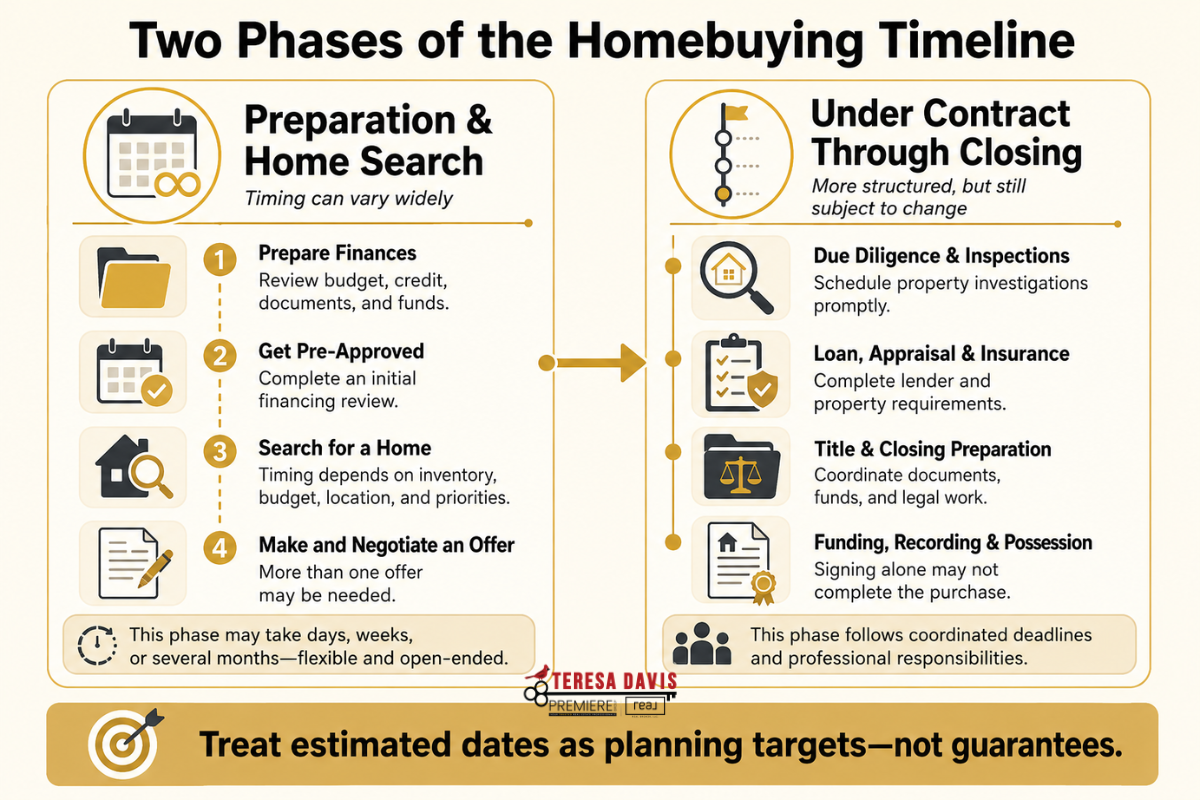
How Your REALTOR® Helps Coordinate the Homebuying Timeline
You are not expected to manage every part of the homebuying process alone. When Teresa Davis represents you as your REALTOR®, she helps organize the transaction, explain what is happening, connect you with the appropriate professionals, track important milestones, and keep communication moving from the beginning of your home search through closing.
Although each professional remains responsible for their own work, Teresa helps coordinate the different parts of the transaction so you understand what needs to happen and who is handling it.
Before You Begin Touring Homes
Teresa can help you prepare for a more focused and manageable home search by:
- Discussing your housing goals, preferred timeline, and practical needs.
- Helping you identify questions to discuss with a qualified loan originator.
- Coordinating communication with your lender or loan originator when appropriate.
- Helping you understand how your financing may affect the types of properties you consider.
- Creating a search based on your approved price range and property criteria.
- Explaining what to expect when a suitable home becomes available.
- Preparing you to make informed decisions without creating unnecessary pressure.
Teresa does not determine whether you qualify for financing, but she can help make sure the home search and financing process remain connected. This reduces the chance of spending time considering properties that do not fit the financing plan or transaction timeline.
When You Find a Home
Once you identify a property you may want to purchase, Teresa helps you review the available information and prepare for the offer process. Her assistance may include:
- Reviewing available property information.
- Discussing comparable sales and current market conditions.
- Helping you evaluate the asking price in relation to the property and available data.
- Explaining the practical purpose of proposed contract dates and terms.
- Helping you consider due-diligence and earnest-money decisions.
- Communicating with the listing agent.
- Preparing and presenting your offer according to your instructions.
- Helping you evaluate a seller’s response or counteroffer.
- Coordinating with your lender when financing details affect the offer.
- Directing legal questions to a qualified North Carolina real estate attorney.
You remain the decision-maker. Teresa’s role is to help you understand the available information, identify important considerations, and carry out your instructions.
After Your Offer Is Accepted
Once the contract becomes effective, Teresa helps coordinate the many moving parts of the transaction. This is one of the most important parts of buyer representation.
Teresa can help you:
- Review the major transaction dates and upcoming responsibilities.
- Understand which tasks require immediate attention.
- Identify inspection and investigation options that may be appropriate for the property.
- Provide information about inspectors and other qualified professionals you may choose to contact.
- Help coordinate property access for inspections and specialized evaluations.
- Communicate with the listing agent regarding scheduling.
- Attend or participate in inspection-related communication when appropriate.
- Help you review inspection findings from a transaction-planning perspective.
- Obtain additional information or repair estimates when practical.
- Prepare and communicate repair requests or other proposals according to your instructions.
- Track the seller’s response and negotiated agreements.
- Coordinate follow-up inspections or repair verification when applicable.
Teresa does not perform the inspection or decide whether a property condition is acceptable for you. Inspectors and specialized professionals explain their findings, and you decide how you want to proceed. Teresa helps organize the process, communicate your decisions, and keep the applicable timeline in view.
Coordinating With the Lender
Your lender or loan originator is responsible for mortgage processing, underwriting, appraisal requirements, and loan approval. Teresa cannot approve the loan or direct the lender’s underwriting decisions, but she can help keep the real estate transaction and lending process coordinated. Her role may include:
- Providing the lender with the executed contract and relevant amendments.
- Confirming that the lender has the transaction information needed to begin processing.
- Monitoring major financing milestones.
- Following up regarding appraisal scheduling or status when appropriate.
- Checking whether important lender-related items remain outstanding.
- Communicating transaction changes that may affect financing or closing.
- Helping identify concerns that require attention from the buyer, lender, seller, or another professional.
- Coordinating discussions when appraisal or property-condition issues affect the transaction.
- Keeping the listing agent informed of appropriate progress without disclosing confidential financial information.
- Helping the parties work toward the scheduled closing date.
Teresa can follow up, ask questions, and help maintain communication, but she cannot control underwriting timeframes, lender staffing, appraisal completion, final loan conditions, or the lender’s approval decision.
The buyer remains responsible for responding directly and promptly to lender requests. Teresa can help you understand where a lender request fits within the transaction, but loan-specific instructions and qualification questions must come from the loan originator or lender.
Coordinating With the Closing Attorney
The closing attorney is responsible for legal and settlement-related work. Teresa cannot provide legal advice or perform the attorney’s duties, but she helps keep the closing process connected to the rest of the transaction. Her coordination may include:
- Providing the closing attorney with the executed contract and amendments.
- Confirming the attorney has the buyer’s contact information.
- Communicating negotiated repairs, credits, or other contract changes.
- Helping coordinate information among the buyer, lender, listing agent, and attorney.
- Monitoring whether title, document, or scheduling concerns may affect closing.
- Helping the buyer understand when the attorney needs information or action.
- Confirming the anticipated closing appointment.
- Coordinating the final walkthrough.
- Communicating last-minute property concerns to the appropriate parties.
- Helping confirm when keys or possession may be released after the required closing steps are complete.
The closing attorney must answer questions about title, deeds, contract interpretation, closing documents, funds, recording, legal ownership, and possession.
Coordinating the Final Walkthrough and Closing
As closing approaches, Teresa helps you prepare for the final stages rather than leaving you to determine the next steps alone. She may help by:
- Confirming the final walkthrough date and time.
- Helping you understand the purpose of the walkthrough.
- Reviewing whether agreed-upon repairs or property-related arrangements need attention.
- Communicating concerns discovered during the walkthrough.
- Confirming the closing appointment and location.
- Reminding you to follow the attorney’s and lender’s instructions concerning identification, funds, and documentation.
- Coordinating with the listing agent regarding keys, access, and possession.
- Confirming when the appropriate professionals have indicated that the transaction is complete.
Teresa remains involved through closing and helps you understand what is happening, what remains outstanding, and which professional should answer a particular question.
You Have Professional Support Throughout the Process
The homebuying process includes many specialized responsibilities, but you do not have to coordinate them without guidance. Teresa helps serve as the communication and transaction-management connection among:
- You.
- The seller’s real estate professional.
- The loan originator and lender.
- Inspectors and specialized property professionals.
- The appraiser when communication is permitted through the appropriate process.
- The insurance provider.
- The closing attorney.
- Contractors or repair professionals when appropriate.
- Homeowners’ association representatives or other transaction participants.
Her role is not to replace these professionals. Her role is to help you understand the process, keep the transaction organized, identify matters that need attention, communicate with the appropriate parties, and advocate for your interests within the scope of her responsibilities as your REALTOR®.
Teresa’s Professional Insight
Many first-time buyers look at the number of steps involved and assume they will be responsible for figuring out every appointment, deadline, document, and professional on their own. That is not how I want my clients to experience the homebuying process.
When I represent you as your REALTOR®, I help you understand what comes next and coordinate the real estate side of the transaction. I can help you arrange inspections, communicate with the listing agent, follow up on major lender milestones, coordinate with the closing attorney, track important dates, prepare for the final walkthrough, and address concerns as they arise.
You will still need to make decisions, provide documents, attend appointments, and respond to the professionals handling your loan, inspections, insurance, and closing. However, you should not feel as though you have been handed a contract and left to manage the transaction by yourself.
One of my most important responsibilities is keeping the different parts of the purchase connected. If an inspection issue could affect financing, if the lender needs a contract document, if the attorney needs updated information, or if a closing concern develops, I help communicate with the appropriate parties and work toward a solution.
I cannot control underwriting, appraisal results, attorney work, seller performance, or third-party schedules. I can monitor the transaction, follow up, communicate, explain the process, and help make sure important matters do not go unnoticed.
A well-managed purchase is not simply one that closes quickly. It is one in which you understand your options, receive appropriate professional guidance, meet important responsibilities, and have someone helping you coordinate the process from beginning to end.
Helpful Tip
Create one shared transaction checklist or calendar as soon as your offer is accepted. Include:
- Due-diligence and earnest-money requirements.
- Inspection and specialized evaluation appointments.
- Repair-request and negotiation dates.
- Lender-document requests.
- Appraisal status.
- Homeowners insurance tasks.
- Closing-attorney requests.
- Final walkthrough.
- Closing appointment.
- Moving-related arrangements.
Keep Teresa informed when you receive an important lender, insurance, inspection, or attorney request. She may not be the professional responsible for answering every question, but knowing what is happening allows her to help coordinate the transaction and identify whether another party also needs the information.
Do not wait until a deadline to begin a task. Starting promptly gives Teresa and the other professionals more time to help address unexpected questions or complications.
Keep in Mind
Your REALTOR® is an important source of guidance, advocacy, communication, and transaction coordination, but each professional has a separate role. Teresa can help coordinate inspections, communicate with the lender and closing attorney, track transaction milestones, prepare requests and contract documents, and help you understand the overall process. She cannot:
- Perform a home inspection or guarantee the property’s condition.
- Make underwriting decisions or guarantee loan approval.
- Control the appraisal result or completion date.
- Provide legal advice or perform the closing attorney’s work.
- Guarantee that the seller or another third party will perform on time.
- Promise that the transaction will close on a specific date.
You also remain responsible for completing buyer-specific tasks, including providing accurate lender documents, selecting inspectors and other professionals, obtaining insurance, reviewing information, making decisions, supplying closing funds, and following legal and lending instructions.
Every purchase has its own timeline. New construction, land, condominiums, wells, septic systems, property repairs, title concerns, financing conditions, and other circumstances may require additional time.
Maintain flexible moving plans until the closing attorney and other appropriate professionals confirm that the required closing, funding, recording, and possession steps have been completed.
Questions concerning legal rights, contract interpretation, title, ownership, recording, or possession should be directed to a qualified North Carolina real estate attorney. Loan qualification and underwriting questions should be directed to the buyer’s loan originator or lender.
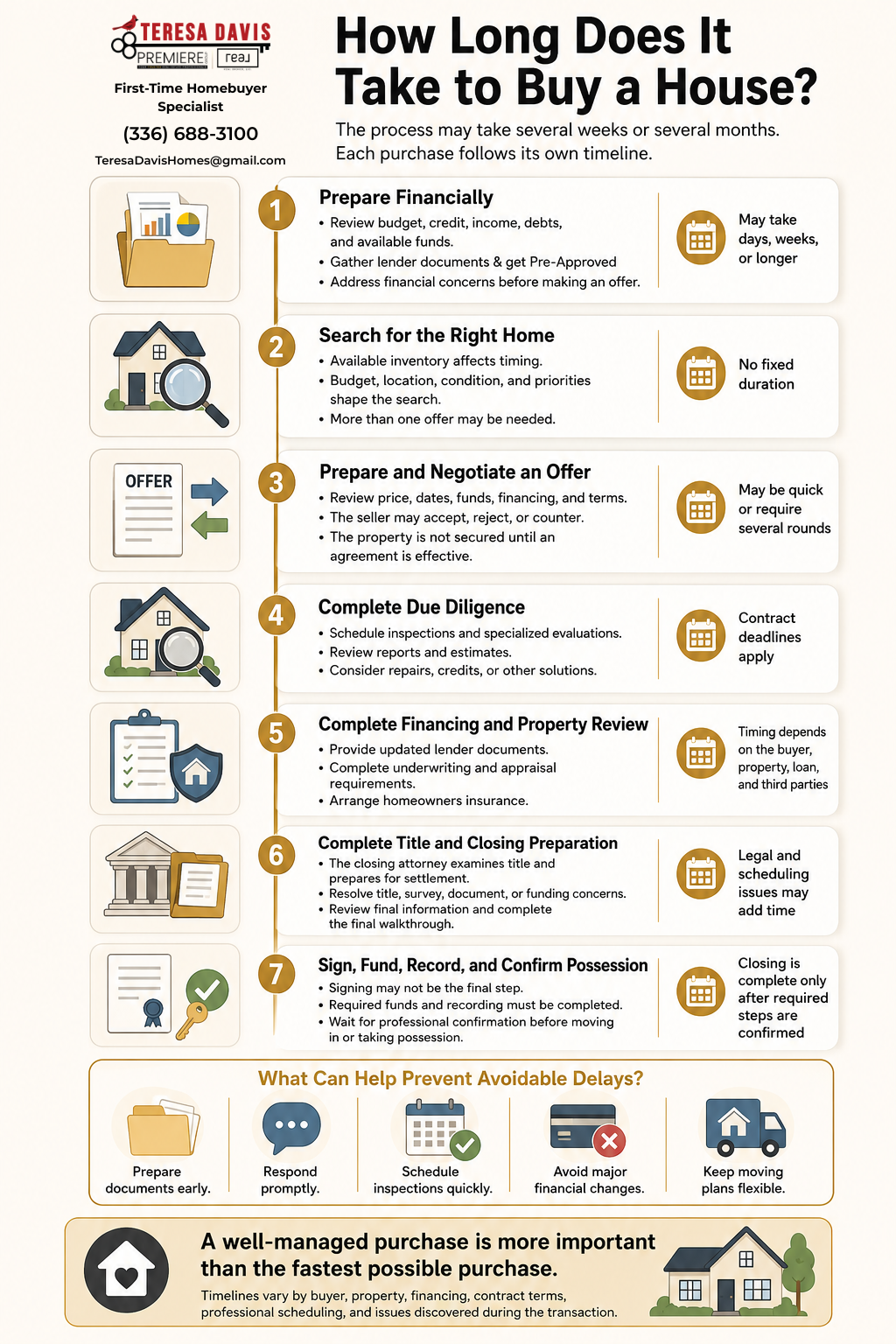
Frequently Asked Questions
Can I buy a house in 30 days?
Some purchases may close in approximately 30 days, but that timeline is not guaranteed. The buyer must find a suitable property, reach an agreement with the seller, complete the contract requirements, and coordinate inspections, financing, appraisal, title work, insurance, closing preparation, funding, and recording.
A 30-day closing may be more realistic when the buyer is already financially prepared, documentation is complete, the property does not present significant concerns, and all professionals can complete their work on schedule. Appraisal issues, inspection findings, title concerns, underwriting conditions, repairs, insurance requirements, or delayed responses may require additional time.
When Teresa Davis represents you as your REALTOR®, she helps coordinate the real estate side of the transaction, arrange access for inspections, communicate with the lender and listing agent, work with the closing attorney, track important milestones, and help identify issues that need attention. She cannot guarantee a 30-day closing or control third-party timelines.
How long does mortgage underwriting take?
There is no single underwriting timeline that applies to every buyer or loan. The lender’s review may occur in stages and may continue until all borrower, property, appraisal, insurance, title, and loan-program requirements have been satisfied.
The time required depends on factors such as:
• The completeness of the buyer’s documentation.
• Income and employment complexity.
• Credit, debt, asset, or deposit questions.
• The loan program.
• Property eligibility.
• Appraisal completion.
• Additional underwriting conditions.
• Lender workload.
• How quickly requested information is provided.
Teresa can help monitor major financing milestones, provide the lender with contract documents and amendments, follow up when appropriate, and help coordinate transaction concerns that affect the scheduled closing. The lender and loan originator remain responsible for underwriting decisions, qualification requirements, and final loan approval.
What usually causes a home closing to be delayed?
A closing may be delayed by incomplete documentation, employment or credit changes, appraisal concerns, inspection findings, repair negotiations, title defects, insurance issues, property-condition requirements, seller delays, scheduling problems, or outstanding lender conditions.
Property-specific concerns may also affect timing. Homes with wells, septic systems, homeowners’ associations, condominium requirements, significant repairs, unusual features, or new-construction work may require additional investigation or documentation.
Teresa helps track the transaction, coordinate inspections and access, communicate with the listing agent, follow up on major lender milestones, provide information to the closing attorney, and help connect the appropriate professionals when an issue develops. She cannot control the lender, appraiser, attorney, seller, inspector, or other third party, but she can help make sure important concerns are communicated and addressed.
How long does it take to find the right home?
The home search may take days, weeks, or several months. The timeline depends on your budget, preferred location, property type, financing, condition expectations, available inventory, competition, and willingness to consider different options.
A buyer with broad criteria may have more homes to consider, while a buyer with highly specific requirements may need to wait longer for a suitable property. You may also need to make more than one offer before reaching an agreement with a seller.
Teresa can create and adjust your property search, help you evaluate available homes, arrange showings, review relevant property information, discuss comparable sales, communicate with listing agents, and help you prepare an offer when you are ready. You remain in control of which home you choose and whether a property meets your needs.
Is buying a house with cash always faster?
A cash purchase may move faster because mortgage underwriting and a lender-required appraisal may not be involved. However, cash does not eliminate the need to make an informed decision or complete other important transaction steps.
A cash buyer may still need time for:
• Inspections and specialized evaluations.
• Due-diligence investigations.
• Title examination.
• Survey work.
• Closing-attorney coordination.
• Homeowners insurance decisions.
• Repair negotiations.
• Final walkthrough.
• Funding and recording.
Teresa can help coordinate these steps, arrange property access, communicate with the listing agent and closing attorney, track major dates, and help you prepare for closing. A faster purchase is not necessarily a better purchase if the buyer gives up appropriate investigations or professional guidance merely to shorten the timeline.
What Happens Next?
Once you understand the stages involved in buying a house, the next question is whether the type of home you are considering fits your current finances, needs, and long-term plans.
Some first-time buyers decide that a practical starter home allows them to become homeowners sooner while remaining within a comfortable budget. Others determine that waiting may give them more time to save, improve their financial position, or find a home that better supports their long-term goals.
The right decision is not based only on how quickly you can buy. It should also consider:
- Your monthly payment comfort.
- Funds available for the purchase and future ownership expenses.
- How long you expect to remain in the home.
- The space and features you currently need.
- The repairs or improvements you are prepared to manage.
- Available homes in your preferred areas.
- Your willingness to adjust location, size, condition, or features.
- Whether waiting is likely to improve your position or simply delay a reasonable opportunity.
Teresa can help you evaluate available properties, understand how different options may affect the transaction, and coordinate with your loan originator so that the home search remains aligned with your financing and goals.
The next Academy lesson explores: Should I buy a starter home or wait for my dream home?
Ready to Take the Next Step?
You do not have to organize every homebuying step by yourself. Teresa Davis can help you build a realistic plan, search for the right property, prepare and negotiate an offer, coordinate inspections, communicate with the lender and closing attorney, track important dates, and guide you through the real estate process from preparation through closing.
Contact Teresa Davis
Talk with Teresa about your homebuying goals, preferred timeline, questions, and next steps.
Teresa Davis
REALTOR® / Professional Real Estate Advisor
PREMIERE Group of Real Broker LLC
Begin the One Real Mortgage Pre-Approval Process
If you are ready to explore financing, begin the pre-approval process with One Real Mortgage. Loan eligibility, terms, approval, and timelines depend on your individual financial circumstances and applicable lending requirements. Using One Real Mortgage is optional and is not required in order to work with Teresa Davis as your REALTOR®.
Teresa Davis
Loan Originator NMLS #2597433
One Real Mortgage
Mortgage qualification, loan programs, terms, costs, and final approval depend on the borrower, property, transaction, documentation, underwriting, and applicable lending requirements. Beginning a pre-approval process does not guarantee financing or require you to purchase a home. It is a practical way to learn more about your potential financing options, estimated payment, and possible next steps.
Ready for the next lesson? Use “Next Question” below to continue to "Should I buy a starter home or wait for my dream home?".
1:14 - Should I buy a starter home or wait for my dream home?

Deciding whether to buy a starter home or wait for your dream home can feel like choosing between what is available now and what you ultimately want. In practice, the better question is whether a home fits your current finances, essential needs, expected timeline, and long-term priorities.
A starter home is not a formal property classification. It generally refers to a home that meets a buyer’s present needs and budget, even if it does not include every preferred feature. A dream home is also a personal concept, and the features you consider ideal may change as your career, household, finances, and lifestyle evolve.
Buying a starter home may be a responsible choice when it meets your essential needs, fits comfortably within your overall budget, and is likely to remain suitable for a reasonable period. Waiting may be more appropriate when buying now would require major compromises, create financial strain, or conflict with an anticipated relocation or other significant life change.
Neither choice is automatically better. The goal is to make a well-informed decision based on the complete cost and practical fit of the home—not fear of missing out, pressure to buy, or the hope that future market conditions will be perfect.
Quick Answer
You may benefit from buying a starter home when you are financially prepared, the property meets your essential needs, and you can reasonably expect it to work for your anticipated ownership timeline.
Waiting for your dream home may make more sense when the available properties would require unacceptable compromises, buying would stretch your finances too far, or you need additional time to improve your savings, credit, income stability, or overall readiness.
A starter home does not have to be temporary, and a dream home does not have to be perfect or permanent. The strongest decision is usually the one that balances affordability, property suitability, future flexibility, and your broader financial goals.
At a Glance
- A starter home is an informal term for a home that fits your current budget and essential needs.
- A dream home reflects your preferred features, location, space, condition, and long-term plans, but those priorities may change over time.
- Buying a starter home may make sense when it meets your needs without requiring you to overextend financially.
- Waiting may be appropriate when you are not ready, expect a significant life change, or cannot find a home that meets your essential requirements.
- Consider the complete cost of buying, owning, maintaining, improving, selling, and moving—not only the purchase price or monthly mortgage payment.
- Qualification for a particular loan amount does not necessarily mean that payment will feel comfortable within your personal budget.
- Home appreciation, future mortgage rates, inventory, and resale conditions cannot be guaranteed.
- Separate your property criteria into must-haves, strong preferences, features you can improve later, and items that are not essential.
- Consider how long the home is likely to meet your needs and whether you are comfortable with the possibility of selling and moving again.
- Waiting is most productive when it supports a clear preparation plan rather than an open-ended search for perfect conditions.
What Is a Starter Home?
A starter home is an informal term commonly used to describe a home that meets a buyer’s current needs and fits within the buyer’s present budget. It is not a formal property classification, loan category, or legal designation.
For one buyer, a starter home may be a small single-family home. For another, it may be a townhome, condominium, or older property that offers a practical entry into homeownership. The defining factor is not the property type. It is whether the home provides a reasonable combination of affordability, functionality, condition, and location for the buyer’s current circumstances.
A starter home may have:
- Less space than the buyer ultimately wants.
- Fewer cosmetic updates.
- A smaller lot.
- Fewer bedrooms or bathrooms.
- An older kitchen or bathroom.
- Limited storage.
- Fewer amenities.
- A location that is acceptable but not the buyer’s first choice.
Those characteristics do not automatically make the home a poor choice. The more important question is whether the property meets the buyer’s essential needs without creating unreasonable financial or practical compromises.
A home originally purchased as a starter home may also remain suitable for many years. Buyers sometimes discover that the location, payment, layout, or manageable maintenance needs continue to work well even after their original plans change.
What Is a Dream Home?
A dream home generally represents the buyer’s preferred combination of location, space, layout, condition, style, amenities, and long-term suitability. The idea of a dream home is highly personal. It may include preferences such as:
- A particular community or geographic area.
- Additional bedrooms or bathrooms.
- A larger kitchen.
- More storage.
- A home office.
- A garage.
- Outdoor living space.
- A larger lot.
- Updated finishes.
- A specific architectural style.
- Less immediate repair or renovation work.
- Features that may support future household or lifestyle changes.
A dream home does not have to be the largest or most expensive home a buyer can afford. It is simply the property the buyer currently believes would provide the best long-term fit.
However, housing priorities often change. A location that seems ideal today may become less convenient after a job change. Extra space may become more or less important. Maintenance expectations may change. A buyer who once wanted a large yard may later prefer lower-maintenance living.
Because priorities evolve, buyers should be cautious about treating any property as a guaranteed forever home. A home can be an excellent fit without satisfying every preference or remaining suitable for every future stage of life.
The Real Question Is Whether the Home Fits
The decision should not depend entirely on whether a property is labeled a starter home or dream home. Those labels can oversimplify a much more important question: Does this home fit your finances, essential needs, expected timeline, and responsibilities of ownership? A practical home fit includes several considerations.
Does the Home Meet Your Essential Daily Needs?
The home should support the way you expect to live. Consider:
- Whether the layout functions for your household.
- Whether the number of bedrooms and bathrooms is workable.
- Whether the location supports your commute and regular obligations.
- Whether the property offers necessary accessibility.
- Whether storage is adequate.
- Whether the maintenance demands are manageable.
- Whether significant repairs would be required immediately.
- Whether the home provides reasonable flexibility for foreseeable changes.
A property does not need every preferred feature, but it should not require you to ignore a need that is important to your daily life or safety.
Does the Home Fit Your Complete Budget?
Affordability includes more than the mortgage principal and interest payment. Depending on the property and financing, ownership expenses may include:
- Property taxes.
- Homeowners insurance.
- Mortgage insurance, when applicable.
- Homeowners association dues.
- Utilities.
- Routine maintenance.
- Repairs.
- Pest control.
- Lawn or exterior care.
- Appliance replacement.
- Major systems such as heating, cooling, plumbing, electrical, and roofing.
- Planned renovations or improvements.
A lower-priced home can still be expensive to own if it requires significant repairs or carries high recurring expenses. A more expensive home may also reduce the financial flexibility available for savings, emergencies, travel, education, retirement, or other priorities.
Is the Property Likely to Work for Your Expected Timeline?
Consider how long the home may reasonably meet your needs. Relevant factors may include:
- Career plans.
- Possible relocation.
- Anticipated household changes.
- Commute requirements.
- Space needs.
- Accessibility needs.
- Maintenance tolerance.
- Future renovation plans.
- The possibility of selling and purchasing another home.
There is no universal period that every buyer must remain in a home. However, buying and later selling can involve substantial costs. A buyer who expects to move soon should carefully compare the possible benefits of ownership with the costs and uncertainty of another transaction.
Are the Compromises Acceptable?
Nearly every home requires compromise. The key is distinguishing between an acceptable compromise and a limitation that may cause ongoing dissatisfaction or expense. An acceptable compromise might be:
- Cosmetic finishes you can update later.
- One fewer preferred feature.
- A smaller amount of storage that can be improved.
- An older but functional kitchen.
- A location slightly outside your first-choice area.
A more serious compromise might involve:
- An unmanageable commute.
- A layout that does not meet essential needs.
- Repairs beyond your available resources.
- A payment that leaves little room for emergencies.
- Accessibility limitations.
- A property type or ownership structure you do not understand or want.
- A likely need to move again much sooner than planned.
A home that is less than perfect can still be a good fit. A home that repeatedly conflicts with essential needs may not be.
When Buying a Starter Home May Make Sense
Buying a starter home may be reasonable when the decision is supported by readiness, affordability, property suitability, and an appropriate timeline.
You Are Financially Prepared
Financial preparation may include:
- Stable and documentable income.
- A realistic purchase budget.
- Funds for required upfront expenses.
- Adequate reserves after closing.
- A clear understanding of the estimated monthly payment.
- Room in the budget for maintenance and unexpected repairs.
- Financing that fits your circumstances.
Being approved for a particular loan amount does not automatically mean buying at that amount is the right choice. A lender evaluates qualification under applicable guidelines, while you must decide what payment and ownership costs feel manageable within your broader financial life.
The Home Meets Your True Must-Have Criteria
A starter home may be appropriate when it provides the features you genuinely need, even if it does not include every preference.
Examples of essential criteria may include:
- A workable number of bedrooms.
- Necessary accessibility.
- A manageable commute.
- A suitable property type.
- Acceptable condition.
- A location within the buyer’s search area.
- A payment within the buyer’s comfort range.
The more clearly you define your must-haves, the easier it becomes to evaluate whether a property is a practical choice or an excessive compromise.
You Expect the Home to Remain Suitable
A starter home may make sense when you reasonably expect it to meet your needs for a meaningful period. This does not require certainty. Life changes are not always predictable. The purpose is to consider whether the home has enough functionality and flexibility to avoid an obviously short ownership period.
For example, a buyer who expects an immediate job transfer or knows the property will not accommodate a near-term need may have a stronger reason to wait. A buyer whose plans are more stable may find that a modest home can remain practical longer than expected.
The Property’s Condition and Responsibilities Are Manageable
A lower purchase price does not necessarily mean a property is affordable to maintain. Before deciding, consider:
- The age and apparent condition of major systems.
- Immediate repair needs.
- Likely maintenance responsibilities.
- Homeowners association obligations, when applicable.
- Insurance availability and estimated cost.
- Whether planned improvements are optional or necessary.
- Whether you have the time, funds, and willingness to manage the property.
Inspections and professional evaluations can provide important information, but no property can be guaranteed to remain free from future repairs.
You Understand That You May Move Again
Buying a starter home may eventually involve another purchase and sale. Future costs may include:
- Preparing the property for sale.
- Real estate transaction expenses.
- Repairs or updates.
- Moving expenses.
- New purchase expenses.
- Temporary housing or storage.
- Changes in interest rates, prices, or inventory.
These future conditions cannot be predicted with certainty. The decision should not depend on an assumption that the home will appreciate enough to cover every future cost.
Potential Benefits of Buying a Starter Home
A starter home can offer practical benefits when the home and timing are appropriate.
It May Allow You to Buy Within a More Comfortable Range
A lower purchase price may provide more room for:
- Emergency savings.
- Maintenance reserves.
- Home improvements.
- Other monthly obligations.
- Retirement contributions.
- Education expenses.
- Travel or family priorities.
- Changes in income or expenses.
The least expensive home is not automatically the best value, but maintaining financial flexibility can be an important part of sustainable homeownership.
It Can Help You Learn What Matters Most
Living in your first home may help you better understand:
- Which layout features are genuinely important.
- How much space you use.
- Which maintenance tasks you are comfortable handling.
- Whether you prefer a larger lot or lower-maintenance property.
- Which improvements provide the greatest personal benefit.
- How location affects your daily routine.
This experience can inform future decisions if you eventually purchase another home.
Some Features May Be Improved Over Time
Certain property characteristics may be changed after purchase, depending on feasibility, cost, permits, restrictions, and professional guidance. Potentially changeable features may include:
- Paint.
- Lighting.
- Fixtures.
- Flooring.
- Landscaping.
- Storage systems.
- Some appliances.
- Selected cosmetic finishes.
Other features may be difficult, expensive, or impossible to change, including:
- Location.
- Lot size.
- Major structural layout.
- Community restrictions.
- Property type.
- Traffic patterns.
- Commute distance.
Buyers should place greater emphasis on essential features that cannot easily be changed.
It May Provide a Home That Continues to Work
A property does not have to be temporary simply because it was initially described as a starter home. A manageable payment, functional layout, acceptable location, and reasonable maintenance demands may allow the home to remain suitable longer than anticipated. The buyer may decide that staying provides more value than moving solely to obtain additional features.
Potential Tradeoffs of Buying a Starter Home
A starter home may also involve limitations and future costs that should be evaluated before making an offer.
The Home May Become Too Limited
Possible limitations may include:
- Insufficient space.
- Limited storage.
- An inconvenient layout.
- Too few bedrooms or bathrooms.
- Lack of accessibility.
- An unsuitable commute.
- Limited parking.
- Maintenance demands that become burdensome.
A compromise that seems manageable during the purchase may become more significant over time.
You May Face Another Transaction
Selling one home and buying another can require time, preparation, coordination, and money. The buyer may need to manage:
- The timing of the sale and purchase.
- Financing for the next home.
- Repairs or improvements before listing.
- Moving logistics.
- Market conditions at the time of sale.
- The possibility that the home’s value has not increased.
- The possibility that selling costs reduce or eliminate expected proceeds.
A future move should be treated as a possibility rather than a guaranteed path to a larger or more expensive home.
Improvements Can Cost More Than Expected
A starter home may seem affordable because certain features can be updated later. However, improvement costs can change, and projects may reveal additional issues. Before relying on future renovations, consider:
- Whether the improvement is structurally feasible.
- Whether permits or approvals may be required.
- Whether homeowners association restrictions apply.
- Whether the improvement is necessary or optional.
- Whether the cost fits your future budget.
- Whether you are willing to live with the current condition if the project is delayed.
Do not assume that every disliked feature can be changed easily or affordably.
Market Conditions May Be Different Later
If you plan to sell a starter home and purchase another property, future conditions may differ from today’s conditions. Possible changes include:
- Home prices.
- Mortgage rates.
- Inventory.
- Buyer demand.
- Selling time.
- Financing guidelines.
- Insurance costs.
- Property taxes.
- Personal income or credit circumstances.
No one can guarantee that a future move will be easier, less expensive, or more profitable. The current purchase should make sense on its own rather than depending entirely on a specific future market outcome.
When Waiting May Make More Sense
Waiting can be a responsible decision when it supports a clear financial, practical, or personal objective. The purpose of waiting should be to improve your readiness or avoid a purchase that does not fit—not simply to postpone the decision while hoping that every condition becomes ideal.
You Need More Financial Preparation
Additional preparation may be helpful when you need time to:
- Build funds for upfront purchase expenses.
- Strengthen your emergency savings.
- Establish reserves for maintenance and repairs.
- Reduce recurring debt obligations.
- Improve your credit profile.
- Stabilize or document income.
- Resolve inaccuracies in your credit reports.
- Better understand your comfortable monthly housing budget.
- Review available financing options with a qualified mortgage professional.
Waiting can be productive when it is tied to measurable steps and a realistic review date. For example, you might establish a specific savings goal, pay down a particular debt, or revisit your pre-approval after a documented income change. A plan is generally more useful than waiting indefinitely for prices, mortgage rates, or inventory to move in a particular direction.
Buying Now Would Stretch Your Finances Too Far
A dream home may include more space, upgrades, or amenities, but those benefits should be considered alongside the complete cost of ownership. A higher purchase price may affect:
- The required down payment.
- Closing expenses.
- The estimated monthly mortgage payment.
- Property taxes.
- Homeowners insurance.
- Mortgage insurance, when applicable.
- Homeowners association dues.
- Utility expenses.
- Maintenance and repair reserves.
- The cost of furnishing or improving the property.
- Your ability to save for emergencies and other goals.
A home can technically fit within lending guidelines while still creating a payment that feels uncomfortable in your personal budget. Qualification is an important part of the process, but it does not replace your own assessment of financial comfort.
Waiting may be more appropriate when purchasing the preferred home would leave little room for normal life expenses, future maintenance, savings, or unexpected events.
Available Homes Do Not Meet Your Essential Needs
Compromise is normal, but a buyer should not ignore a requirement that materially affects daily life, safety, accessibility, or long-term suitability. Waiting may be reasonable when available homes consistently fail to provide:
- A workable layout.
- Necessary accessibility.
- An acceptable location or commute.
- Adequate space for essential needs.
- A manageable property condition.
- A suitable ownership structure.
- A payment within the buyer’s comfort range.
- Reasonable flexibility for a foreseeable change.
The distinction between a need and a preference matters. An older kitchen may be a preference issue. A layout that cannot accommodate a necessary accessibility feature may be an essential-fit issue.
Before deciding to wait, confirm that the unavailable feature is truly necessary and cannot reasonably be addressed through another property, location, price range, or future improvement.
You Expect a Significant Change Soon
A near-term change may affect whether buying now is practical. Examples may include:
- A likely job relocation.
- A major change in income.
- A planned move to another area.
- A household change.
- A significant shift in commuting needs.
- A change in accessibility requirements.
- A known financial obligation.
- A plan to change careers or employment structure.
Not every possible life change requires waiting. However, when a change is probable and could make the home unsuitable soon after purchase, it deserves careful consideration.
You Do Not Yet Understand the Responsibilities of the Property
Different property types may involve different responsibilities, restrictions, and recurring expenses. Before purchasing, you should understand matters such as:
- Exterior and interior maintenance responsibilities.
- Homeowners association dues and rules.
- Condominium ownership considerations.
- Shared walls, common areas, or shared systems.
- Insurance responsibilities.
- Utility arrangements.
- Property restrictions.
- Repair obligations.
- Parking or use limitations.
Waiting briefly to obtain and review important information may be more responsible than purchasing a property type or ownership arrangement you do not fully understand.
The Risk of Stretching for a Dream Home
A dream home can become difficult to enjoy if the financial commitment creates ongoing stress or limits your ability to manage normal ownership expenses.
A Higher Payment Can Reduce Flexibility
A larger housing payment may leave less room for:
- Emergency savings.
- Repairs and maintenance.
- Utility increases.
- Insurance changes.
- Property tax changes.
- Medical or family expenses.
- Transportation costs.
- Retirement savings.
- Education.
- Travel.
- Career changes.
- Periods of reduced income.
The issue is not whether a larger payment is always inappropriate. The issue is whether the payment remains manageable when ordinary expenses change.
Larger or More Complex Homes May Cost More to Maintain
Additional space and amenities can create additional responsibilities. Depending on the property, costs may be affected by:
- More square footage to heat and cool.
- A larger roof.
- Additional plumbing fixtures.
- More exterior surfaces.
- Larger landscaping areas.
- Pools, outbuildings, or specialized systems.
- More appliances.
- More rooms to furnish.
- Higher utility usage.
- Greater replacement costs.
These costs vary by property. Buyers should avoid assuming that the mortgage payment represents the full difference between a starter home and a dream home.
Upgrades Do Not Eliminate Future Repairs
A renovated, newer, or more expensive home can still require maintenance and repairs. Updated finishes do not necessarily provide information about:
- The roof.
- Heating and cooling systems.
- Plumbing.
- Electrical systems.
- Drainage.
- Foundation.
- Appliances.
- Windows.
- Insulation.
- Exterior materials.
Professional inspections and appropriate evaluations can help identify observable concerns, but they cannot guarantee that a property will not require future work.
Financial Pressure Can Affect Other Goals
A home purchase should be considered within the buyer’s complete financial picture. Stretching for a preferred property may delay or reduce progress toward:
- Building emergency savings.
- Paying down debt.
- Saving for retirement.
- Funding education.
- Preparing for household changes.
- Starting or maintaining a business.
- Replacing a vehicle.
- Managing health-related expenses.
- Making desired home improvements.
A home may offer many preferred features and still be inconsistent with your broader priorities.
The Risk of Waiting for Perfection
Waiting may be appropriate, but waiting for perfect conditions can create its own challenges.
Future Mortgage Rates Are Uncertain
Mortgage rates can rise, fall, or remain relatively stable. Even when rates decline, other factors may affect the buyer’s options, including:
- Home prices.
- Competition.
- Available inventory.
- Loan qualification.
- Income.
- Credit.
- Insurance costs.
- Property taxes.
Waiting solely for a particular rate may not produce the total housing cost or selection the buyer expects.
Future Home Prices Are Uncertain
Home prices can change by location, property type, price range, and market conditions. A buyer should not assume that:
- Prices will decline.
- Prices will increase.
- A starter home will appreciate.
- A dream home will become more affordable.
- A future sale will produce a particular amount of equity.
- Market conditions will favor the buyer at a specific time.
Future price movements should not be treated as guaranteed.
Inventory May Improve or Become More Limited
Waiting may provide access to different homes, but there is no guarantee that future inventory will include the right property at the right price. Inventory can vary based on:
- Season.
- Location.
- Property type.
- Price range.
- Seller activity.
- New construction availability.
- Buyer demand.
- Broader economic conditions.
The goal is not to purchase simply because a home is available. It is to avoid assuming that a more suitable option will definitely appear later.
Your Own Circumstances May Change
Waiting can improve readiness, but personal circumstances may also change in ways that affect qualification or affordability. Possible changes include:
- Income.
- Employment.
- Debt.
- Credit.
- Savings.
- Interest rates.
- Insurance costs.
- Household expenses.
- Lending guidelines.
- Personal priorities.
This does not mean you should buy before you are ready. It means waiting should be supported by a plan rather than a belief that every future factor will move in your favor.
Separate Must-Haves From Preferences
One of the most useful decision-making exercises is to divide your home criteria into four categories.
Must Have Now
These are requirements that materially affect whether the property can work for you. Examples may include:
- Necessary accessibility.
- A workable commute.
- A particular property type.
- A minimum functional bedroom count.
- A payment within your comfort range.
- Acceptable property condition.
- A location within your required search area.
- Space for an essential activity or responsibility.
The list should be focused. When nearly every preference becomes a must-have, the search can become unnecessarily restrictive.
Strongly Prefer
These features matter and may improve your satisfaction, but you could consider a home without them. Examples may include:
- A garage.
- A larger kitchen.
- A home office.
- A particular architectural style.
- Additional storage.
- A preferred lot size.
- An updated bathroom.
- Outdoor entertaining space.
Strong preferences can be used to compare homes after essential needs are satisfied.
Can Improve Later
Some features may be changed after purchase, depending on cost, feasibility, restrictions, and professional guidance. Examples may include:
- Paint.
- Light fixtures.
- Flooring.
- Landscaping.
- Cabinet hardware.
- Storage systems.
- Selected appliances.
- Certain cosmetic finishes.
Do not automatically place every disliked feature in this category. Structural changes, additions, major renovations, and system replacements may be expensive, restricted, or impractical.
Not Essential
These are features that may be attractive but do not significantly affect whether the home supports your needs. Identifying nonessential features can prevent a home from being rejected solely because it differs from an idealized picture.
Consider What Can and Cannot Be Changed
A practical comparison should give greater weight to features that are difficult or impossible to change.
Features That Usually Cannot Be Changed Easily
These may include:
- Location.
- Lot size.
- Traffic patterns.
- Commute distance.
- Nearby land uses.
- Property type.
- Community restrictions.
- Shared walls.
- General neighborhood infrastructure.
- Major structural configuration.
Features That May Be Changeable
Depending on the property, cost, permits, restrictions, and professional evaluation, these may include:
- Paint.
- Fixtures.
- Flooring.
- Landscaping.
- Storage solutions.
- Selected appliances.
- Some interior finishes.
Features That Require Careful Evaluation
These may be possible to change but could involve substantial expense or complexity:
- Removing walls.
- Adding bedrooms or bathrooms.
- Building an addition.
- Finishing an attic or basement.
- Changing major plumbing or electrical systems.
- Expanding parking.
- Adding accessibility features.
- Replacing a septic system.
- Correcting drainage or structural concerns.
Do not base a purchase decision on an assumed renovation without first considering feasibility, cost, restrictions, and appropriate professional input.
Consider How Long the Home May Work
Your anticipated ownership timeline can affect whether a starter home is practical.
Think Beyond Your Current Situation
Ask how the home might function if your circumstances change. Consider:
- Whether the layout offers flexibility.
- Whether the location remains practical.
- Whether maintenance demands are sustainable.
- Whether the home supports anticipated accessibility needs.
- Whether storage and functional space are adequate.
- Whether the property can accommodate foreseeable changes without major work.
The goal is not to predict every future event. It is to identify obvious conflicts between the home and your known plans.
Avoid Relying on a Universal Ownership Rule
There is no single number of years that guarantees buying will be financially better than renting or that a starter home will produce a successful resale. The result can be affected by:
- Purchase expenses.
- Financing costs.
- Property condition.
- Maintenance.
- Improvements.
- Market value changes.
- Selling expenses.
- The timing of the next purchase.
- Local market conditions.
- Personal circumstances.
A buyer considering a shorter ownership period should review the complete transaction picture carefully.
Consider Whether You Would Be Comfortable Staying Longer
Plans can change. A home you expected to own briefly may need to work longer than anticipated. Ask:
- Could I remain here if moving becomes impractical?
- Would the payment remain manageable?
- Would the location still work?
- Could I tolerate the current layout and condition?
- Would the maintenance responsibilities remain reasonable?
A home does not need to satisfy every long-term preference, but it should not become unworkable if your timeline changes.
Compare the Complete Cost of Each Choice
The comparison between buying a starter home and waiting for a dream home should include immediate, recurring, and future costs.
Possible Costs of Buying a Starter Home Now
These may include:
- Down payment.
- Closing expenses.
- Inspections and evaluations.
- Moving expenses.
- Repairs.
- Maintenance.
- Utilities.
- Insurance.
- Property taxes.
- Mortgage insurance, when applicable.
- Homeowners association dues.
- Improvements.
- Future selling expenses.
- The cost of purchasing and moving again.
Possible Costs and Benefits of Waiting
Waiting may involve:
- Continued rent or other housing expenses.
- Additional time to save.
- The opportunity to improve credit or reduce debt.
- The ability to clarify long-term needs.
- The possibility of different inventory.
- The possibility of different mortgage rates.
- The possibility of higher or lower home prices.
- The possibility that qualification or personal circumstances change.
Neither list determines the correct answer by itself. The decision depends on which option best supports your needs and preparation.
Compare Monthly Comfort, Not Only Approval Amount
Your lender can help you understand qualification, estimated payments, and financing options. You should also evaluate how the payment fits with your actual spending, savings, and priorities. Consider:
- The estimated total housing payment.
- Utilities.
- Maintenance reserves.
- Transportation costs.
- Existing debts.
- Savings goals.
- Expected household expenses.
- Changes that may occur after purchase.
The most appropriate price range may be lower than the maximum amount for which you qualify.
A Practical Decision Framework
Use the following questions to organize your decision.
1. Am I Financially Prepared to Buy?
Consider whether you have:
- A realistic purchase budget.
- Funds for required upfront expenses.
- Adequate reserves after closing.
- A manageable estimated monthly payment.
- A plan for maintenance and repairs.
- Financing that you understand.
If buying would leave you financially vulnerable, additional preparation may be appropriate.
2. Does the Home Meet My Essential Needs?
Identify whether the home supports your required:
- Location.
- Functionality.
- Accessibility.
- Space.
- Property type.
- Condition.
- Ownership responsibilities.
A home that fails an essential need may not be a good starter home simply because it is affordable.
3. Is the Home Likely to Work for My Anticipated Timeline?
Consider whether:
- A move is likely soon.
- The property offers enough flexibility.
- You could remain longer if plans change.
- The costs of another transaction would be manageable.
4. Am I Comfortable With the Possibility of Moving Again?
A future move may require:
- Selling the current home.
- Paying transaction and moving expenses.
- Qualifying for another mortgage.
- Coordinating two transactions.
- Adapting to future market conditions.
Do not assume that appreciation will make the next move easy or profitable.
5. Why Am I Waiting?
Waiting may be productive when you are:
- Saving toward a defined goal.
- Reducing debt.
- Improving credit.
- Stabilizing income.
- Preparing for a known change.
- Expanding a realistic search area.
- Clarifying your needs.
Waiting may be less productive when the only reason is the hope that prices, rates, inventory, and personal circumstances will all become ideal at the same time.
6. Are My Expectations Flexible but Still Responsible?
Review whether you are rejecting suitable homes because of:
- Cosmetic finishes.
- Trends.
- Features that could be improved later.
- Preferences that do not affect daily function.
- An unrealistic expectation of perfection.
Flexibility should not mean ignoring essential needs or financial limits.
Starter Home Versus Dream Home Decision Summary
A starter home may be a responsible choice when:
- You are financially prepared.
- The property meets your essential needs.
- The payment and ownership costs are manageable.
- The home is likely to remain suitable for a reasonable period.
- The condition and maintenance responsibilities fit your resources.
- You understand that another move may eventually be necessary.
- The purchase makes sense without depending on guaranteed appreciation.
Waiting may be a responsible choice when:
- You need additional financial preparation.
- Buying would create excessive financial strain.
- Available homes do not meet essential needs.
- A significant near-term change could make ownership impractical.
- You do not yet understand the responsibilities of the available property types.
- You have a clear preparation plan and review timeline.
A more expensive home is not automatically a better decision. A less expensive home is not automatically a good value. The right choice depends on how the property, financing, ownership costs, timeline, and your broader priorities fit together.
The goal is not to choose between settling and achieving a dream. It is to choose a homebuying path that is financially sustainable, practically suitable, and consistent with your current plans.
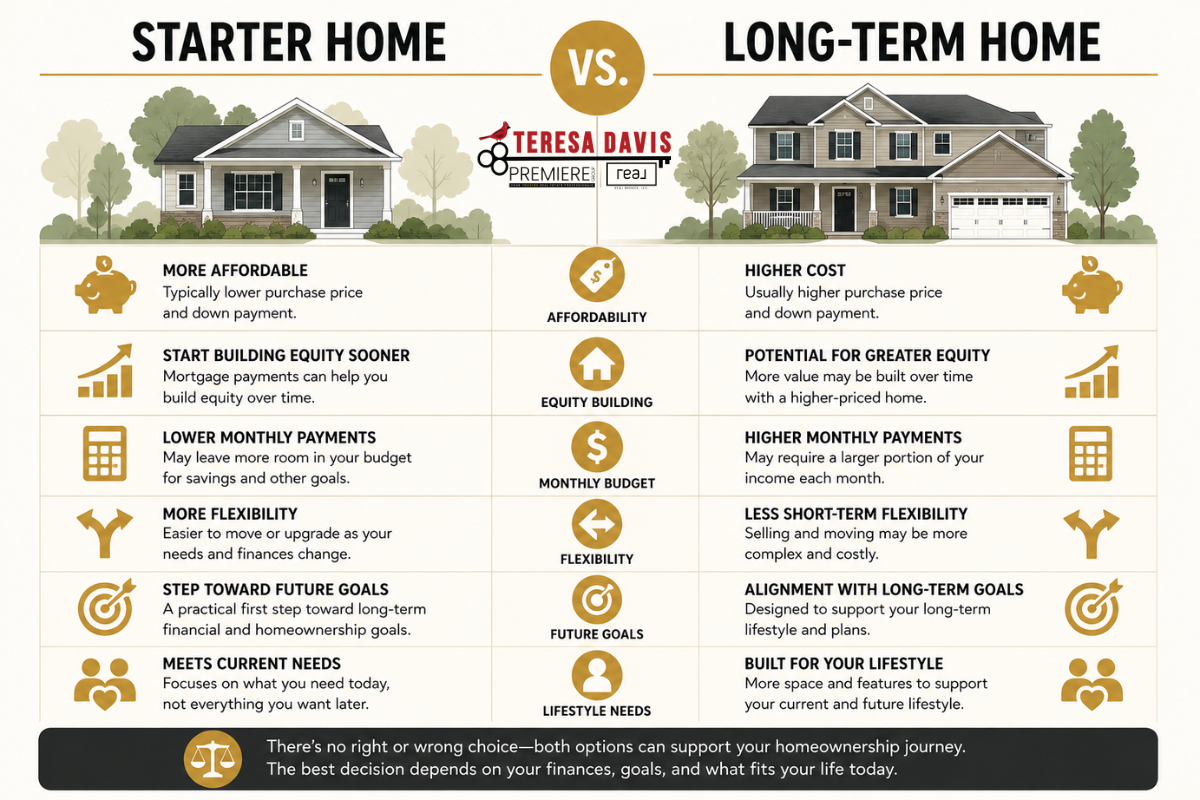
REALTOR® Guidance
A REALTOR® can help you evaluate whether a property is a practical first home, a possible long-term home, or a compromise that may become costly or frustrating.
The goal is not to convince you to buy a starter home or stretch for a dream home. It is to help you compare available properties using your actual needs, finances, timeline, and ownership responsibilities.
Clarify Your Must-Haves and Preferences
Before touring homes, identify which features are essential and which are preferences. A REALTOR® can help you organize your criteria into categories such as:
- Must have now.
- Strongly prefer.
- Could improve later.
- Not essential.
This process can help prevent cosmetic features from receiving more weight than location, layout, property condition, affordability, or other factors that may have a greater effect on daily life.
Compare Homes Across Realistic Price Ranges
When appropriate, reviewing homes in more than one price or feature category can help you understand the tradeoffs available in the current market.
For example, you may compare:
- A smaller updated home with a higher price.
- A larger home that needs cosmetic work.
- A lower-maintenance townhome or condominium.
- A detached home with greater maintenance responsibilities.
- A property in your preferred location with fewer features.
- A property outside your first-choice location that offers more space or a different condition.
The purpose is not to assume that one property type or location is better. It is to identify which combination of features, costs, and responsibilities fits your priorities.
Evaluate Property Condition and Improvement Potential
A REALTOR® can help you recognize visible property characteristics that may deserve closer review, including:
- Apparent maintenance needs.
- The age of major systems when information is available.
- Signs that additional professional evaluation may be appropriate.
- Features that may be cosmetic.
- Improvements that may involve significant cost or complexity.
- Homeowners association or condominium considerations.
- Property restrictions that may affect planned improvements.
A REALTOR® is not a substitute for a licensed home inspector, engineer, contractor, attorney, insurance professional, or other specialist. When specialized guidance is needed, the appropriate professional should be consulted.
Consider Features That Are Difficult to Change
Some property features may be improved later, while others may be difficult or impossible to change. Greater attention should generally be given to factors such as:
- Location.
- Lot characteristics.
- Commute distance.
- Property type.
- Community restrictions.
- Structural layout.
- Shared walls.
- Parking arrangements.
- Accessibility.
- Nearby land uses.
- Major maintenance responsibilities.
Cosmetic finishes may be easier to change than the fundamental characteristics of the property.
Review Comparable Sales and Current Listing Conditions
A REALTOR® can provide information about recent comparable sales, current competing listings, and other available market data. This information may help you evaluate:
- Whether the asking price appears consistent with available comparable information.
- How the property compares with other available homes.
- Whether condition or features affect the property’s positioning.
- Which compromises are common within the price range.
- Whether another search area or property type may provide different options.
Comparable sales and listing information can support a more informed decision, but they cannot guarantee future value, appreciation, selling time, or resale proceeds.
Think About Future Marketability Without Predicting the Future
A REALTOR® can help you consider characteristics that may influence how broadly a property could appeal to future buyers. These may include:
- Property condition.
- Functional layout.
- Location.
- Accessibility.
- Maintenance requirements.
- Homeowners association obligations.
- Lot characteristics.
- Parking.
- Major property restrictions.
Future market conditions and buyer preferences cannot be predicted with certainty. A property should make sense for your current needs and finances rather than depending on a guaranteed future sale or profit.
Coordinate the Home Search With Your Financing
Your home search should reflect both mortgage qualification and personal financial comfort. A REALTOR® can coordinate with your chosen mortgage professional so that you understand:
- The price range supported by your financing.
- How different property prices may affect estimated payments.
- Whether homeowners association dues may affect qualification.
- Whether property type may affect financing options.
- How taxes and insurance estimates may change the total payment.
- Whether a property’s condition could create financing concerns.
The final lending determination belongs to the lender. Your personal comfort level may also be lower than the maximum amount for which you qualify.
Revisit Your Criteria as You Learn
Your priorities may become clearer after you tour several homes. You may discover that:
- A preferred feature is less important than expected.
- A smaller home feels more functional than anticipated.
- A particular layout does not work well.
- Maintenance responsibilities matter more than extra space.
- Location is more important than cosmetic updates.
- A home initially described as a starter home could work for many years.
Revising your criteria based on experience is not the same as lowering your standards. It can be part of developing a more accurate understanding of what you need.
Teresa’s Professional Insight
When buyers begin their search, they often focus on visible features such as countertops, paint colors, flooring, appliances, or decorative finishes. Those features can influence how a home feels, but they are not always the factors that have the greatest effect on long-term satisfaction.
I encourage buyers to first look at the parts of the property that are difficult to change:
- Is the location practical?
- Does the layout function for your daily needs?
- Is the property type consistent with the responsibilities you want?
- Is the lot manageable?
- Does the home provide the space and accessibility you need?
- Are the payment and likely ownership costs comfortable?
- Could the home still work if your plans change?
Paint, fixtures, and some cosmetic finishes may be updated over time. Location, lot characteristics, major structural limitations, and an uncomfortable payment are usually much harder to change.
I also encourage buyers not to assume that a starter home must be temporary. A modest home with a manageable payment and functional layout may continue to meet your needs longer than expected. At the same time, a home should not be purchased simply because it is affordable if it fails an essential need or requires responsibilities you are not prepared to manage.
The objective is not to find a perfect home. It is to identify a home that provides a responsible balance of affordability, condition, functionality, and flexibility.
Helpful Tip
Create a four-column home criteria worksheet before you begin touring properties.
Column 1: Must Have Now
Include only requirements that materially affect whether the home can work for you. Examples may include:
- Necessary accessibility.
- A manageable commute.
- A required property type.
- A functional number of bedrooms.
- A payment within your comfort range.
- Acceptable property condition.
- A location within your required search area.
Column 2: Strongly Prefer
List features that matter but are not essential. Examples may include:
- A garage.
- Additional storage.
- A home office.
- A larger kitchen.
- Outdoor space.
- A preferred architectural style.
- Updated finishes.
Column 3: Can Improve Later
List features that may be changed after purchase, subject to cost, feasibility, permits, restrictions, and professional guidance. Examples may include:
- Paint.
- Lighting.
- Selected flooring.
- Cabinet hardware.
- Landscaping.
- Storage systems.
- Some appliances.
- Certain cosmetic finishes.
Column 4: Not Essential
List features that would be appealing but would not materially affect whether the home meets your needs. Review the worksheet after touring several properties. You may find that some features move from one category to another as you gain a clearer understanding of available homes, ownership responsibilities, and the tradeoffs within your price range.
Keep in Mind
A starter home is not automatically a good purchase simply because it is less expensive. A lower-priced property may still involve:
- Significant repairs.
- High maintenance demands.
- Homeowners association dues.
- Insurance challenges.
- High utility expenses.
- An unsuitable location.
- A layout that does not meet essential needs.
- Costs for improvements that exceed your available resources.
A dream home is not automatically a responsible purchase simply because it includes more preferred features. A higher-priced property may:
- Reduce your financial flexibility.
- Require greater maintenance.
- Increase utility or insurance expenses.
- Leave less room for savings and emergencies.
- Create pressure to delay other important goals.
Do not assume that a starter home will appreciate enough to fund a future purchase. Property values can rise, fall, or remain relatively stable, and future selling expenses may reduce expected proceeds.
Do not assume that waiting will guarantee lower mortgage rates, lower prices, or better inventory. Future market conditions cannot be predicted with certainty.
Your decision should be based on the information available today, your current readiness, your anticipated timeline, and the practical suitability of the property.
This lesson provides general education and does not replace individualized financial, legal, tax, lending, insurance, inspection, construction, or other professional advice. Consult the appropriate qualified professionals when guidance specific to your circumstances or a particular property is needed.
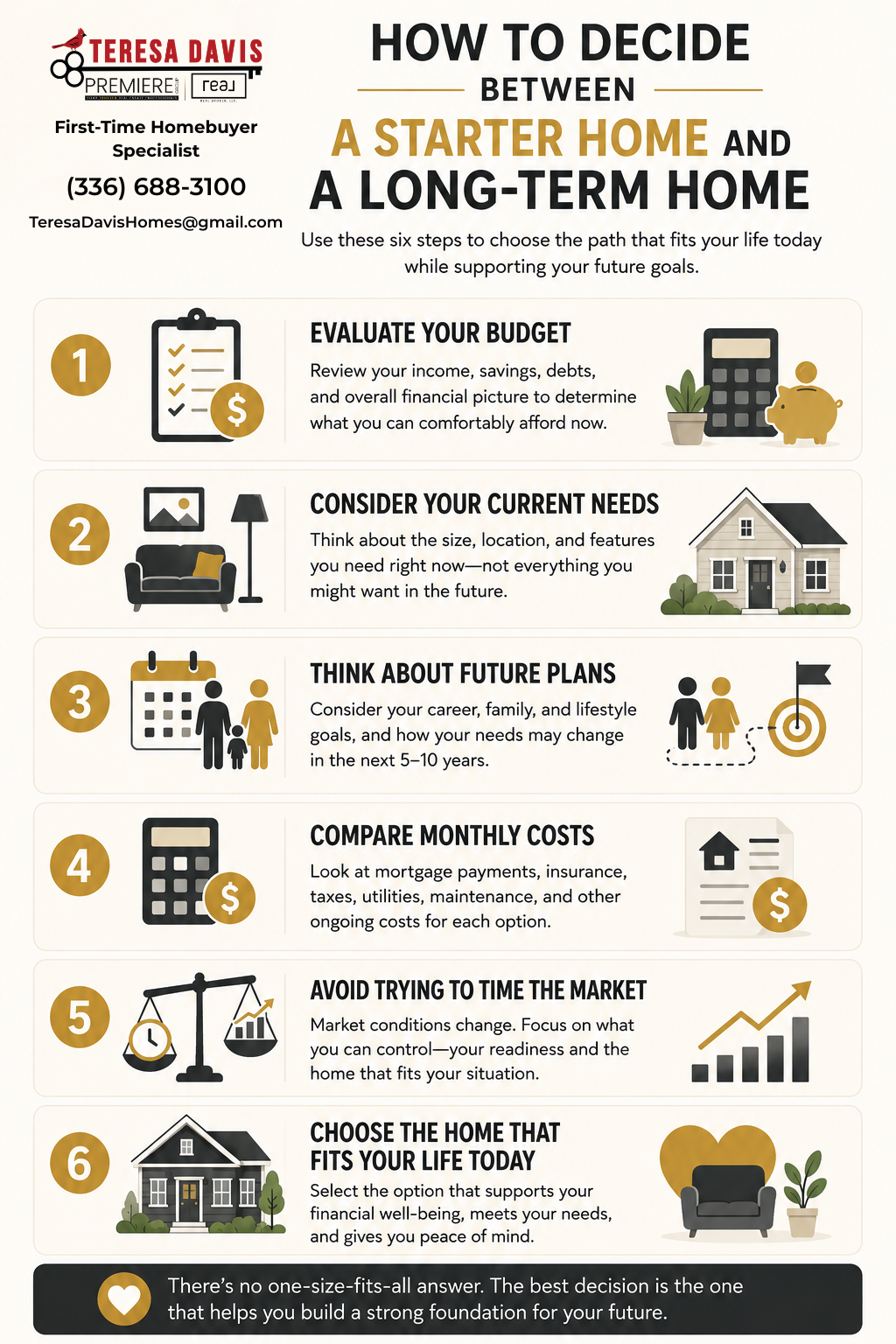
Frequently Asked Questions
What is considered a starter home?
A starter home is an informal term for a property that generally fits a buyer’s current budget and essential needs. It is not a formal property classification, loan category, or legal designation.
A starter home may be smaller, older, less updated, or located outside the buyer’s first-choice area. It may also be a townhome, condominium, or another property type that provides a practical combination of affordability and functionality.
The home does not have to be temporary. A property originally described as a starter home may continue to meet the owner’s needs for many years.
Is buying a starter home a waste of money?
Buying a starter home is not automatically a waste of money, but it is also not automatically a good financial decision. The buyer should consider:
- Purchase and closing expenses.
- The estimated monthly payment.
- Maintenance and repair responsibilities.
- Improvement costs.
- The likely ownership timeline.
- Future selling expenses.
- Moving costs.
- The possibility that the home’s value may not increase.
- Whether the property meets essential needs.
A starter home should make sense based on its current affordability, condition, functionality, and suitability. The decision should not depend on guaranteed appreciation or an assumption that selling later will produce enough proceeds to purchase a more expensive home.
How long should I plan to live in a starter home?
There is no universal minimum period that applies to every buyer or property. The appropriate timeline may depend on:
- Purchase expenses.
- Financing costs.
- Property condition.
- Maintenance and improvements.
- Future selling expenses.
- Local market conditions.
- The timing and cost of another move.
- Whether the home continues to meet the owner’s needs.
A buyer who expects to relocate soon should compare the complete costs and uncertainty of buying and selling with the possible benefits of ownership. Buyers should also consider whether they would be comfortable remaining in the home longer if their plans or future market conditions change.
Should I stretch my budget to buy my dream home?
Stretching to purchase a dream home may reduce the financial flexibility available for maintenance, repairs, utilities, insurance, property taxes, savings, emergencies, retirement, education, transportation, and other priorities.
A lender may determine that you qualify for a particular purchase amount under applicable lending guidelines. That does not automatically mean the resulting payment and ownership costs will feel comfortable within your personal budget.
Before purchasing near the top of your approved range, consider:
- The estimated total monthly housing payment.
- Funds remaining after closing.
- Maintenance and repair reserves.
- Utility and insurance costs.
- Existing debts.
- Savings goals.
- Expected changes in income or expenses.
- The ongoing cost of the home’s size, systems, and amenities.
The appropriate price range may be lower than the maximum amount for which you qualify.
Can a starter home become my long-term home?
Yes. A home originally purchased as a starter home may continue to meet your needs longer than expected.
A manageable payment, practical location, functional layout, reasonable maintenance demands, and the ability to make selected improvements may allow the property to remain suitable for many years. Your priorities may also change. Features that once seemed essential may become less important, while affordability, location, or lower maintenance may become more valuable.
A starter home is not required to become a long-term home, and a home believed to be a dream home may not remain suitable forever. The important question is whether the property continues to support your needs, finances, and responsibilities.
What Happens Next?
Begin by writing down the property features that are essential to your daily life. Separate those needs from preferences, cosmetic features, and improvements that may be possible later.
Next, review the complete financial picture of homeownership. Consider the estimated monthly payment, funds needed for upfront expenses, reserves remaining after closing, maintenance responsibilities, and the other goals your housing costs must leave room to support.
If you have not completed the mortgage pre-approval process, or if your finances have changed since your last review, speak with a qualified mortgage professional. A current pre-approval can help you understand available financing, estimated payments, and the price range supported by your documented financial information.
Then, discuss your home criteria and comfortable price range with a REALTOR®. Reviewing realistic homes across different price points, conditions, locations, and property types can help you understand the compromises available in the current market.
As you tour homes, compare each property using the same questions:
- Does it meet my essential needs?
- Is the payment comfortable?
- Are the condition and maintenance responsibilities manageable?
- Could the home remain suitable if my plans change?
- Am I rejecting it because of a genuine limitation or a feature that could be improved later?
- Would I be comfortable owning it if moving again takes longer than expected?
You do not have to decide in advance that you will buy a starter home or wait for a dream home. The search process may help you discover that an attainable property offers more long-term value than expected, or that waiting is appropriate because the available homes do not fit your essential needs or financial plan.
The next Academy lesson explains how professional buyer representation may help you evaluate properties, understand the purchase process, coordinate with other professionals, and protect your interests: Do I need a REALTOR® to buy my first home?
Ready to Take the Next Step?
You do not have to decide between a starter home and a dream home without understanding the real options available to you. A thoughtful comparison of your finances, essential needs, ownership timeline, property condition, and local housing options can help you make a more confident decision.
Contact Teresa Davis
Contact Teresa Davis for help identifying your must-have criteria, comparing realistic home options, understanding property tradeoffs, and creating a home-search strategy that fits your goals without pressure to purchase before you are ready.
Teresa Davis
REALTOR® / Professional Real Estate Advisor
PREMIERE Group of Real Broker LLC
Begin the One Real Mortgage Pre-Approval Process
If you are ready to understand your potential financing options and estimated price range, you may begin or review the pre-approval process. Using One Real Mortgage is optional and is not required in order to work with Teresa Davis as your REALTOR®.
Teresa Davis
Loan Originator NMLS #2597433
One Real Mortgage
Mortgage qualification, loan programs, terms, costs, and final approval depend on the borrower, property, transaction, documentation, underwriting, and applicable lending requirements. Beginning a pre-approval process does not guarantee financing or require you to purchase a home. It is a practical way to learn more about your potential financing options, estimated payment, and possible next steps.
Ready for the next lesson? Use “Next Question” below to continue to "Do I need a REALTOR® to buy my first home?".
1:15 - Do I need a REALTOR® to buy my first home?

Buying your first home involves much more than finding a property you like and deciding what price to offer. There are financing decisions, property research, comparable sales, negotiations, inspections, due diligence, appraisal, contractual deadlines, closing preparations, and many smaller decisions along the way. When you have never been through the process before, it can be difficult to know what questions to ask—or when a decision could affect your money or your options later in the transaction.
You can buy a home without hiring your own REALTOR®, but doing so means taking on much more of the process yourself. A knowledgeable buyer’s REALTOR® can help you understand what is happening, evaluate the information in front of you, prepare for important decisions, coordinate the many people involved in the transaction, and represent your interests as you move from the first home search through closing.
That guidance can be especially valuable for a first-time homebuyer. My role is not simply to help you find houses to tour. I specialize in helping first-time buyers understand the process before they are expected to make major decisions. That includes helping you evaluate properties and comparable sales, develop an offer strategy, understand important North Carolina transaction terms and deadlines, coordinate with your lender and other professionals, and know what should happen next.
Buyer representation also includes an upfront conversation about the services being provided and the negotiated compensation for those services. Compensation is negotiable and should be clearly explained in your buyer agreement. Depending on the property and the terms of the transaction, some or all of that compensation may be paid by the seller or another permitted source, and seller payment can be negotiated as part of the offer when appropriate. Seller payment is not guaranteed, so the important point is that you understand the arrangement before moving forward—not that you should assume contacting a REALTOR® automatically means receiving a separate unexpected bill.
For first-time buyers in Davidson County, Randolph County, Guilford County, Forsyth County, and surrounding North Carolina communities, having someone who understands both the local buying process and the questions first-time buyers commonly encounter can make the experience easier to understand and more organized from the beginning.
Quick Answer
No, you are not required to hire your own REALTOR® simply because you are buying your first home. However, if you choose to buy without your own representation, you will be responsible for handling much more of the transaction yourself.
A buyer’s REALTOR® can help you search for and evaluate properties, research comparable sales, develop an offer strategy, negotiate price and terms, understand North Carolina due diligence and other important deadlines, coordinate inspections and appraisal issues, communicate with your lender and closing professionals, and help you understand the decisions that arise between your first showing and closing day.
It is also important to understand whom the real estate professionals in a transaction represent. The agent associated with the seller’s listing is not automatically representing your interests as the buyer. Having your own representation gives you a professional whose role is focused on helping you navigate the purchase from the buyer’s side.
Buyer-agent compensation is negotiated and established in the buyer agreement. Depending on the transaction, some or all of that compensation may be paid by the seller or another permitted source, and seller payment may be negotiated as part of your offer. Because every transaction is different, seller payment should not be assumed or guaranteed. Your REALTOR® should explain the compensation arrangement clearly before you proceed.
For a first-time homebuyer, the value of representation is not simply having someone open doors. It is having an experienced professional help you understand the process, evaluate your choices, anticipate what comes next, and make informed decisions throughout the purchase.
At a Glance
- You can buy a home without hiring your own REALTOR®, but you will be taking on more responsibility for managing the transaction yourself.
- A buyer’s REALTOR® can help with property searches, comparable sales, pricing, offer strategy, negotiations, due diligence, inspections, appraisal issues, deadlines, and closing coordination.
- The agent connected with a seller’s listing does not automatically represent you as the buyer, so it is important to understand agency relationships before relying on someone for advice or sharing confidential information.
- A REALTOR® can help you evaluate whether an asking price is supported by comparable sales and other relevant market information, but no REALTOR® can guarantee a particular value, appraisal result, or negotiation outcome.
- In North Carolina, decisions involving due diligence, earnest money, inspections, deadlines, and other contract terms can affect both your options and the money you have committed to the transaction.
- Buyer-agent compensation is negotiated and should be clearly explained in your buyer agreement before you begin working together.
- Depending on the transaction, some or all of the negotiated compensation may be paid by the seller or another permitted source, and seller payment can be negotiated as part of an offer when appropriate; however, seller payment is not guaranteed.
- Your REALTOR® does not replace your lender, closing attorney, inspector, appraiser, insurance professional, surveyor, or other specialists. A major part of the REALTOR®’s role is helping coordinate those moving pieces and helping you understand when another professional’s expertise is needed.
- First-time buyers often benefit from working with a REALTOR® who regularly helps people through their first purchase and is willing to explain not only what needs to happen, but why it matters.
- You do not need to become a real estate expert before buying your first home. Having the right professional guidance can help you understand your choices and make better-informed decisions as you move through the process.
You Can Buy a Home Without Your Own REALTOR®—But Understand What That Means
You can purchase a home without hiring your own REALTOR®. The more useful question for a first-time buyer is whether you want to take responsibility for navigating the purchase without professional representation on your side.
Buying a home involves a series of decisions that can affect your finances, your contractual obligations, and whether a particular property is a good fit for you. If you proceed without your own representation, you may need to take a more active role in:
- finding and evaluating properties;
- researching property information and recent comparable sales;
- deciding what price and terms to offer;
- understanding the significance of due diligence and earnest money in North Carolina;
- keeping track of important dates and deadlines;
- arranging inspections and determining whether additional evaluations may be appropriate;
- deciding how to respond to inspection findings;
- communicating and negotiating with the seller or the seller’s representative;
- monitoring financing and appraisal developments;
- coordinating with the closing attorney and other professionals; and
- handling unexpected issues that arise between the offer and closing.
None of this means a first-time buyer is incapable of purchasing a home without a REALTOR®. It means that the buyer should understand how much responsibility comes with that decision.
A knowledgeable REALTOR® can help organize these moving parts, explain what requires your attention, and help you evaluate your choices before you make them. That can be particularly useful when you are buying for the first time because you may not yet know which questions are important at each stage of the transaction.
The Listing Agent and Your REALTOR® Have Different Roles
One of the easiest misunderstandings for a first-time homebuyer is assuming that the real estate professional associated with a property listing is automatically there to represent the buyer too.
That is not something you should assume. In North Carolina, agency relationships matter because they help establish whom a real estate professional represents in the transaction. Before relying on a broker for advice, discussing your negotiating position, or sharing confidential information, you should understand the broker’s role and whom that broker represents.
A listing agent is generally working on behalf of the seller. The seller and buyer may want the same transaction to close, but their interests are not necessarily the same.
For example, a seller may want to:
- obtain favorable price and terms;
- limit concessions;
- minimize requested repairs or credits; and
- structure the transaction in a way that supports the seller’s goals.
As the buyer, you may be focused on:
- determining whether the price is supported by relevant market information;
- preserving cash when possible;
- deciding how much due diligence fee and earnest money you are comfortable putting at risk;
- obtaining enough time to investigate the property;
- addressing inspection findings;
- protecting your financing strategy; and
- structuring an offer that supports your own priorities.
Having buyer representation means you have a professional focused on helping you work through the transaction from the buyer’s perspective.
There can be situations involving different agency arrangements, including circumstances in which the same firm may be involved on both sides of a transaction. Those situations should be explained to you before you consent to them. You do not need to become an expert in agency law, but you should know who represents you before you begin relying on someone for guidance.
A REALTOR® Can Help Before You Ever Make an Offer
Some buyers think they need a REALTOR® only after they find a house they want to purchase. For a first-time homebuyer, some of the most valuable guidance can happen well before an offer is written.
Before you begin serious home shopping, an experienced buyer’s REALTOR® can help you understand the overall process and prepare for decisions you are likely to encounter later.
That preparation may include helping you:
- clarify your housing needs and priorities;
- understand the general sequence from financing preparation through closing;
- coordinate appropriately with your lender;
- establish a home-search strategy;
- understand how different property types may affect your search;
- recognize questions to ask when reviewing a listing or touring a property;
- understand the purpose of comparable sales;
- learn the basic components of a North Carolina offer;
- become familiar with due diligence, earnest money, inspections, appraisal, and closing; and
- anticipate expenses and decisions that can arise once you are under contract.
This is especially important for first-time buyers because the homebuying process can move quickly once the right property appears. Learning the terminology and understanding the major decisions beforehand can make it easier to evaluate your options without trying to learn everything while an offer deadline is approaching.
Your REALTOR® should also explain the buyer agreement before you begin working together, including the services being provided and the negotiated compensation for those services. The goal should be clarity from the beginning so that you understand both the relationship and the process before you become focused on a particular house.
Helping You Evaluate a Home, Not Just Find One
Finding homes online has become easy. Evaluating whether a particular home makes sense for you is a different task. A buyer’s REALTOR® can help you look beyond photographs and the asking price and consider information that may affect your decision.
Depending on the property, that may include reviewing:
- recent comparable sales;
- current competing listings;
- available property and listing history;
- the relationship between the asking price and relevant market evidence;
- property disclosures and other available documentation;
- HOA information when applicable;
- observable conditions that may deserve additional investigation;
- property characteristics that could affect your intended use or future resale; and
- questions that should be directed to the appropriate professional.
This does not mean your REALTOR® replaces the professionals who perform specialized evaluations. A REALTOR® is not your home inspector, appraiser, attorney, surveyor, engineer, insurance professional, or tax adviser.
Instead, an important part of good buyer representation is recognizing when an issue deserves additional investigation and helping you identify the type of professional who may be able to provide the information you need.
For example, your REALTOR® may notice something during a showing that deserves a closer look, but a qualified inspector or other appropriate specialist should evaluate the condition. Your REALTOR® may research comparable sales to help you consider an offer price, but the lender’s appraiser independently develops an opinion of value for the lending process.
The distinction matters: your REALTOR® helps you gather information, ask better questions, coordinate the process, and understand how the different pieces may affect your decision. For a first-time buyer, that type of guidance can be far more valuable than simply receiving a list of homes for sale.
A REALTOR® Can Help You Make a More Informed Offer
One of the most important responsibilities a buyer takes on when purchasing without representation is deciding how much to offer and which terms to include. The asking price is simply the price the seller is requesting. It does not automatically establish what the property is worth, what another buyer may be willing to pay, or what an appraiser may ultimately conclude.
Before you make an offer, a buyer’s REALTOR® can research relevant comparable sales and other available market information to help you evaluate the property in context. Depending on the home and the available data, that analysis may consider:
- recent sales of reasonably comparable properties;
- differences in location, size, condition, age, features, and property type;
- current competing listings;
- available listing and price history;
- how quickly comparable properties have been selling;
- current market conditions affecting negotiation; and
- factors that may make the subject property different from the most obvious comparable homes.
Comparable-sales research does not guarantee what a home will appraise for, and a REALTOR® does not determine the appraised value. The appraisal is an independent valuation performed as part of the lending process when required. What the REALTOR® can do is help you make a more informed decision before you commit yourself to a purchase price.
For a first-time homebuyer, that distinction is important. Without knowledgeable representation, it can be easy to assume that the seller’s asking price must be reasonable simply because the property was listed at that amount. It may be reasonable—but the buyer should make that decision using available evidence rather than assumption.
Why Offering Too Much Can Create a Financial Problem
Paying careful attention to price becomes particularly important when you are financing the purchase. Suppose you agree to purchase a home for more than the lender’s appraisal ultimately supports. The lender generally bases its lending decision on the applicable loan terms and the appraised value rather than simply increasing the loan because the buyer agreed to a higher purchase price.
If an appraisal comes in below the contract price, several things may be possible depending on the contract, financing, timing, and willingness of the parties. For example:
- the seller may agree to reduce the purchase price;
- the parties may negotiate another solution;
- the buyer may decide to contribute additional cash if financially able and permitted by the financing terms; or
- the buyer may decide not to proceed with the purchase.
The important point is that a low appraisal does not automatically require the seller to reduce the price. If the seller will not adjust the price and you still want to purchase the property, you may need significantly more cash than you originally expected in order to cover some or all of the difference between the price and the amount supported for financing. If you decide not to proceed instead, the financial consequences can depend on your contract and when you terminate.
That is one reason experienced buyer representation can be so valuable. Your REALTOR® can help you evaluate comparable sales before the offer, discuss the potential consequences of the price you are considering, help you understand the relevant offer terms, coordinate with your lender, and help you evaluate your options if the appraisal creates a problem.
No REALTOR® can guarantee that an appraisal will equal the purchase price. The goal is to help you make the offer with your eyes open rather than discovering the financial implications after you are already under contract.
The Offer Is About Much More Than Purchase Price
A strong buyer strategy is not simply, “What number should I offer?” An offer contains multiple terms that can affect your money, flexibility, negotiating position, and overall risk. In a North Carolina transaction, those considerations may include:
- purchase price;
- due diligence fee;
- earnest money deposit;
- length of the due diligence period;
- proposed closing date;
- financing considerations;
- seller-paid expenses or concessions when applicable;
- negotiated buyer-agent compensation arrangements when applicable;
- personal property or other negotiated items; and
- additional terms appropriate to the particular transaction.
Two offers at the same purchase price can expose buyers to very different levels of financial risk because the other terms may be different.
For example, agreeing to a larger due diligence fee may make an offer more attractive to a seller, but it can also increase the amount of the buyer’s money that is generally at risk if the transaction does not close. The North Carolina Real Estate Commission explains that the due diligence fee is generally nonrefundable except in limited circumstances and is paid for the buyer’s right to conduct due diligence during the agreed period.
The amount of a due diligence fee, earnest money deposit, and other offer terms should therefore be treated as negotiating decisions, not simply numbers copied from another transaction. A REALTOR® can help you understand those tradeoffs before you sign the offer.
Buying Without Representation Can Expose You to Significant Financial Risk
A home purchase is usually one of the largest financial transactions a consumer will make. Buying without experienced representation can create substantial financial and transaction risk, particularly for a first-time buyer who may not yet recognize which decisions deserve extra attention.
A buyer can have money committed or spent at several points in the transaction, potentially including:
- a due diligence fee;
- earnest money;
- home-inspection fees;
- specialized inspection or evaluation fees;
- appraisal expenses;
- survey expenses;
- lender-related expenses; and
- other transaction costs.
Not every one of those amounts is treated the same way if the purchase does not close.
Under the commonly used North Carolina due diligence framework, a buyer who properly terminates during the due diligence period will generally be entitled to the earnest money deposit but will generally not recover the due diligence fee. After the due diligence period expires, additional money—including earnest money—may be at risk depending on the circumstances and the contract.
Money already spent on inspections, appraisal, specialized evaluations, or other services may also have been earned by the professionals who performed those services even if the buyer later decides not to purchase the property. This is why deadlines matter so much.
Imagine that an appraisal comes in below the agreed purchase price. If the seller refuses to reduce the price, the buyer may have to decide whether to bring additional money to closing, attempt another negotiated solution, or terminate the transaction. What happens to the buyer’s deposits and other money already spent can depend on the contract terms, the timing of that decision, and the circumstances surrounding the transaction.
A buyer who does not fully understand those consequences may discover too late that walking away from a transaction is not financially the same as simply deciding not to buy something at a store. A REALTOR® cannot eliminate every risk, guarantee that money will be recoverable, or make contractual decisions for you.
What an experienced REALTOR® can do is help you understand important deadlines, recognize when money may be at risk, discuss available options, help negotiate on your behalf, and recommend that you obtain legal or other professional advice when a situation requires expertise outside the REALTOR®’s role. For a first-time buyer, having that guidance before a decision is made can be much more valuable than trying to determine what went wrong afterward.
Your REALTOR® Helps Manage the Due Diligence Process
Once you are under contract, the home still needs to be evaluated. The North Carolina Real Estate Commission describes due diligence as a vital part of the buying process because it gives the buyer an opportunity to gather information about the property and determine whether to move forward.
Depending on the property and transaction, your REALTOR® can help you coordinate activities such as:
- the general home inspection;
- additional inspections or evaluations when appropriate;
- review of available property documents;
- HOA-related information when applicable;
- survey considerations;
- insurance-related questions;
- repair discussions;
- appraisal coordination;
- financing milestones; and
- other property-specific investigations.
Your REALTOR® does not perform the inspector’s, attorney’s, appraiser’s, lender’s, surveyor’s, engineer’s, or insurance professional’s job. Instead, the REALTOR® helps keep the process organized and helps you recognize what requires attention while the time available for making decisions may be limited. That coordination can be especially important when several issues arise at once.
For example, an inspection might reveal an unexpected repair concern at approximately the same time the lender requests additional documentation and an appraisal deadline is approaching. A first-time buyer may see those as unrelated events. An experienced REALTOR® understands that each may affect the transaction timeline and that decisions may need to be coordinated rather than handled independently.
Your REALTOR® Can Help With Inspection and Repair Negotiations
A home inspection does not produce a simple pass-or-fail result. It provides information that the buyer must evaluate. Once the inspection report is available, a REALTOR® can help you work through questions such as:
- Which findings deserve the most attention?
- Does a finding require further evaluation by a specialist?
- Which concerns appear relatively minor?
- What additional information should be obtained?
- Should you request a repair, credit, other negotiated solution, or no change at all?
- How do the condition of the property, purchase price, market conditions, and your priorities affect the negotiation?
The REALTOR® should not diagnose defects or estimate repairs beyond the REALTOR®’s expertise. Qualified professionals should evaluate technical issues when appropriate.
The REALTOR®’s role is to help you understand the transaction implications, organize your questions, communicate with the other side, and negotiate according to the strategy you decide to pursue. The seller may agree with a request, reject it, or offer another solution. No repair negotiation can be guaranteed.
That makes experienced advice particularly useful: the goal is not to promise a particular result, but to help you make a reasoned decision based on the information available.
Representation Continues After the Offer Is Accepted
Getting an offer accepted is not the end of the REALTOR®’s work. In many ways, it is when transaction coordination becomes even more important. Between contract acceptance and closing, your REALTOR® may help coordinate and monitor:
- due diligence activities;
- inspections and additional evaluations;
- repair or credit negotiations;
- lender communication;
- appraisal developments;
- important contract dates;
- communication with the listing side;
- communication with the closing attorney;
- document and information requests;
- final walkthrough preparations;
- closing logistics; and
- unexpected issues that need attention.
Problems do not always occur one at a time. An inspection concern can affect negotiations. A negotiation can affect the lender. An appraisal can affect the amount of money a buyer needs. A delayed document can affect the timeline. A closing issue can require communication among several different professionals.
A buyer’s REALTOR® can serve as an important point of coordination so that you know what is happening, what needs your attention, who should be involved, and what decision may be required next.
That does not mean your REALTOR® makes those decisions for you. The home is yours to choose. The offer is yours to authorize. The amount of money you are comfortable risking is your decision. Whether you proceed after inspections or an appraisal issue is ultimately your decision subject to your contract and professional advice.
Good buyer representation gives you the information, context, negotiation assistance, and coordination you need to make those decisions more intelligently. For a first-time homebuyer, that is one of the strongest reasons to have an experienced REALTOR® on your side.
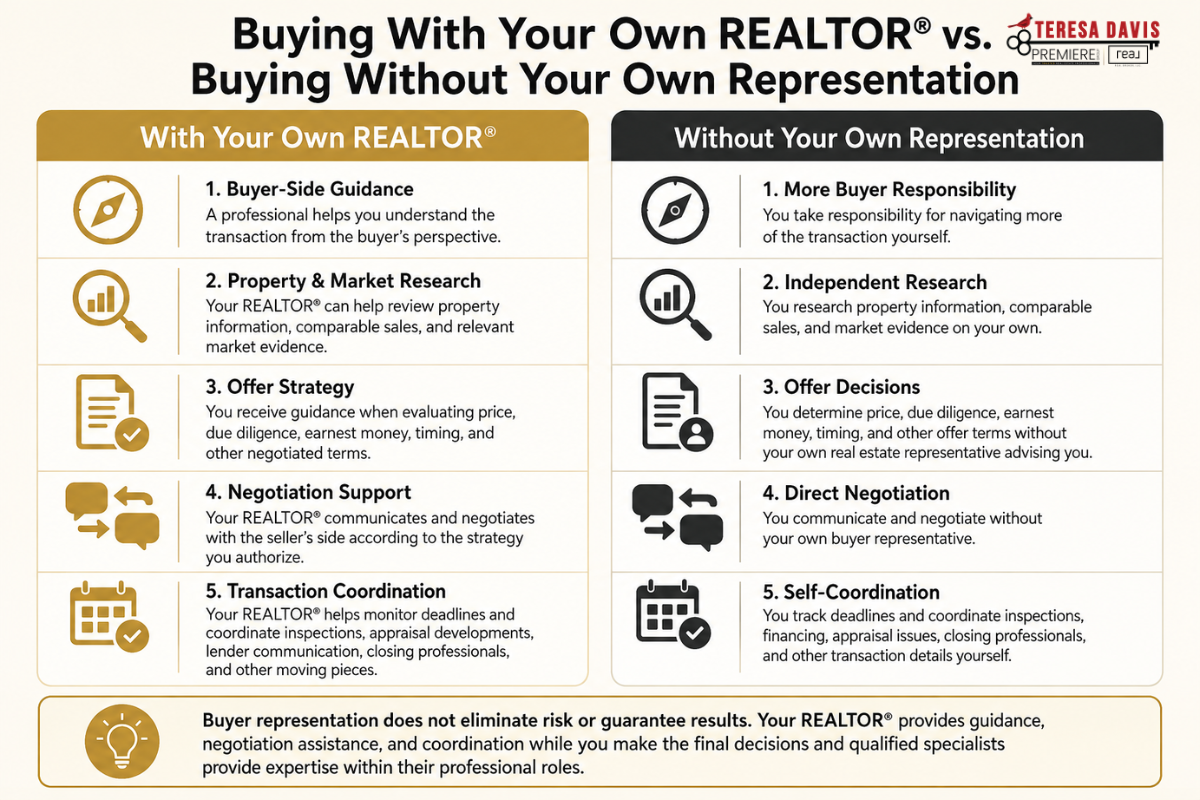
How the Right REALTOR® Helps Protect Your Interests
Buying a home without knowledgeable representation can expose a first-time buyer to significant financial and transaction risk. The value of having your own REALTOR® is not simply access to listings or having someone schedule showings. It is having an experienced professional on your side who understands how the pieces of the transaction fit together and can help you recognize the consequences of a decision before you commit to it.
A knowledgeable buyer’s REALTOR® can help you:
- understand the homebuying process before you are under pressure to make decisions;
- search for properties that fit your goals and financial plan;
- research recent comparable sales and other relevant market information;
- evaluate whether an asking price appears supported by available market evidence;
- develop an offer strategy based on both price and terms;
- understand how much due diligence fee and earnest money you may be putting at risk;
- recognize how offer terms can affect your flexibility later;
- negotiate with the seller through the seller’s representative;
- coordinate inspections and additional evaluations when appropriate;
- help you evaluate inspection findings and possible negotiation strategies;
- monitor important due diligence and contractual dates;
- communicate with your lender as financing progresses;
- help you understand the transaction implications of an appraisal that comes in below the purchase price;
- coordinate with the closing attorney and other professionals;
- prepare for the final walkthrough and closing; and
- help manage problems that arise along the way.
One of the most valuable services your REALTOR® can provide happens before the offer is submitted. If you are considering offering $325,000 for a home, for example, you should not have to rely only on the seller’s asking price or your emotional reaction to the property. Your REALTOR® can research comparable sales and discuss the available market information with you so you can make a more informed decision about what you are willing to offer.
That analysis cannot guarantee the future appraisal. However, it can help you understand whether your proposed offer has reasonable market support before you become contractually committed. That matters because an appraisal problem can become a cash problem.
If the property appraises below the purchase price, the seller is not automatically required to reduce the price. Depending on your financing, contract, timing, and negotiations, you may face a decision about whether to negotiate another solution, contribute additional cash, or decide not to proceed.
If you decide not to proceed, money already committed or spent may also be affected. Your due diligence fee, earnest money, inspection costs, appraisal expense, specialized evaluation costs, and other transaction expenses do not all have the same refund rules. In North Carolina, timing and the terms of the contract can make a significant difference in what money may remain at risk.
A REALTOR® cannot eliminate those risks or guarantee a particular outcome. What experienced representation can do is help you understand the risk before you make the decision, watch important deadlines, help you negotiate, coordinate with the professionals involved, and make sure you are not navigating a major financial decision without guidance.
That is especially important for a first-time buyer because you may be encountering appraisal issues, due diligence, inspection negotiations, repair requests, lender requirements, and closing procedures for the first time—all within the same transaction.
The right REALTOR® should not simply tell you what to do. Your REALTOR® should explain your options, help you understand the potential consequences, and give you the information you need to make the decision that is right for you.
Teresa’s Professional Insight
First-time homebuyers often tell me they are worried about asking the “wrong” questions. I tell them something very different: you are not supposed to already know everything about buying a home. That is one of the reasons I enjoy working with first-time buyers. My job is not simply to send you listings and open doors. I want you to understand what you are doing and why it matters before you are asked to make decisions involving thousands of dollars.
When we are considering a home, I want to help you look beyond whether you love the kitchen or the backyard. We need to consider the property, the asking price, recent comparable sales, your financing, the likely competition, the terms of the offer, the amount of money you may be putting at risk, and what could happen if something does not go according to plan.
For example, before recommending an offer strategy, I can research comparable sales and available market information so we have a better foundation for discussing price. That does not guarantee what an appraiser will conclude, but it gives us more information than simply assuming the asking price must be the right price.
If an appraisal later comes in below the purchase price, I help you understand what that means for the transaction, communicate with your lender, evaluate the situation with you, and negotiate with the other side based on the options available. If the seller will not reduce the price, we need to understand the potential consequences before you decide whether contributing additional cash, pursuing another negotiated solution, or not proceeding makes sense for you.
The same principle applies throughout the transaction. If an inspection identifies a concern, I help you determine what questions need to be asked and whether another professional should evaluate it. If a deadline is approaching, I help keep it in front of us. If the lender needs something that could affect our transaction, we coordinate. If there is a repair negotiation, appraisal issue, closing concern, or unexpected problem, you are not trying to determine what happens next by yourself.
Because I work closely with first-time homebuyers, I also understand that the explanation is often just as important as the transaction itself. I want you to know what due diligence means before you put money at risk. I want you to understand why comparable sales matter before you decide what to offer. I want you to know the difference between an inspection and an appraisal before either one occurs. And I want you to understand how a decision today could affect your options later.
As both a REALTOR® / Professional Real Estate Advisor with PREMIERE Group of Real Broker LLC and a Loan Originator NMLS #2597433 with One Real Mortgage, I also understand how closely the real estate and financing sides of a home purchase can interact. When I am serving in a particular professional role, I keep that role clear, while using my broader understanding of the process to help you recognize when real estate decisions and financing considerations need to be coordinated.
My primary service area includes Davidson, Randolph, Guilford, and Forsyth Counties and surrounding North Carolina communities. Local experience matters because real estate is not just about houses—it is also about understanding the transaction practices, market information, property considerations, and professionals involved in the area where you are buying.
A Quick Word About REALTOR® Compensation
I also do not want compensation to feel like a mysterious subject or something that makes you hesitant to ask for help. When we decide to work together, I will explain the buyer agreement, the services I provide, and the negotiated compensation clearly so you understand the arrangement from the beginning. Compensation for a buyer’s real estate professional is negotiable and is documented in the written buyer agreement. That does not automatically mean you should expect to write me a separate check for the full amount.
Depending on the property and transaction, compensation may be available from the seller or another permitted source, or we may request and negotiate seller payment as part of the offer. Current industry rules allow buyer-broker compensation to be negotiated as part of the purchase transaction, while the amount and source of payment must still comply with the buyer’s written agreement.
When appropriate, one of the things I work to negotiate is seller payment of my compensation as part of the overall offer. Seller payment cannot be guaranteed because every property, seller, and negotiation is different. My goal is to explain the options before you make an offer and structure the transaction in a way that supports your overall buying strategy.
I do not want fear about how your REALTOR® is paid to keep you from getting professional guidance on one of the largest purchases you may ever make. We discuss it upfront, we understand the negotiated arrangement, and then we can focus on helping you make a smart, informed home purchase.
Helpful Tip
Choose your REALTOR® before you fall in love with a house. It is much easier to learn about buyer representation, comparable sales, offer strategy, due diligence, earnest money, inspections, appraisal, compensation, and the overall buying process when you are not facing an offer deadline.
Talk with your REALTOR® early enough to ask questions and understand how you will work together. A useful first conversation should help you understand:
- what the REALTOR® will do for you;
- how the home-search process will work;
- how properties and comparable sales will be evaluated;
- how offers and negotiations are approached;
- how the REALTOR® will communicate with you;
- what the buyer agreement provides;
- how negotiated compensation works;
- what expenses you should be prepared for; and
- what will happen after an offer is accepted.
For a first-time homebuyer, choosing someone who is willing to teach while representing you can be just as important as choosing someone who knows how to write an offer.
Keep in Mind
A REALTOR® cannot remove every risk from a home purchase, guarantee that a seller will accept your offer, guarantee that a home will appraise for the purchase price, guarantee inspection results, guarantee repairs, or guarantee that every dollar you spend will be recoverable.
What good representation can do is substantially improve the amount of information, professional guidance, negotiation assistance, deadline management, and transaction coordination available to you while you make those decisions.
Your REALTOR® also does not replace the other professionals involved in your purchase. Depending on the transaction, you may need guidance or services from your lender, closing attorney, home inspector, appraiser, surveyor, insurance professional, engineer, tax professional, or another specialist.
An experienced REALTOR® helps you recognize when those professionals need to become involved and how their work connects to the rest of your transaction.
Also remember that buyer-agent compensation is negotiated. The services and compensation should be explained in your written buyer agreement, and the source of that compensation can vary by transaction. Seller-paid compensation may be available or negotiated, but it should never be represented as guaranteed.
Most importantly, do not measure the value of buyer representation by how many doors someone opens. The more meaningful question is: Who will be beside you when you have to decide how much to offer, how much money to put at risk, what to do after an inspection, how to respond to a low appraisal, whether a negotiation still makes sense, and what needs to happen before you close?
For a first-time homebuyer, having an experienced professional representing your interests through those decisions can be one of the most valuable parts of the entire homebuying process.
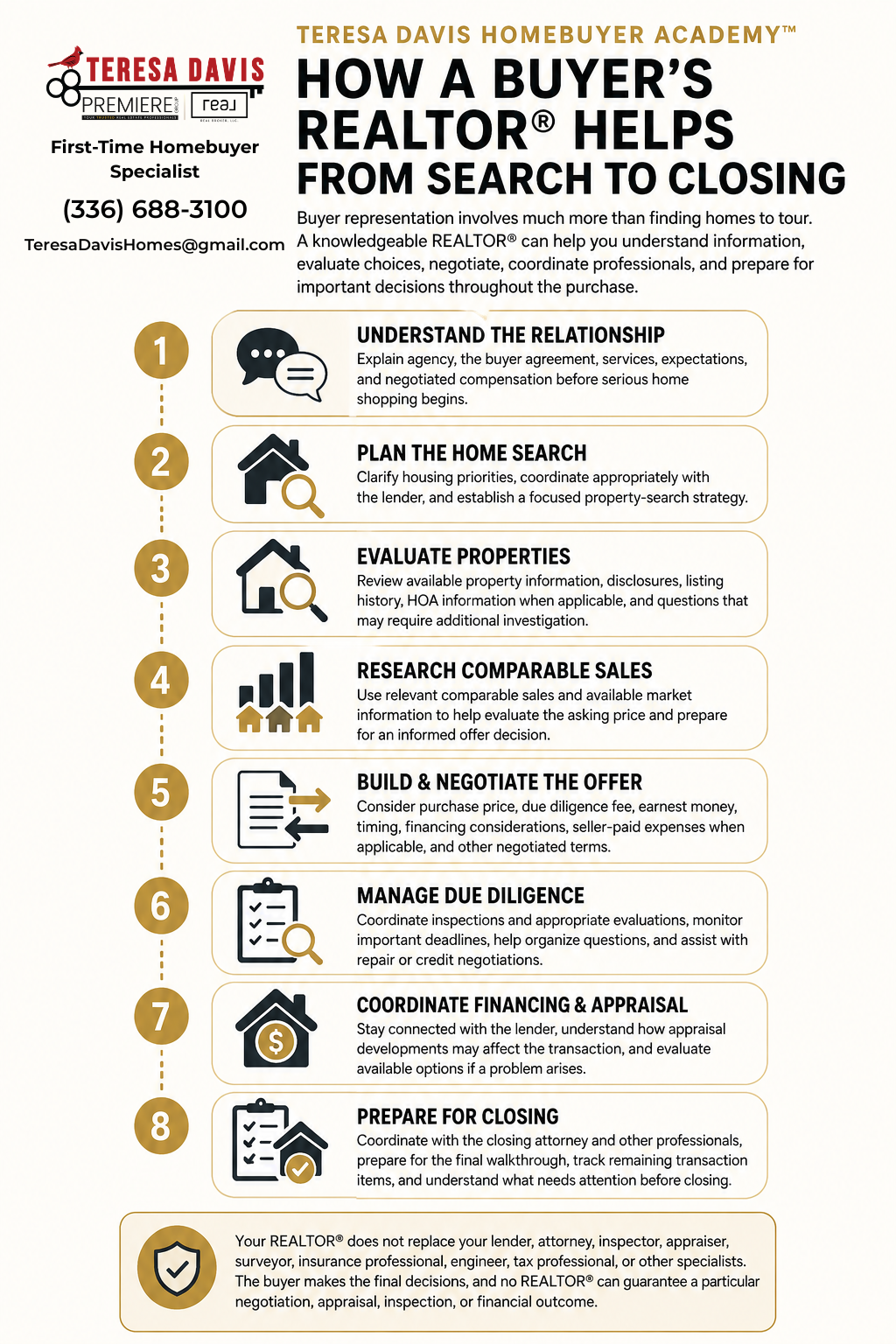
Frequently Asked Questions
Do I have to use a REALTOR® to buy a house in North Carolina?
No. You can purchase a home without hiring your own REALTOR®. However, buying without knowledgeable representation means accepting considerably more responsibility for evaluating the property, researching comparable sales, deciding what to offer, negotiating terms, understanding North Carolina due diligence, tracking deadlines, coordinating inspections, responding to appraisal issues, communicating with the other side, and helping move the transaction toward closing.
For a first-time homebuyer, the risk is not simply that you may have questions. The greater concern is that you may not yet know which questions need to be asked before an important deadline or financial decision occurs.
For example, offering substantially more than market evidence supports can become a serious issue if the property later appraises below the purchase price. The seller is not automatically required to reduce the price, and depending on your contract, financing, timing, and negotiations, you may have to consider contributing additional cash, negotiating another solution, or deciding not to proceed. Money you have already committed or spent—including due diligence, earnest money, inspections, appraisal, or other expenses—may be affected differently depending on the circumstances.
A REALTOR® cannot remove every risk, but experienced buyer representation can help you evaluate those risks before you make decisions involving your money.
What does a buyer’s REALTOR® actually do for a first-time homebuyer?
A buyer’s REALTOR® can help with much more than finding homes and scheduling showings. Depending on your transaction, your REALTOR® may help you:
- understand the homebuying process;
- establish a property-search strategy;
- evaluate homes and available property information;
- research recent comparable sales;
- consider whether an asking price appears supported by available market evidence;
- develop an offer strategy;
- understand the potential financial consequences of due diligence fees, earnest money, and other offer terms;
- negotiate price and terms;
- coordinate inspections and additional evaluations;
- help you work through inspection findings;
- monitor important contractual deadlines;
- communicate with your lender;
- help you understand the transaction implications of a low appraisal;
- negotiate when problems arise;
- coordinate with the closing attorney and other professionals;
- prepare for the final walkthrough and closing; and
- help you understand what needs your attention next.
For a first-time homebuyer, one of the most valuable parts of good representation is having someone who is willing to teach you while representing you. You should not be expected to already know how every part of a real estate transaction works before buying your first home. A REALTOR® who regularly works with first-time buyers can help turn an unfamiliar process into a series of decisions that are easier to understand and manage.
Who pays my REALTOR® when I buy a home?
Buyer-agent compensation is negotiated and should be clearly explained in your written buyer agreement. The amount or method used to determine compensation must be defined in the agreement, and compensation is not set by law. That does not automatically mean you should expect to pay the full amount directly out of pocket.
Depending on the property and transaction, some or all of the negotiated compensation may be paid by the seller or another permitted source. A buyer can also ask the seller to pay buyer-agent compensation as part of the purchase offer. Current consumer guidance from the National Association of REALTORS® specifically identifies requesting seller payment as an available option.
When I represent a buyer, compensation is something I explain upfront. When appropriate, I work to negotiate seller payment of my compensation as part of the overall offer strategy. Seller payment cannot be guaranteed because the seller, property, competing offers, financing, and other terms of each transaction are different.
The goal is for you to understand the negotiated arrangement before you move forward so that compensation is not an unexpected issue later in the transaction.
Why do I need to sign a buyer agreement before touring homes?
A written buyer agreement explains the professional relationship between you and your real estate professional, including the services being provided and the negotiated compensation arrangement. For REALTORS® and MLS Participants subject to current National Association of REALTORS® MLS policy, a written agreement with the buyer is required before touring a home together. The agreement must include specific compensation disclosures, and compensation must be objectively ascertainable rather than open-ended.
North Carolina has also long required buyer agency agreements to be in writing no later than the time an offer is made, although an agreement may be entered into earlier. The buyer agreement should not be treated as something you are expected to sign without understanding it.
Before we begin working together, I want you to understand what I will do for you, how we will work together, the negotiated compensation, and the expectations on both sides. If something is unclear, that is the time to ask questions. For a first-time buyer, having that conversation before you become emotionally attached to a particular house can make the rest of the process much easier to understand.
Can the listing agent help me if I do not have my own REALTOR®?
A listing agent can provide information about the property and facilitate parts of the transaction, but you should understand whom that agent represents before relying on that person for advice or sharing confidential information. In a typical listing relationship, the listing firm represents the seller. North Carolina recognizes different agency arrangements, and any situation involving representation of both sides requires specific agency disclosures and consent.
The seller and buyer may both want the transaction to close, but they can have very different negotiating interests. The seller may want a higher price, stronger deposits, fewer concessions, or terms favorable to the seller. As the buyer, you may be focused on paying a price supported by available market information, limiting unnecessary financial exposure, obtaining appropriate time for due diligence, addressing property concerns, and structuring terms that support your financing and goals.
Having your own REALTOR® gives you someone whose role is focused on helping you understand and navigate the transaction from the buyer’s perspective.
What Happens Next?
You have reached the final question in Section 1 — Dreaming About Buying a Home.
At this point, you have worked through many of the big-picture questions first-time buyers commonly ask before they are ready to seriously pursue a home: whether you are ready, whether buying makes financial sense, how affordability works, whether you need a large down payment, whether you should buy now or wait, what the process costs, how long buying can take, what kind of first home may make sense, and why professional buyer representation matters.
The next stage is turning those ideas into financial preparation. You do not need to have perfect finances before you begin learning about homeownership. You do need to understand where you stand, what money may be needed, what expenses to prepare for, and what financial decisions could make buying easier or more difficult.
That is exactly what Section 2 — Preparing Your Finances is designed to help you do. Your next lesson is: How Much Money Do I Need to Buy a Home?
In that lesson, we will begin breaking down the money you may need before and during a home purchase—including the down payment, closing-related expenses, due diligence, inspections, appraisal, reserves, and other costs that can be easy for first-time buyers to overlook.
The goal is not to make buying a home feel financially overwhelming. It is to help you know what to prepare for so you can build a realistic plan.
Ready to Take the Next Step?
If you are thinking about buying your first home and still have questions, you do not have to figure everything out before reaching out for help. One of the reasons I specialize in working with first-time homebuyers is that I understand how many questions come before the home search ever begins. You may be wondering whether your finances are ready, how much home makes sense for your budget, what you should do first, how buyer representation works, or whether buying is even the right decision for you yet.
Those are exactly the conversations I am here to have. My goal is to help you understand the process before you are expected to make major decisions—not to pressure you into buying before you are ready.
Contact Teresa Davis
If you would like to talk through your situation, questions, timeline, or what working together would look like, you can contact me directly.
Teresa Davis
REALTOR® / Professional Real Estate Advisor
PREMIERE Group of Real Broker LLC
I am especially familiar with helping first-time homebuyers throughout Davidson County, Randolph County, Guilford County, Forsyth County, and surrounding North Carolina communities.
Begin the One Real Mortgage Pre-Approval Process
If you are ready to take a closer look at the financing side of buying a home, you can begin the pre-approval process through One Real Mortgage. Using One Real Mortgage is optional and is not required in order to work with Teresa Davis as your REALTOR®.
Teresa Davis
Loan Originator NMLS #2597433
One Real Mortgage
Pre-approval is subject to application, qualification, documentation, underwriting requirements, loan terms, and applicable lending guidelines. Mortgage qualification, loan programs, terms, costs, and final approval depend on the borrower, property, transaction, documentation, underwriting, and applicable lending requirements. Beginning a pre-approval process does not guarantee financing or require you to purchase a home. It is a practical way to learn more about your potential financing options, estimated payment, and possible next steps.
Ready for the next lesson? Use “Next Question” below to continue to "How much money do I need to buy a home?"
You have completed Section 1 — Dreaming About Buying a Home. Your next step is Section 2 — Preparing Your Finances, beginning with: How Much Money Do I Need to Buy a Home?
2. Preparing Your Finances
← Back to Homebuyer RoadmapPreparing your finances is about understanding your budget, improving your credit, and knowing how much you may need for upfront and ongoing homeownership costs. These resources will help you create a realistic plan and move toward buying a home with greater confidence.
2:1 - How much money do I need to buy a home?

Knowing how much money you need to buy a home is about more than figuring out a down payment. A successful homebuying budget considers the money you may need at several different points in the process—from making an offer and completing inspections to paying closing costs and preparing for expenses after you receive the keys.
For first-time buyers in North Carolina, this distinction is especially important because some transaction funds may be paid before closing. Depending on your offer and contract, you may need money for a due diligence fee, earnest money, inspections, and other due-diligence expenses in addition to the funds ultimately required at closing. Your actual costs will depend on the home, mortgage, contract terms, services you choose, and other details of your transaction.
The goal is not simply to save enough to reach closing. It is to understand the full cash picture so you can make informed decisions without assuming every dollar you have available should go toward the purchase. A well-planned homebuying budget also considers moving expenses, immediate home needs, maintenance, unexpected repairs, and the savings you want to keep after closing.
Quick Answer
There is no single amount of money that every buyer needs to purchase a home. Your total will depend on factors such as the purchase price, mortgage program, required down payment, closing costs and prepaid expenses, North Carolina contract deposits, inspections and other due-diligence expenses, and any eligible credits, gift funds, or assistance that may apply to your transaction.
Your down payment is only one part of the equation. The Consumer Financial Protection Bureau's Loan Estimate separates the down payment from other closing costs and calculates an Estimated Cash to Close after accounting for applicable deposits, seller credits, and other adjustments.
Some mortgage programs may allow qualified buyers to purchase with a relatively small down payment—or, for eligible borrowers using certain VA or USDA financing, potentially no down payment. That does not mean the entire purchase requires no money out of pocket, because other transaction and property-related expenses may still apply.
A better question than “How much do I need for a down payment?” is: “How much money should I have available for the entire homebuying process and still feel financially prepared after closing?”
At a Glance
- Your down payment is not your total homebuying cost. You may also need money for closing costs, prepaid expenses, contract-related funds, inspections, and other transaction expenses.
- Some money may be needed before closing. In North Carolina, your offer may include negotiated due diligence and earnest money, and you may pay for inspections or other due-diligence services while you are under contract.
- Your mortgage program affects how much cash you may need. Down-payment requirements and permitted sources of funds vary by loan program and individual eligibility.
- Credits or other eligible funds may reduce what comes directly from your savings. Depending on the transaction and applicable requirements, seller credits, permitted gift funds, or qualifying homebuyer assistance may affect your out-of-pocket amount.
- Cash to close is different from your total financial plan. The amount needed to complete the closing does not include every expense you may face before or after buying the home.
- Plan for life after closing, too. Consider preserving funds for moving, immediate household needs, maintenance, unexpected repairs, and an emergency cushion instead of assuming every available dollar should be used for the purchase.
- Your actual numbers should be calculated for your specific situation. Your REALTOR® and mortgage professional can help you understand the real estate and financing pieces so you can build a more realistic homebuying cash plan.
Start With the Full Cash Picture, Not Just the Down Payment
When buyers ask, “How much money do I need to buy a home?” they often focus first on the down payment. That is an important number, but it is only one part of the financial picture.
A more useful way to plan is to think about when your money may be needed and what each amount is for. Depending on your transaction, you may need funds before closing, funds at closing, and savings that you intentionally keep available after the purchase.
Your homebuying cash plan may include:
- a down payment;
- closing costs;
- prepaid expenses;
- money associated with your North Carolina offer and contract;
- inspections and other due-diligence expenses;
- moving and immediate household expenses; and
- savings you want to preserve for homeownership after closing.
Some of these amounts may ultimately be credited toward the transaction, while others are separate expenses. That is why simply multiplying the purchase price by a down-payment percentage does not tell you how much money you should have available.
Your Down Payment Is Only One Piece of the Purchase
A down payment is the portion of the purchase price that you pay rather than finance through your mortgage. For example, if you purchase a home for $300,000 and make a 5% down payment, the down payment itself would be $15,000.
That does not mean $15,000 is all the money you would need for the purchase. Closing costs, prepaid expenses, inspections, deposits, and other transaction expenses may also need to be considered.
The amount required for a down payment depends on the mortgage program and the buyer's eligibility. A 20% down payment is not universally required. Current mortgage programs include qualifying conventional options with loan-to-value ratios as high as 97%, which generally means a 3% down payment, while FHA financing can allow a down payment as low as 3.5% for qualifying borrowers.
Eligible VA borrowers may also have access to a purchase-loan option with no down payment when applicable program requirements are satisfied.
These are program examples, not guarantees of qualification. Credit, income, debt, property eligibility, occupancy, loan limits, underwriting requirements, and other factors can affect which mortgage options are actually available to an individual buyer.
A lower down payment can help a buyer preserve more cash, but it may also affect mortgage insurance, monthly payment, loan pricing, or other financing considerations. The goal is not automatically to make the smallest or largest down payment possible. The better goal is to choose a financing structure that fits the buyer's complete financial situation.
Closing Costs Are Separate From the Down Payment
In addition to the down payment, buyers generally encounter closing costs associated with obtaining the mortgage and completing the real estate transaction.
Depending on the transaction, these may include charges connected with:
- the mortgage lender;
- appraisal or valuation services;
- settlement or closing services;
- title-related services;
- recording;
- homeowners insurance;
- property taxes or tax-related adjustments; and
- other services or requirements associated with the purchase.
Not every buyer will have the same charges, and not every transaction will use the same services. For that reason, it is better to review transaction-specific estimates than to assume that every buyer's closing costs will equal one standard percentage of the purchase price.
Your lender's Loan Estimate provides an early breakdown of projected loan terms and closing costs. As the transaction moves toward closing, the Closing Disclosure provides the final loan and closing information for review. The Consumer Financial Protection Bureau explains that lenders generally must provide the Closing Disclosure at least three business days before the scheduled mortgage closing.
What Are Prepaid Expenses?
Some amounts paid at or around closing are not simply fees for a service. They are amounts collected in advance for expenses associated with owning the home or maintaining the mortgage.
These may include, depending on the loan and transaction:
- prepaid interest;
- homeowners insurance premiums;
- property taxes; and
- initial deposits into an escrow account when an escrow account is being established.
These amounts can vary based on factors such as the closing date, insurance cost, tax timing, loan structure, and property. For example, prepaid interest may be affected by the number of days between closing and the beginning of the next full interest period. Property-tax and insurance amounts can also differ significantly from one property to another. This is another reason two buyers purchasing similarly priced homes may need different amounts of cash.
Understand the Difference Between Closing Costs and Cash to Close
One of the most important distinctions for a first-time buyer is the difference between closing costs and cash to close.
Closing costs are the various costs associated with the mortgage and transaction.
Cash to close is the amount the buyer is expected to bring to complete the closing after the applicable parts of the transaction are calculated together.
The Consumer Financial Protection Bureau explains that the Estimated Cash to Close shown on the Loan Estimate includes the down payment and closing costs, reduced by items such as deposits already paid to the seller, seller credits, and other applicable adjustments.
In simplified terms, the calculation may look something like this:
Down payment
+ closing costs and applicable prepaid expenses
− deposits already credited toward the purchase
− applicable seller credits or other adjustments
= estimated cash still needed at closing
This is a simplified educational framework, not a substitute for your actual Loan Estimate or Closing Disclosure.
It is also important to remember that cash to close does not necessarily represent every dollar you will spend during the homebuying process. You may already have paid certain expenses before closing, such as inspections or other due-diligence costs. Those expenses still matter when determining how much money you should have available overall.
A Simple Example
Consider a hypothetical buyer purchasing a $300,000 home.
Suppose the buyer's mortgage requires a 5% down payment.
The down payment would be: $300,000 × 5% = $15,000
If the buyer stopped planning there, the buyer might conclude that $15,000 is enough to purchase the home. But the complete financial picture could also include:
- transaction-specific closing costs;
- prepaid taxes, insurance, or interest;
- North Carolina due diligence and earnest money;
- inspection expenses;
- other property-specific due-diligence costs; and
- money the buyer wants to retain after closing.
If a portion of the buyer's deposits is credited at closing, or if the transaction includes eligible seller credits or other approved assistance, those amounts may reduce what the buyer must still bring on closing day. The important lesson is not the specific dollar amount in this hypothetical example. It is the planning method: Do not stop at the down payment. Build a budget for the entire transaction.
Once you understand that distinction, you can begin planning for the money that may be needed before closing, which is especially important for buyers purchasing a home in North Carolina.
Money You May Need Before Closing in North Carolina
One reason it is important to think beyond the down payment is that some homebuying expenses can occur well before closing day. In a North Carolina purchase, your offer may include a due diligence fee and earnest money deposit. These are separate amounts with different purposes and different contract consequences. Neither amount should simply be treated as another name for your down payment.
Understanding when these funds may be due is important because a buyer can have enough money planned for the eventual mortgage closing but still be unprepared for the cash needed earlier in the transaction.
What Is the Due Diligence Fee?
Under the commonly used North Carolina residential purchase contract, the due diligence fee is a negotiated amount paid by the buyer to the seller in exchange for the buyer's negotiated due diligence period. The amount is not established by law and may vary from one transaction to another. North Carolina Real Estate Commission guidance explains that the fee is generally delivered to the seller at contract formation.
During the due diligence period, the buyer can investigate the property and other aspects of the purchase. Depending on the transaction, that may include inspections, financing, appraisal considerations, insurance availability, title matters, surveys, repair concerns, and other issues relevant to the buyer's decision.
The due diligence fee is particularly important when planning your available cash because it is generally nonrefundable if the buyer terminates the standard contract, although contractual circumstances can affect the parties' rights. North Carolina Real Estate Commission guidance specifically cautions that the due diligence fee generally is not returned when a buyer terminates during the due diligence period.
That does not mean every transaction works exactly the same way or that a REALTOR® should provide a legal interpretation of a buyer's contract. Your specific rights and obligations depend on the contract and circumstances. Questions requiring legal interpretation should be discussed with a North Carolina real estate attorney.
How Is Earnest Money Different?
Earnest money is a separate negotiated deposit associated with the purchase contract. North Carolina Real Estate Commission consumer guidance distinguishes earnest money from the due diligence fee and notes that a due diligence fee is not required by law.
Under the commonly used standard contract, the treatment of earnest money can depend on when and why the contract ends. For example, North Carolina Real Estate Commission guidance explains that when a buyer properly terminates during the due diligence period under the standard form, earnest money is generally returned while the due diligence fee generally is not.
For financial planning purposes, the important point is this: Due diligence money and earnest money can require available funds before you ever reach closing.
The amount offered for either one can vary depending on the transaction, negotiations, market conditions, purchase price, and the buyer's strategy. There is no single amount that is appropriate for every North Carolina buyer.
Inspections and Other Due-Diligence Expenses Also Require Cash
Deposits are not the only expenses that may arise while you are under contract. A buyer may also choose or need to pay for property investigations and transaction services before closing. Depending on the property and circumstances, these can include:
- a general home inspection;
- pest or wood-destroying-insect inspection;
- well or septic evaluation;
- radon testing;
- HVAC, roofing, structural, electrical, plumbing, or other specialized evaluations;
- surveys or property-related research; and
- other services that may be appropriate for the particular home.
Not every buyer needs every inspection or service. The property's age, features, location, condition, loan requirements, and information discovered during the transaction can affect what additional evaluations make sense. These expenses are important to include in your homebuying plan because they may be paid when the service is performed, rather than being postponed until closing.
If a transaction does not close, amounts already spent on inspections or other professional services are generally separate from the money needed to complete the purchase. That is another reason buyers should avoid thinking of their savings only in terms of a down payment.
Credits, Gift Funds, and Assistance May Change How Much You Need
The amount that must come directly from your own savings can sometimes be affected by other permitted sources of funds. Depending on the mortgage program, transaction, and eligibility requirements, these may include:
- seller credits toward allowable closing costs;
- lender credits;
- permitted gift funds from an eligible source; or
- qualifying down payment or closing-cost assistance.
Seller credits are negotiated as part of the transaction and are not guaranteed. The Consumer Financial Protection Bureau explains that sellers may agree to contribute toward a buyer's closing costs, and those credits are reflected in the closing calculations.
Mortgage programs also have specific rules regarding acceptable sources of funds, documentation, contribution limits, and how money can be used. A buyer should verify those requirements with the mortgage professional handling the loan rather than assuming that any gift, credit, or assistance program can automatically be used.
North Carolina Homebuyer Assistance May Be Available
Some qualifying buyers in North Carolina may be eligible for homebuyer assistance. As of August 2026, the North Carolina Housing Finance Agency states that its NC Home Advantage Mortgage™ can provide qualified first-time and move-up buyers with down payment assistance of up to 3% of the loan amount. The Agency also offers the NC 1st Home Advantage Down Payment, which currently provides $15,000 in down payment assistance to eligible first-time buyers and military veterans who satisfy the program's additional requirements.
These programs have eligibility, loan, income, sales-price, property, and other requirements that can change. Assistance should therefore be viewed as a potential resource—not money a buyer should assume will be available until eligibility has been confirmed. The Academy will address North Carolina first-time homebuyer assistance in greater detail in the dedicated lesson “Can I qualify for first-time homebuyer assistance in North Carolina?”
Do Not Plan to Spend Every Dollar You Have
There is an important difference between: the amount required to complete the purchase and the amount you may want available to remain financially comfortable after the purchase. Buying the home is the beginning of homeownership, not the end of your financial responsibilities.
After closing, you may need money for moving, utility setup, furnishings or appliances, routine maintenance, immediate repairs, deductibles, and unexpected expenses. Even a well-maintained home can create expenses that were not obvious when the purchase was planned. That is why a buyer who technically has enough money to reach closing may still decide that purchasing immediately would leave too little financial flexibility afterward.
There is no universal emergency-fund amount that works for every household. Income stability, other obligations, property condition, personal risk tolerance, and anticipated expenses all matter. The lesson is simply to treat post-closing savings as part of your homebuying decision rather than an afterthought.
Build Your Homebuying Cash Plan in Separate Buckets
Instead of asking whether one savings-account balance is “enough,” separate your planning into three categories:
1. Money needed before closing
This may include your negotiated due diligence fee, earnest money, inspections, and other due-diligence expenses.
2. Money needed at closing
This may include your remaining down payment, closing costs, prepaid expenses, and other amounts shown in the final cash-to-close calculation after applicable credits and deposits are accounted for. The CFPB's Loan Estimate and Closing Disclosure are designed to help borrowers understand these transaction-specific figures.
3. Money you want to keep after closing
This is your separate cushion for moving, homeownership expenses, emergencies, and other financial priorities.
Thinking in these three categories can provide a much clearer picture than simply saying, “I have enough for the down payment.”
A Practical Homebuying Cash Framework
A simplified planning framework can look like this:
Down payment
+ estimated closing costs and prepaid expenses
+ funds needed for your North Carolina offer and contract
+ inspections and other due-diligence expenses
− applicable deposits that are credited at closing
− eligible seller or lender credits
− eligible assistance or other approved funds
= estimated overall buyer cash requirement
Then consider a separate amount for:
Post-closing savings and reserves
This framework is intended to help organize your planning. It is not a substitute for your lender's Loan Estimate, Closing Disclosure, loan-program requirements, purchase contract, or individualized advice from the appropriate professionals.
Why Two Buyers Purchasing the Same-Priced Home May Need Different Amounts
Two buyers can purchase homes at the same price and still need very different amounts of cash.
One buyer might make a larger down payment but receive a seller credit toward eligible closing costs. Another may use a lower-down-payment mortgage but have different prepaid expenses or mortgage costs. One buyer may qualify for down payment assistance while another does not. Their negotiated due diligence fees, earnest money deposits, inspections, insurance premiums, closing dates, and loan structures can also differ.
That is why there is no trustworthy universal answer such as: “You need exactly $20,000 to buy a $300,000 home.” The better approach is to calculate your own transaction using real numbers as they become available.
Your mortgage professional can help estimate the financing and cash-to-close side of the purchase, while your REALTOR® can help you understand the timing and real estate implications of your offer, deposits, due-diligence decisions, negotiations, and other transaction expenses.
Together, those pieces give you a much clearer answer to the question that matters most: “How much money should I have available to buy this home without overlooking the rest of the financial picture?”
How Your REALTOR® Helps You Plan for Upfront Homebuying Costs
Buying a home involves more than qualifying for a mortgage. Your financing determines important parts of what you may be able to purchase, but your offer strategy and contract decisions can also affect how much money you need and when you need it.
A North Carolina REALTOR® can help you understand the real estate side of that financial timeline before you make an offer.
For example, your REALTOR® can help you evaluate how proposed offer terms may affect:
- the due diligence fee;
- earnest money;
- the length of the due diligence period;
- inspection and other property-investigation expenses;
- seller concessions or closing-cost negotiations;
- repair negotiations;
- the proposed closing date; and
- other transaction terms that could affect your available funds.
This becomes especially important when you are considering a competitive offer. A stronger offer is not simply the offer with the highest purchase price or the largest deposits. The terms should also make sense for your financial position, financing, risk tolerance, and overall homebuying plan.
Your REALTOR® should also coordinate with your mortgage professional when offer terms could affect financing. For example, before relying on a seller credit or changing financial terms in an offer, it is important to understand whether the proposed structure works with your mortgage program.
The REALTOR® and mortgage professional have different responsibilities, but their work often overlaps in practical ways:
- Your mortgage professional helps you understand financing, qualification, loan-program requirements, estimated payment, and cash-to-close considerations.
- Your REALTOR® helps you understand the real estate transaction, property, market information, offer strategy, contract-related decisions, negotiations, and transaction timeline.
When those pieces are coordinated, you can make decisions based on the whole transaction instead of discovering later that an offer term or upfront expense placed more pressure on your available cash than expected.
Your REALTOR® does not determine mortgage eligibility, and no REALTOR® can guarantee that a seller will accept an offer, provide concessions, make repairs, or agree to particular financial terms. Likewise, questions requiring interpretation of your legal rights or obligations under a contract should be directed to a North Carolina real estate attorney.
Teresa’s Professional Insight
One of the most important financial conversations to have before serious home shopping is not simply, “How much house can I afford?” It is: “How much money will I need throughout the transaction, when will I need it, and what do I want to have left after closing?” A buyer can have enough money for a down payment and still be unprepared for everything else that happens between making an offer and becoming a homeowner.
That is why I encourage buyers to look at their funds in stages. We want to understand what may be needed when an offer is made, what expenses may come up while the home is under contract, what the lender estimates will be needed at closing, and what the buyer wants to keep available afterward.
As both a REALTOR® / Professional Real Estate Advisor with PREMIERE Group of Real Broker LLC and a Loan Originator NMLS #2597433 with One Real Mortgage, I understand how closely the real estate and mortgage sides of a purchase can interact. My goal is to help buyers understand those moving pieces and ask the right questions early, while making sure each professional role remains clear.
The amount of cash you have available can affect more than your down payment. It may influence your financing choices, offer strategy, due-diligence decisions, negotiations, and how comfortable you feel after you receive the keys.
You do not need to know every exact number before you begin learning about the process. But before making major financial or contractual decisions, you should have a realistic picture of the full homebuying cash requirement—not just the down payment.
Helpful Tip
Create separate savings categories instead of thinking of all your available money as one homebuying fund. A simple way to organize your planning is:
Purchase and transaction funds
Money that may ultimately be applied toward the purchase or closing.
Pre-closing expenses
Money you may spend before closing for items such as inspections and other due-diligence services.
Cash-to-close funds
Money your lender and closing documents indicate will be required to complete the transaction after applicable credits, deposits, and adjustments.
Post-closing savings
Money you intentionally keep available for moving, immediate home needs, maintenance, unexpected repairs, emergencies, and other priorities.
Keeping these categories separate can make it easier to see whether you are truly prepared for the entire purchase rather than simply reaching a down-payment target.
Keep in Mind
- The minimum down payment is not the same as the total amount of money needed to buy a home.
- Some expenses may occur before closing. North Carolina buyers should plan for the possibility of contract-related funds, inspections, and other due-diligence expenses during the transaction.
- Due diligence fees and earnest money are negotiated. There is no universal amount that every buyer should offer.
- Closing costs and prepaid expenses vary. Your actual amounts depend on your mortgage, property, closing date, insurance, taxes, services, and transaction details.
- Seller credits are negotiated, not guaranteed. They may also be subject to mortgage-program requirements and limits.
- Gift funds and assistance programs have rules. Do not assume funds can be used until your mortgage professional confirms the applicable requirements and documentation.
- Homebuyer assistance is eligibility-based. Program availability, requirements, and benefits can change, so current information should be verified before relying on assistance in your purchase plan.
- Your Loan Estimate and Closing Disclosure provide transaction-specific information. Use actual lender disclosures rather than a generic online estimate when making final financial decisions.
- Keep post-closing needs in the conversation. Having enough to complete the purchase does not necessarily mean using every available dollar is the right decision for your household.
- Professional roles matter. Your REALTOR® can guide you through the real estate transaction, your mortgage professional can address financing, and a North Carolina real estate attorney should address questions requiring legal interpretation.
The goal is not to find one universal savings number. It is to understand your complete financial picture so you can prepare for the purchase with fewer surprises and more informed expectations.
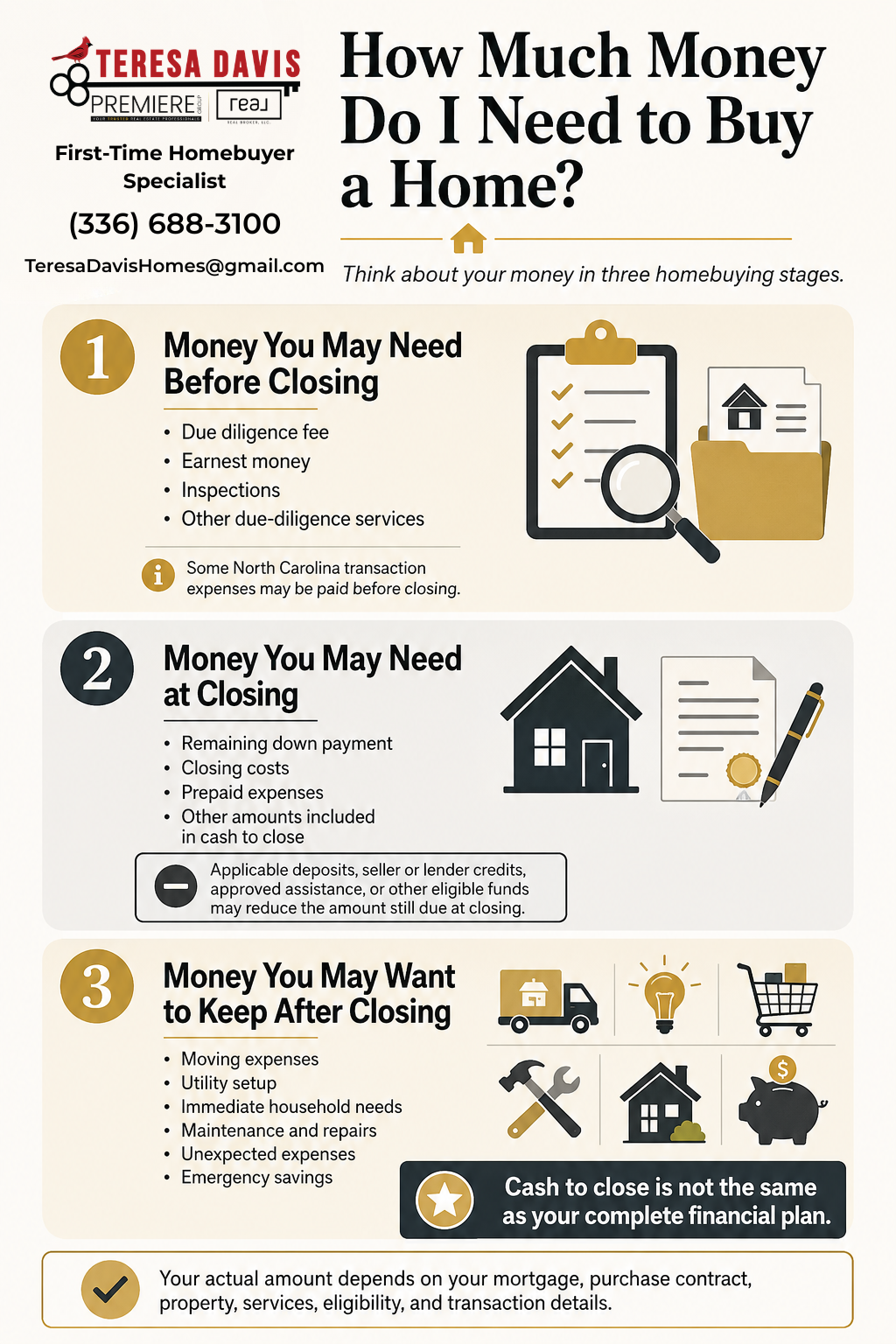
Frequently Asked Questions
Is the down payment the only money I need to buy a home?
No. Your down payment is only one part of the total financial picture. You may also need money for closing costs, prepaid expenses, North Carolina due diligence and earnest money, inspections, and other transaction expenses. Some of those costs may occur before closing, while others are included in your final cash-to-close calculation.
It is also helpful to consider money you want to keep after closing for moving, maintenance, unexpected repairs, emergencies, and other homeownership expenses.
How much money might I need before closing on a home in North Carolina?
The amount varies by transaction. Before closing, a North Carolina buyer may need funds for a negotiated due diligence fee, earnest money deposit, inspections, and other property-related due-diligence services.
The amounts and timing depend on the contract, property, negotiations, services selected, and other transaction details. Your REALTOR® can help you understand the real estate timeline, while your mortgage professional can help you plan for financing and estimated cash-to-close requirements.
Are the due diligence fee and earnest money part of my down payment?
No. The due diligence fee and earnest money are separate from the mortgage down payment.
In a typical North Carolina transaction, they are negotiated contract-related funds that may be paid before closing. Depending on the contract and transaction, certain deposits may later be credited in the closing calculations, but that does not make them the same thing as a down payment.
Because contractual rights and refundability can depend on the circumstances, questions requiring legal interpretation should be discussed with a North Carolina real estate attorney.
Can seller credits, gift funds, or down payment assistance reduce how much money I need?
Potentially. Depending on the mortgage program, transaction, and your eligibility, permitted seller or lender credits, approved gift funds, or qualifying homebuyer assistance may reduce the amount that must come directly from your own savings.
However, these sources are subject to different rules. Seller credits must be negotiated, gift funds must satisfy applicable mortgage requirements, and assistance programs have eligibility and documentation requirements. Your mortgage professional should confirm what is permitted for your specific financing before you rely on any of these funds.
Should I use all of my savings for the down payment and closing costs?
Not necessarily. Having enough money to complete the purchase is different from deciding how much of your savings you are comfortable using.
After closing, you may still have moving expenses, utility costs, maintenance, immediate household needs, unexpected repairs, insurance deductibles, and other financial obligations. There is no universal reserve amount that is right for every household, but it is wise to include post-closing financial flexibility in your planning rather than focusing only on the minimum amount required to close.
What Happens Next?
Once you understand that buying a home requires planning for more than a down payment, the next step is to look at another important part of your financial preparation: your credit.
Your credit profile can affect mortgage eligibility, the loan programs available to you, loan pricing, and other financing considerations. You do not need perfect credit to begin learning about homeownership, and different mortgage programs can have different qualification standards.
In the next lesson, “What credit score do I need to buy a home in North Carolina?”, you will learn how credit scores fit into mortgage qualification, why there is not one universal score required for every home loan, and what first-time buyers should understand before applying for financing.
Ready to Take the Next Step?
You do not have to guess how the different pieces of your homebuying budget fit together. If you are beginning to plan for a purchase, the next step can simply be getting clearer information about your options and the costs that may apply to your situation.
Contact Teresa Davis
If you would like help understanding the North Carolina homebuying process, transaction timing, offer-related expenses, or how the real estate side of your purchase fits into your overall financial plan, you can contact Teresa Davis.
Teresa Davis
REALTOR® / Professional Real Estate Advisor
PREMIERE Group of Real Broker LLC
Explore the One Real Mortgage Pre-Approval Process
If you are ready to explore financing, the pre-approval process can help you better understand potential mortgage options, qualification requirements, estimated payment considerations, and the funds that may be needed for your specific purchase. Using One Real Mortgage is optional and is not required in order to work with Teresa Davis as your REALTOR®.
Teresa Davis
Loan Originator NMLS #2597433
One Real Mortgage
Mortgage qualification, loan programs, terms, costs, and final approval depend on the borrower, property, transaction, documentation, underwriting, and applicable lending requirements. Beginning a pre-approval process does not guarantee financing or require you to purchase a home. It is a practical way to learn more about your potential financing options, estimated payment, and possible next steps.
Continue Through the Teresa Davis Homebuyer Academy™
Ready for the next lesson? Use “Next Question” below to continue to "What credit score do I need to buy a home in North Carolina?".
2:2 - What credit score do I need to buy a home in North Carolina?

If you have searched online for the credit score needed to buy a home, you may have seen numbers such as 580, 620, or 640. That can make it sound as though there is one universal score you must reach before you can become a homeowner. There is not one credit score that every buyer must have to purchase a home in North Carolina.
The credit requirements that apply to you depend on several factors, including the mortgage program, how the loan is underwritten, the lender’s requirements, and whether you are using a homebuyer assistance program. For example, Fannie Mae currently does not require a minimum credit score for loan files receiving automated underwriting through Desktop Underwriter, while manually underwritten conventional loans can have minimum-score requirements.
VA does not establish a minimum credit score for VA-backed loans, and USDA’s Section 502 Guaranteed Loan Program states that it has no program credit-score requirement, although lenders still evaluate creditworthiness and may have their own requirements.
North Carolina assistance programs can add another layer. The NC Home Advantage Mortgage™ currently requires a credit score of 640 or higher, with a 660 requirement for manufactured homes. That means a buyer could potentially meet the requirements of an underlying mortgage program but not meet the separate requirements of a particular assistance program.
Understanding your credit is important, but your goal should not be to chase one “magic number.” A mortgage decision generally considers your overall financial profile—including your credit history, income, debts, assets, loan program, and other underwriting factors. Learning where you stand can help you determine whether you may be ready to move forward now or whether additional preparation would be helpful.
Quick Answer
There is no single minimum credit score required to buy a home in North Carolina. The score you may need depends on the type of mortgage, the underwriting method, the lender, and any assistance program you plan to use.
Some current mortgage programs and automated underwriting systems do not impose one universal minimum score. For example, Fannie Mae’s Desktop Underwriter does not require a minimum credit score for DU (Desktop Underwriter) loan casefiles, and Freddie Mac states that a minimum Indicator Score is not required for mortgages receiving an Accept recommendation through Loan Product Advisor. VA does not set a minimum credit score for VA-backed loans, and USDA’s Section 502 Guaranteed Loan Program does not have a program minimum credit-score requirement. Individual lenders and specific loan products can still apply additional requirements.
If you are considering North Carolina down payment assistance, separate program requirements may apply. The NC Home Advantage Mortgage™ currently requires a credit score of at least 640 for most eligible properties.
Most importantly, meeting a minimum credit-score requirement does not guarantee mortgage approval, and having a score below a number you have heard online does not automatically mean you cannot qualify. The best way to understand your options is to have your complete mortgage profile evaluated rather than relying on one credit score by itself.
At a Glance
- There is no universal North Carolina credit-score requirement. Your financing path determines which credit standards apply.
- A 620 score is not a universal conventional-loan minimum. Fannie Mae currently does not require a minimum score for DU loan casefiles, although manually underwritten loans and particular mortgage products can have minimum requirements.
- Government-backed programs work differently. VA does not set a minimum credit score, and USDA’s Section 502 Guaranteed Loan Program states that it has no program credit-score requirement, although lenders still evaluate the borrower’s credit and may impose additional requirements.
- North Carolina assistance programs can have separate requirements. The NC Home Advantage Mortgage™ currently requires a credit score of 640 or higher, and manufactured homes currently require 660.
- Credit score is only one part of mortgage qualification. Lenders may also evaluate credit history, income, debts, assets, the loan program, and the overall underwriting findings.
- Do not automatically disqualify yourself based on a score you see online. Your actual mortgage options depend on your complete financial profile and the financing program being considered.
There Is No One “Magic” Credit Score for Buying a Home
When buyers ask, “What credit score do I need to buy a home?” they are often expecting one number. Mortgage qualification is more nuanced. There is no single credit score that applies to every financed home purchase in North Carolina.
The credit standard that applies can depend on several layers:
- the mortgage program;
- whether the loan receives an automated underwriting decision or is manually underwritten;
- requirements associated with a particular loan product;
- additional standards established by the lender or investor; and
- separate eligibility requirements for a down payment or homebuyer assistance program.
That distinction matters because a number you see associated with FHA, conventional, VA, or USDA financing may describe only one part of the qualification process. Meeting a program's minimum standard does not mean a lender must approve the loan, and a lender's own minimum should not automatically be described as the minimum established by the government agency or mortgage program.
Your credit score also does not stand alone. Mortgage underwriting can consider information such as your credit history, income, debts, assets, and other characteristics of the application. VA, for example, explains that a lender considers a borrower's credit history, income, debts, and assets when determining the loan amount the borrower can afford.
Understanding these distinctions can help you avoid two common mistakes: assuming that reaching a particular score guarantees approval, or assuming that falling below a number you found online automatically means homeownership is out of reach.
Conventional Loans: Why “You Need a 620” Is No Longer a Complete Answer
For years, consumers have commonly heard that a 620 credit score is the minimum for a conventional mortgage. That statement is now too broad to accurately describe all conventional underwriting.
Fannie Mae's current Selling Guide distinguishes between loans that are manually underwritten and loans evaluated through Desktop Underwriter (DU), its automated underwriting system.
For manually underwritten loans, Fannie Mae currently lists minimum credit scores of:
- 620 for fixed-rate loans; and
- 640 for adjustable-rate mortgages (ARMs).
For DU loan casefiles, however, Fannie Mae states that a minimum credit score is not required. Instead, DU assesses the borrower's creditworthiness using its automated risk analysis. Fannie Mae also explains that credit scores are not an integral part of DU's risk assessment because DU analyzes information contained in the credit report.
Freddie Mac has a similar distinction for loans evaluated through Loan Product Advisor (LPA). Its current guidance states that a minimum Indicator Score is not required for mortgages receiving an Accept risk-class recommendation through LPA.
That does not mean credit scores are irrelevant to conventional financing. Fannie Mae still requires credit scores for most loans it purchases or securitizes, and credit score can affect loan-level pricing adjustments. Particular products, transactions, manual underwriting situations, lenders, and investors may also have requirements that affect eligibility.
For a first-time buyer, the practical takeaway is this: do not assume that 620 is a universal conventional-loan cutoff, but do not assume that having no universal automated-underwriting minimum means every credit profile will qualify.
The complete loan application and underwriting result still matter.
FHA Loans: Understanding the 580 and 500–579 Credit-Score Ranges
FHA financing is often discussed in connection with buyers who have less-than-perfect credit, but the FHA credit-score rules need to be explained carefully.
Under current FHA policy:
- A borrower with a Minimum Decision Credit Score of 580 or higher may be eligible for FHA's maximum financing.
- A borrower with a Minimum Decision Credit Score between 500 and 579 is limited to a maximum loan-to-value ratio of 90%, which generally means a substantially larger borrower investment than the minimum required with maximum FHA financing.
For a typical FHA purchase transaction that qualifies for maximum financing, FHA permits a maximum loan-to-value ratio of 96.5%, which is why FHA financing is commonly associated with a minimum 3.5% down payment. These numbers are FHA program guidelines, not promises of approval.
An FHA-approved lender still has to underwrite the borrower's complete application. A lender or investor may also establish requirements that are more restrictive than FHA's baseline eligibility standards. As a result, seeing that FHA permits certain financing at a particular score does not necessarily mean every FHA lender will approve the same borrower at that score.
This is an important distinction for buyers comparing information online:
FHA's baseline rule tells you what the FHA program permits. Your lender's requirements determine whether that lender can approve your particular application under the program.
VA Loans: VA Does Not Set a Minimum Credit Score
For eligible Veterans, service members, and other qualifying borrowers, VA-backed home loans work differently.
The U.S. Department of Veterans Affairs currently states plainly that VA does not require a minimum credit score for a VA-backed home loan. VA also notes that some lenders do have their own credit-score requirements.
That distinction is especially important because consumers may encounter statements such as “VA requires a 620.” A particular lender may use 620—or another score—as part of its own lending standards, but that should not be confused with a universal minimum established by VA.
VA eligibility also does not mean automatic loan approval. VA explains that the lender still evaluates factors that include:
- credit history
- income
- debts
- assets
A buyer considering VA financing should therefore distinguish between eligibility for the VA home loan benefit and qualification for the actual mortgage. A Certificate of Eligibility establishes that a borrower has qualifying VA home loan entitlement; it does not by itself establish that the borrower is approved for a particular mortgage amount.
USDA Guaranteed Loans: No Program Minimum Does Not Mean No Credit Review
USDA's Single Family Housing Guaranteed Loan Program, commonly called a USDA loan, can be another important financing option for eligible properties and borrowers in qualifying rural areas.
USDA Rural Development currently states that the Section 502 Guaranteed Loan Program has no credit score requirement. At the same time, USDA requires applicants to demonstrate a willingness and ability to manage debt, and borrowers apply through approved lenders that handle the loan application and underwriting process. This means that “USDA has no minimum credit score” should not be interpreted as “credit does not matter.”
USDA's Guaranteed Underwriting System, known as GUS, evaluates loan applications, and USDA guidance distinguishes among different underwriting recommendations and documentation requirements. For example, current USDA guidance states that GUS Accept files do not require credit-score validation, while other underwriting paths can require additional credit analysis or validation.
As with VA financing, an individual lender or investor may establish its own credit requirements even though the federal program itself does not establish one universal minimum score. USDA's own consumer guidance encourages applicants to work with approved lenders regarding their individual scenarios.
For buyers considering properties in Davidson, Randolph, Guilford, Forsyth, or surrounding North Carolina counties, USDA eligibility also depends on requirements beyond credit—including household income and whether the property is located in an eligible rural area. Credit score is therefore only one part of determining whether USDA financing may be an appropriate option.
North Carolina Homebuyer Assistance Can Have Its Own Credit Requirements
The mortgage itself is only one part of the credit-score question. If you plan to use a North Carolina homebuyer or down payment assistance program, that program may have separate eligibility requirements in addition to the requirements for your first mortgage.
For example, the North Carolina Housing Finance Agency currently requires a credit score of 640 or higher for the NC Home Advantage Mortgage™. For eligible manufactured homes, the current requirement is 660 or higher. The program can be paired with qualifying FHA, USDA, VA, or conventional financing through participating lenders.
The NC 1st Home Advantage Down Payment program also currently requires a credit score of 640 or higher, with a 660 requirement for manufactured homes.
This creates an important distinction: Qualifying for an underlying mortgage program does not automatically mean you qualify for a particular North Carolina assistance program.
For example, VA itself does not establish a minimum credit score, but a buyer seeking to combine VA financing with NC Home Advantage would also have to satisfy the applicable NC Home Advantage requirements. The same principle can apply when combining assistance with FHA, USDA, or conventional financing.
This is one reason first-time buyers should avoid comparing credit-score requirements without identifying exactly which mortgage and which assistance program they are discussing. Program requirements can change, so the applicable guidelines should be confirmed when you are preparing to apply.
The Credit Score You See Online May Not Be the Score Used for Your Mortgage
Another source of confusion is the credit score displayed by a bank, credit card company, credit-monitoring service, or consumer app.
You do not have just one credit score. The Consumer Financial Protection Bureau explains that a person's score can vary based on:
- the information used to calculate the score;
- the credit reporting company providing the information;
- the scoring model being used;
- the type of loan for which the score is being calculated; and
- when the score is calculated.
Mortgage lending is also undergoing changes in the credit-score models permitted for loans sold to Fannie Mae and Freddie Mac. In 2026, the Federal Housing Finance Agency confirmed that approved lenders may use Classic FICO or VantageScore 4.0 on an interim basis for applicable loans sold to the Enterprises, with additional modernization of credit-score models planned.
That is another reason not to treat a score displayed in a consumer app as a definitive mortgage-qualification result. A score you see might be higher or lower than the score used during an actual mortgage evaluation. Even when the numbers are similar, the lender still evaluates the application according to the requirements of the particular mortgage program and underwriting process.
The practical lesson is simple: use consumer credit tools to stay informed, but do not use one displayed score to approve or deny yourself for a mortgage.
Credit Score Is Only One Part of Mortgage Qualification
Credit matters, but lenders do not generally make mortgage decisions by looking at the score and ignoring everything else. Depending on the mortgage program and underwriting method, the complete application may include evaluation of factors such as:
- your credit history and payment patterns;
- qualifying income;
- employment or other acceptable sources of income;
- monthly debt obligations;
- debt-to-income ratio;
- assets and funds available for the transaction;
- significant derogatory credit events;
- the selected mortgage program;
- automated underwriting findings;
- property eligibility; and
- other loan-specific requirements.
VA's consumer guidance, for example, specifically notes that lenders consider credit history, income, debts, and assets when evaluating a borrower for a VA-backed home loan.
Automated conventional underwriting also illustrates why a score should not be viewed in isolation. Fannie Mae's Desktop Underwriter evaluates credit risk using information from the borrower's credit report and other characteristics of the loan application rather than relying solely on one minimum-score threshold for DU casefiles.
Two borrowers with the same numerical credit score can therefore have different financial profiles and potentially different underwriting outcomes. Similarly, a borrower with a higher score is not automatically approved if another important qualification requirement is not satisfied.
Why a Higher Credit Score Can Still Help
The fact that some mortgage programs or automated underwriting systems do not establish one fixed minimum credit score does not mean your score is unimportant. A stronger credit profile may improve your financing options. The Consumer Financial Protection Bureau explains that, generally, higher credit scores make it easier to qualify for credit and may result in better interest rates or loan terms.
Credit scores can also affect conventional mortgage pricing. Fannie Mae currently assesses loan-level price adjustments based partly on the representative credit score for the loan, along with other eligibility and loan characteristics.
Depending on the financing, credit can potentially affect areas such as:
- the mortgage options available to you;
- interest-rate or pricing opportunities;
- mortgage insurance considerations;
- lender eligibility requirements; and
- the amount of flexibility available within a particular loan structure.
This does not mean that increasing your score by a specific number of points will produce a particular interest rate or savings amount. Mortgage pricing depends on multiple factors and can change with market conditions.
The more useful goal is to work toward the strongest overall credit and financial profile reasonably available to you, rather than focusing exclusively on reaching one advertised score.
What If My Credit Score Is Lower Than I Expected?
Seeing a lower credit score can be discouraging, especially if you have already started thinking seriously about purchasing a home. But a lower-than-expected score does not tell you everything you need to know about your mortgage options.
Instead of immediately deciding that you cannot buy, determine what the complete credit and financial picture shows. Depending on your circumstances, you may discover that:
- you already have a financing path worth exploring;
- another eligible mortgage program may be more appropriate;
- a lender requirement affects your current options;
- an assistance program has a higher credit threshold than the underlying mortgage;
- information on your credit report should be reviewed for accuracy; or
- additional time spent strengthening your credit would put you in a better financial position before buying.
The right answer is not always “buy now,” and it is not always “wait until your score reaches a particular number.”
The better question is: What does my current financial profile allow me to do responsibly, and what would improve my options? That approach helps you make a homebuying decision based on your actual circumstances rather than a generic credit-score chart.
Review Your Credit Before You Are Ready to Make an Offer
Credit preparation is most useful when it happens before you are under pressure to purchase a particular home. Reviewing your credit early gives you time to understand what is being reported, identify information you believe may be inaccurate, and determine whether additional preparation should be part of your homebuying plan.
You can review your own credit without worrying that simply checking it will damage your score. Consumer credit monitoring and checking your own credit are different from a lender obtaining credit as part of an application. The CFPB also explains that credit-scoring models recognize that consumers may shop among lenders and generally treat multiple qualifying loan inquiries made within a reasonably short shopping period differently from unrelated applications for new credit.
You do not need perfect credit before you begin learning about your mortgage options. What matters is understanding where you stand, what requirements apply to the financing you are considering, and whether moving forward now or preparing further is the more appropriate next step.
If your credit needs improvement, the next lesson—How can I improve my credit before buying a home?—will focus specifically on practical steps that may help strengthen your credit profile over time without promising a particular score increase or mortgage outcome.
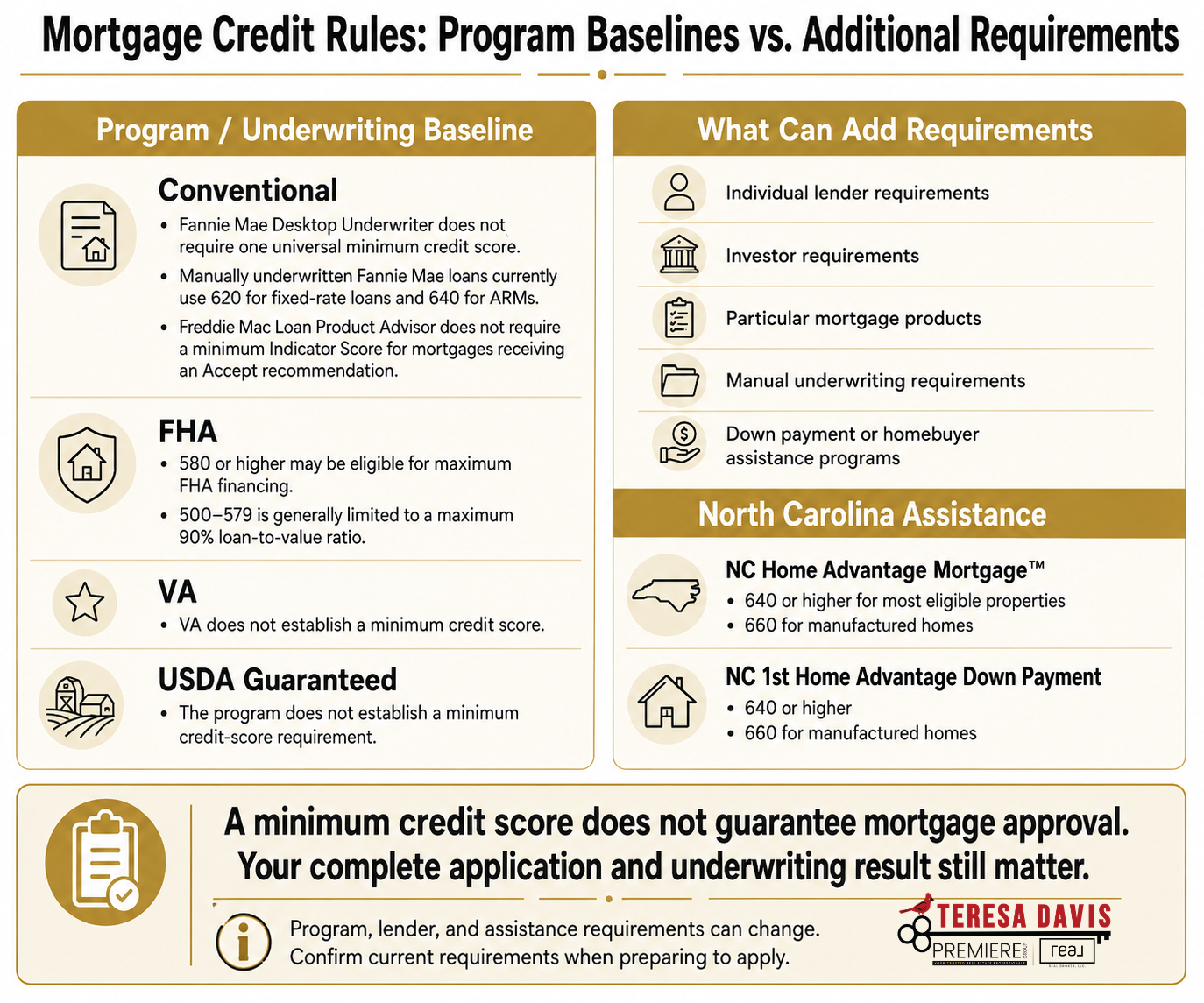
REALTOR® Guidance: Understand Your Financing Before You Fall in Love With a Home
Your credit profile can influence more than whether you qualify for a mortgage. It can also affect which financing options are available to you, the price range that fits your financing, and potentially the terms of the mortgage you are offered. Credit score is an important factor in mortgage lending, but it is not the only factor a lender considers. That is why it is helpful to understand your financing position before you become emotionally or financially committed to a particular home.
As your REALTOR®, I want the homes we consider to make sense not only for your needs but also for the financing strategy you can realistically use. Knowing your mortgage options earlier can help us search within an appropriate price range, recognize when a property may have financing considerations, and build an offer strategy around information rather than assumptions.
If a credit issue or financing limitation exists, finding out early gives you more time to evaluate your options. Depending on your circumstances, that could mean proceeding with the financing available to you, considering another eligible loan program, addressing an issue before purchasing, or allowing additional preparation time.
Because I am also a Loan Originator NMLS #2597433 with One Real Mortgage, I can help explain how mortgage considerations connect with your home search and the overall buying process. However, mortgage approval is never based on one factor or one conversation. Final eligibility depends on the complete application, applicable loan-program requirements, underwriting findings, lender requirements, and the property being financed.
The goal is not to push you toward buying before you are ready. It is to help you understand the information early enough to make better-informed decisions.
Teresa’s Professional Insight
One of the most important things I want first-time buyers to understand is this: Do not automatically decide that you cannot buy a home because of a credit score you see on an app or website.
You can have more than one credit score. Scores may differ because different credit reporting companies, scoring models, loan types, and calculation dates can produce different results. The score a mortgage lender evaluates may therefore differ from a score you regularly monitor through another service.
At the same time, I would not recommend assuming that a score you see online means you definitely qualify. The responsible approach works in both directions: do not unnecessarily disqualify yourself, and do not assume approval based on one number. I would rather help you understand where you actually stand.
For buyers in Davidson, Randolph, Guilford, Forsyth, and surrounding North Carolina counties, that may mean reviewing whether you are ready to explore financing now or whether there are practical steps that could strengthen your position first. Sometimes a buyer discovers that the situation is better than expected. Other times, the best decision is to prepare a little longer. Either outcome is useful because you can make your next decision with better information instead of guessing.
Helpful Tip
Review your credit before you are ready to make an offer on a home. Checking your own credit report or credit score does not hurt your credit score because your own request is treated differently from a lender's credit inquiry.
Review your reports for information you do not recognize, accounts that appear inaccurate, or other items you may need to investigate. The Consumer Financial Protection Bureau recommends reviewing credit reports for errors that could affect access to credit or the terms available to you.
The purpose at this stage is not to try every credit-improvement strategy you find online. It is to understand what is currently being reported so you can make informed decisions about your next steps.
The next Academy lesson, How can I improve my credit before buying a home?, will focus specifically on responsible ways to work on your credit profile before purchasing.
Keep in Mind
A minimum credit score is not the same as guaranteed approval. Mortgage qualification involves more than reaching a particular number.
Mortgage-program guidelines and lender requirements are not always identical. A government agency or mortgage program may permit something that an individual lender or loan product does not offer.
The credit score you see may not be the credit score evaluated for your mortgage. Consumers can have multiple scores because lenders and scoring systems may use different credit data and models.
Credit score is only one part of your financial profile. Mortgage lenders may consider other factors alongside credit when determining whether you qualify and what terms may be available.
Finally, mortgage guidelines, lender requirements, credit-scoring practices, and homebuyer assistance programs can change. The requirements that apply to your purchase should be verified when you are preparing to apply rather than relying solely on an article, social media post, or credit-score chart you found months or years earlier.
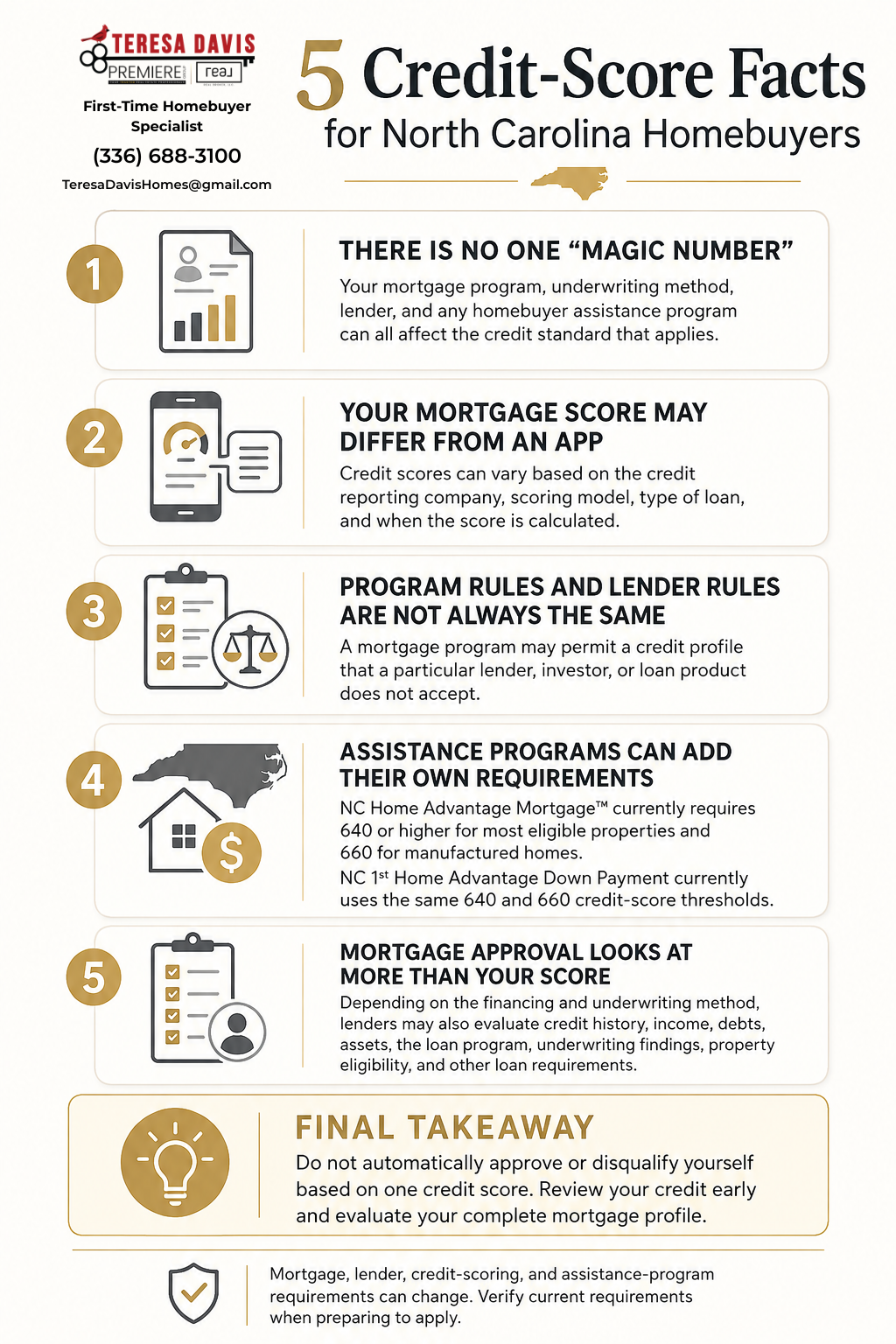
Frequently Asked Questions
Can I buy a house with a 580 credit score?
Possibly. Under FHA's baseline rules, a borrower with a Minimum Decision Credit Score of 580 or higher may be eligible for maximum FHA financing, while borrowers with scores from 500 through 579 are generally limited to a maximum 90% loan-to-value ratio. A 580 score does not guarantee approval, however. The lender still has to evaluate the complete application and may have requirements that are more restrictive than FHA's minimum standards.
Other financing possibilities may also depend on the underwriting system, lender, loan product, and the rest of the borrower's financial profile. The best approach is to evaluate the complete mortgage situation rather than assuming that one score automatically qualifies or disqualifies you.
Do I still need a 620 credit score for a conventional mortgage?
Not in every situation. Fannie Mae's current Selling Guide states that a minimum credit score is not required for Desktop Underwriter loan casefiles, although manually underwritten Fannie Mae loans retain applicable minimum credit-score requirements, including 620 for fixed-rate loans and 640 for adjustable-rate mortgages.
That does not mean credit score no longer matters or that every borrower below 620 will qualify. Lenders, investors, particular products, pricing requirements, and the automated underwriting result can still affect whether a conventional loan is available. A blanket statement that every conventional borrower must have a 620 score is therefore no longer an accurate explanation of all conventional underwriting.
Do VA and USDA loans have minimum credit-score requirements?
VA itself does not require a minimum credit score for a VA-backed home loan, although VA specifically notes that individual lenders may establish their own credit-score requirements.
USDA Rural Development likewise states that its Single Family Housing Guaranteed Loan Program has no program credit-score requirement, but applicants must still demonstrate the willingness and ability to manage debt and must satisfy the lender's underwriting requirements.
For both programs, “no program minimum” should not be interpreted as “credit does not matter” or “approval is automatic.”
What credit score do I need for NC Home Advantage or first-time homebuyer assistance in North Carolina?
The North Carolina Housing Finance Agency currently requires a credit score of 640 or higher for the NC Home Advantage Mortgage™. Manufactured homes currently require a 660 credit score.
The NC 1st Home Advantage Down Payment program also currently requires a score of 640 or higher, with 660 required for manufactured homes. Additional eligibility requirements apply to the assistance program, so meeting the credit-score threshold by itself does not establish eligibility.
Because assistance-program guidelines can change, the requirements should be verified when you are preparing to apply.
Will a higher credit score help me get a better mortgage rate?
It can. The Consumer Financial Protection Bureau explains that borrowers with higher credit scores are generally offered more affordable loans, including lower interest rates, and may have more lenders to choose from.
That does not mean a particular increase in your credit score will guarantee a particular mortgage rate. Interest rates and loan pricing can depend on multiple factors, including the loan program, loan characteristics, market conditions, and lender pricing. The more useful goal is to build the strongest overall financial profile you reasonably can rather than focusing only on reaching one specific score.
What Happens Next?
Now that you understand why there is no single credit score that applies to every North Carolina homebuyer, the next question is what to do if your credit is not where you want it to be.
Start by understanding what is actually appearing on your credit reports. Checking your own credit report does not lower your credit score, and reviewing your reports can help you identify information that may need attention before you apply for a mortgage.
If your credit profile needs work, that does not mean you need to guess at what to change or chase a particular number you found online. Different actions can affect consumers differently, and credit improvement usually takes time rather than happening instantly.
The next lesson, How can I improve my credit before buying a home?, will walk through responsible credit-preparation strategies and help you understand which habits generally support a stronger credit profile without promising a specific score increase or mortgage approval.
Ready to Take the Next Step?
You do not need to know every mortgage rule before beginning a conversation. Whether you are ready to explore financing now or simply want to understand what you may need to work on first, the next step should help you make a more informed decision—not pressure you into buying before you are ready.
Contact Teresa Davis
If you have questions about how your credit, financing options, and home search fit together, you can contact me, Teresa Davis. I can help you understand how the pieces of the North Carolina homebuying process connect and what questions may be helpful to address next.
Teresa Davis
REALTOR® / Professional Real Estate Advisor
PREMIERE Group of Real Broker LLC
Begin the One Real Mortgage Pre-Approval Process
If you are ready for an individualized mortgage review, you can begin the One Real Mortgage pre-approval process. Your actual qualification will depend on your complete application, applicable loan-program requirements, underwriting, lender requirements, and the property being financed. Using One Real Mortgage is optional and is not required in order to work with Teresa Davis as your REALTOR®.
Teresa Davis
Loan Originator NMLS #2597433
One Real Mortgage
Mortgage qualification, loan programs, terms, costs, and final approval depend on the borrower, property, transaction, documentation, underwriting, and applicable lending requirements. Beginning a pre-approval process does not guarantee financing or require you to purchase a home.
Ready for the next lesson? Use “Next Question” below to continue to "How can I improve my credit before buying a home?".
2:3 - How can I improve my credit before buying a home?

If you are preparing to buy a home, improving your credit can strengthen your overall mortgage readiness—but the goal is not simply to chase the highest score possible. A better approach is to understand what is affecting your credit, correct genuine errors, build consistent credit habits, and avoid financial changes that could work against you as you get closer to applying for a mortgage.
Your credit report and credit score are related, but they are not the same thing. Your credit reports contain information about your credit accounts and payment history, while credit scores are calculated from information in those reports. You can also have more than one credit score because different scoring models, credit-reporting data, loan types, and calculation dates may produce different results. That means the score you see through a consumer app may not be the exact score a mortgage lender uses.
For many first-time homebuyers, the most productive place to start is with the underlying credit information. Review your reports carefully, make sure the information is accurate, pay bills on time, work on reducing high revolving balances when appropriate, and be cautious about opening or closing credit accounts simply because you are planning to buy a home. Current Consumer Financial Protection Bureau guidance identifies on-time payments, responsible use of available credit, maintaining established credit history, limiting unnecessary credit applications, and checking reports for errors as important credit-management practices.
You can currently obtain free weekly credit reports from Equifax, Experian, and TransUnion through AnnualCreditReport.com. Reviewing those reports before mortgage shopping gives you an opportunity to identify inaccurate information and better understand what a lender may see when evaluating your credit history.
Credit improvement is individual. No legitimate strategy can guarantee that a particular action will raise your score by a specific number of points or within a specific amount of time. If you expect to buy soon, it can also be helpful to review your credit and overall financial picture with a mortgage professional before making major changes to accounts or debt.
Quick Answer
You may be able to improve your credit before buying a home by reviewing your credit reports for errors, paying every bill on time, bringing past-due accounts current when possible, reducing revolving credit-card balances, and avoiding unnecessary new credit applications.
Be careful about automatically closing older credit-card accounts. Closing an account can reduce your available credit and may increase your credit utilization ratio, which can affect your score depending on the rest of your credit profile.
Most importantly, focus on consistent financial habits rather than quick fixes. You do not need to carry an interest-bearing credit-card balance to build good credit; paying balances in full can help you avoid finance charges while keeping revolving balances lower.
If you are planning to apply for a mortgage soon, consider reviewing your situation with a mortgage professional before opening new accounts, closing existing accounts, or making major debt-payoff decisions. The best step for improving a credit score in isolation is not always the same as the best step for your complete mortgage-readiness plan.
At a Glance
- Start with your credit reports. Review the information being reported before focusing only on the score.
- Correct genuine errors. If information is inaccurate or incomplete, use the appropriate dispute process rather than trying to remove accurate negative information.
- Pay on time, every time. Consistent payment history is an important part of maintaining and strengthening credit.
- Watch revolving balances. Using a large portion of your available credit can affect your credit profile, so reducing balances may help when appropriate.
- Do not carry debt just to build credit. Paying a credit-card balance in full can help you avoid interest while still building a positive payment history.
- Limit unnecessary new credit. New credit-card, auto-loan, personal-loan, or other applications shortly before or during the mortgage process may create additional inquiries and financial obligations.
- Think before closing established accounts. Closing a credit card can sometimes increase credit utilization and reduce a score rather than improve it.
- Expect different credit scores. The score you see online may differ from the score used for mortgage lending.
- Avoid promises of instant results. Credit improvement takes responsible management over time, and no specific score increase can be guaranteed.
- Consider the whole mortgage picture. Credit, debt, available savings, income, and other qualification factors can work together, so major financial changes are worth reviewing before you make them.
Understand What You Are Trying to Improve
Before you start making changes to your credit, it helps to understand what you are actually trying to improve. Your credit report and your credit score are connected, but they are not the same thing.
A credit report contains information reported about your credit history, such as credit accounts, balances, payment history, and certain other account details. A credit score is a number calculated from information in a credit report. Because different scoring models and credit-reporting data may be used, you can have more than one credit score.
That distinction matters when you are preparing for a mortgage. The score displayed by a bank, credit-card company, or consumer credit app can be useful for monitoring your credit, but you should not assume it will be identical to the score used when a mortgage lender evaluates your application.
Instead of concentrating only on a number, begin with the information behind the number. Make sure your credit reports are accurate, understand which accounts may be affecting your credit profile, and build consistent habits that support both your credit and your overall mortgage readiness.
Step 1: Review Your Credit Reports
One of the best places to begin is by reviewing your credit reports from Equifax, Experian, and TransUnion.
Consumers in the United States can currently review a free credit report from each of the three nationwide credit bureaus once each week through AnnualCreditReport.com. The Federal Trade Commission reported in 2026 that the three nationwide bureaus permanently extended weekly access through this service.
Checking your own credit report does not hurt your credit score. Reviewing your reports is a consumer request for your own information rather than a lender inquiry associated with an application for new credit.
When you review your reports, look carefully at information such as:
- your name and identifying information;
- credit cards, loans, and other reported accounts;
- account balances and credit limits;
- payment history;
- accounts reported as late or past due;
- collection accounts;
- accounts you do not recognize;
- duplicate accounts or information;
- accounts that you believe should show a different status.
Do not be surprised if the three reports are not identical. Creditors and other companies may not necessarily furnish the same information to every credit reporting company. What matters is whether the information that is being reported about you is accurate.
If something looks unfamiliar, investigate it rather than assuming it is simply a reporting mistake. An unfamiliar account or other suspicious information could sometimes indicate identity theft. The CFPB directs consumers who suspect identity theft to the federal IdentityTheft.gov recovery resource.
Why Reviewing the Reports Comes Before Chasing a Score
A credit score is calculated from information contained in a credit report. If the underlying report contains inaccurate information, concentrating only on the resulting number does not address the underlying problem.
Reviewing your reports can also help you identify issues you may be able to address through normal financial management. For example, you may discover a revolving balance that is higher than you realized, an account that has become past due, or inaccurate information that needs to be disputed.
This is why a productive credit-improvement plan usually begins with understanding the underlying data rather than searching for a shortcut that promises a particular score increase.
Step 2: Correct Genuine Credit-Report Errors
The Consumer Financial Protection Bureau recommends disputing an error with both:
- the credit reporting company that is showing the information; and
- the company that furnished the information, such as a lender, credit-card issuer, or other creditor.
Your dispute should clearly identify what you believe is wrong and explain why. Supporting documentation can be helpful when it is available.
Examples of possible errors could include:
- an account that does not belong to you;
- an incorrect balance;
- a payment incorrectly reported as late;
- an account reported more than once when it should not be;
- information belonging to another consumer;
- an account status that is being reported inaccurately.
Keep copies of relevant records, correspondence, dispute confirmations, and supporting documents so you have a clear record of what you submitted.
A Dispute Is for Inaccurate Information—not Simply Negative Information
There is an important difference between information that is wrong and information that is negative but accurate.
You generally cannot have accurate negative information removed from your credit report simply because you are preparing to buy a home or because the information is lowering your score. CFPB guidance states that accurate negative information generally cannot be removed merely because it is unfavorable, and most negative payment-history information can generally remain on a credit report for up to seven years.
That means you should not dispute a legitimate late payment, collection, or other account simply in hopes that the credit bureau will delete it and increase your score.
The goal is an accurate credit report, not an artificially altered one.
Step 3: Be Careful With “Credit Repair” Promises
Homebuyers who are worried about their credit can be especially vulnerable to advertisements promising a fast solution.
Be cautious of anyone who claims they can:
- erase all negative credit history;
- remove accurate information simply by disputing it;
- guarantee a specific credit-score increase;
- create a completely new credit identity;
- deliver an instant credit fix.
The Federal Trade Commission states that credit-repair companies cannot legally remove accurate, current information merely because it is negative. Consumers can dispute genuine credit-report errors themselves without paying a company to exercise that right.
Improving an accurate credit history usually comes from responsible credit management over time—not from finding a way to make legitimate information disappear.
If your report contains serious credit problems and you are unsure how to proceed, consider getting guidance from an appropriate qualified professional rather than relying on promises of guaranteed results.
Focus First on Accuracy, Then on Improvement
Once you understand what your reports contain and have addressed genuine inaccuracies, you are in a much better position to focus on the behaviors that may strengthen your credit profile going forward.
Those next steps include paying obligations on time, managing revolving balances, being thoughtful about new credit, and avoiding unnecessary account changes as you approach the mortgage process.
Credit improvement should be viewed as part of your overall financial preparation for homeownership—not as a race to reach a particular number.
Step 4: Pay Every Bill on Time
Once your credit reports are accurate, one of the most important habits you can build is simply paying your obligations on time.
Credit-scoring models consider your payment history when calculating your scores. A pattern of paying as agreed can support your credit profile, while new late payments can work against the progress you are trying to make before applying for a mortgage.
That makes consistency especially important when you are preparing to buy a home.
Helpful strategies may include:
- setting automatic payments for at least the minimum amount due;
- using calendar reminders several days before due dates;
- reviewing your accounts regularly instead of waiting for statements;
- making sure automatic payments are connected to an account with sufficient funds;
- addressing past-due accounts rather than allowing additional missed payments to accumulate.
If an account is already past due, your situation may require more individualized guidance. Do not assume that one payment strategy is automatically best for every mortgage applicant.
The larger goal is to prevent new credit problems while you are preparing for homeownership.
Do Not Expect One On-Time Payment to Create an Instant Score Increase
Credit improvement does not operate on a universal schedule.
Different creditors may report account information at different times, different scoring models can evaluate information differently, and the rest of your credit profile also matters.
For that reason, avoid planning your home purchase around claims such as:
- “Your score will increase 50 points in 30 days.”
- “Make this payment and your score will immediately jump.”
- “This one strategy works for everyone.”
Responsible credit management can improve your overall profile over time, but the exact effect of an individual action cannot be guaranteed.
Step 5: Pay Attention to Revolving Credit Balances
Credit cards and other revolving accounts deserve special attention when you are preparing for a mortgage.
One factor credit-scoring models consider is how much revolving credit you are using compared with how much is available to you. This is commonly called your credit utilization ratio. CFPB guidance explains that being close to your credit limits can negatively affect a credit score and recommends keeping revolving balances low relative to available credit.
For example, if you have a credit card with a $5,000 limit and a $4,500 reported balance, you are using a large portion of the credit available on that account. Reducing the balance may improve that part of your credit profile, depending on the rest of your credit history and the scoring model being used.
The important concept is not a single “magic” utilization percentage. It is generally better to avoid being heavily dependent on your available revolving credit.
You Do Not Need to Carry a Credit-Card Balance to Build Credit
A common misconception is that you must leave a balance on your credit card and pay interest in order to build a stronger credit history. You do not.
CFPB guidance states that paying a credit-card balance in full each month can help improve credit scores, and you do not need to carry a balance merely for credit-building purposes.
If you can pay the balance in full while preserving the savings you need for your home purchase and other obligations, doing so can also help you avoid unnecessary interest charges.
However, deciding whether to use substantial savings to eliminate debt before purchasing a home involves more than credit utilization. You may also need money for your down payment, closing costs, due diligence expenses, moving expenses, reserves, and unexpected homeownership costs.
That broader decision is addressed in the next Academy lesson: Should I pay off debt before buying a home?
Step 6: Limit Unnecessary New Credit
When you are preparing to buy a home, this is usually not the time to open several new credit accounts simply because you qualify for them. When you apply for new credit, a lender may obtain your credit report as part of the application. That type of lender-requested credit check is generally a hard inquiry, and hard inquiries can affect credit scores because scoring models consider recent credit applications.
Even after you are pre-approved, applying for or opening new credit can change your credit score, monthly debt obligations, or overall financial profile and could affect your loan terms—or, in some cases, your ability to qualify for the mortgage.
Before and during the mortgage process, think carefully before applying for:
- a new credit card;
- an auto loan;
- a personal loan;
- retail-store financing;
- furniture financing;
- appliance financing;
- “buy now, pay later” or other new financing arrangements that could create an additional obligation.
Before applying for any new credit while preparing to buy a home or while under contract, talk with your mortgage lender first. The concern is not only the credit inquiry. A new account can also create a new monthly payment or change other information that a mortgage lender evaluates.
That does not mean you should be afraid to let mortgage lenders check your credit when you are legitimately shopping for a home loan. Credit-scoring models generally recognize that consumers shop for loan terms and may treat multiple mortgage inquiries made within a reasonably short shopping period as a single inquiry for scoring purposes. The detailed rules surrounding mortgage pre-approval and credit inquiries are covered later in Question 2.07, Will getting pre-approved hurt my credit score?
The practical lesson here is simpler: Avoid unnecessary new borrowing while you are trying to strengthen your mortgage profile.
Step 7: Think Before Closing Older Credit-Card Accounts
Another common mistake is assuming that fewer open credit cards automatically mean a better credit score. That is not always true.
Closing a revolving account reduces the amount of credit available to you. If your outstanding balances stay the same while your total available credit decreases, your overall utilization ratio can increase. CFPB guidance specifically notes that closing an existing credit card can increase utilization and may lower a credit score, although the effect varies according to the consumer's individual credit profile.
Consider a simplified example:
- You have two credit cards with a combined $10,000 in available credit.
- You owe $2,000 across those cards.
- You close a card that provided $5,000 of the available credit.
- You still owe the same $2,000, but now considerably less revolving credit remains available.
The exact effect on your score cannot be predicted from this example alone, but it illustrates why closing an account is not automatically a credit-improvement strategy. There may be legitimate reasons to close an account, such as avoiding an unwanted annual fee or dealing with an account you no longer wish to maintain. The point is not that you should never close a credit card.
The point is that you should understand the possible effect before assuming closure will improve your mortgage readiness. If you are getting close to applying for a mortgage, consider discussing a significant account change with your mortgage professional first.
Step 8: Give Responsible Credit Management Time to Work
Credit improvement is usually a process, not an event. Your credit profile reflects information reported over time, and different credit scores may vary depending on the credit reporting company, scoring model, loan type, and even when the score is calculated.
That is why it is difficult to give every first-time buyer the same answer to: “How long will it take to improve my credit?”
The answer depends on what needs improvement. Correcting an actual reporting error is different from:
- recovering from recent late payments;
- lowering revolving balances;
- establishing a longer record of on-time payments;
- addressing collections or other derogatory information;
- rebuilding after more serious credit problems.
Someone with an inaccurate account on an otherwise strong report has a very different situation from someone rebuilding after several recent delinquencies. Focus on the specific factors affecting your reports rather than comparing your timeline with someone else's.
Step 9: Remember That the Mortgage Goal Is Bigger Than the Credit Score
A higher credit score can be valuable when you are preparing for a mortgage, but it should not become your only financial objective. Mortgage lenders evaluate more than one number. CFPB homebuying guidance notes that credit scores are important to mortgage pricing and qualification, but they are only one part of a lender's decision.
Depending on the loan and borrower, the broader financial picture may include factors such as:
- income;
- monthly debt obligations;
- available funds;
- down payment;
- closing funds;
- reserves;
- credit history;
- the loan program being considered.
This is one reason a financial move that appears helpful from a credit-score perspective may not automatically be the best mortgage-preparation move.
For example, using nearly all of your available savings to pay off a debt might reduce your monthly obligations, but it could also leave you with less cash available for your home purchase. Conversely, keeping a large revolving balance simply to preserve savings may affect both your credit profile and your monthly finances. Those tradeoffs should be evaluated together.
A Better Goal: Become Mortgage Ready
Instead of asking only: “How do I get the highest possible credit score?”
consider asking: “What changes would put me in the strongest overall position to buy a home?”
That question encourages you to look at the complete picture:
- Is the information on your credit reports accurate?
- Are your payments current?
- Are revolving balances manageable?
- Are you avoiding unnecessary new obligations?
- Do you have savings available for the purchase?
- Are you protecting emergency reserves?
- Do you understand how your existing debts affect mortgage qualification?
- Have you reviewed your situation before making major financial changes?
This approach is especially valuable for first-time buyers in Davidson, Randolph, Guilford, Forsyth, and surrounding North Carolina counties because preparing financially before becoming deeply involved in the home search can make the later mortgage and real estate process easier to understand.
You do not need perfect credit to begin learning about your options, and you should not assume that a less-than-perfect score automatically means homeownership is out of reach. The objective is to understand where you stand, determine what can realistically be improved, and make informed decisions that support the entire homebuying plan.
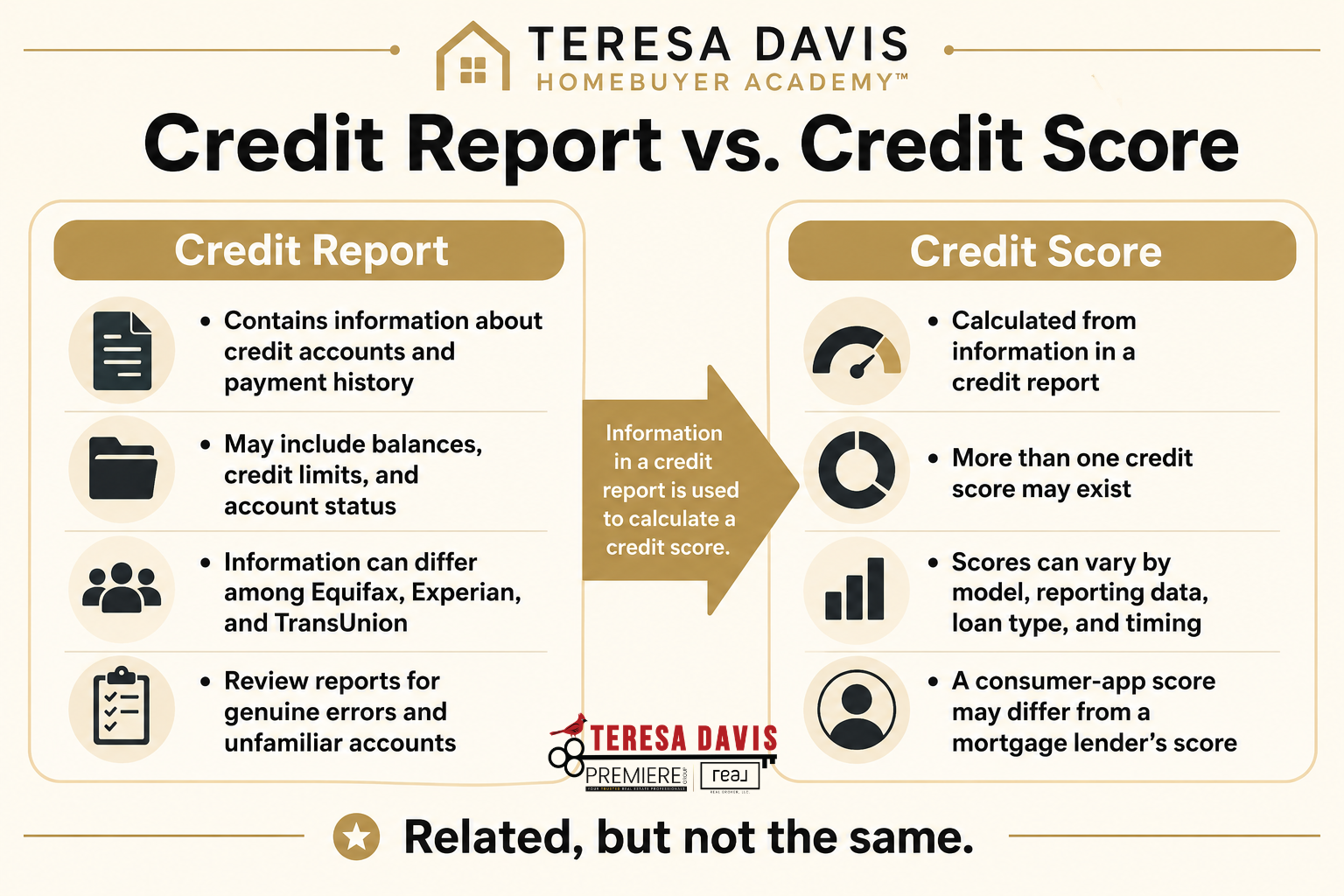
How Your REALTOR® Can Help You Prepare Before You Start Shopping
Improving your credit is primarily a financial and mortgage-preparation matter, but it also affects when and how you begin the home search. A REALTOR® does not determine your credit score, repair your credit, or decide whether you qualify for a mortgage. However, an experienced REALTOR® can help you understand how financial preparation fits into the larger homebuying process and why it can be helpful to address financing questions before becoming deeply involved in looking at homes.
When buyers begin shopping before they understand their mortgage readiness, it can be easy to focus on homes that may not fit the financing options ultimately available to them. Preparing first can help you search with a clearer understanding of your likely price range, financing considerations, and next steps.
Your REALTOR® can also work alongside your mortgage professional so that the real estate and financing sides of the transaction remain coordinated. That can be especially important when a financial decision could affect your timing or purchasing plan.
For example, before buying a car, financing furniture, opening a new credit account, or making another significant financial change while preparing to purchase a home, it may be wise to discuss the potential mortgage impact with your loan professional.
The objective is not to make you afraid to use credit. It is to help you avoid unnecessary surprises and make financial decisions with the homebuying process in mind.
For first-time buyers in Davidson, Randolph, Guilford, Forsyth, and surrounding North Carolina counties, having the real estate and mortgage preparation conversations early can make the transition from “I want to buy a home” to “I am ready to start looking” much clearer.
Teresa’s Professional Insight
One of the most important things I want first-time buyers to understand is that the action that appears best for your credit score by itself is not always automatically the best action for your complete mortgage plan.
Because I work with buyers as both a REALTOR® / Professional Real Estate Advisor with PREMIERE Group of Real Broker LLC and a Loan Originator NMLS #2597433 with One Real Mortgage, I look at credit preparation as one part of a much larger picture.
For example, a buyer may think:
- “I should close the credit cards I am not using.”
- “I should use all of my savings to pay off debt.”
- “I need to open another card to build credit faster.”
- “I should wait until my credit is perfect before I talk to anyone.”
Any of those decisions could have consequences beyond the credit score itself. Mortgage readiness can also involve your monthly debt obligations, available savings, funds needed for the purchase, loan program requirements, and the timing of your planned home purchase.
That is why I encourage buyers who expect to purchase soon to review the overall picture before making major changes. Sometimes the most productive first step is not doing more—it is understanding what is already on your credit reports, identifying what actually needs attention, and creating an organized plan.
You also do not have to wait until everything is perfect before asking questions. An early conversation can help identify what may need improvement, what may already be workable, and which financial decisions are worth reviewing before you make them.
The goal is not perfection. The goal is to become informed, prepared, and mortgage ready.
Helpful Tip
Use This 7-Step Credit Preparation Checklist
If you are not sure where to begin, work through these steps in order:
- 1. Review all three credit reports.
Look at the information being reported by Equifax, Experian, and TransUnion rather than relying only on a consumer credit score. - 2. Identify genuine inaccuracies.
Make a separate list of information you believe is incorrect or incomplete and use the appropriate dispute process when needed. - 3. Protect your payment history.
Confirm your due dates and consider reminders or automatic payments to help prevent new late payments. - 4. Review your revolving balances.
Look at how much of your available credit you are currently using and whether balances can reasonably be reduced. - 5. Avoid unnecessary new credit.
Think carefully before applying for new cards, vehicle financing, personal loans, furniture financing, or other new obligations while preparing for a mortgage. - 6. Do not close established accounts automatically.
Understand the possible effect before assuming that closing a credit card will improve your credit. - 7. Review major changes before making them.
If you expect to buy soon, consider discussing significant debt, credit, or account changes with your mortgage professional first.
Keep a simple record of what you reviewed, what you changed, and what still needs attention. That can make your financial preparation feel much more manageable than repeatedly checking your score and wondering what to do next.
Keep in Mind
Credit improvement is not an exact formula, and no legitimate person or company can promise that a particular action will increase your score by a specific number of points within a specific period.
Also remember:
- You can have more than one credit score. The score you see through a consumer service may not be the same score used during mortgage lending.
- Accurate negative information is different from incorrect information. A dispute process is intended to address information that is inaccurate or incomplete—not simply information you would prefer not to appear.
- You do not need to carry credit-card debt or pay interest just to build credit.
- Closing an account is not automatically an improvement. It can change the amount of revolving credit available to you and may affect utilization.
- Paying off debt is a separate strategic decision. Reducing debt can help in some situations, but using large amounts of savings can also affect the funds you have available for your home purchase.
- Mortgage readiness involves more than credit. Income, debts, available funds, reserves, loan requirements, and other factors may also matter.
If your credit history includes collections, significant delinquencies, identity-theft concerns, complicated disputes, or other substantial issues, your circumstances may require individualized guidance from the appropriate credit, mortgage, legal, or financial professional.
The purpose of this lesson is to help you understand the fundamentals so you can ask better questions and make more informed decisions as you prepare to buy a home.
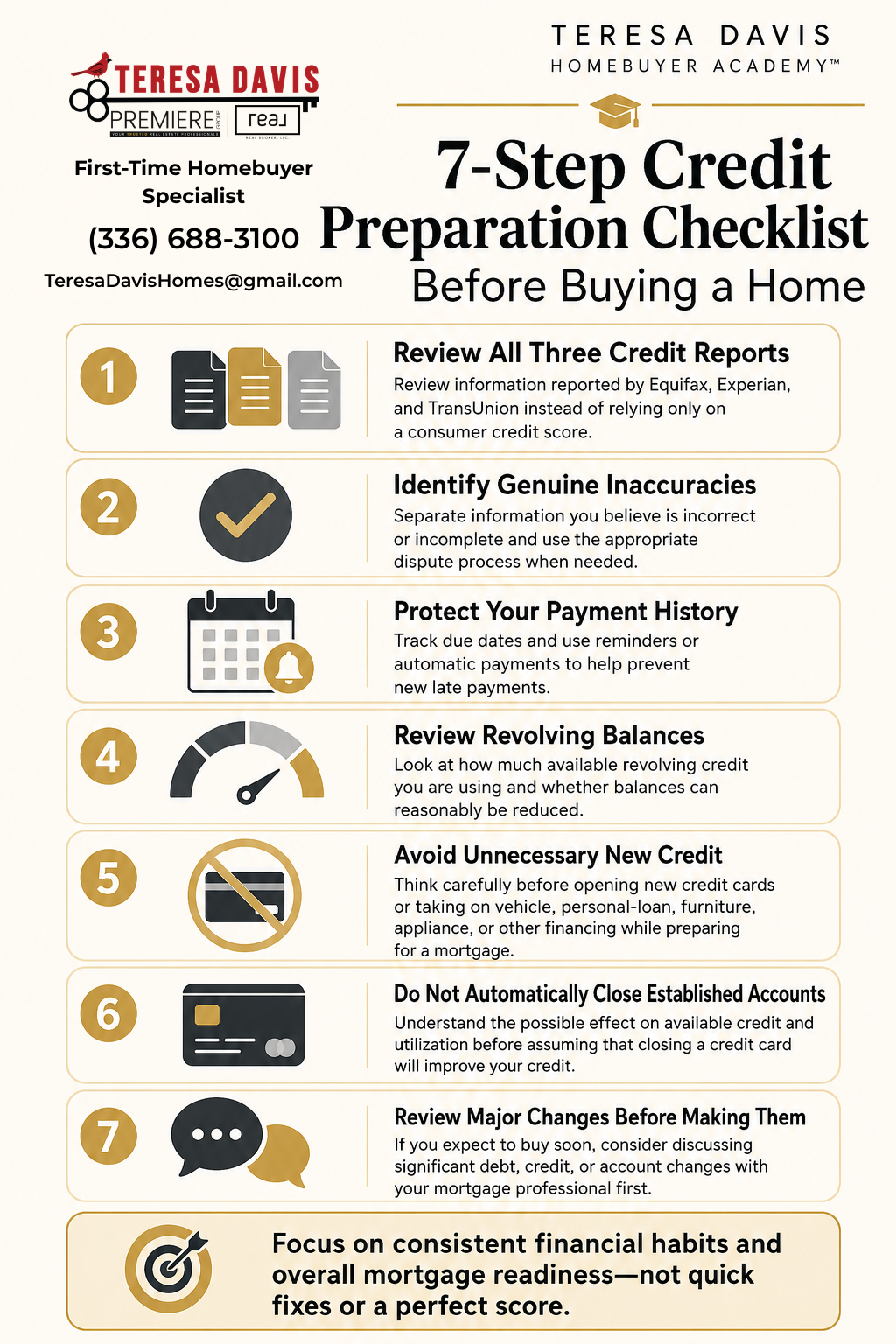
Frequently Asked Questions
How quickly can I improve my credit before buying a house?
There is no universal timeline for improving a credit score. How quickly your credit may change depends on what is affecting your credit profile, when creditors report updated information, the information in your credit reports, and the scoring model being used. Building stronger credit usually requires consistent habits over time, such as paying bills on time, managing revolving balances, and limiting unnecessary new credit. No legitimate person or company can guarantee that a particular action will increase your score by a specific number of points within a specific period.
Should I pay off my credit cards completely before applying for a mortgage?
Paying down revolving credit-card balances can help reduce the amount of available credit you are using, which may support your credit profile. Paying a credit-card balance in full can also help you avoid finance charges; you do not need to carry an interest-bearing balance merely to build credit. However, whether you should use significant savings to pay off debt before applying for a mortgage depends on your broader financial situation, including the cash you may need for the home purchase. The next Academy lesson, Should I pay off debt before buying a home?, explores that decision in greater detail.
Should I close credit cards I am not using before buying a home?
Not automatically. Closing a credit-card account reduces the amount of revolving credit available to you. If your outstanding balances remain the same, that can increase your credit utilization ratio and may lower your credit score, although the actual effect depends on your individual credit profile. There can be legitimate reasons to close an account, but simply assuming that fewer open accounts will improve your credit can be a mistake. If you expect to apply for a mortgage soon, consider reviewing a significant account change before making it.
Can a credit repair company quickly raise my credit score?
Be cautious of any company promising a guaranteed or rapid credit-score increase. Credit-repair companies cannot legally remove accurate, current negative information simply because it is hurting your score, and consumers have the right to dispute genuine credit-report errors themselves. Improving an accurate credit history generally takes responsible credit management over time rather than an instant fix.
Why is the credit score my mortgage lender sees different from the score I see online?
You can have multiple credit scores because different scoring models and versions may evaluate credit-report information differently. The score provided by a consumer app, bank, or credit-monitoring service therefore may not be identical to the score used in mortgage lending. Rather than assuming one consumer-facing number determines your mortgage options, focus on maintaining accurate credit reports and reviewing your actual mortgage qualification with your lender.
What Happens Next?
Once you understand how to review your credit reports and build healthier credit habits, the next question is often whether you should start paying off debt before you buy.
That decision deserves its own discussion because reducing debt can affect more than your credit score. It may change your monthly obligations and mortgage qualification, but using a large amount of savings to eliminate debt can also reduce the cash you have available for your down payment, closing expenses, reserves, moving costs, and other homebuying needs.
The goal is not necessarily to become debt-free before buying a home. It is to understand how your debts, available savings, credit profile, and mortgage options work together.
Continue to the next lesson below: Should I pay off debt before buying a home?
Ready to Take the Next Step?
If you are thinking about buying a home but are unsure whether your credit is ready, you do not have to guess or wait until everything feels perfect before asking questions. Understanding where you stand can help you identify which steps may be useful now and which financial changes are better reviewed before you make them.
Contact Teresa Davis
If you would like help understanding how financial preparation fits into your North Carolina homebuying plan, contact Teresa Davis, REALTOR® / Professional Real Estate Advisor with PREMIERE Group of Real Broker LLC.
Begin the One Real Mortgage Pre-Approval Process
If you are ready to discuss mortgage readiness or determine what may need attention before pre-approval, Teresa also serves as a Loan Originator NMLS #2597433 with One Real Mortgage. Using One Real Mortgage is optional and is not required in order to work with Teresa Davis as your REALTOR®.
Mortgage qualification, loan programs, terms, costs, and final approval depend on the borrower, property, transaction, documentation, underwriting, and applicable lending requirements. Beginning a pre-approval process does not guarantee financing or require you to purchase a home. It is a practical way to learn more about your potential financing options, estimated payment, and possible next steps.
Ready for the next lesson? Use “Next Question” below to continue to "Should I pay off debt before buying a home?"
2:4 - Should I pay off debt before buying a home?

If you have credit cards, a car loan, student loans, or other monthly debt, you may wonder whether you need to pay everything off before you can buy a home. For many first-time buyers, the answer is no. Having debt does not automatically prevent you from qualifying for a mortgage.
What matters is how your existing obligations fit into your overall financial picture. Mortgage lenders evaluate recurring monthly debt payments along with qualifying income when assessing your ability to manage a new housing payment. Your debt-to-income ratio, commonly called DTI, is one way lenders measure that relationship, and acceptable limits can vary by loan product and lender.
That means the best strategy is not necessarily to pay off the debt with the largest balance—or to use all of your savings trying to become debt-free. In some situations, reducing or eliminating a particular monthly payment may improve your mortgage qualification or make your future housing payment more comfortable. In other situations, keeping that cash available for your down payment, closing costs, emergency savings, or other homebuying expenses may be more useful.
The goal is to understand what a debt payoff would actually accomplish before you move the money. A well-planned approach looks at your monthly obligations, available savings, credit profile, anticipated homebuying costs, and mortgage options together rather than treating debt payoff as a one-size-fits-all requirement.
Quick Answer
You usually do not need to pay off all of your debt before buying a home. The better question is whether paying down or paying off a particular debt would meaningfully improve your mortgage qualification, monthly affordability, or overall financial position.
Because lenders consider recurring monthly obligations when evaluating mortgage qualification, eliminating certain payments can sometimes help. For example, current Fannie Mae conventional guidance allows a revolving-account payment to be excluded from long-term debt when the balance is paid off at or before closing under the applicable requirements; the account does not have to be closed solely for that exclusion.
However, using too much of your available cash to eliminate debt can create a different problem. You may still need money for your down payment, closing costs, inspections and other transaction expenses, moving costs, immediate home expenses, and emergency savings.
Before making a large payoff, review the numbers with your mortgage professional. The most useful strategy is often to determine which debt, if any, gives you the greatest homebuying benefit for the amount of cash required to reduce or eliminate it.
At a Glance
- You do not have to be debt-free to buy a home. Mortgage qualification considers your overall financial profile, including recurring monthly obligations and qualifying income.
- Monthly payments can matter as much as the balance you owe. Mortgage DTI calculations focus on qualifying monthly obligations relative to qualifying income.
- Paying down the largest debt is not automatically the best mortgage strategy. The potential benefit depends on the type of debt, its required payment, the amount needed to reduce or eliminate it, and the applicable loan requirements.
- Paying down revolving debt may serve more than one purpose. It may reduce the required monthly obligation and can affect credit utilization, although individual credit-score results should never be assumed or guaranteed.
- Do not sacrifice all of your available cash just to eliminate debt. Your homebuying plan also needs to account for funds required before, at, and after closing.
- Compare payoff scenarios before acting. Reviewing different options with your mortgage professional can show whether a proposed payoff is likely to provide a meaningful qualification or affordability benefit.
- Loan guidelines vary. Different mortgage products and lenders can have different DTI limits and debt-treatment requirements.
- The next Academy lesson will explain DTI in more detail. Understanding how debt-to-income ratio works will help you see why some monthly obligations have a greater effect on mortgage qualification than others.
You Do Not Have to Be Debt-Free to Buy a Home
One of the most common financial assumptions first-time buyers make is that they need to eliminate every credit card, auto loan, student loan, or other debt before applying for a mortgage. In many cases, that is not necessary.
Mortgage lenders expect many applicants to have existing financial obligations. What matters is whether the borrower's complete financial profile supports the proposed mortgage. Existing debt is part of that evaluation, but the presence of debt by itself does not automatically disqualify someone from buying a home.
A lender may consider obligations such as:
- credit card payments;
- auto loans;
- student loans;
- personal loans;
- other installment debts;
- certain other recurring financial obligations.
One important measurement is the borrower's debt-to-income ratio, or DTI. The Consumer Financial Protection Bureau defines DTI as monthly debt payments divided by gross monthly income and notes that lenders use the ratio as one way to evaluate a borrower's ability to manage monthly payments. Different mortgage products and lenders can have different DTI limits.
This lesson is not about finding a universal DTI number—that is covered in the next Academy lesson. The important point here is that the decision to pay off debt should be based on what that payoff actually changes in your homebuying plan.
For example, two buyers could each owe $10,000 in consumer debt and still have very different mortgage situations. One could have a relatively small required monthly payment, while the other's monthly payment could consume a much larger portion of qualifying income. Looking only at the outstanding balance would not tell the whole story.
Why the Monthly Payment Can Matter More Than the Balance Alone
When buyers think about debt, they often focus first on the amount they owe. That number is important for their overall finances, but mortgage qualification also focuses heavily on the required monthly obligation.
Consider this simplified example:
Debt A
- Balance: $12,000
- Required monthly payment: $175
Debt B
- Balance: $5,000
- Required monthly payment: $300
If the goal is specifically to improve a mortgage qualification scenario, Debt B could deserve closer attention even though its balance is much smaller. Eliminating a $300 monthly obligation could have a different effect on the mortgage calculation than eliminating a $175 obligation.
That does not mean Debt B should automatically be paid off. The buyer would still need to know:
- how much cash is required to eliminate the payment;
- whether the lender can actually exclude the obligation under the applicable loan guidelines;
- what effect the change would have on qualification;
- and how much money the buyer would have left afterward.
Current Fannie Mae conventional guidance illustrates why the details matter. Its liability guidance requires lenders to evaluate applicable borrower liabilities when calculating DTI, while separate guidance addresses circumstances in which debts paid off or paid down at or before closing may be excluded from long-term debt.
Those are underwriting rules for a particular conventional lending framework, not a universal rule for every mortgage. The practical takeaway for a buyer is simpler: do not assume that paying a balance automatically produces the mortgage benefit you expect. Have the proposed payoff evaluated first.
When Paying Down Debt May Help
There are several reasons a buyer and mortgage professional might evaluate debt reduction before purchasing a home.
It may reduce recurring monthly obligations
If an applicable debt payment is legitimately reduced or eliminated for mortgage qualification, the buyer may have less monthly debt included in the lender's analysis.
Because DTI compares qualifying monthly debt obligations with qualifying monthly income, changing an included monthly payment can change that calculation.
That does not necessarily mean a buyer should use every available dollar to obtain the lowest possible DTI. Mortgage qualification is only one part of the financial decision.
It may make the buyer's personal monthly budget more comfortable
There is an important difference between what a lender may approve and what a buyer feels comfortable paying every month.
A buyer may qualify for a mortgage while still deciding that reducing another recurring payment would create more breathing room in the household budget. That is a personal budgeting consideration rather than simply an underwriting calculation.
The goal should not be to stretch to the maximum possible approval. A sustainable homebuying plan should account for the mortgage payment along with utilities, maintenance, transportation, food, savings, and the buyer's other financial priorities.
Paying down revolving debt may affect credit utilization
Credit cards are revolving accounts, and the relationship between the reported balance and the available credit limit can be one factor in a consumer's credit profile. Reducing a revolving balance may therefore have implications beyond the monthly payment itself. However, buyers should not assume that a particular payment will produce a specific credit-score increase. Credit-scoring outcomes depend on the complete credit file and the scoring model being used.
This is why a buyer who is paying down debt primarily to improve credit should coordinate that strategy with the credit-planning concepts covered in the previous Academy lesson, How can I improve my credit before buying a home?
Pay Down, Pay Off, or Leave It Alone?
Once you know that debt may affect your mortgage plan, the next question becomes more strategic: Should you pay it down, pay it off completely, or leave it alone for now? There is no single answer that works for every buyer.
Option 1: Pay the balance down
A partial payoff may make sense when reducing the balance accomplishes a specific objective without consuming an unnecessary amount of cash. For revolving debt, for example, a buyer may want to evaluate whether lowering the balance helps the overall credit or mortgage profile while still preserving funds needed for the purchase.
The key word is evaluate. A partial payment that feels significant to the buyer does not necessarily change the qualifying monthly obligation in the way the buyer expects.
Option 2: Pay the debt off
A complete payoff may be worth considering when eliminating a particular obligation meaningfully improves the mortgage scenario or the buyer's personal monthly budget.
For certain conventional loans, Fannie Mae's current guidance provides circumstances in which qualifying debts paid off or paid down at or before closing may be excluded from long-term debt. The guidance also specifically states that payoff or paydown undertaken solely for qualification must be considered as part of the overall loan analysis.
That is an important reminder that mortgage underwriting involves more than simply removing one number from a calculation. Before paying a debt off, ask:
- How much cash will the payoff require?
- What monthly obligation would actually be eliminated?
- Will the lender be able to exclude that obligation under the applicable guidelines?
- How much difference would it make to my mortgage scenario?
- How much cash would I have left afterward?
Option 3: Leave the debt alone for now
Sometimes the best homebuying strategy may be not to pay off a debt before purchasing the home.
That can be worth considering when:
- the debt is not preventing qualification;
- eliminating it would provide little mortgage benefit;
- the payoff would consume a large portion of available savings;
- the buyer needs those funds for the transaction;
- or retaining cash would provide greater financial flexibility after closing.
For example, using $8,000 to eliminate a debt may sound attractive in isolation. But if that same $8,000 is needed for a combination of closing expenses, moving costs, immediate repairs, and emergency savings, paying off the debt could solve one problem while creating several others.
The decision should therefore be made in the context of the entire homebuying financial plan, not simply by asking which account can be brought to a zero balance first.
Credit Card Debt and Installment Debt Can Affect the Mortgage Picture Differently
Not all debt works the same way. Understanding the difference between revolving debt and installment debt can help you see why a mortgage professional may recommend addressing one account while leaving another alone.
Revolving debt
Credit cards and personal lines of credit are examples of revolving accounts. The balance can change from month to month, and the required payment can change with it.
For mortgage qualification, revolving accounts generally contribute a monthly obligation to the lender's debt analysis. Current Fannie Mae guidance treats revolving charge accounts and unsecured lines of credit as recurring monthly debts. If a revolving balance is paid off at or before closing under its applicable requirements, the monthly payment on that balance generally does not have to be included in long-term debt for that conventional loan analysis. Fannie Mae also states that the account does not have to be closed solely to exclude that payment from DTI.
Paying down revolving debt may also affect your credit utilization, which considers how much revolving credit you are using compared with the amount available to you. However, credit scoring is complex, and no one should promise that paying a particular balance will increase your score by a specific number of points. The CFPB also cautions that closing a credit card can sometimes increase utilization and reduce a credit score, depending on the rest of the consumer's credit profile.
For that reason, paying off a credit card and closing a credit card are two separate decisions. Do not assume the account must be closed simply because the balance has been paid.
Installment debt
Installment debts typically have a defined repayment schedule. Examples include:
- auto loans;
- personal loans;
- many student loans;
- other fixed-payment obligations.
For current Fannie Mae conventional underwriting, installment debt with more than ten monthly payments remaining generally must be included in recurring monthly obligations. An installment debt with fewer remaining payments may still need to be considered if it significantly affects the borrower's ability to meet credit obligations.
That guidance demonstrates why buyers should avoid relying on a simple rule such as, “Pay off the smallest balance first,” or, “Always pay off the car before applying.”
The useful question is: What happens to my mortgage scenario if I use this amount of cash to reduce or eliminate this particular payment?
The answer depends on the actual debt, loan program, underwriting requirements, and complete borrower profile.
Do Not Drain Your Homebuying Fund Just to Become Debt-Free
Paying off debt can feel like financial progress—and often it is. But when you are preparing to buy a home, you also need to protect the cash required to complete the purchase and transition into homeownership.
Depending on your transaction, your available funds may need to cover expenses such as:
- down payment;
- closing costs and prepaid expenses;
- due diligence-related expenses;
- inspections or specialized evaluations;
- moving expenses;
- utility setup or deposits;
- immediate repairs or maintenance;
- furnishings or essential household purchases;
- emergency savings after closing.
The exact costs will vary from one buyer and transaction to another. Imagine having $20,000 available for your homebuying plan and deciding to use $15,000 to eliminate debt before anyone evaluates whether that payoff is necessary. You may have improved one part of your financial picture, but now only $5,000 remains for everything else.
If the debt payoff materially improves qualification and sufficient funds remain, that strategy may make sense. If the payoff produces little or no mortgage benefit, using most of the available cash could leave you financially less prepared for the purchase.
This is why cash preservation and debt reduction should be considered together.
A lender's approval does not eliminate the need for a workable household budget after closing. Homeownership comes with expenses that renters may not have previously paid directly, including maintenance and unexpected repairs. Maintaining financial flexibility can therefore be just as important as reducing debt.
Which Debt Should You Consider Paying First?
There is no universal mortgage rule saying that the debt with the highest balance, highest interest rate, smallest balance, or largest payment should always be paid first. Those can each matter for different financial goals.
If your immediate goal is preparing for a mortgage, evaluate each debt using a consistent set of questions.
1. What is the required monthly payment?
Start with the payment that appears in your monthly budget and may be included in mortgage qualification.
A $300 payment and a $75 payment do not have the same effect on monthly cash flow, even if their outstanding balances are similar.
2. How much cash would it take to reduce or eliminate the obligation?
Next, compare the potential benefit with the amount of money required. Eliminating a $250 monthly obligation by using $2,000 may create a very different tradeoff from eliminating the same monthly payment by using $15,000.
That does not automatically make the first option correct. It simply shows why the cash required relative to the potential benefit deserves attention.
3. Would the payoff actually change mortgage qualification?
Do not assume! Ask your mortgage professional to model the scenario using the applicable loan guidelines.
For example:
- What happens if I leave this debt as it is?
- What happens if I pay the balance down?
- What happens if I pay it off?
- Does the qualifying payment change?
- Does the DTI change enough to matter?
- Would the payoff affect the loan structure or amount I can comfortably pursue?
Current Fannie Mae guidance specifically says that payoff or paydown undertaken solely to qualify must be considered as part of the overall loan analysis, reinforcing the importance of evaluating the complete file rather than treating debt removal as an isolated calculation.
4. Could the payment also affect my credit profile?
For revolving debt, lowering balances may affect utilization. Closing an account after payoff, however, can have different credit implications and should not be treated as an automatic next step.
If credit improvement is the primary objective, coordinate the payoff decision with your broader credit strategy instead of focusing only on the account balance.
5. How much cash will remain after the payoff?
This question is easy to overlook. After the proposed payment, will you still have enough money for:
- the planned down payment;
- transaction expenses;
- moving expenses;
- near-term home expenses;
- and an appropriate financial cushion for your circumstances?
A payoff strategy that improves DTI but leaves you without sufficient funds to complete the purchase may not move you closer to your goal.
Use a “Benefit per Dollar” Mindset
You do not need a complicated formula to compare debt-payoff choices. Instead, think of each option in terms of the homebuying benefit received for the cash used.
Suppose a buyer has two debts:
Option A
- Payoff required: $2,500
- Monthly payment that may be eliminated: $225
Option B
- Payoff required: $9,000
- Monthly payment that may be eliminated: $240
If the mortgage professional confirms that both payments could be excluded under the applicable loan requirements after payoff, Option A could provide nearly the same monthly-debt reduction while preserving substantially more cash.
That does not mean Option A is automatically the right choice. Interest rates, credit considerations, required reserves, personal budgeting priorities, and other factors can also matter.
The example simply illustrates why buyers should compare what each payoff accomplishes, rather than choosing an account based only on the balance.
Ask Before You Move the Money
One of the most useful habits during mortgage preparation is to discuss significant financial moves before making them.
A simple sequence is: Review → Model → Decide → Act
Review
Identify the balances, monthly payments, available savings, and expected funds needed for the purchase.
Model
Ask your mortgage professional to compare relevant scenarios.
For example:
- no payoff;
- partial payoff;
- full payoff of one obligation;
- full payoff of another obligation.
Decide
Compare the mortgage impact with the amount of cash required and the money that would remain.
Act
Once you understand the likely effect and applicable documentation requirements, carry out the strategy that fits the approved mortgage plan and your broader financial goals. This approach can help prevent a buyer from using thousands of dollars on a payoff that does not materially improve the mortgage scenario.
It is also important not to create new debt while trying to eliminate old debt. Financing a vehicle, opening new credit, taking out a personal loan, or making other significant credit changes during the homebuying process can change the financial information on which a mortgage evaluation was based.
A Simple Debt-Payoff Decision Example
Consider a hypothetical first-time buyer who has:
- $18,000 available for the home purchase and financial reserves;
- a credit card with a $3,000 payoff and a $150 required monthly payment;
- an auto loan with a $9,000 payoff and a $325 monthly payment;
- additional funds that will be needed for the transaction and the move.
The buyer initially assumes the $9,000 auto loan should be paid off because it has the larger monthly payment.
Before paying it, the buyer asks the mortgage professional to evaluate three scenarios:
Scenario 1 — Pay nothing off
The lender evaluates the mortgage using the qualifying obligations required under the applicable program.
Scenario 2 — Pay off the credit card
The buyer uses $3,000 but retains substantially more cash for the transaction and reserves.
Scenario 3 — Pay off the auto loan
The buyer eliminates a larger monthly obligation but uses half of the original $18,000 available.
The mortgage professional can then compare whether either payoff meaningfully changes qualification and whether the remaining assets are sufficient for the buyer's planned transaction. The right answer cannot be determined from the balances alone.
Current conventional guidance itself demonstrates why the underlying obligation matters: Fannie Mae applies different qualifying treatment to revolving accounts and installment debts and requires lenders to consider the borrower's complete liability picture.
The buyer can then make an informed decision based on three questions:
- What mortgage benefit does the payoff provide?
- How much cash does it require?
- What financial position will I be in after the payoff and after I buy the home?
That is a more useful framework than assuming that becoming debt-free as quickly as possible must always come before homeownership.
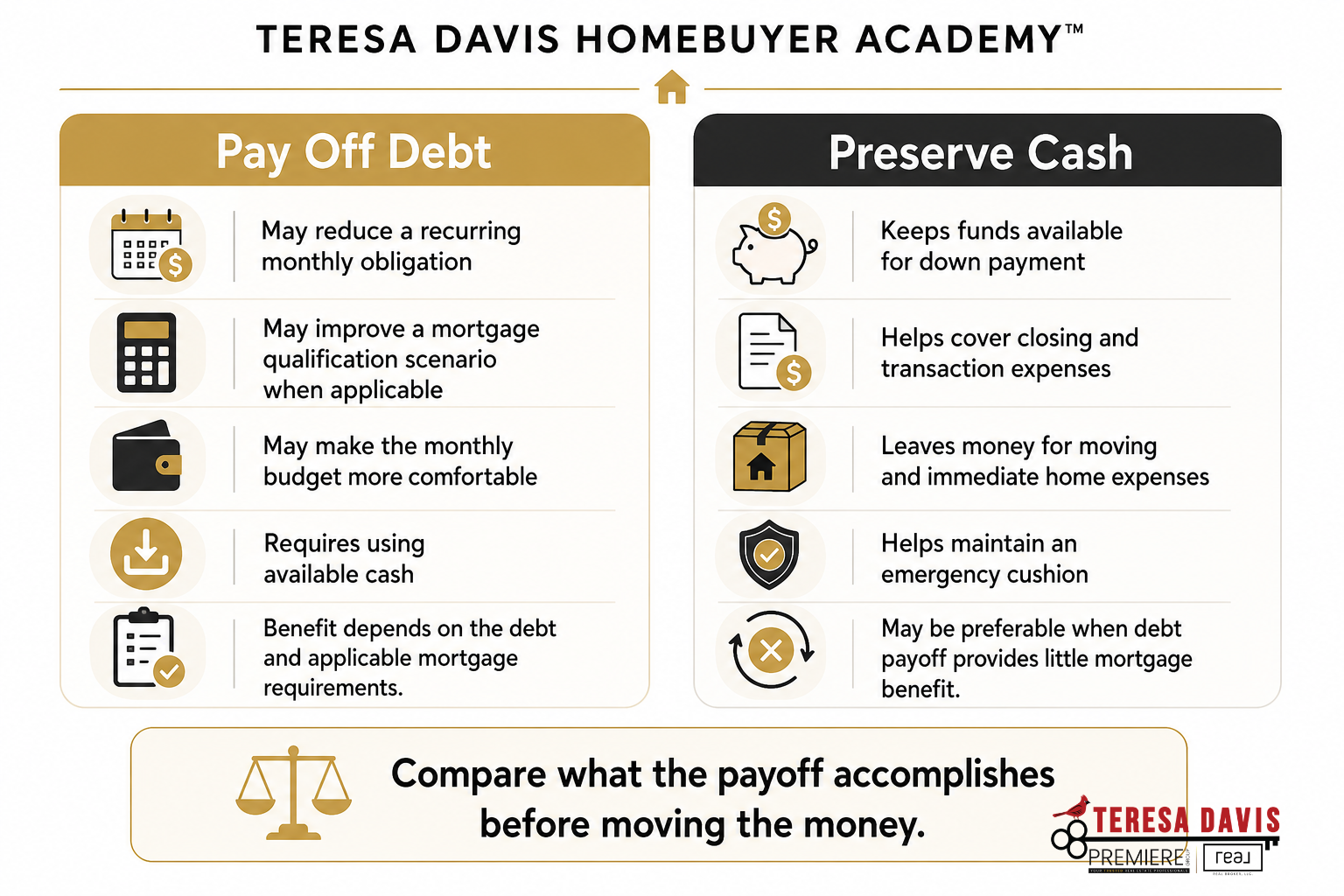
How Your Debt Strategy Connects to Your Homebuying Budget
Preparing financially for a home purchase involves more than qualifying for a mortgage. The amount of cash you keep available and the monthly obligations you carry can also affect the homes you are comfortable considering, the expenses you can handle during the transaction, and your financial flexibility after closing. That is why debt decisions should be coordinated with the overall homebuying plan.
Before using a significant amount of savings to pay off debt, consider how that money may also be needed for:
- your down payment;
- closing costs and prepaid expenses;
- inspections and other due diligence-related expenses;
- moving costs;
- immediate repairs or maintenance;
- and funds you want available after closing.
From a real estate perspective, your financing plan and your home-search strategy should support each other. A mortgage approval establishes an important financial boundary, but your personal comfort level matters too. You may decide that purchasing below the maximum amount for which you qualify gives you more room for maintenance, savings, other obligations, and the normal expenses of homeownership.
Likewise, paying off debt simply to increase a potential approval amount may not be worthwhile if doing so leaves you without enough cash for the transaction or creates a monthly housing budget that feels uncomfortable.
A thoughtful approach is to establish both:
- what your financing supports; and
- what purchase price and monthly obligation fit comfortably within your broader financial goals.
As you move from financial preparation into the home search, those two numbers may not always be identical.
Teresa’s Professional Insight
One of the most useful things you can do before paying off a large debt is find out what that payoff would actually accomplish. Two buyers can have similar debt balances and need completely different strategies. Their income, required monthly payments, credit profiles, available savings, loan options, and homebuying goals may all be different. That is why I would rather help a buyer evaluate the complete picture before they move a large amount of money.
For example, if using several thousand dollars to eliminate one debt meaningfully improves the mortgage scenario while still leaving adequate funds for the purchase, that may be worth considering. But if the payoff provides little qualification benefit and leaves the buyer short on funds for closing, moving, or financial reserves, keeping the cash may support the homebuying plan more effectively.
As both a REALTOR® / Professional Real Estate Advisor with PREMIERE Group of Real Broker LLC and a Loan Originator NMLS #2597433 with One Real Mortgage, I can help buyers understand how the financing side and the real estate side of the purchase connect. The objective is not simply to qualify for a mortgage. It is to build a homebuying plan that makes sense from preparation through closing and into homeownership.
For buyers in Davidson, Randolph, Guilford, Forsyth, and surrounding North Carolina counties, that means looking at the complete plan before deciding that becoming debt-free must come first.
Helpful Tip
Create a simple debt worksheet before deciding what to pay off. For each debt, write down:
- the type of debt;
- the current balance;
- the required monthly payment;
- and the approximate payoff amount.
Then ask your mortgage professional to compare the likely effect of leaving the debt alone, paying it down, or paying it off.
Do this before sending a large payment. A few minutes of scenario planning can help you understand whether the payoff is likely to improve your mortgage position enough to justify using the cash.
Keep in Mind
Paying off debt can be helpful, but it does not guarantee mortgage approval, a particular loan amount, or a specific credit-score improvement.
A debt strategy can also involve tradeoffs. Reducing a monthly obligation may strengthen one part of your financial profile while using cash that you need for the down payment, closing costs, transaction expenses, moving, or emergency savings.
Mortgage products and lenders can also apply different qualification and debt-treatment requirements. For that reason, generic rules such as “pay off all debt before applying” should not replace an evaluation of your actual mortgage scenario.
Before making significant financial changes, discuss the proposed strategy with the professionals helping with your purchase. This lesson provides general homebuyer education and is not individualized financial, tax, or legal advice.
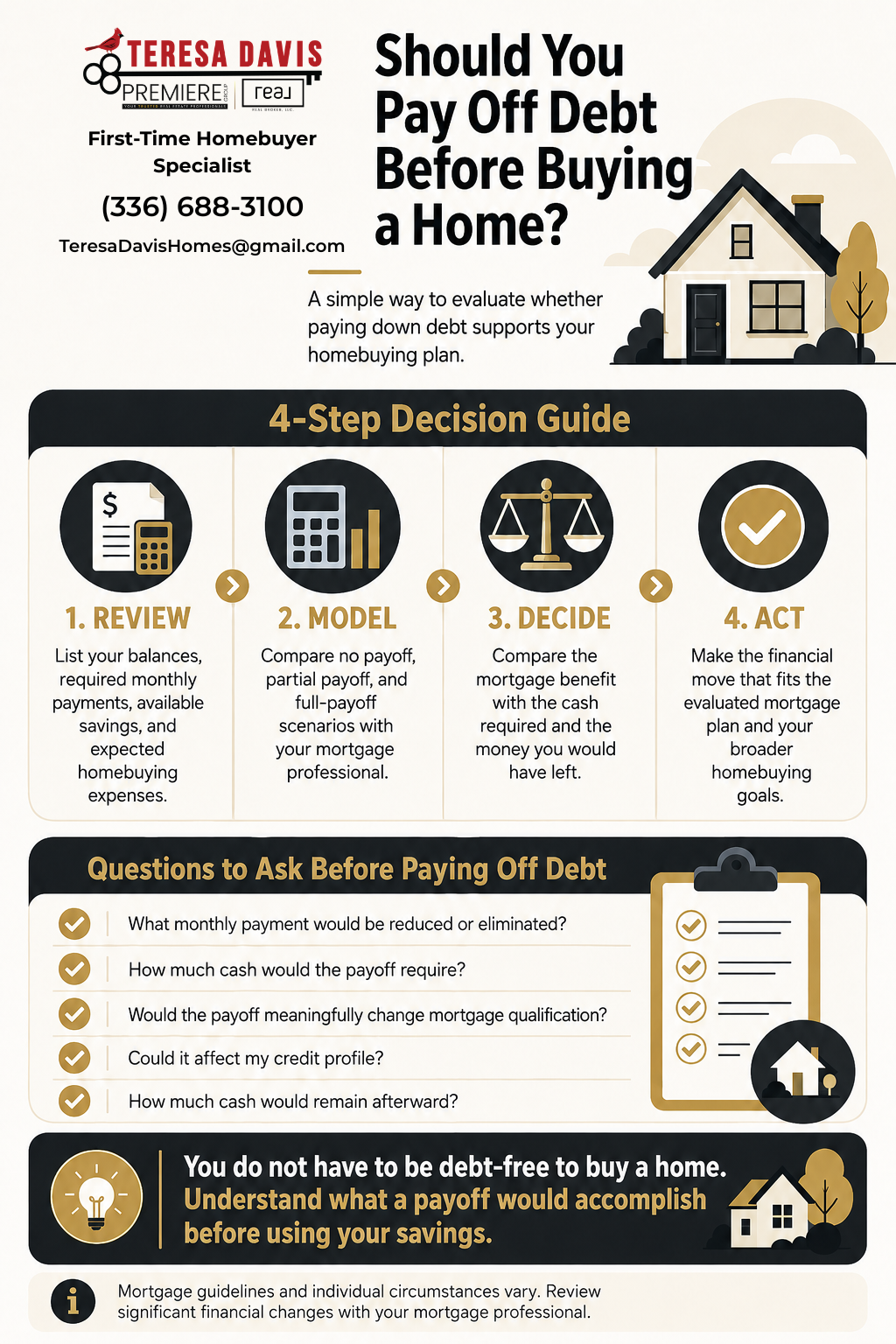
Frequently Asked Questions
Do I have to be debt-free to qualify for a mortgage?
No. You generally do not have to eliminate every debt before qualifying for a mortgage. Lenders evaluate your overall financial profile, including qualifying income and applicable monthly debt obligations. Debt-to-income ratio is one measurement used in that evaluation, and requirements can differ depending on the mortgage product and lender.
The more useful question is whether your current obligations fit within the mortgage program you are considering and a monthly budget you are comfortable maintaining.
Is it better to pay off credit cards or save more money for a down payment?
There is no universal answer. Paying down revolving debt may reduce balances, affect credit utilization, and, depending on the circumstances, change the monthly debt considered for mortgage qualification. Keeping the money may instead help with your down payment, closing expenses, reserves, or other costs of buying the home.
Before choosing between the two, compare what the proposed payoff would accomplish with how much cash you would have left for the purchase.
Will paying off a car loan help me qualify for a larger mortgage?
It may help in some situations if eliminating the qualifying monthly payment improves the mortgage analysis, but the result depends on the loan program, the remaining obligation, your income, your other debts, and the complete application.
Do not assume that paying off an auto loan will automatically increase the mortgage amount available to you. Have the mortgage professional evaluate the before-and-after scenarios first.
Should I close a credit card after I pay it off before buying a home?
Not automatically. Paying off a credit card balance and closing the account are separate decisions. For example, current Fannie Mae conventional guidance states that a revolving account paid off at or before closing does not have to be closed solely for its payment to be excluded from long-term debt under the applicable requirements. CFPB also explains that closing a card can increase credit utilization and may lower a credit score depending on the rest of the consumer's credit profile.
Before closing an account during mortgage preparation, discuss the potential mortgage and credit implications with the appropriate professionals.
Should I pay off debt before I talk to a lender?
Usually, it makes sense to review the mortgage scenario before making a large payoff. A mortgage professional can compare your current obligations with possible payoff options and help you understand whether paying down a particular account is likely to provide a meaningful qualification benefit.
That allows you to make the decision with more information instead of using savings first and discovering afterward that the payoff was unnecessary.
What Happens Next?
Understanding whether you should pay off debt is only part of preparing your finances for a home purchase. The next step is understanding how lenders compare your monthly debt obligations with your income.
That measurement is called your debt-to-income ratio, or DTI. CFPB describes DTI as total monthly debt payments divided by gross monthly income and notes that mortgage-product and lender limits can differ.
In the next Teresa Davis Homebuyer Academy™ lesson, What debt-to-income ratio do I need to buy a home?, you will learn how DTI works, which obligations may be considered, and why the ratio can affect mortgage qualification.
Understanding DTI will also make the strategy in this lesson easier to apply because you will be able to see more clearly why eliminating one monthly payment may have a different effect from paying down another debt.
Ready to Take the Next Step?
If you are trying to decide whether to pay off debt before buying a home, you do not have to make that decision based on a generic rule. Reviewing your debt, available savings, homebuying costs, and mortgage options together can help you understand which strategy best supports your next step.
Contact Teresa Davis
If you would like to discuss your homebuying goals and how your financing strategy can connect with your real estate plan, contact Teresa Davis.
Teresa Davis
REALTOR® / Professional Real Estate Advisor
PREMIERE Group of Real Broker LLC
Start the One Real Mortgage Pre-Approval Process
If you are ready to have your actual mortgage scenario evaluated, start the One Real Mortgage pre-approval process. Reviewing your financial profile before making major debt-payoff decisions can help determine which changes, if any, may be useful. Using One Real Mortgage is optional and is not required in order to work with Teresa Davis as your REALTOR®.
Teresa Davis
Loan Originator NMLS #2597433
One Real Mortgage
Mortgage qualification, loan programs, terms, costs, and final approval depend on the borrower, property, transaction, documentation, underwriting, and applicable lending requirements. Beginning a pre-approval process does not guarantee financing or require you to purchase a home. It is a practical way to learn more about your potential financing options, estimated payment, and possible next steps.
Ready for the next lesson? Use “Next Question” below to continue to "What debt-to-income ratio do I need to buy a home?".
2:5 - What debt-to-income ratio do I need to buy a home?

If you are preparing to buy a home, you may hear that your debt-to-income ratio, or DTI, needs to be below a certain percentage. DTI is an important part of mortgage qualification, but there is not one universal percentage that every homebuyer must meet.
Your debt-to-income ratio compares your qualifying monthly debt payments with your gross monthly income. In simple terms, it helps a lender evaluate how much of your monthly income is already committed to debt before adding or evaluating a mortgage payment. The Consumer Financial Protection Bureau defines DTI as monthly debt payments divided by gross monthly income and notes that different loan products and lenders can have different DTI limits.
That distinction matters because numbers such as 36%, 41%, 43%, 45%, or 50% may appear when you research mortgage qualification online, but those percentages can apply to different loan programs, underwriting methods, or circumstances. For example, Fannie Mae currently has different DTI parameters for manually underwritten loans and loan casefiles evaluated through Desktop Underwriter.
For a first-time buyer, the more useful question is not simply, “Is my DTI below a certain number?” It is, “How does my DTI fit into the mortgage program, payment, and overall financial profile being evaluated?” Understanding that difference can help you make better decisions about debt, savings, your potential monthly housing payment, and the price range you explore.
Quick Answer
There is no single debt-to-income ratio required for every person who wants to buy a home. Your acceptable DTI can depend on the mortgage program, underwriting method, lender requirements, and other parts of your financial profile.
DTI is generally calculated by dividing your qualifying monthly debt payments by your gross monthly income. A lower DTI generally means less of your income is committed to monthly debt obligations, but DTI is only one part of mortgage qualification. Fannie Mae's automated underwriting system, for example, evaluates DTI along with factors such as credit history, income, reserves, and the borrower's overall risk profile.
The goal is not necessarily to reach one “perfect” DTI percentage. The goal is to understand how your actual income, debts, proposed housing payment, and mortgage options work together.
At a Glance
- DTI compares monthly debt with gross monthly income. Gross income generally means income before taxes and other payroll deductions.
- There is no universal mortgage DTI cutoff. Different mortgage products and lenders can use different limits and underwriting requirements.
- Your proposed housing payment matters. Mortgage qualification considers the housing obligation associated with the home you are financing along with other qualifying monthly debts.
- DTI is only one part of approval. Credit, qualifying income, assets, loan program requirements, underwriting findings, and other factors may also affect the mortgage decision.
- A maximum allowable DTI is not the same as a comfortable household budget. Qualifying for a payment does not mean you must spend at the maximum amount available to you.
What Is a Debt-to-Income Ratio?
Your debt-to-income ratio (DTI) compares the monthly debt obligations used for mortgage qualification with the gross monthly income that can be used to qualify. Mortgage lenders use this ratio as one way to evaluate whether the proposed housing payment and your existing debt obligations appear manageable relative to your income. The Consumer Financial Protection Bureau explains that DTI is calculated by adding monthly debt payments and dividing that total by gross monthly income.
A higher DTI means more of your gross monthly income is already committed to debt payments. A lower DTI generally means a smaller portion of your income is committed to those obligations. Neither number, by itself, tells the complete story of whether you will qualify for a mortgage.
The Basic DTI Calculation
The basic calculation is: Total qualifying monthly debt payments ÷ gross monthly income × 100 = DTI percentage
Consider a hypothetical buyer with:
- $6,000 in gross monthly qualifying income;
- $450 per month for an auto loan;
- $150 per month in qualifying credit-card payments; and
- a proposed monthly housing obligation of $1,800.
The qualifying monthly obligations in this simplified example total $2,400. Dividing $2,400 by $6,000 produces a DTI of 40%. That example demonstrates the mathematics only. It does not mean that a 40% DTI will automatically qualify—or fail to qualify—a borrower for a particular mortgage.
DTI Uses Gross Monthly Income, Not Your Take-Home Pay
For the basic DTI calculation, gross monthly income generally means income before taxes and other payroll deductions. That can make DTI feel different from a household budget.
You may make everyday spending decisions based primarily on the money that actually reaches your bank account after taxes, insurance, retirement contributions, and other deductions. Mortgage underwriting, however, applies the applicable loan program's rules for determining what income can be documented and used for qualification.
This is one reason you should distinguish between:
- the payment you may qualify for under mortgage underwriting
- the payment you personally feel comfortable carrying each month
Those amounts do not have to be the same.
What Monthly Debts Can Affect DTI?
The exact treatment of an obligation depends on the mortgage program and the circumstances, but recurring obligations that may affect mortgage qualification can include items such as:
- auto loans;
- student loans;
- credit-card minimum payments;
- installment loans;
- other mortgage obligations; and
- certain court-ordered or recurring financial obligations when applicable.
The proposed housing obligation is also considered when the lender evaluates the mortgage transaction.
It is important not to assume that every account is treated identically. Mortgage programs can have detailed rules governing whether an obligation must be counted and which monthly payment should be used. For example, Fannie Mae maintains specific requirements for recurring monthly debt obligations and for determining qualifying payments in particular circumstances.
That is why an online DTI calculator can be useful for education but may not reproduce the exact DTI calculated during mortgage underwriting.
Your Monthly Payment Can Matter More Than the Balance Alone
When thinking about DTI, buyers sometimes focus primarily on how much debt they owe in total. For mortgage qualification, however, the qualifying monthly payment associated with the debt can be especially important because DTI is based on monthly obligations relative to monthly income.
For example, two borrowers could each owe $10,000 but have very different required monthly payments. Those debts could therefore affect their DTI calculations differently.
This also explains why paying down debt does not always produce the DTI improvement a buyer expects. If paying down an account does not change the qualifying monthly obligation, the effect on DTI may be different from eliminating or materially reducing a payment.
Before using a substantial amount of savings to pay down debt solely to improve mortgage qualification, it can be helpful to understand how the specific obligation will be treated and how the change could affect both DTI and the cash you retain for the home purchase.
There Is No One DTI Percentage Required for Every Mortgage
One of the most important things to understand is that there is not one universal DTI percentage that determines whether every borrower can buy a home. The CFPB specifically notes that DTI limits can differ depending on the loan product and lender.
That is why you may see several different percentages when researching mortgages. A percentage may represent:
- a guideline associated with a particular mortgage program;
- a manual-underwriting limit;
- an automated-underwriting parameter;
- a threshold that requires additional underwriting considerations; or
- a lender or investor requirement.
Those numbers should not be treated as interchangeable. A borrower should therefore be cautious about reading one percentage online and concluding, “My DTI is below this number, so I will be approved,” or “My DTI is above this number, so I cannot buy a home.” Neither conclusion considers the complete mortgage scenario.
Conventional Mortgages: One Example of Why the Numbers Vary
Fannie Mae's current conventional underwriting requirements provide a useful example of why there is no single DTI number that applies in every situation.
For loans that are manually underwritten, Fannie Mae generally establishes a maximum total DTI of 36%, with the possibility of going as high as 45% when specified credit-score and reserve requirements are met. For loan casefiles evaluated through Fannie Mae's Desktop Underwriter (DU), the maximum allowable DTI can be 50%.
Those figures are Fannie Mae requirements for the circumstances to which they apply. They should not be interpreted as a universal rule for every conventional loan, every lender, or every borrower.
The distinction also demonstrates an important underwriting principle: how a mortgage is evaluated matters. A manually underwritten file and an automated-underwriting file may not be evaluated under identical DTI parameters.
Even when a particular underwriting framework permits a higher DTI, that does not mean every borrower with that DTI will qualify. DTI remains one part of the overall mortgage evaluation.
FHA Mortgages Also Require Context
FHA-insured mortgages have their own underwriting framework, which is another reason consumers should avoid applying a conventional-loan percentage to every mortgage program.
HUD's FHA guidance for manually underwritten loans uses qualifying ratios of 31% for the mortgage-payment expense ratio and 43% for the total fixed-payment ratio as the baseline framework, with specific provisions governing circumstances in which other ratios may be permitted.
The important consumer takeaway is not simply to memorize “31/43.” It is to understand that these figures belong to a particular FHA underwriting context.
An FHA mortgage evaluated through an automated underwriting system may involve a different underwriting process than a manually underwritten FHA loan. Therefore, saying that every FHA borrower must have exactly the same DTI would oversimplify how mortgage qualification works.
The same principle will become even clearer when comparing other mortgage programs: DTI matters, but the applicable loan program and underwriting method determine how that ratio is evaluated.
VA Loans: DTI Is Important, but Residual Income Matters Too
VA mortgage underwriting provides another example of why buyers should not treat one DTI percentage as a universal pass-or-fail number. The Department of Veterans Affairs maintains specific underwriting guidance for VA-guaranteed loans, and its current lender resources direct mortgage professionals to the VA Lender’s Handbook and related underwriting materials.
VA underwriting evaluates more than the relationship between monthly debts and gross income. Residual income—the income remaining after major monthly obligations are accounted for—is also an important part of the VA analysis. The VA framework has historically used 41% as an important DTI reference point, but that figure should not be interpreted as an absolute rule that automatically approves or disqualifies every eligible borrower.
For a first-time homebuyer using VA financing, the practical takeaway is that the complete underwriting picture matters. A borrower’s DTI should be evaluated together with the applicable VA requirements, residual income, credit information, documented income, and other underwriting considerations.
USDA Loans Have Their Own Ratio Framework
USDA's Single Family Housing Guaranteed Loan Program also illustrates why mortgage DTI should always be discussed in the context of the actual loan program.
Current USDA training materials identify a 29% housing ratio and a 41% total debt ratio within the program's qualifying framework. USDA guidance also recognizes circumstances in which ratios above those benchmarks may receive consideration through the applicable underwriting process rather than automatically resulting in denial.
These figures are USDA program standards, not universal homebuying rules. A buyer considering USDA financing should therefore avoid comparing a USDA ratio directly with a Fannie Mae, FHA, or VA number without understanding the different underwriting rules behind each program.
A Maximum Qualifying DTI Is Not the Same as a Comfortable Budget
Mortgage qualification and personal affordability are related, but they are not identical. An underwriting system may determine that a borrower meets the requirements for a particular monthly housing obligation. That does not mean the borrower must choose a home at the highest payment that underwriting may permit.
Your personal household budget may also need to account for expenses that are not reflected in the mortgage DTI calculation in the same way as qualifying debts, such as:
- utilities;
- groceries;
- transportation and fuel;
- childcare or other household expenses;
- savings goals;
- home maintenance;
- repairs;
- medical or insurance expenses;
- retirement contributions; and
- personal spending priorities.
For that reason, it can be useful to think about two different questions:
- What housing payment might I qualify for under mortgage underwriting?
- What housing payment fits comfortably within the way I want to manage my household finances?
A responsible homebuying plan considers both.
Your Proposed Housing Payment Can Change Your DTI
Your DTI during mortgage qualification is not based only on the debts you have before purchasing a home. The proposed housing expense associated with the property being financed is also part of the analysis.
For example, Fannie Mae defines the monthly housing expense for a subject property to include principal and interest as well as applicable property taxes, homeowners insurance, mortgage insurance, association dues, assessments, and certain other housing-related obligations.
That means your estimated DTI can change when the projected housing payment changes. A buyer who appears to be within an acceptable range at one payment level could have a different DTI if the proposed payment increases.
Two Similar-Priced Homes Can Produce Different Qualifying Payments
The purchase price is important, but it is not the only factor affecting the housing expense used during mortgage qualification. Two homes with similar prices can have different projected monthly housing expenses because of differences such as:
- property taxes;
- homeowners insurance;
- mortgage insurance, when applicable;
- homeowners association dues;
- special assessments; and
- financing structure.
Fannie Mae's housing-expense rules specifically include applicable taxes, insurance, mortgage insurance, association dues, and certain assessments in the monthly housing expense.
For buyers in Davidson, Randolph, Guilford, Forsyth, and surrounding North Carolina counties, this is one reason it can be useful to evaluate the property-specific payment, not simply the listing price. A home that falls within an expected price range may still need a fresh payment review if its taxes, insurance, HOA dues, or other qualifying expenses differ materially from the assumptions used earlier in the mortgage process.
Lowering a Monthly Debt Payment Can Affect DTI
Because DTI compares qualifying monthly obligations with qualifying monthly income, reducing or eliminating a monthly obligation can sometimes improve the ratio. However, simply reducing the outstanding balance of a debt does not necessarily produce the same result.
For example, if a borrower pays down a revolving account but the qualifying monthly payment used for underwriting does not change enough to affect the calculation, the DTI improvement may be smaller than expected. Conversely, when an obligation can properly be excluded or its qualifying monthly payment is reduced under the applicable underwriting rules, the effect on DTI may be more meaningful.
Fannie Mae, for example, has specific rules addressing certain debts paid off at or before closing and circumstances in which a qualifying monthly payment may no longer need to be included in DTI.
This is why it can be helpful to evaluate the mortgage impact before using a large amount of savings to pay down debt solely because you believe it will improve DTI. The decision may involve more than the ratio itself. Buyers may also need cash for their down payment, closing costs, inspections, moving expenses, reserves, and the transition into homeownership.
DTI Is Only One Part of Mortgage Qualification
A debt-to-income ratio is an important underwriting measurement, but mortgage approval is not based on DTI alone. Depending on the loan program and transaction, the complete evaluation may also consider factors such as:
- qualifying and documented income;
- credit history and credit profile;
- assets and available funds;
- reserves when required;
- mortgage program eligibility;
- the proposed property;
- the housing payment;
- automated or manual underwriting results; and
- applicable lender, investor, or agency requirements.
For example, Fannie Mae's Desktop Underwriter evaluates multiple credit-risk factors rather than making the mortgage decision from DTI alone. Its current conventional guidance separately establishes DTI parameters for manually underwritten loans and DU-underwritten casefiles. This helps explain why two borrowers with the same calculated DTI can potentially receive different underwriting results.
Being Below a Published DTI Maximum Does Not Guarantee Approval
Suppose you calculate your DTI and discover that it falls below a maximum percentage you found for a particular mortgage program. That can be useful information, but it does not establish that the mortgage will be approved. The lender still has to evaluate the complete application under the applicable underwriting requirements.
Likewise, being above a percentage that you saw in a general article does not automatically mean you cannot qualify. The percentage may apply only to a particular underwriting method, loan program, or set of circumstances.
The more accurate question is: How will my actual DTI be evaluated under the mortgage program and underwriting method that apply to me?
Your Own DTI Calculation Is a Helpful Starting Point
Calculating your DTI before applying for a mortgage can still be very useful. It can help you:
- understand how much of your gross income is committed to monthly debt;
- identify which monthly obligations have the greatest effect on the ratio;
- see how a proposed housing payment could change your DTI;
- prepare more informed questions for your mortgage professional; and
- understand why a change in debt or housing payment can affect mortgage qualification.
But your self-calculated percentage should be treated as an educational estimate, not an underwriting decision. A mortgage professional still needs to determine which income can be used, which obligations must be counted, what qualifying payments apply, and which mortgage programs fit your circumstances.
The Most Useful Number Is the One Calculated for Your Actual Scenario
Instead of trying to reach a generic DTI percentage before speaking with a lender, consider having your actual situation evaluated. That review can help determine:
- which income can be used for qualification;
- how your current debts will be treated;
- which monthly payments must be included;
- how the proposed housing payment affects the calculation;
- which mortgage programs may be available; and
- whether reducing a particular monthly obligation could materially change the scenario.
This can be especially valuable before making a major financial move such as paying off a loan, transferring savings, opening new credit, or changing the way you manage existing accounts. Understanding your actual DTI does more than give you a percentage. It can help connect your financial preparation, mortgage options, and home-search budget so that you can move forward with clearer expectations.
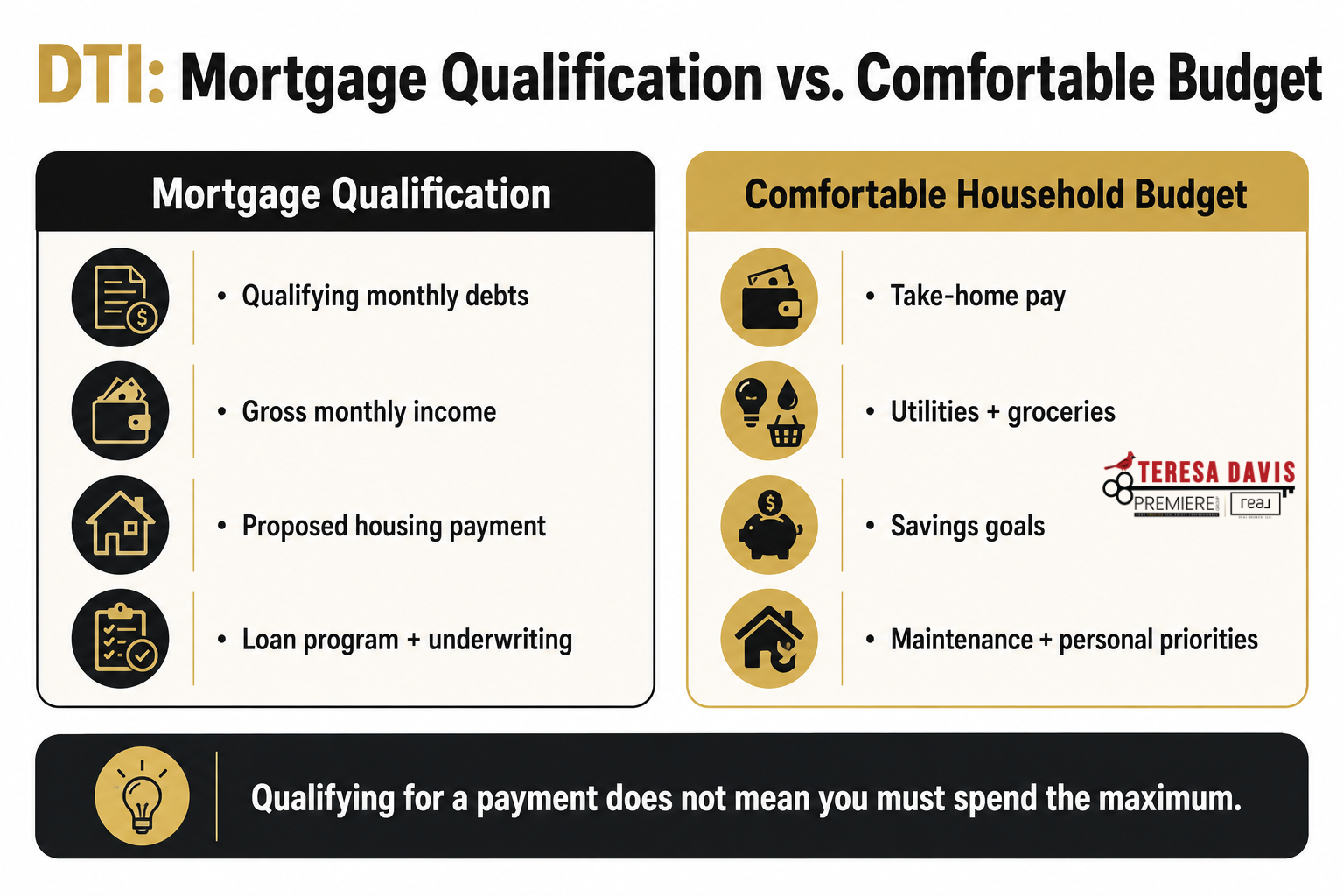
How DTI Can Affect Your Home Search
Your debt-to-income ratio is primarily a mortgage-qualification measurement, but it can also affect how you approach the home search. Once your lender or mortgage professional has evaluated your income, monthly obligations, loan options, and estimated housing payment, that financing information can help establish a more realistic price and payment range for your search.
The important word is payment. Two homes with similar purchase prices can have different projected monthly costs because property taxes, homeowners insurance, homeowners association dues, mortgage insurance when applicable, and other property-specific expenses may differ. For that reason, a home that appears to fit comfortably within your price range may still need a payment review before you make assumptions about affordability or financing.
As your REALTOR®, I can help you evaluate property-specific information that may affect the projected housing expense and coordinate with your mortgage professional when a home you are considering changes the assumptions used during pre-approval.
If you have been pre-approved for a certain amount, remember that a pre-approval amount is not a requirement to spend that much. The better goal is to find a home that works with both your financing and the monthly payment you are comfortable carrying.
When property taxes, insurance, HOA dues, purchase price, or other relevant costs change significantly from one property to another, having the loan scenario reviewed again can help you make an informed decision before moving forward.
Teresa’s Professional Insight
One of the biggest mistakes I want first-time buyers to avoid is chasing a single “perfect” DTI percentage without understanding what that percentage means in their actual mortgage scenario. Two buyers can have the same calculated DTI and still receive different underwriting results because their income, credit profiles, assets, loan programs, property-related expenses, and other underwriting factors may be different.
I also recommend being careful about paying off debt solely because you believe it will make your DTI look better. Reducing debt can sometimes help, but the monthly payment being used for qualification is particularly important to the DTI calculation. Paying down an account may not always change that qualifying payment as much as you expect. At the same time, using a large amount of savings to eliminate debt could leave you with less money available for your down payment, closing costs, inspections, moving expenses, reserves, and the expenses that can come with becoming a homeowner.
Because I serve buyers as both a REALTOR® / Professional Real Estate Advisor with PREMIERE Group of Real Broker LLC and a Loan Originator NMLS #2597433 with One Real Mortgage, I can help connect the financing conversation with the practical home-search conversation. The objective is not simply to determine the largest mortgage payment that may be available. It is to help you understand your options so you can make a homebuying decision that fits your broader financial plans.
Helpful Tip
Before discussing mortgage qualification, make a simple list of your recurring debts. For each debt, write down:
- the type of account;
- the approximate outstanding balance; and
- the required monthly payment.
Also gather information about your gross monthly income. This gives your mortgage professional a clearer starting point for determining how your obligations may be treated under the mortgage programs being considered.
Pay particular attention to the monthly payment, not just the outstanding balance. DTI compares qualifying monthly obligations with qualifying monthly income, so two debts with the same balance can affect the calculation very differently if their required monthly payments are different.
If you are considering paying off or substantially reducing a debt before purchasing a home, ask how that specific change is expected to affect your mortgage scenario before moving the money. That allows you to evaluate the potential DTI benefit alongside the amount of cash you may want to preserve for the purchase.
Keep in Mind
Debt-to-income guidelines are not one-size-fits-all and can change over time. Different mortgage programs may have different requirements for:
- acceptable DTI ratios;
- how particular debts are counted;
- which monthly payment must be used;
- how qualifying income is calculated;
- automated versus manual underwriting; and
- circumstances in which additional underwriting considerations apply.
Individual lenders or investors may also have requirements beyond a mortgage program's general guidelines. A published maximum DTI should therefore not be interpreted as a promise that a mortgage will be approved. Likewise, a self-calculated DTI above a percentage you found online does not necessarily establish that homeownership is out of reach.
Your own DTI calculation is best used as an educational estimate. The actual mortgage analysis depends on the documentation, loan program, property, underwriting method, and complete financial profile being evaluated.
Also remember that qualifying for a payment and being comfortable with that payment are different questions. Mortgage underwriting does not replace your own household budgeting decisions.
Before making a major financial change specifically to improve mortgage qualification—such as paying off a loan, transferring a large amount of savings, opening or closing credit, or changing existing accounts—consider discussing the potential effect with the appropriate mortgage professional first.
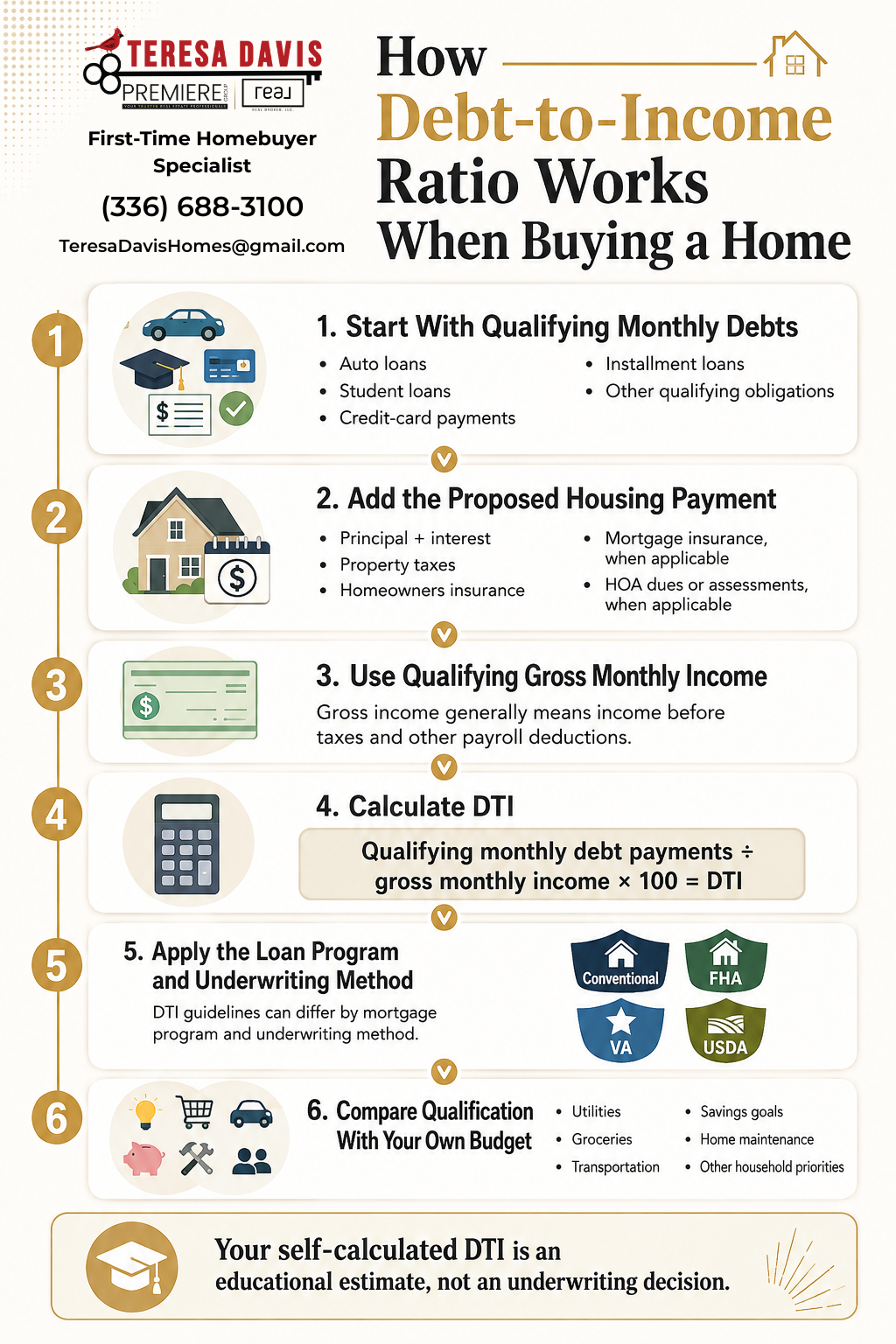
Frequently Asked Questions
What is considered a good debt-to-income ratio for buying a home?
There is no single DTI percentage that is considered “good” for every mortgage borrower. In general, a lower DTI means that a smaller portion of your gross monthly income is committed to qualifying debt payments. However, acceptable ratios can vary by mortgage program, underwriting method, lender or investor requirements, and the rest of your financial profile. The most useful approach is to have your actual DTI evaluated for the mortgage options you are considering rather than relying on one universal percentage.
How do I calculate my debt-to-income ratio for a mortgage?
A basic DTI estimate is calculated by adding your qualifying monthly debt payments, dividing that total by your gross monthly income, and multiplying by 100. For example, $2,000 in qualifying monthly obligations divided by $5,000 in gross monthly income equals a 40% DTI. Your own calculation is useful for education, but a mortgage professional may calculate the final qualifying ratio differently based on the applicable program rules, documented income, debt treatment, and proposed housing payment.
What debts are included in my mortgage DTI calculation?
Depending on the mortgage program and your circumstances, qualifying obligations may include items such as auto loans, student loans, credit-card payments, installment loans, other mortgage obligations, certain recurring or court-ordered obligations, and the proposed housing expense. The exact treatment of a debt can vary, including which monthly payment must be used or whether a particular obligation may be excluded under applicable guidelines. That is why an online DTI calculator may not exactly match the lender's underwriting calculation.
Can I qualify for a mortgage if my DTI is above 43%?
Possibly. A DTI above 43% is not an automatic denial for every mortgage program or borrower. Different loan programs and underwriting methods use different DTI frameworks, and some may permit ratios above 43% when applicable requirements are satisfied. Mortgage qualification also involves more than DTI alone. Your income, credit profile, assets, loan program, proposed property, underwriting findings, and other requirements may also affect the decision. A mortgage professional should evaluate your actual scenario before you assume that a particular percentage disqualifies you.
Will lowering my debt-to-income ratio help me qualify for more house?
It can, but not in every situation and not necessarily dollar-for-dollar. Reducing a qualifying monthly debt payment can lower your DTI and may create additional room for a proposed housing payment. However, paying down a balance without materially changing the qualifying monthly payment may have less effect than expected. Using savings to reduce debt can also leave you with less cash for your down payment, closing costs, reserves, moving expenses, and other homebuying needs. Before paying off debt specifically to increase mortgage qualification, have the expected impact evaluated as part of your complete financing scenario.
What Happens Next?
Now that you understand how debt-to-income ratio works, the next question is an important one: Can you still get approved for a mortgage if you already have debt? The answer is not determined by the simple fact that debt exists. Mortgage underwriting looks at how your monthly obligations compare with qualifying income and how those obligations fit within the requirements of the mortgage program being evaluated.
Your next lesson (see below) will look more closely at how different types of debt, required monthly payments, credit, income, assets, and underwriting considerations can affect mortgage approval. Understanding that distinction can help you move away from the idea that you must become completely debt-free before buying a home and toward a more useful question: How does my current financial profile fit the mortgage options available to me?
Ready to Take the Next Step?
If you are unsure what your debt-to-income ratio is—or you have calculated it yourself but are not sure what the percentage means for your homebuying plans—you do not have to rely on a generic online limit. Reviewing the actual numbers can help you understand how your income, monthly debts, estimated housing payment, and available mortgage options fit together.
Contact Teresa Davis
If you are beginning to plan your home search and want help connecting your financing expectations with a practical home-search strategy, contact Teresa Davis.
Teresa Davis
REALTOR® / Professional Real Estate Advisor
PREMIERE Group of Real Broker LLC
Begin the One Real Mortgage Pre-Approval Process
If you are ready for an individualized mortgage evaluation, you can begin the One Real Mortgage pre-approval process. Using One Real Mortgage is optional and is not required in order to work with Teresa Davis as your REALTOR®.
Teresa Davis
Loan Originator NMLS #2597433
One Real Mortgage
Mortgage qualification, loan programs, terms, costs, and final approval depend on the borrower, property, transaction, documentation, underwriting, and applicable lending requirements. Beginning a pre-approval process does not guarantee financing or require you to purchase a home. It is a practical way to learn more about your potential financing options, estimated payment, and possible next steps.
Ready for the next lesson? Use “Next Question” below to continue to "Can I get approved for a mortgage if I have debt?".
2:6 - Can I get approved for a mortgage if I have debt?

Having debt does not automatically mean you cannot qualify for a mortgage. Many first-time homebuyers have existing financial obligations such as credit card balances, car payments, student loans, personal loans, or other monthly debts when they begin preparing to buy a home.
What matters is not simply whether you owe money. Mortgage qualification generally looks at how your required monthly obligations fit with your qualifying income, the proposed housing payment, your credit profile, assets, and the requirements of the mortgage program being considered. The Consumer Financial Protection Bureau explains that lenders use debt-to-income ratio as one measure of a borrower's ability to manage monthly payments, and that applicable limits can vary by loan product and lender.
Different types of debt may also be evaluated differently. For example, current Fannie Mae guidance separately addresses obligations such as installment loans, student loans, revolving accounts, and lease payments when determining a borrower's monthly debt obligations. Other mortgage programs may apply their own requirements.
That is why it is usually more helpful to understand how your debt affects your mortgage qualification than to assume you must eliminate every debt before you can consider buying a home.
Quick Answer
Yes, you may be able to get approved for a mortgage even if you have debt.
Having credit cards, student loans, a car payment, or another debt does not automatically disqualify you. A mortgage lender evaluates the overall financial picture, including your qualifying income, required monthly debt payments, proposed housing expense, credit profile, assets, and applicable loan-program requirements.
One important distinction is that the amount you owe and the monthly payment used for mortgage qualification are not always the same thing. Mortgage guidelines may specify how particular obligations must be counted, and those rules can differ depending on the type of debt and mortgage program. Current conventional guidance, for example, contains separate treatment requirements for several categories of monthly obligations.
The goal is not necessarily to become debt-free before buying a home. The better question is whether your existing obligations fit within a mortgage scenario that is financially manageable and meets the applicable underwriting requirements.
At a Glance
- Debt does not automatically prevent mortgage approval. Many borrowers qualify while carrying credit cards, auto loans, student loans, or other obligations.
- Monthly payments matter. Mortgage qualification considers the payments you are responsible for each month, not simply whether an account has an outstanding balance.
- Different debts can be treated differently. Revolving accounts, installment loans, leases, student loans, and other obligations can have different underwriting requirements.
- Your entire financial profile matters. Income, debt obligations, credit history, assets, proposed housing costs, and mortgage-program requirements can all affect qualification.
- There is no single debt amount that automatically determines approval or denial. Debt-to-income requirements and underwriting standards can vary by mortgage product and lender.
- Do not assume you must pay off everything first. Before making a major financial change specifically to qualify for a mortgage, it can be helpful to determine how that particular obligation is actually being counted.
- An individualized mortgage review provides more useful information than guessing. It can show which obligations affect qualification and whether reducing or eliminating a particular payment would meaningfully change the financing scenario.
1. Having Debt Does Not Automatically Mean You Cannot Buy a Home
One of the most common misconceptions among first-time homebuyers is that they need to become debt-free before they can qualify for a mortgage. In reality, having debt and being unable to qualify for a mortgage are not the same thing.
Many consumers enter the homebuying process with existing obligations such as:
- credit card payments;
- car loans;
- student loans;
- personal or installment loans;
- lease payments; or
- other recurring financial obligations.
Mortgage qualification is generally based on how those obligations fit into the borrower's overall financial picture. The Consumer Financial Protection Bureau explains that lenders use debt-to-income ratio, or DTI, as one way to measure a consumer's ability to manage monthly debt payments in relation to gross monthly income. The CFPB also notes that different mortgage products and lenders can have different DTI limits.
That distinction is important. A lender is not simply asking, “Does this borrower have debt?” The more useful questions include:
- What monthly payments is the borrower responsible for?
- How much qualifying income is available?
- What will the proposed housing payment be?
- How does the borrower manage existing credit?
- What assets and available funds does the borrower have?
- What does the applicable mortgage program require?
This is why two people who both “have debt” can have very different mortgage qualification results. Having debt therefore should not be viewed as an automatic reason to postpone a conversation about home financing. The purpose of mortgage qualification is to evaluate the complete financial situation rather than make a decision based solely on whether debt exists.
2. Mortgage Qualification Looks at More Than the Amount You Owe
When consumers think about debt, they often focus first on the outstanding balance. A mortgage lender also needs to determine the monthly obligation associated with that debt.
Those are two different numbers. For example, one borrower might have a relatively large loan balance with a manageable required monthly payment, while another borrower could have a smaller total balance but several monthly payments that consume a larger portion of income. Those situations do not necessarily affect mortgage qualification in the same way.
Depending on the type of obligation and the applicable mortgage guidelines, a lender may need to consider factors such as:
- the required monthly payment;
- the remaining repayment term;
- whether the debt is revolving or installment debt;
- whether a reported payment accurately reflects the obligation;
- whether the borrower is legally responsible for the debt; and
- whether mortgage-program rules allow a particular obligation to be treated differently under specific circumstances.
Current Fannie Mae conventional guidance, for example, identifies several categories of non-mortgage debt separately, including installment loans, student loans, revolving accounts, lease payments, alimony, child support, and separate maintenance. This illustrates why debt cannot always be evaluated with one universal rule. Other mortgage programs may have different requirements.
The practical takeaway is that the balance shown on a statement or credit report does not, by itself, tell you exactly how that debt will affect mortgage qualification.
A buyer who sees $20,000, $40,000, or another balance on a credit report should not automatically conclude that the balance is either acceptable or unacceptable. The lender must determine how the obligation is treated under the mortgage program being evaluated.
3. How Monthly Debt Payments Affect Mortgage Qualification
Your required monthly debt payments can affect the amount of additional housing expense you may be able to qualify for. Debt-to-income ratio compares monthly debt payments with gross monthly income. For mortgage purposes, the calculation generally considers the proposed housing obligation along with other qualifying monthly debts. CFPB describes DTI as total monthly debt payments divided by gross monthly income and explains that lenders use it as one measure of a consumer's ability to manage the payments associated with borrowing.
Suppose two prospective buyers earn similar qualifying incomes. One has very few recurring debt payments, while the other has a substantial car payment, student loan payment, and several minimum credit card payments. Even if both have good credit, the second buyer has more income already committed to existing obligations.
That does not automatically mean the second buyer will be denied. It does mean those monthly obligations may affect the mortgage amount and housing payment that fit within the applicable underwriting requirements.
This lesson focuses on whether buyers can qualify while carrying debt. For a more detailed explanation of how debt-to-income ratio works, see What debt-to-income ratio do I need to buy a home?
A particularly important point is that there is no single dollar amount of debt that automatically determines whether someone can buy a home. A $10,000 balance cannot be evaluated accurately without knowing what kind of debt it is, its required payment, the borrower's income, the proposed housing expense, and the applicable mortgage guidelines.
4. Common Types of Debt a Mortgage Lender May Review
Not every debt works the same way. Understanding the basic categories can help make the mortgage review process less confusing.
Credit Cards and Other Revolving Accounts
Credit cards are a form of revolving debt because the balance can change as the account is used and repaid. For mortgage qualification, the lender generally needs a monthly payment to associate with the revolving obligation. Current Fannie Mae guidance contains specific requirements for revolving accounts, including how a monthly payment may be determined when a required payment is not shown on the credit report.
The exact treatment can vary with the mortgage program, so a buyer should not assume that every lender or loan type will use the same calculation.
Auto Loans and Other Installment Loans
An installment loan typically has a defined payment schedule over a specific period. Common examples include auto loans and personal loans.
The monthly payment is generally relevant to mortgage qualification, although program guidelines can contain specific provisions based on factors such as the remaining number of payments. Fannie Mae's conventional guidelines, for example, separately address installment loans as part of the borrower's monthly debt obligations.
That does not mean every installment debt with a certain remaining term will automatically be ignored. The lender must apply the requirements of the mortgage program being used.
Student Loans
Student loans deserve special attention because the payment appearing on a credit report does not always tell the entire underwriting story. Depending on the loan program and circumstances, mortgage guidelines may specify how the qualifying student-loan payment must be determined. A loan that is deferred or reports a low or $0 payment should therefore not automatically be assumed to have no effect on mortgage qualification.
Current Fannie Mae guidance specifically identifies student loans as a separate category within its monthly-debt-obligation requirements. The treatment of student loans can be program-specific, so detailed student-loan calculations should be confirmed for the particular financing option being evaluated.
Lease Payments
A vehicle lease or another qualifying lease obligation may also need to be considered. A lease is different from an installment loan because reaching the end of the current lease term does not necessarily mean the consumer will no longer have a transportation expense. Current Fannie Mae guidance specifically includes lease payments among non-mortgage debts addressed in its monthly debt requirements.
Again, the purpose of mentioning Fannie Mae here is to illustrate the way one major conventional mortgage framework evaluates obligations—not to suggest that every mortgage program follows identical rules.
Existing Real Estate and Other Recurring Obligations
A borrower may also have obligations associated with existing real estate, support payments, tax payment arrangements, or other legally enforceable recurring debts. These situations can require additional documentation and program-specific analysis.
The important consumer takeaway is that a mortgage lender needs to identify the obligations that affect the borrower's ability to make the proposed mortgage payment. Fannie Mae's general liability guidance, for example, requires the lender's risk analysis to include liabilities that affect income or assets and the borrower's ability to meet the mortgage obligation.
If you have an unusual obligation, it is better to disclose it and determine how it must be treated than to assume it will either count or not count.
5. Can You Get a Mortgage With Credit Card Debt?
Yes, credit card debt by itself does not automatically prevent mortgage approval. What matters is how the revolving debt affects the broader qualification analysis. A lender may consider:
- the outstanding balance;
- the required monthly payment;
- the borrower's overall revolving credit usage;
- payment history;
- other monthly obligations;
- qualifying income; and
- applicable mortgage-program requirements.
Current Fannie Mae guidance addresses revolving accounts within the calculation of monthly debt obligations, while separate credit-risk guidance also considers factors such as payment history, delinquencies, balances relative to credit limits, and recent credit activity.
This means there are really two separate questions to consider:
- How does the credit card payment affect monthly mortgage qualification?
- What does the credit account and its payment history contribute to the borrower's overall credit profile?
Those questions are related, but they are not identical.A buyer may have credit card balances and still qualify for a mortgage. Conversely, simply paying down a balance does not guarantee mortgage approval because lenders evaluate more than one part of the financial profile.
It is also important not to make major changes based only on assumptions. For example, paying off a credit card can reduce or eliminate a monthly obligation under certain mortgage guidelines, but using a large portion of your available savings to do so could affect the money available for the home purchase and other financial needs. Current Fannie Mae guidance contains specific provisions for revolving accounts paid off at or before closing, demonstrating why the effect of paying off a debt should be evaluated within the actual mortgage scenario.
Before paying off, consolidating, refinancing, opening, or substantially changing debt specifically because you plan to buy a home, it can be helpful to understand what problem you are trying to solve. The best financial move is not necessarily the one that produces the smallest total debt balance; for mortgage preparation, the effect on required payments, available funds, credit, and overall qualification may all matter.
6. Auto Loans, Personal Loans, and Other Installment Debt
Car loans, personal loans, and other installment debts do not automatically prevent mortgage approval. The important question is how the required monthly payment affects the overall mortgage qualification.
An installment loan usually has a fixed repayment schedule with a defined number of payments remaining. Under current Fannie Mae conventional guidelines, installment debts such as automobile loans and personal loans generally must be included in recurring monthly debt obligations when more than 10 monthly payments remain. Even when 10 or fewer payments remain, the obligation may still need to be considered if it significantly affects the borrower's ability to meet other credit obligations.
This is a useful example of why looking only at a loan balance can be misleading. Consider two buyers:
- Buyer A owes $6,000 on an auto loan but has a relatively large monthly payment.
- Buyer B owes $15,000 on an auto loan but has a smaller required monthly payment.
The larger balance does not automatically mean Buyer B will have the greater impact on mortgage qualification. The qualifying monthly obligation and the rest of each borrower's financial profile also matter.
Mortgage programs can have different underwriting requirements, so the Fannie Mae rule above should not be interpreted as a universal rule for every conventional, FHA, VA, USDA, or other mortgage. The lender must apply the requirements of the actual financing program being considered.
Fannie Mae also permits certain installment debts that are being paid off or paid down to 10 or fewer remaining monthly payments to be excluded from long-term debt under its current payoff and paydown rules. Its guidance specifically cautions that paying off or paying down debt solely to qualify should be evaluated as part of the overall loan analysis.
That is an important distinction for a buyer who is considering using several thousand dollars of savings to eliminate a car loan or personal loan. The question should not simply be: “Can I pay this debt off?”
A more useful mortgage-planning question is: “Would paying this obligation off meaningfully improve my qualification, and what would I be giving up by using those funds?”
Money used to eliminate debt may no longer be available for the down payment, closing-related expenses, reserves, moving costs, or expenses that arise after becoming a homeowner.
7. Student Loans Require Special Attention
Student loans are another area where buyers sometimes make assumptions based only on what appears on a credit report.
A borrower may see:
- a regular monthly payment;
- a reduced payment;
- a deferred payment;
- a temporarily suspended payment; or
- a $0 payment.
That information does not necessarily tell the borrower what payment will ultimately be used for mortgage qualification.
Current Fannie Mae guidance specifically treats student loans as a category of monthly debt obligation and includes rules for determining the qualifying payment. It also distinguishes student loans from other deferred installment debts.
This means a buyer should not automatically assume:
- a deferred student loan will be ignored;
- a $0 payment shown on a credit report means the lender will use $0;
- an income-driven repayment arrangement will be treated identically by every mortgage program; or
- having student loans makes mortgage approval impossible.
The correct treatment depends on the loan program, the documentation available, the payment status, and the applicable underwriting requirements. For first-time buyers in North Carolina who have student loans, this is one of the clearest examples of why an individualized mortgage review can be more useful than trying to estimate qualification from a credit-report balance alone.
The mortgage professional can determine which payment must be used for the financing option being evaluated and then show how that amount affects the complete qualification picture.
8. Debt and Credit History Are Related, but They Are Not the Same Thing
A borrower can have debt and still demonstrate responsible credit management. Mortgage qualification evaluates more than the mathematical amount of debt. Credit history can provide information about how the borrower has managed financial obligations over time.
Current Fannie Mae guidance requires lenders reviewing traditional credit history to consider the current status of credit accounts and the timeliness, frequency, recency, and severity of delinquent payments. It also recognizes that delinquent payments should be evaluated within the broader credit history, including factors such as account history, credit utilization, and recent attempts to obtain additional credit.
This creates two related but separate mortgage questions:
- How much of the borrower's monthly income is already committed to debt?
- What does the borrower's history of managing credit indicate about credit risk?
A buyer can therefore have an acceptable monthly-debt picture while still having credit issues that require additional evaluation.
The reverse can also be true. Someone may have a strong history of paying obligations as agreed but carry monthly payments that reduce the amount of additional housing expense that fits within mortgage qualification.
This is why debt-to-income ratio and credit history should not be treated as interchangeable concepts. Debt-to-income ratio measures the relationship between qualifying income and qualifying monthly obligations. Credit analysis looks more broadly at how credit accounts have been managed. Both can influence mortgage qualification, but they answer different questions.
9. How Debt Can Reduce Your Homebuying Range
Existing monthly obligations can affect the amount of housing expense that fits within a mortgage qualification. Imagine that a portion of a buyer's qualifying monthly income is already committed to:
- a car payment;
- student loans;
- credit card minimum payments; and
- a personal loan.
Those obligations may leave less room within the applicable underwriting calculation for the proposed mortgage payment. That does not mean the buyer cannot purchase a home. It may mean that the mortgage amount or payment that fits the buyer's qualifying profile is different from what it would be with fewer monthly obligations.
This is also why a buyer's home-search range should be based on an actual financing review rather than simply an online home-price calculator. Two buyers with the same income may qualify very differently because their existing monthly obligations, credit profiles, assets, proposed housing expenses, and loan programs can differ.
If a monthly debt payment can appropriately be reduced or eliminated under the applicable mortgage guidelines, the financing picture may change. But the amount of that change should be evaluated rather than assumed.
A $5,000 payoff, for example, is not automatically worthwhile simply because it lowers total debt. The important questions include:
- How much monthly payment would actually be eliminated?
- Would the debt still need to be counted under the applicable guidelines?
- Would using those funds reduce the buyer's available cash too much?
- Would the buyer still have adequate funds for the transaction and post-closing needs?
- Would the resulting mortgage qualification meaningfully improve?
The answer can vary from one borrower to another.
10. Why “Pay Everything Off First” Is Not Always the Best Starting Assumption
Becoming debt-free can be a worthwhile personal financial goal, but buying a home does not universally require eliminating every debt first. A buyer preparing for a mortgage often has several competing uses for available cash, including:
- down payment;
- closing-related expenses;
- prepaid expenses and escrow funding when applicable;
- reserves;
- moving costs;
- immediate homeownership expenses; and
- an emergency fund.
Using a large amount of cash to pay off debt can reduce one monthly obligation while simultaneously reducing available assets. Current Fannie Mae guidance specifically states that payoff or paydown of debt solely to qualify should be carefully evaluated as part of the overall loan analysis. It also distinguishes between installment debt and revolving debt when determining whether payments may be excluded after payoff or paydown.
That does not mean paying down debt is a bad strategy. It means the strategy should have a purpose. For example, there can be a meaningful difference between:
- paying $3,000 toward a balance but leaving the required monthly payment essentially unchanged; and
- paying off an obligation in a way that legitimately eliminates a qualifying monthly payment.
Similarly, paying off one debt may help mortgage qualification more than paying the same dollar amount toward another debt. Before deciding what to pay off, it can be useful to identify which obligation is actually limiting the mortgage scenario. For a deeper discussion of that decision, see Should I pay off debt before buying a home?
11. Mortgage Approval Depends on the Whole File
Debt is only one part of mortgage qualification. A lender generally needs to evaluate multiple pieces of information together, including:
- qualifying income;
- recurring liabilities;
- credit history;
- available assets;
- proposed housing expense;
- property and transaction details;
- the selected mortgage program; and
- applicable underwriting requirements.
Fannie Mae's current liability guidance also requires lenders to address significant debts shown on the application or credit report and provides for additional verification when necessary. If additional liabilities are discovered through closing, its guidelines can require the lender to recalculate the borrower's debt-to-income ratio.
This helps explain why no responsible mortgage evaluation can be reduced to a statement such as: “You have debt, so you cannot qualify.”
It also cannot responsibly be reduced to: “Your debt is below a certain dollar amount, so you will qualify.”
Mortgage approval is based on the interaction of multiple underwriting factors. A buyer with a car loan and student loans may qualify. A buyer with very little debt may still have another issue affecting qualification. A buyer who currently does not qualify may have options for improving the financial profile over time.
The useful goal is to understand which factors are actually affecting the mortgage decision.
12. Get the Debt Evaluated Before Assuming You Cannot Qualify
One of the most important steps a first-time buyer can take is to avoid self-disqualifying. If you have:
- student loans;
- a car payment;
- credit card balances;
- a personal loan;
- an existing mortgage;
- a lease; or
- another recurring obligation.
The presence of that debt alone does not tell you whether you can obtain mortgage financing. An actual mortgage review can help determine:
- 1. which obligations must be included;
- 2. what monthly payments must be used;
- 3. how those payments interact with qualifying income;
- 4. whether a particular debt materially affects the financing range;
- 5. whether any documentation is needed to clarify an obligation; and
- 6. whether changing a debt would meaningfully improve the overall mortgage scenario.
This can be particularly valuable before making major financial decisions. For example, a buyer should be cautious about paying off, consolidating, refinancing, opening, closing, or significantly changing credit accounts solely because they believe it will help with a future mortgage. The effect of that change depends on how the obligation and the resulting financial profile will actually be evaluated.
For first-time buyers in Davidson, Randolph, Guilford, Forsyth, and surrounding North Carolina counties, the practical starting point is the same: understand the numbers before assuming the answer is no.
You do not have to know every underwriting rule before asking about mortgage qualification. You need an accurate picture of your income, debts, credit, available funds, and homebuying goals so the applicable financing options can be evaluated. Having debt may affect the mortgage you qualify for. It does not automatically mean homeownership is out of reach.
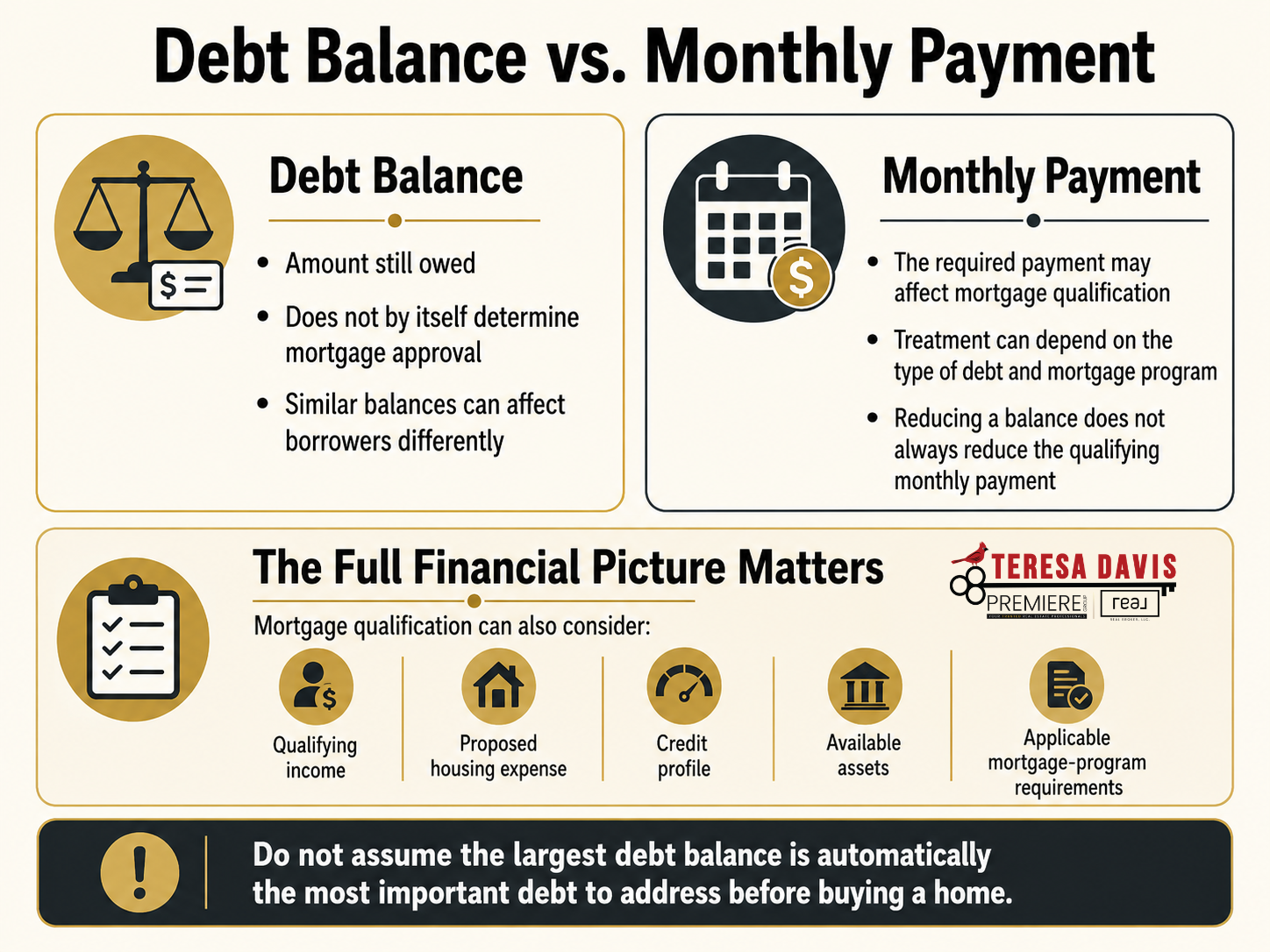
How Your Debt Can Affect Your Home Search
Your mortgage qualification and your home search should work together. A buyer may begin by focusing on a home price, but the more useful planning number is often the housing payment that fits both the mortgage qualification and the buyer's broader financial situation.
Existing monthly debts can affect that calculation because income already committed to car payments, student loans, credit cards, personal loans, or other obligations may reduce the amount available for a proposed housing payment. That is why it is helpful to establish a realistic financing framework before becoming deeply invested in homes at a particular price point.
From the REALTOR® side of the transaction, understanding that financing framework can help with decisions such as:
- selecting an appropriate home-search range;
- comparing homes with different property taxes, insurance considerations, or homeowners association dues;
- evaluating how much cash may be needed for the transaction;
- planning an offer without unnecessarily using funds the buyer may need elsewhere; and
- avoiding a search based solely on an online affordability estimate that does not account for the buyer's actual financial profile.
A REALTOR® should not determine which debts a lender will include or tell a buyer which accounts must be paid off to qualify. Those are mortgage-underwriting questions that should be evaluated under the applicable loan guidelines. Instead, the REALTOR® can use the financing information supplied through the mortgage process to help the buyer make better real estate decisions.
For buyers searching in Davidson, Randolph, Guilford, Forsyth, and surrounding North Carolina counties, this coordination can be especially useful because two similarly priced homes may not produce the same overall monthly housing expense. Property taxes, homeowners insurance, homeowners association dues when applicable, and other property-specific costs can affect the payment associated with a particular home.
The goal is not simply to determine the highest purchase price a buyer might qualify for. The goal is to build a home search around financing that has been evaluated realistically so the homes being considered make sense within the buyer's actual situation.
Teresa’s Professional Insight
Many first-time buyers tell themselves they need to “get all of their debt paid off” before they are ready to speak with anyone about buying a home. That assumption can delay useful planning.
Having debt is not the same thing as being unqualified, and not every dollar used to reduce debt produces the same mortgage benefit. What matters is understanding which obligations are affecting the mortgage scenario, how they are being counted, and what would actually change if a particular debt were reduced or eliminated.
That is especially important when savings are limited. For example, using several thousand dollars to pay down a debt may sound like the obvious choice. But if the required monthly payment does not meaningfully change, the buyer may have used money that could otherwise have remained available for a down payment, closing-related expenses, reserves, moving expenses, or the costs that come with owning a home.
The opposite can also occur. A particular monthly obligation may be having a significant effect on qualification, and addressing that obligation appropriately could materially change the financing picture. The important word is appropriately. The answer should come from evaluating the buyer's actual numbers rather than following a blanket rule such as “pay off all your debt first.”
As both a REALTOR® / Professional Real Estate Advisor with PREMIERE Group of Real Broker LLC and a Loan Originator NMLS #2597433 with One Real Mortgage, I believe buyers benefit when the financing conversation and the home-search conversation support each other. The mortgage side can help identify how income, liabilities, credit, assets, and the proposed housing payment fit together. The real estate side can then use that information to build a more realistic and productive home search.
You do not need to arrive at that conversation with perfect finances or with every debt eliminated. You need an accurate picture of where you are now so you can understand what your realistic next steps may be.
Helpful Tip
Before paying off a debt specifically because you want to qualify for a mortgage, find out what effect eliminating that debt would actually have on your mortgage scenario.
Ask questions such as:
- What monthly payment is currently being counted?
- Would paying the balance down reduce the qualifying monthly payment?
- Would the debt need to be paid off completely before the payment could be eliminated from the calculation?
- Would the applicable mortgage guidelines still require the obligation to be counted?
- How much cash would I have left after paying the debt?
- Would using those funds affect my down payment, closing-related expenses, reserves, or emergency savings?
- Would eliminating the payment meaningfully change the mortgage amount or housing payment I may qualify for?
The objective is not to find the debt with the largest balance and automatically pay it first. The objective is to understand which financial change, if any, actually helps accomplish your homebuying goal without unnecessarily weakening another part of your financial position.
Keep in Mind
Having debt does not guarantee that a mortgage application will be denied, and having very little debt does not guarantee that a mortgage will be approved. Mortgage qualification depends on the complete application and the requirements that apply to the financing being considered.
Keep these points in mind:
- Different mortgage programs can treat obligations differently. A debt calculation used for one financing option should not automatically be assumed to apply to every other loan program.
- The outstanding balance and the qualifying monthly payment are different concepts. A large balance does not automatically mean a large mortgage impact, and a smaller balance can still carry a significant monthly payment.
- Student loans can require program-specific treatment. Do not assume that a deferred loan or a $0 payment shown on a credit report will automatically be ignored.
- Debt-to-income ratio and credit history are related but separate considerations. The amount of monthly debt and the history of managing credit can both affect mortgage qualification in different ways.
- Do not assume every debt must be paid off. Paying down or eliminating debt may help in some circumstances, but the effect should be evaluated within the complete mortgage scenario.
- Preserving cash can matter too. Buyers may need funds for the down payment, closing-related expenses, reserves, moving costs, emergency savings, and expenses after becoming homeowners.
- Avoid making major credit or debt changes based solely on general advice. Opening, closing, refinancing, consolidating, paying off, or substantially changing accounts can affect different parts of the mortgage profile.
- Qualification is not the same as comfortable affordability. Even when a mortgage is available, buyers should consider how the resulting housing payment fits with their own budget, priorities, and other financial responsibilities.
- Mortgage requirements can change. Program-specific treatment of debts should be confirmed using current guidelines when the buyer is preparing for an actual mortgage application.
- An individualized review is more reliable than self-disqualifying. If you have debt, the most useful next step is to determine how it actually affects your financing options before assuming homeownership is not possible.
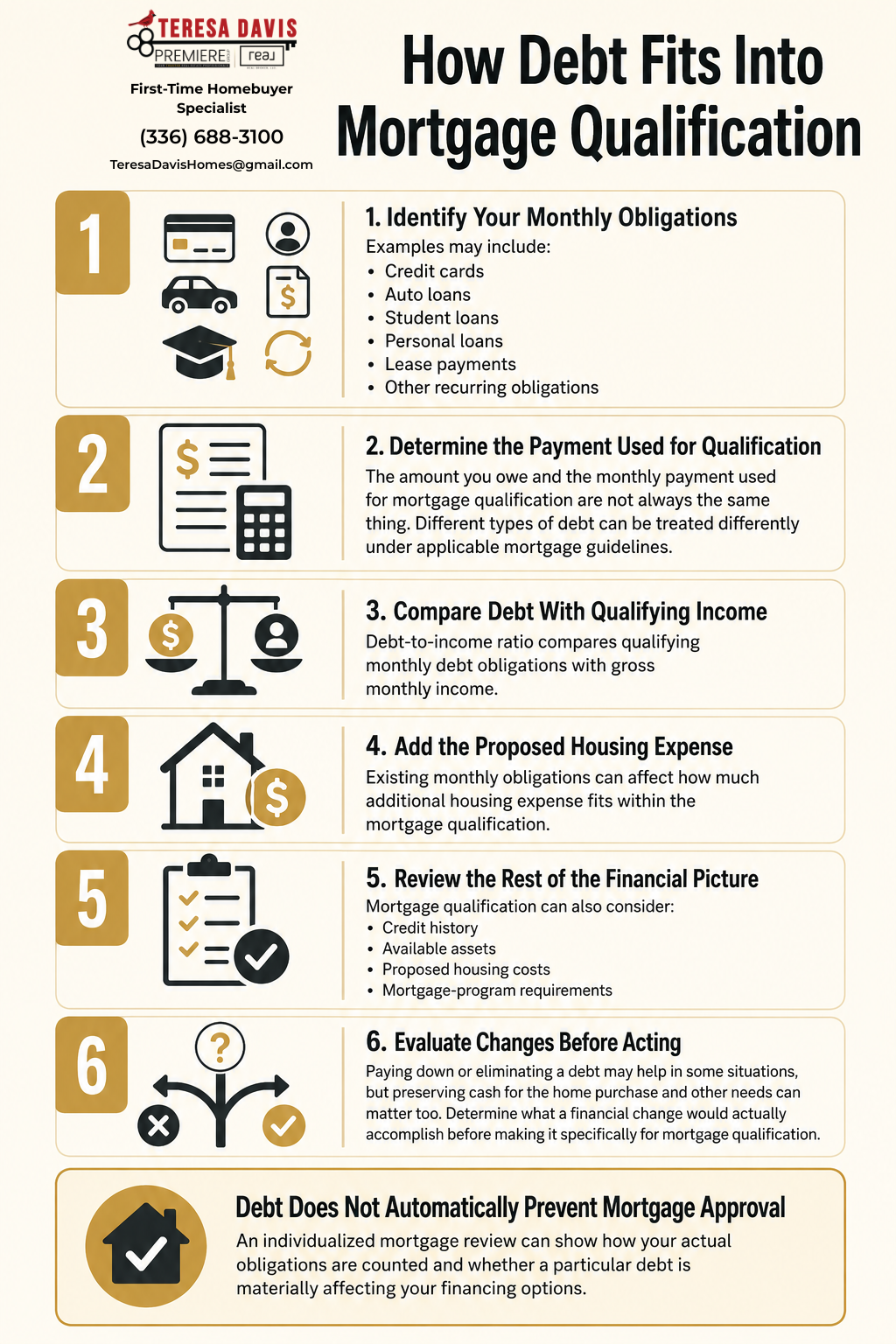
Frequently Asked Questions
How much debt is too much to get approved for a mortgage?
There is no single dollar amount of debt that automatically makes someone ineligible for a mortgage. A lender generally evaluates the monthly obligations associated with the debt, the borrower's qualifying income, proposed housing expense, credit profile, assets, and the requirements of the mortgage program being considered.
For example, owing $20,000 does not provide enough information by itself to determine whether someone can qualify. The type of debt, required monthly payment, remaining repayment terms when applicable, income, and other obligations can all affect the analysis.
Debt-to-income requirements can also vary by mortgage program and lender. That is why an individualized mortgage review is more useful than trying to identify one universal amount of debt that is “too much.”
Can I get approved for a mortgage if I have credit card debt?
Yes, having credit card debt does not automatically prevent mortgage approval. A lender may consider the required monthly payment, outstanding balance, credit utilization, payment history, other debts, qualifying income, and applicable mortgage-program requirements.
The effect of the credit card account can therefore involve more than one part of the mortgage review. The required payment may affect monthly debt qualification, while the history and use of the account may also contribute to the overall credit profile.
You should not assume that you must pay off every credit card before applying for a mortgage. If you are considering a significant payoff specifically to improve mortgage qualification, it can be helpful to determine whether that change would actually improve the financing scenario and how it would affect your available cash.
Can I get a mortgage if I have a car payment or personal loan?
Potentially, yes. Car loans and personal loans are common installment debts, and borrowers can qualify for mortgages while carrying them. The lender generally needs to determine how the required monthly payment must be treated under the applicable mortgage guidelines.
The remaining repayment term can also matter under some mortgage programs, but there is no universal rule that every installment loan with a certain number of payments remaining can automatically be ignored.
A car or personal-loan payment may reduce the amount of additional housing expense that fits within mortgage qualification, but it does not automatically mean the borrower will be denied.
Before using savings to pay off an installment loan solely for mortgage purposes, determine whether eliminating that particular payment would meaningfully improve the overall financing scenario.
Can I qualify for a mortgage if I have student loans?
Yes, borrowers with student loans may qualify for a mortgage. Student loans require particular attention because the payment used for mortgage qualification may not always be obvious from the balance or payment shown on a credit report.
A deferred student loan or an account reporting a $0 payment should not automatically be assumed to have no effect on mortgage qualification. Different mortgage programs can have specific requirements for determining the qualifying student-loan payment.
The appropriate approach is to have the student loans reviewed under the guidelines for the financing option being considered rather than assuming that student debt either automatically prevents approval or will automatically be excluded.
Can collections or charged-off accounts keep me from getting a mortgage?
Collections or charged-off accounts can affect mortgage qualification, but their presence does not create one universal outcome for every borrower or every mortgage program. They may affect the borrower's credit profile, and depending on the type of account, amount, circumstances, mortgage program, and underwriting requirements, additional documentation or action may be required.
A buyer should not assume that every collection or charge-off must automatically be paid before a mortgage is possible. At the same time, these accounts should not be ignored when preparing for mortgage qualification. The most reliable approach is to have the complete credit profile reviewed and determine what the applicable mortgage guidelines require before paying, disputing, settling, or otherwise changing an account specifically for mortgage purposes.
What Happens Next?
Once you understand that having debt does not automatically prevent you from qualifying for a mortgage, the next question is often what happens when you actually begin the pre-approval process.
Mortgage pre-approval commonly includes a review of your financial information and credit profile. That can make first-time buyers wonder whether allowing a lender to review their credit could lower their credit score or create a problem before they have even started shopping for a home.
The next Academy lesson explains that issue in more detail so you can understand the role of credit inquiries in mortgage pre-approval and approach the process with better information.
Ready for the next lesson?: Scroll down to see "Will getting pre-approved hurt my credit score?"
Ready to Take the Next Step?
If debt is making you wonder whether buying a home is realistic, you do not have to make that decision based on assumptions. A conversation about your current situation can help you understand how your debts, income, credit, available funds, and homebuying goals fit together—and whether there are practical next steps to consider.
Contact Teresa Davis
If you have questions about preparing to buy a home or want help coordinating your financing and home-search plans, contact Teresa Davis.
Teresa Davis
REALTOR® / Professional Real Estate Advisor
PREMIERE Group of Real Broker LLC
One Real Mortgage — Pre-Approval
If you are ready to have your mortgage qualifications reviewed, start the One Real Mortgage pre-approval process. Using One Real Mortgage is optional and is not required in order to work with Teresa Davis as your REALTOR®.
Teresa Davis
Loan Originator NMLS #2597433
One Real Mortgage
Mortgage qualification, loan programs, terms, costs, and final approval depend on the borrower, property, transaction, documentation, underwriting, and applicable lending requirements. Beginning a pre-approval process does not guarantee financing or require you to purchase a home. It is a practical way to learn more about your potential financing options, estimated payment, and possible next steps.
Ready for the next lesson? Use “Next Question” below to continue to "Will getting pre-approved hurt my credit score?".
2:7 - Will getting pre-approved hurt my credit score?

Many first-time homebuyers worry that getting pre-approved for a mortgage will damage their credit. That concern can cause buyers to delay speaking with a lender even when they are otherwise ready to begin preparing for a home purchase. Understanding what actually happens when a lender checks your credit can help you approach pre-approval with more confidence.
A mortgage pre-approval may involve a hard credit inquiry, which can affect your credit score. However, the impact of a single inquiry is only one part of your overall credit profile, and there is no universal number of points that every consumer will lose. The effect can vary based on your individual credit history and the credit-scoring model being used.
Mortgage shopping also receives special treatment under commonly used credit-scoring models. When several mortgage lenders check your credit within a concentrated rate-shopping period, those inquiries may be treated as a single inquiry for scoring purposes rather than as separate applications for unrelated new credit. The applicable shopping period can vary by scoring model; CFPB guidance describes a range of approximately 14 to 45 days, while newer FICO® models generally use a 45-day rate-shopping window and some older versions use 14 days.
That does not mean every lender follows the same pre-approval process. Some preliminary mortgage conversations or screening processes may use a soft inquiry, while a more formal review may require a hard inquiry. Before authorizing a credit check, ask the lender whether the inquiry will be soft or hard and at what point a hard credit pull will be required.
Whether you are preparing to buy in Davidson, Randolph, Guilford, Forsyth, or another North Carolina county, the goal should not be to avoid every legitimate mortgage credit inquiry. A better approach is to understand the process, organize serious mortgage shopping within a reasonably concentrated timeframe, and continue protecting your credit throughout the homebuying process.
Quick Answer
Getting pre-approved for a mortgage may affect your credit score if the lender performs a hard credit inquiry, but the effect is generally limited and should not automatically discourage you from getting pre-approved. There is no fixed number of points that every buyer will lose because credit-score changes depend on the consumer's overall credit profile and the scoring model being used.
If you compare mortgage lenders, credit-scoring systems generally recognize that you are shopping for one mortgage rather than trying to open several different mortgage accounts. Mortgage inquiries completed close together may therefore be grouped for scoring purposes. Depending on the scoring model, the applicable rate-shopping window may range from about 14 to 45 days.
The practical approach is to do your serious mortgage comparison shopping within a concentrated period rather than spreading applications over many weeks or months. The Consumer Financial Protection Bureau specifically encourages consumers to compare mortgage lenders and notes that consumers can obtain multiple pre-approvals while shopping for a mortgage.
Also remember that pre-approval may not be the last time your credit is reviewed. A lender may obtain your credit information when you apply and may review it again before closing, so continuing to manage your credit carefully throughout the mortgage process is important.
At a Glance
- Mortgage pre-approval may involve a hard credit inquiry. A hard inquiry can affect your credit score, although the exact effect varies by consumer and scoring model.
- Not every mortgage credit check is necessarily the same. Ask whether a lender will use a soft inquiry or a hard inquiry before authorizing the credit check.
- There is no universal number of points a pre-approval will cost you. Your credit history, other recent credit activity, and the scoring model can affect the result.
- Mortgage rate shopping receives special scoring treatment. Multiple mortgage inquiries made within an applicable shopping window may be treated as one inquiry for scoring purposes.
- The rate-shopping window is not identical under every scoring model. Depending on the model, it may range from approximately 14 to 45 days, so completing serious lender comparisons within a concentrated timeframe is a practical approach.
- Mortgage inquiries are different from applying for unrelated new credit. Rate-shopping treatment should not be interpreted as a reason to apply for credit cards, auto loans, or other new debt while preparing for a mortgage.
- You may have your credit reviewed again later. Mortgage lenders may obtain credit information during the application process and again before closing.
- Do not avoid useful mortgage preparation solely because you are afraid of an inquiry. Understanding what type of inquiry will occur and organizing your lender shopping thoughtfully can help you make informed decisions.
- Continue protecting your credit throughout the homebuying process. Avoid unnecessary new debt or significant credit changes unless you have discussed the potential mortgage impact with your loan professional.
What Happens to Your Credit During Mortgage Pre-Approval?
Understanding what a mortgage lender is looking for can make the credit-check process feel much less intimidating. A credit inquiry is not a judgment about whether you are a “good” or “bad” borrower. It is one part of the lender's evaluation of your overall mortgage application.
Your credit report provides information about how you have managed credit over time, including your payment history, existing accounts, balances, and recent applications for credit. Your credit score summarizes information from your credit report using a particular scoring model. Mortgage lenders use credit information along with other factors such as income, employment, assets, debts, and the loan program being considered.
A strong credit score can help with mortgage qualification and pricing, but your credit score is not the only factor that determines whether you can obtain a mortgage. A lender evaluates the complete application rather than making a decision based solely on one number.
Why Does a Mortgage Lender Check Your Credit?
When you formally apply for mortgage credit, the lender needs enough information to evaluate whether you meet its lending and loan-program requirements. A credit report helps the lender understand your existing credit obligations and your history of managing borrowed money.
A mortgage credit review may help the lender evaluate factors such as:
- your payment history;
- your outstanding credit accounts;
- your current credit balances;
- your recent applications for new credit;
- the length and composition of your credit history; and
- information that may affect mortgage qualification or loan pricing.
Credit is only one part of the mortgage picture. A borrower can have a strong credit score and still have other qualification issues, just as a borrower with less-than-perfect credit may still have mortgage options depending on the complete application and applicable loan requirements.
For that reason, it is usually more helpful to think of pre-approval as a financial review rather than simply a credit-score check.
Soft Credit Inquiry vs. Hard Credit Inquiry
One of the most important distinctions to understand is the difference between a soft credit inquiry and a hard credit inquiry.
Soft Credit Inquiry
A soft inquiry generally does not affect your credit score. Soft inquiries can occur in situations that are not applications for new credit, such as when you check your own credit or when certain companies review credit for informational or screening purposes.
Some mortgage-related preliminary processes may also use a soft inquiry, depending on the lender and the stage of the process. However, you should not assume that a process is a soft inquiry simply because it is described as a “prequalification,” “pre-check,” or preliminary review.
The safest approach is simple: Ask the lender whether the credit review will be a soft inquiry or a hard inquiry before you authorize it.
Hard Credit Inquiry
A hard inquiry generally occurs when a lender accesses your credit in connection with an application for new credit. Mortgage applications are one common example.
A hard inquiry can affect your credit score because credit-scoring models consider recent applications for new credit as part of the overall credit-risk evaluation.
That does not mean a hard inquiry will cause a major score decrease. The impact varies from one consumer to another because every credit profile is different.
A person with a long, established credit history may experience a different effect than someone with a shorter credit history or several recent applications for new credit.
Does Pre-Approval Always Require a Hard Credit Inquiry?
Not necessarily at every stage of the conversation. You may be able to ask a lender general questions about mortgage programs, interest rates, estimated payments, or the lender's process before a hard inquiry occurs. The Consumer Financial Protection Bureau notes that if a consumer is simply asking about rates, the lender cannot pull the consumer's credit report for that reason alone.
Once you formally apply for mortgage credit, however, the lender will generally obtain credit information as part of evaluating the application. CFPB identifies this type of inquiry as a hard inquiry that can affect a credit score.
Because lender processes can vary, do not rely solely on the words prequalification or pre-approval to determine what will happen to your credit. Ask specifically:
- Will you perform a credit check at this stage?
- Will it be a soft inquiry or a hard inquiry?
- At what point will a hard inquiry be required?
- Will my credit need to be reviewed again later in the mortgage process?
Those questions allow you to understand the process before providing authorization.
How Much Will a Hard Inquiry Lower My Credit Score?
There is no responsible way to tell every homebuyer that a mortgage inquiry will lower a credit score by a specific number of points.
Credit scores are calculated from information in an individual's credit file, and different scoring models may evaluate that information differently. Recent credit inquiries are only one part of that calculation.
The effect of an inquiry can depend on factors such as:
- the consumer's overall credit history;
- the number and timing of other recent inquiries;
- the type of credit being requested;
- how established the consumer's credit history is; and
- the credit-scoring model being used.
For this reason, statements such as “a mortgage inquiry always costs five points” or “pre-approval will drop your score by ten points” should not be treated as universal rules.
The more useful question is not: “Can I prevent any possible movement in my credit score?”
It is: “How can I complete the mortgage qualification process thoughtfully without creating unnecessary credit activity?”
That distinction matters because avoiding a legitimate mortgage evaluation solely out of fear of an inquiry can leave you without important information about your financing options, purchasing range, and financial readiness.
A Credit Inquiry Is Only One Part of Your Credit Profile
Buyers sometimes focus so heavily on the potential impact of one mortgage inquiry that they overlook larger credit factors.
For example, payment history, outstanding debt, credit utilization, recent new accounts, and the overall information contained in your credit reports can all be relevant to your credit profile. A mortgage lender also evaluates financial information beyond credit when reviewing an application.
That means protecting your credit before buying a home involves more than simply avoiding inquiries. A practical approach includes:
- paying obligations on time;
- avoiding unnecessary new debt;
- being cautious about opening or closing credit accounts during the mortgage process;
- reviewing your credit reports for accuracy;
- keeping your lender informed about significant financial changes; and
- asking before making a credit decision when you are unsure how it could affect your mortgage application.
Getting pre-approved should therefore be viewed as one step in a larger financial-preparation process—not as an isolated event that determines your credit future.
What Happens When You Compare More Than One Mortgage Lender?
Many first-time buyers assume that speaking with several mortgage lenders means their credit score will be penalized separately for every lender they contact. Credit-scoring systems are designed to recognize that consumers commonly compare lenders when shopping for a mortgage.
The Consumer Financial Protection Bureau encourages consumers to compare mortgage options from multiple lenders. CFPB currently explains that multiple mortgage credit checks completed within a 45-day window are recorded for mortgage-shopping purposes as a single inquiry, so consumers can compare lenders without an additional scoring impact from each mortgage inquiry during that window.
This rate-shopping treatment exists because applying with several mortgage lenders usually means you are shopping for one mortgage, not trying to obtain several mortgages at the same time.
That distinction can make it easier to compare:
- interest rates;
- loan programs;
- lender fees;
- estimated monthly payments;
- mortgage insurance, when applicable;
- lender credits or points;
- cash needed for closing; and
- the overall terms being offered.
Comparing lenders can therefore be an important part of making an informed mortgage decision rather than something a buyer should automatically avoid because of concern about credit inquiries.
What Is the Mortgage Rate-Shopping Window?
A rate-shopping window is a period during which multiple inquiries for certain types of installment loans can receive special treatment under a credit-scoring model. For mortgages, the important point is that the exact scoring treatment can depend on the credit-scoring model being used.
Current FICO® guidance explains that newer versions of the FICO Score generally use a 45-day rate-shopping window, while some older versions use a 14-day window. FICO also explains that mortgage, auto, and student-loan inquiries receive this special treatment because consumers commonly compare rates before choosing one loan.
CFPB consumer guidance likewise explains that scoring models generally recognize comparison shopping when multiple inquiries for the same type of loan occur within a reasonably short period.
For a homebuyer, the practical lesson is straightforward: Once you are seriously comparing mortgage lenders, organize that comparison shopping within a concentrated timeframe rather than unnecessarily spreading mortgage applications over a long period.
You do not need to become an expert on which credit-scoring model every lender may eventually use. Keeping your mortgage shopping organized and reasonably close together is a practical way to take advantage of rate-shopping protections while comparing your options.
Rate Shopping Does Not Mean Every Credit Application Gets Combined
Mortgage rate-shopping protection should not be misunderstood as permission to apply for multiple unrelated types of credit. If you apply for a mortgage and also apply for an auto loan, credit card, personal loan, or another unrelated form of credit, those applications are not simply converted into one mortgage-shopping inquiry.
CFPB specifically distinguishes shopping for the same type of loan from applying for different types of credit.
That is especially important while preparing to buy a home because opening a new account can affect more than the inquiry portion of your credit profile. New debt can also change your required monthly obligations and potentially affect the financial information your mortgage lender previously reviewed.
For that reason, during the mortgage process it is generally wise to avoid unnecessary new credit unless you have discussed the potential effect with your loan professional. Examples include being cautious about:
- financing a vehicle;
- opening a new credit card;
- financing furniture or appliances;
- taking out a personal loan;
- increasing balances substantially on existing accounts; or
- co-signing a new debt obligation for someone else.
The issue is not that a homebuyer can never make another financial decision. The important point is that changes to debt, credit, income, or available funds during the mortgage process can require additional evaluation.
Can a Mortgage Lender Check Your Credit Again After Pre-Approval?
Yes. A credit review performed during pre-approval should not be viewed as necessarily being the final credit review associated with the mortgage. The CFPB states that a lender may obtain a credit report when you apply for credit and may obtain credit information again shortly before closing.
That is one reason maintaining financial consistency after pre-approval is important. Until your mortgage transaction is complete, consider continuing the same credit habits that helped you qualify in the first place:
- make payments on time;
- avoid unnecessary new debt;
- avoid significant increases in credit-card balances;
- do not assume a new financing obligation is harmless because you are already pre-approved;
- keep documentation of significant financial changes; and
- contact your loan professional before making a major credit or borrowing decision if you are unsure of the potential mortgage impact.
A pre-approval is an important milestone, but it is based on information available to the lender at a particular point in time. It should not be interpreted as permission to substantially change your financial profile without considering how those changes could affect the loan.
What Should You Ask Before Authorizing a Credit Check?
You do not need to be uncomfortable asking a lender how its credit-review process works. Before authorizing a credit check, consider asking:
Will this be a soft inquiry or a hard inquiry?
This is the most direct way to understand whether the particular credit review may affect your score.
At what point do you require a hard credit inquiry?
A lender may be able to provide general mortgage information before a formal application. CFPB states that if you are simply asking about mortgage rates, a lender cannot pull your credit report solely for that purpose.
What information will you review for the pre-approval?
Credit is only part of the mortgage evaluation. Understanding what documents and financial information the lender needs can help you prepare for a more complete conversation.
Will you need to review my credit again before closing?
Knowing that additional review may occur can help you understand why maintaining your financial profile throughout the transaction matters.
If I want to compare lenders, when should I complete those applications?
This gives the loan professional an opportunity to explain the lender's process while you keep your mortgage shopping organized within a concentrated period.
Should Fear of a Credit Inquiry Keep You From Getting Pre-Approved?
For most buyers, avoiding pre-approval solely because of fear that a credit inquiry might affect their score can create a different problem: beginning a home search without knowing how their financing situation has been evaluated.
A meaningful mortgage pre-approval can help clarify:
- whether your current financial profile supports mortgage qualification;
- what loan options may be available;
- approximately how much you may be qualified to borrow;
- what monthly payment range you want to consider;
- how much cash you may need for the transaction; and
- whether there are financial issues that would be better addressed before you begin making offers.
Pre-approval does not guarantee final loan approval, and the amount a lender says you may qualify to borrow is not necessarily the amount you should personally choose to spend.
Those are separate decisions. The goal is to obtain enough reliable information to make informed choices about your home search and mortgage options.
Focus on the Complete Financial Picture
When preparing to buy a home, protecting your credit is important—but protecting your credit does not mean avoiding every legitimate credit inquiry.
A better strategy is to understand the process and manage it deliberately:
- Review your own credit and financial position before you begin.
- Ask whether a lender's initial credit check will be soft or hard.
- Begin formal mortgage shopping when you are genuinely ready to compare options.
- Keep serious mortgage comparison shopping within a concentrated timeframe.
- Avoid unnecessary applications for unrelated new credit.
- Continue making payments on time and managing existing balances responsibly.
- Discuss significant financial or credit changes with your loan professional during the mortgage process.
- Remember that your lender may review your credit again before closing.
Getting pre-approved is not about creating a perfect credit profile or guaranteeing that your finances will remain unchanged forever. It is about giving you and the lender a clearer picture of where you stand so you can make better-informed decisions about the next steps toward buying a home.
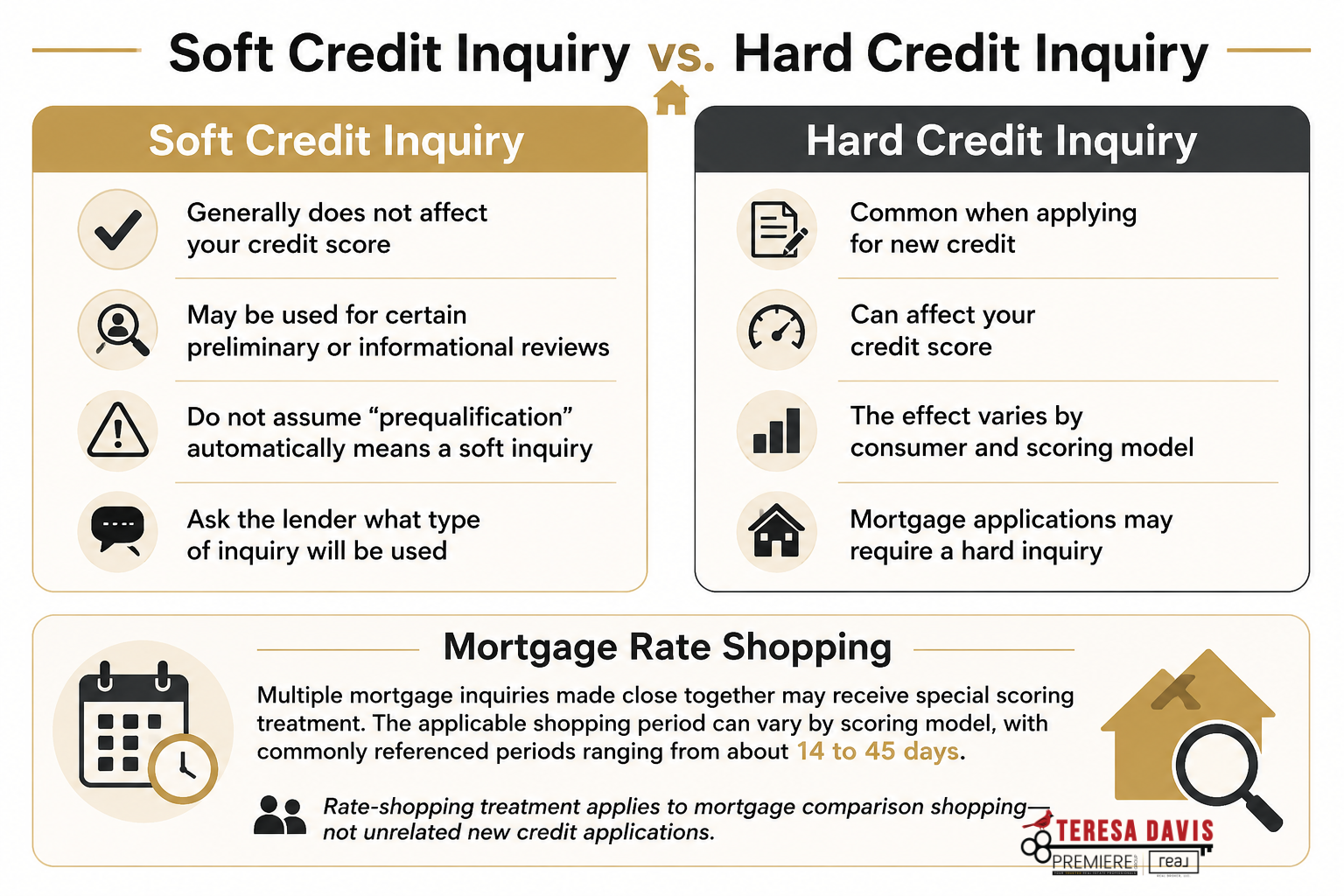
How Pre-Approval Fits Into Your Homebuying Plan
A mortgage pre-approval is more than a credit check. It can provide important information that helps you make better decisions about your home search.
From the real estate side of the process, a meaningful pre-approval can help you:
- understand the price range your financing may support;
- compare that financing range with the monthly payment you are personally comfortable carrying;
- identify potential financing issues before you find a home you want to purchase;
- focus your search on homes that better fit your financial plan;
- understand whether certain property types or price ranges may require different financing considerations; and
- be better prepared to make an offer when you find the right property.
Your REALTOR® does not determine whether you qualify for a mortgage. Mortgage qualification, underwriting requirements, loan programs, credit standards, and loan approval are determined by the lender and applicable loan guidelines. However, your financing information and your home search are closely connected.
For example, a lender may determine that you qualify for a certain maximum mortgage amount. That does not mean you must purchase a home at that maximum amount. You still need to consider the monthly payment you are comfortable with, your other financial priorities, anticipated homeownership expenses, available savings, and the amount of cash you want to keep available after closing. A REALTOR® can help you use the information from your mortgage professional as part of a broader home-search strategy.
For buyers in Davidson, Randolph, Guilford, Forsyth, and surrounding North Carolina counties, that coordination can be especially useful because property prices, property taxes, homeowners insurance costs, HOA expenses, and property characteristics can vary from one home to another. The home you choose can affect the financing and monthly housing expense just as your financing can affect which homes make sense to consider.
Pre-approval therefore works best when it is treated as part of an organized homebuying plan—not simply as a document you obtain before scheduling showings.
Teresa’s Professional Insight
Many first-time buyers hesitate to begin the pre-approval process because they are afraid that a credit inquiry will seriously damage their credit. In practice, that fear can sometimes become a barrier to getting the information they need to make an informed decision about buying a home.
The better approach is to understand the lender's process before you begin. Ask whether the initial credit review will be soft or hard. Ask when a hard inquiry becomes necessary. If you plan to compare mortgage lenders, organize that comparison within a concentrated timeframe. And once you are pre-approved, continue protecting your credit rather than assuming the financial review is finished.
As both a REALTOR® / Professional Real Estate Advisor with PREMIERE Group of Real Broker LLC and a Loan Originator NMLS #2597433 with One Real Mortgage, I look at pre-approval as part of the larger preparation process. The purpose is not simply to determine the largest loan amount you might qualify for. It is to help you understand your financing position so your home search can be built around realistic numbers and your own financial comfort level.
Every buyer's credit profile, income, debt, assets, and mortgage options are different. That is why general education can help you understand the process, but your individual mortgage qualifications should be reviewed with a qualified mortgage professional using your actual financial information.
Helpful Tip
Before allowing a mortgage lender to check your credit, ask one direct question: “Will this be a soft inquiry or a hard inquiry?” That simple question helps you understand exactly what stage of the mortgage process you are entering.
If you are only gathering general information, you may not yet need a formal credit review. When you are ready for an actual pre-approval and serious lender comparison, try to complete your mortgage shopping within a concentrated timeframe rather than spacing applications unnecessarily far apart.
It can also help to make your lender comparisons systematically. Look beyond the interest rate alone and compare the overall loan structure, estimated payment, lender fees, mortgage insurance when applicable, cash needed for closing, and other terms that affect the true cost of the mortgage.
Keep in Mind
A mortgage pre-approval can be an important financial planning tool, but there are several limitations to remember.
First, no one can promise exactly how many points a mortgage inquiry will change your credit score. Credit files differ, and scoring models do not all evaluate inquiries in exactly the same way.
Second, do not assume that one rate-shopping timeframe applies identically under every credit-scoring model. Mortgage-shopping protections exist, but different models may use different time periods. Keeping serious mortgage applications reasonably close together is more practical than trying to time your applications around one assumed scoring formula.
Third, rate-shopping treatment applies to comparison shopping for the same type of loan. It should not be interpreted as permission to apply for unrelated new credit while preparing for a mortgage.
Fourth, pre-approval is not final mortgage approval. Your lender may review your financial information again, and credit may be reviewed later in the process. Significant changes to debt, credit balances, employment, income, or available funds can affect the mortgage evaluation.
Finally, the amount you qualify to borrow and the amount you are comfortable spending are not necessarily the same. Your mortgage professional can help explain qualification, while you should also consider your broader budget, savings goals, emergency reserves, and anticipated costs of homeownership before deciding what price range feels appropriate for you.
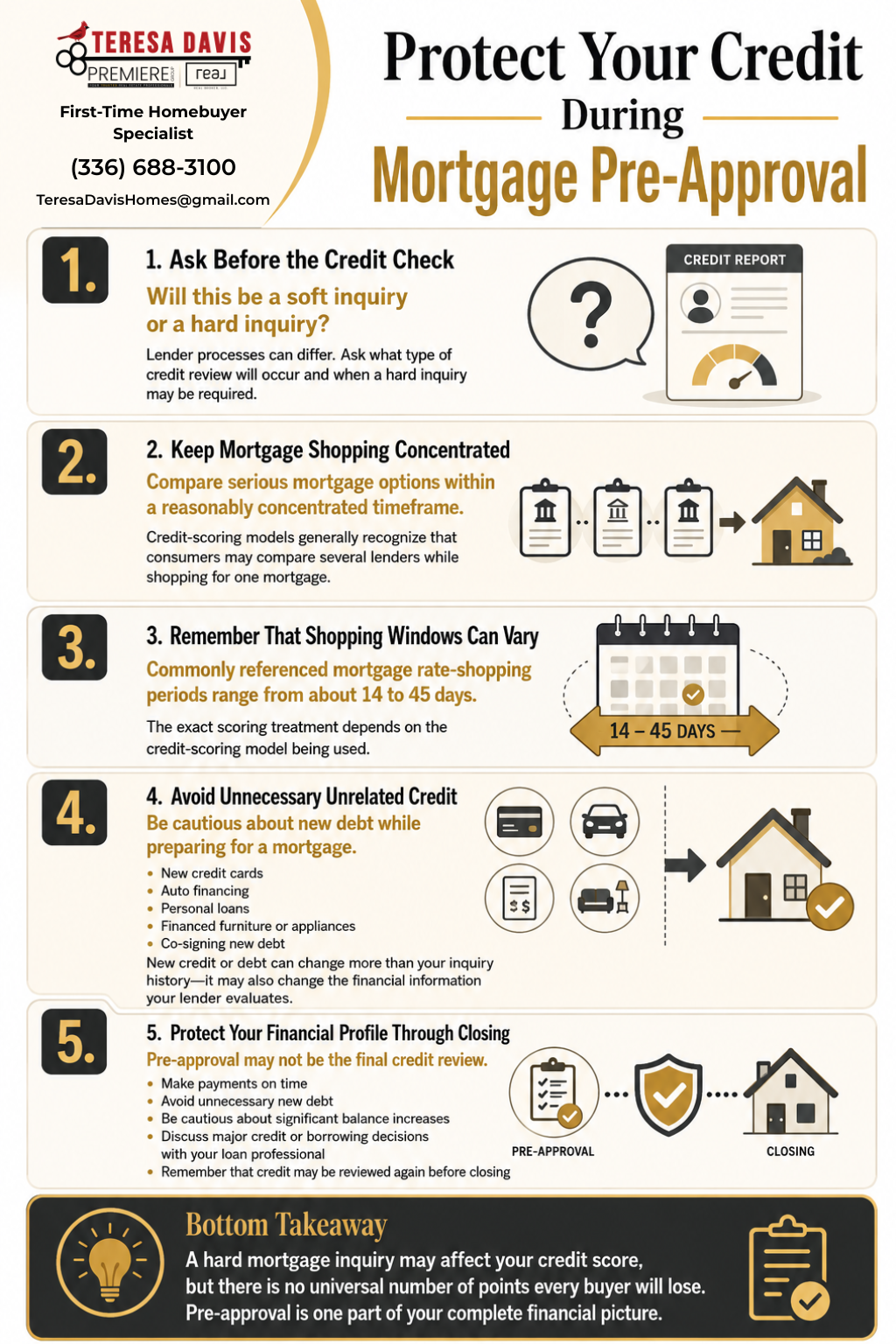
Frequently Asked Questions
Does mortgage pre-approval require a hard credit inquiry?
A mortgage pre-approval commonly involves a lender reviewing your credit to evaluate how much it may be willing to lend and whether you meet applicable mortgage requirements. That review may involve a hard credit inquiry, which can affect your credit score. However, lender processes can differ, and some preliminary mortgage discussions or screening processes may use a soft inquiry. Before authorizing a credit check, ask the lender whether the inquiry will be soft or hard and when a hard credit pull will become necessary.
How much will a mortgage pre-approval lower my credit score?
There is no universal number of points that every buyer will lose from a mortgage inquiry. The effect depends on your overall credit profile and the credit-scoring model being used. A single lender inquiry generally has limited impact compared with the broader information in your credit profile. Rather than focusing on an assumed point decrease, concentrate on limiting unnecessary credit activity and managing your overall credit responsibly while preparing for a mortgage.
Will getting pre-approved by several mortgage lenders hurt my credit more?
Mortgage rate shopping receives special treatment because credit-scoring systems recognize that consumers may contact several lenders while shopping for one mortgage. Multiple mortgage credit checks made close together may therefore be treated as a single inquiry for scoring purposes. Credit-scoring treatment can vary by model, and commonly referenced rate-shopping periods range from approximately 14 to 45 days. For that reason, completing serious mortgage comparisons within a concentrated timeframe is a practical approach.
Does mortgage prequalification affect my credit score?
It depends on how the lender conducts the prequalification. The words prequalification and pre-approval do not by themselves tell you whether a lender will perform a soft inquiry or a hard inquiry. Some preliminary reviews may use information you provide or a soft inquiry, while a more formal evaluation may involve a hard credit check. Ask the lender specifically what type of credit inquiry will occur before you authorize it.
Can my mortgage lender check my credit again after I am pre-approved?
Yes. A credit review during pre-approval may not be the final credit review associated with your mortgage. A lender may obtain credit information when you apply and may review your credit again before closing. That is one reason to continue paying obligations on time, avoid unnecessary new debt, and discuss significant credit or financial changes with your mortgage professional until the transaction is complete.
What Happens Next?
Once you understand that mortgage pre-approval may involve a credit inquiry—and that thoughtful mortgage shopping does not mean you should be afraid to compare options—the next step is to look at another important part of financial readiness: your savings.
Mortgage qualification tells only part of the story. Even if you qualify for financing, you may still need funds for expenses such as your down payment, closing-related costs, inspections, moving expenses, initial homeownership costs, and reserves for unexpected expenses.
How much you should save depends on your purchase plan, mortgage program, available resources, and the amount of financial cushion you want to maintain after closing. The next Academy lesson will help you think through those savings needs so you can prepare for more than simply qualifying for the loan.
Ready for the Next Question: Scroll down to see "How much should I save before buying a home?"
Ready to Take the Next Step?
If concern about a credit inquiry has been keeping you from learning more about mortgage pre-approval, you do not have to make the decision based on assumptions. Understanding what type of credit review may occur, how your current financial profile fits potential mortgage options, and where you are in the homebuying process can help you decide what step makes sense next.
Contact Teresa Davis
If you have questions about how mortgage preparation and your home search fit together, contact Teresa Davis. I can help you understand how the different parts of the North Carolina homebuying process connect and what questions may be helpful to address before you begin searching for a home.
Teresa Davis
REALTOR® / Professional Real Estate Advisor
PREMIERE Group of Real Broker LLC
Start the One Real Mortgage Pre-Approval Process
If you are ready for an individualized mortgage evaluation, you can start the One Real Mortgage pre-approval process. Your actual mortgage qualification will depend on your complete application, credit profile, income, debts, assets, applicable loan-program requirements, lender requirements, underwriting, and the property being financed. Using One Real Mortgage is optional and is not required in order to work with Teresa Davis as your REALTOR®.
Teresa Davis
Loan Originator NMLS #2597433
One Real Mortgage
Mortgage qualification, loan programs, terms, costs, and final approval depend on the borrower, property, transaction, documentation, underwriting, and applicable lending requirements. Beginning a pre-approval process does not guarantee financing or require you to purchase a home. It is a practical way to learn more about your potential financing options, estimated payment, and possible next steps.
Ready for the next lesson? See “Next Question” below "How much should I save before buying a home?
2:8 - How much should I save before buying a home?

Saving for a home is about more than reaching one specific dollar amount. The amount you may need depends on several pieces of your purchase, including the price of the home, your mortgage financing, your down payment, estimated closing costs, expenses that occur during the transaction, and how much money you want to keep available after closing.
One of the most common misunderstandings among first-time buyers is that they must save 20% of the purchase price before they can seriously consider buying a home. A 20% down payment is not universally required. Depending on the mortgage program and the buyer’s qualifications, lower-down-payment options may be available. At the same time, the down payment is only one part of the financial picture.
A more useful way to prepare is to build a savings target that accounts for the different places your money may need to go. That can include your down payment, closing and prepaid costs, inspections and other transaction expenses, moving and setup costs, and money you intentionally preserve for life after closing.
The goal is not simply to accumulate enough money to complete the purchase. It is to understand the entire cash picture so you can make informed decisions about your price range, financing options, offer strategy, and financial comfort as a new homeowner.
Quick Answer
There is no single amount everyone should save before buying a home. A practical savings target is the total amount you expect to need for the purchase—such as your down payment, closing and prepaid costs, transaction expenses, and moving or setup costs—plus the amount of savings you want to preserve after closing.
You do not automatically need a 20% down payment. The amount required depends on the mortgage program, your qualifications, and the specific transaction. Some buyers may also qualify to use permitted gift funds, down payment or closing-cost assistance, seller concessions, or other approved sources that can reduce the amount they personally need to provide.
Because these numbers vary from buyer to buyer, an early savings estimate should be treated as a planning tool rather than a final cash-to-close figure. A mortgage professional can help you evaluate financing scenarios and develop a more personalized estimate based on your circumstances.
At a Glance
- There is no universal savings amount that every homebuyer must have before purchasing a home.
- Your down payment is only one part of the money you may need.
- A 20% down payment is not required for every mortgage or every buyer.
- Closing costs and prepaid expenses should be budgeted separately from the down payment.
- Some expenses, such as inspections or other transaction-related costs, may need to be paid before closing.
- North Carolina home purchases may also involve negotiated upfront funds associated with an offer, depending on the contract terms.
- Moving, utility setup, immediate household needs, and early homeownership expenses should be considered when setting your savings goal.
- Avoid assuming that every available dollar should be spent on the purchase; consider how much savings you want to retain after closing.
- Eligible assistance programs, permitted gift funds, seller concessions, or other approved sources may reduce the amount you personally need, but availability and requirements must be verified.
- The most useful savings target is one based on your expected home price, financing plan, transaction costs, and desired post-closing financial cushion.
Start With the Total Cash Picture
When you are deciding how much to save before buying a home, it helps to think beyond the down payment. The better planning question is: How much cash might I need before closing, at closing, and shortly after I become a homeowner?
Your savings target can be divided into several categories. Some of that money may go toward the down payment. Some may be needed for closing costs and prepaid expenses. Other funds may be needed earlier in the transaction for inspections or negotiated deposits. You may also want money available for moving expenses and for your financial cushion after closing.
Looking at these expenses separately can give you a clearer picture than choosing one savings percentage and assuming it will cover everything.
Savings Bucket 1 — Your Down Payment
A down payment is the portion of the purchase price you pay from approved funds rather than finance through your primary mortgage.
You may hear that you need to save 20% of the home's price before buying. That is not a universal mortgage requirement. Some mortgage options permit significantly smaller down payments for qualified borrowers. For example, Freddie Mac currently offers certain mortgage programs with down payments as low as 3% for eligible borrowers. The mortgage program, property, borrower qualifications, and other requirements determine what options are actually available in an individual transaction.
That does not mean the smallest possible down payment is automatically the best choice. A larger down payment can reduce the amount borrowed and may affect the monthly payment, mortgage insurance, interest costs, and other parts of the financing. On the other hand, putting more money down can leave you with less cash available for closing costs, moving, repairs, emergencies, and other expenses.
The goal is to evaluate the down payment as one part of the complete financial plan, rather than treating 20% as a required savings milestone.
Example
Suppose two buyers are considering homes in the same general price range. One buyer may decide that putting more money down fits comfortably within their savings plan. Another may qualify for a lower-down-payment option and decide that preserving more cash after closing is important.
Neither decision should be based on the down-payment percentage alone. The mortgage terms, monthly housing expense, available savings, expected ownership costs, and the buyer's broader financial circumstances all matter.
Savings Bucket 2 — Closing Costs and Prepaid Expenses
Your down payment and your closing costs are separate expenses.
The Consumer Financial Protection Bureau currently advises consumers that closing costs commonly range from approximately 2% to 5% of the home's purchase price, excluding the down payment. That is a planning range, not a guarantee. Actual costs depend on factors such as the home price, loan type, lender charges, property, location, and individual transaction.
Closing-related expenses can include items such as:
- lender and loan-related charges;
- appraisal charges when applicable;
- title-related expenses;
- government or recording charges;
- homeowners insurance;
- property-tax or insurance escrow funding when applicable;
- prepaid interest; and
- other transaction-specific expenses.
The CFPB identifies appraisal fees, title insurance, government taxes, homeowners insurance, property-tax prepayments, and prepaid interest among expenses that may appear in connection with a mortgage closing.
Because these costs vary, you should not assume that saving enough for the down payment means you have saved enough to close.
A Simple Planning Example
For educational purposes, imagine that you are considering a $300,000 home.
If you were planning for a 5% down payment, the down payment would be: $15,000
If you also used a rough planning range of 2% to 5% for closing costs, that range would be approximately: $6,000 to $15,000
That does not mean your actual closing costs will fall at a specific point within that range. It simply demonstrates why your savings plan needs to account for more than the down payment.
Your lender's transaction-specific disclosures will eventually provide much more useful estimates. The CFPB's Loan Estimate guidance explains that the Estimated Cash to Close calculation includes the down payment and closing costs while also accounting for items such as deposits already paid and seller credits when applicable.
Savings Bucket 3 — Expenses That Can Occur Before Closing
Another common planning mistake is assuming that every homebuying expense is paid on closing day.
Depending on the property and transaction, you may have expenses earlier in the process. These can include:
- a general home inspection;
- specialized inspections when appropriate;
- an appraisal if the fee is collected before closing;
- due diligence funds;
- earnest money; and
- other transaction-specific expenses.
These amounts should not be treated as universal or fixed. Inspection choices vary by property, and negotiated deposits depend on the terms of the transaction.
North Carolina Due Diligence and Earnest Money
North Carolina buyers should pay particular attention to funds associated with an accepted offer.
Under the commonly used North Carolina Offer to Purchase and Contract, a buyer may agree to pay a due diligence fee directly to the seller and may also provide earnest money under the contract. These are different forms of money with different purposes and consequences. North Carolina Real Estate Commission guidance explains that the due diligence fee is generally paid to the seller at contract formation and, with limited exceptions, is generally nonrefundable.
The amount of any due diligence fee or earnest money is not something a buyer should assume from a generic online rule. The amounts and terms are part of the individual transaction and should be evaluated carefully before an offer is made.
From a savings standpoint, the important point is that a buyer may need access to some funds before closing, rather than expecting the entire savings balance to remain untouched until closing day.
Keep Each Savings Category Separate
Instead of thinking of your savings as one large “house fund,” it can help to divide your expected cash needs into separate categories:
- 1. Down payment
- 2. Closing and prepaid costs
- 3. Inspections and other transaction expenses
- 4. Moving and initial setup costs
- 5. Savings you intend to keep after closing
You do not necessarily need separate bank accounts for each category. The purpose is to avoid mentally committing the same dollar to more than one expense.
For example, if you have $25,000 saved and assume all $25,000 can be used toward the down payment, you could underestimate the additional cash you may need for closing costs, transaction expenses, and your post-closing needs.
A more complete savings plan assigns a purpose to each part of the money before you decide how much of it can comfortably go toward the down payment.
Savings Bucket 4 — Moving and Initial Homeownership Expenses
Your financial planning should continue beyond the closing table. Becoming a homeowner can create expenses that do not appear in your mortgage closing figures. Depending on your situation, you may need money for:
- moving expenses;
- utility deposits, transfers, or connection costs;
- changing locks or addressing basic security needs;
- essential household items;
- immediate maintenance;
- necessary repairs that you already know about; and
- appliances or furnishings that are genuinely needed.
These expenses can vary significantly from one buyer and property to another. You do not have to furnish, renovate, or personalize every part of a home immediately after moving in. Separating needs from wants can help preserve savings during the first months of homeownership.
A home that appears affordable based only on the purchase price may feel very different financially if you use nearly all of your available cash to complete the purchase and then immediately face moving, maintenance, or repair expenses.
Savings Bucket 5 — The Money You Intend to Keep After Closing
One of the most important distinctions in your savings plan is the difference between: money available for the purchase and money intentionally retained after the purchase.
Homeowners are responsible for maintenance and unexpected repairs, which is one reason the Consumer Financial Protection Bureau recommends building emergency savings for unplanned expenses.
That does not mean every buyer needs the same emergency-fund amount before purchasing a home. Your appropriate financial cushion depends on your income stability, regular expenses, property, other obligations, household circumstances, and personal comfort with financial risk.
For this lesson, the important point is not to assume that every dollar you have saved should automatically become part of your cash to close. The next Academy lesson—How much emergency savings should I have before buying a home?—will explore post-closing emergency savings in greater detail.
Build Your Personal Homebuying Savings Target
Instead of starting with an arbitrary number, build your savings target step by step.
Step 1 — Estimate a Realistic Home-Price Range
Start with a general price range that fits your financial situation rather than choosing a savings goal without knowing what you may eventually purchase.
Your target does not need to be exact at this stage. The purpose is to create a reasonable starting point for estimating the expenses connected with the purchase.
Step 2 — Estimate Your Down Payment
Consider the down payment that might apply to realistic financing options available to you.
Do not automatically calculate 20% unless that is actually the strategy you are considering. Your eventual mortgage program and qualifications will determine the down-payment requirements that apply.
Step 3 — Add Estimated Closing and Prepaid Costs
Budget separately for closing costs and prepaid expenses.
Early in the process, these numbers are estimates. As you move into mortgage financing, your Loan Estimate will provide transaction-specific information, including an Estimated Cash to Close calculation. CFPB guidance explains that this figure accounts for the down payment and closing costs as well as applicable deposits, seller credits, and other adjustments.
Step 4 — Add Expenses You May Pay During the Transaction
Consider funds that may be needed before closing, such as:
- inspections;
- specialized evaluations;
- appraisal costs when collected separately;
- negotiated due diligence funds;
- earnest money; and
- other transaction-specific expenses.
Avoid assuming that money paid earlier in the transaction is automatically an additional cost in every situation. Some amounts may later be reflected in the transaction's cash-to-close calculations, depending on what was paid and how the transaction is structured.
Step 5 — Add Moving and Initial Ownership Expenses
Estimate what you realistically expect to spend to move into the home and handle immediate necessities.
Focus first on expenses you are likely to need rather than optional projects or upgrades that can wait.
Step 6 — Decide What Savings You Want to Preserve
Before deciding how much money you can put toward the purchase, determine how much you would prefer to keep available afterward.
That amount should be considered separately from the money earmarked for the transaction.
Step 7 — Account Only for Assistance or Other Funds You Can Actually Use
Some buyers may qualify for resources that change how much of their own savings they need for a transaction. Depending on eligibility and the financing involved, those resources can potentially include:
- down payment assistance;
- closing-cost assistance;
- permitted gift funds;
- negotiated seller concessions; or
- lender credits.
Do not subtract potential assistance from your savings target until you know that you qualify for it and understand how it may be used.
For example, the North Carolina Housing Finance Agency currently offers homebuyer mortgage and down-payment-assistance options for qualified North Carolina buyers, with eligibility requirements that vary by program.
Seller credits can also affect the amount a buyer brings to closing when they are permitted by the transaction and financing. CFPB guidance identifies seller credits as one of the items that can reduce Estimated Cash to Close.
Treat these resources as possible adjustments to your plan, not money you should assume will be available.
Step 8 — Review the Estimate With Your Mortgage Professional
Once you have a preliminary savings target, a mortgage professional can help you compare that estimate with realistic financing scenarios.
That conversation may help clarify:
- potential down-payment requirements;
- estimated loan-related costs;
- whether mortgage insurance may apply;
- permitted sources of funds;
- possible assistance programs;
- estimated cash needed to close; and
- how different financing choices affect the overall plan.
An early estimate is useful for planning, but it should not be mistaken for a final cash-to-close figure.
Why Waiting Until You Save 20% Is Not Automatically the Best Strategy
It can be tempting to use one simple rule: Do not buy until you have saved 20% of the purchase price.
For some buyers, putting 20% or more down may fit their goals and financial circumstances. For others, waiting specifically for that percentage may not be necessary if they qualify for financing that permits a smaller down payment.
The decision involves more than comparing two down-payment percentages. Consider the complete picture:
- the amount borrowed;
- the resulting monthly housing expense;
- mortgage insurance when applicable;
- interest rate and loan terms;
- closing costs;
- savings remaining after closing;
- other debts and obligations;
- income stability;
- expected ownership expenses; and
- your anticipated homebuying timeline.
For example, using additional savings for a larger down payment may reduce the mortgage balance, but it also reduces the cash you keep available. Using a smaller down payment may preserve more savings, but it can change the loan amount, monthly payment, mortgage-insurance considerations, and other financing costs.
Neither approach is automatically right for every buyer. The better question is: What combination of down payment, purchase costs, monthly housing expense, and remaining savings creates a financially workable homebuying plan for me?
Your Savings Goal Should Be a Working Number
Your homebuying savings target will probably become more precise as you move through the process. At first, you may be working with:
- an estimated home-price range;
- an estimated down payment;
- an estimated closing-cost range;
- an estimated amount for transaction expenses; and
- a personal goal for savings you want to preserve.
Later, actual financing information, the property you choose, negotiated contract terms, inspections, insurance, taxes, credits, deposits, and other transaction details can change those numbers. That is normal.
The purpose of setting a savings target is not to predict every dollar perfectly before you begin. It is to make sure you understand the major categories competing for your cash so you can prepare intentionally and adjust as better information becomes available.
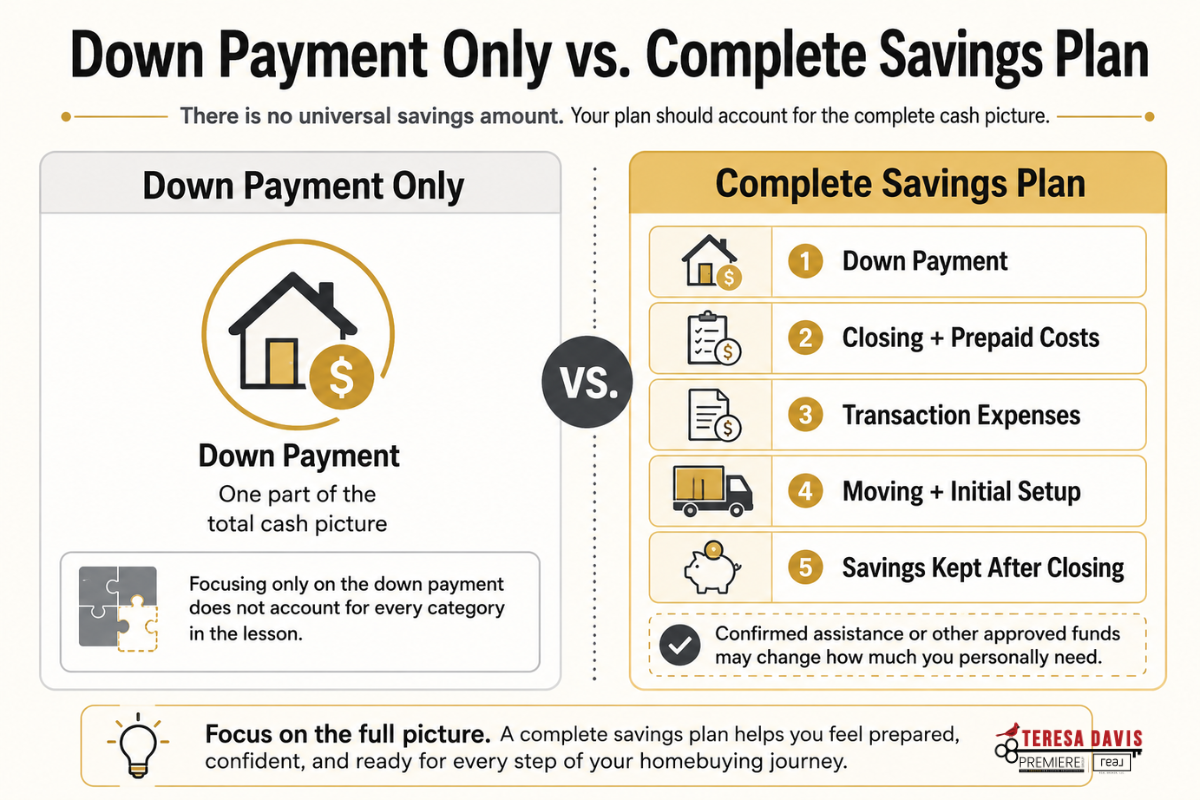
How a REALTOR® Can Help You Plan Beyond the Purchase Price
A REALTOR® can help you understand where expenses may arise during the homebuying process so your savings plan reflects more than the purchase price and down payment.
Before you make an offer, it is helpful to understand how the terms you choose may affect the amount of money you need during the transaction. In North Carolina, that can include discussions about due diligence funds, earnest money, inspections, and other negotiated terms. The appropriate amounts and strategies depend on the specific property, market conditions, your financing, and your comfort with the risks involved.
Your REALTOR® can also help you think through property-related expenses that may affect your budget. For example, one home may have immediate maintenance needs, while another may involve homeowners association dues, different insurance considerations, or other ownership expenses that should be included in your planning.
Seller concessions can also become part of an offer strategy when appropriate. Whether a seller is willing to provide a concession is negotiable, and any concession must also comply with the requirements of the buyer’s financing. A REALTOR® can help you evaluate the real estate and negotiation side of that decision while your mortgage professional determines what the loan permits and how a concession would affect your financing.
The goal is coordination. Your home search, offer strategy, financing, and savings plan should work together rather than being treated as separate decisions.
Teresa’s Professional Insight
When I work with first-time buyers, I encourage them not to make the down payment their only savings goal. Knowing that you have enough for a certain down-payment percentage does not necessarily tell you whether you are financially prepared for the complete transaction.
A more useful approach is to understand three numbers:
- 1. What you expect to need before and at closing.
- 2. What other expenses you expect as you move into the home.
- 3. What amount you want to remain available after the purchase.
Those numbers can influence more than your financing. They can also affect the price range you are comfortable considering, the terms you are willing to offer, and how much flexibility you have when an unexpected expense comes up.
Because I work with buyers on the real estate side as a REALTOR® / Professional Real Estate Advisor with PREMIERE Group of Real Broker LLC and also serve as a Loan Originator NMLS #2597433 with One Real Mortgage, I can help explain how the different parts of the homebuying process connect. Actual mortgage qualification, loan terms, cash-to-close requirements, and permitted sources of funds still depend on the applicable loan program, documentation, underwriting, and individual transaction.
The objective is not to spend the maximum amount you can possibly bring to closing. It is to understand your options clearly enough to make a purchase decision that fits the larger financial picture.
Helpful Tip
Create a simple homebuying savings worksheet with a separate line for each major category:
- down payment;
- closing and prepaid costs;
- inspections and other transaction expenses;
- moving and initial setup costs; and
- savings you want to preserve after closing.
As you obtain better information, update each category instead of changing one large overall savings number.
For example, once you receive more accurate financing estimates, replace your rough closing-cost estimate with the newer information. When you begin considering a specific property, add the inspection expenses and other transaction costs that may apply. If confirmed assistance, permitted gift funds, seller concessions, or lender credits become part of the transaction, update the appropriate category rather than assuming those funds are available in advance.
This approach makes it easier to see where your money is expected to go and helps prevent the same dollars from being counted twice.
Keep in Mind
A homebuying savings target is an estimate for planning, not a guaranteed cash-to-close figure. Your actual amount can change based on the property you choose, the purchase price, mortgage program, interest rate, insurance, taxes, negotiated contract terms, lender charges, deposits already paid, seller concessions, assistance programs, and other transaction details.
Loan programs and assistance options also have their own eligibility, documentation, and source-of-funds requirements. Do not assume that gift money, assistance, concessions, or other funds can be used until the applicable requirements have been confirmed.
If you are preparing for mortgage financing, keep clear records showing where your funds came from. Before making unusual transfers, moving large sums between accounts, borrowing money, or making other significant financial changes, discuss the situation with the mortgage professional handling your loan so you understand whether additional documentation or other considerations may apply.
Finally, remember that qualifying to use money for the purchase and deciding that you are comfortable spending that money are two different questions. Your personal emergency savings and post-closing financial cushion deserve separate consideration. The next Academy lesson addresses that question in greater detail.
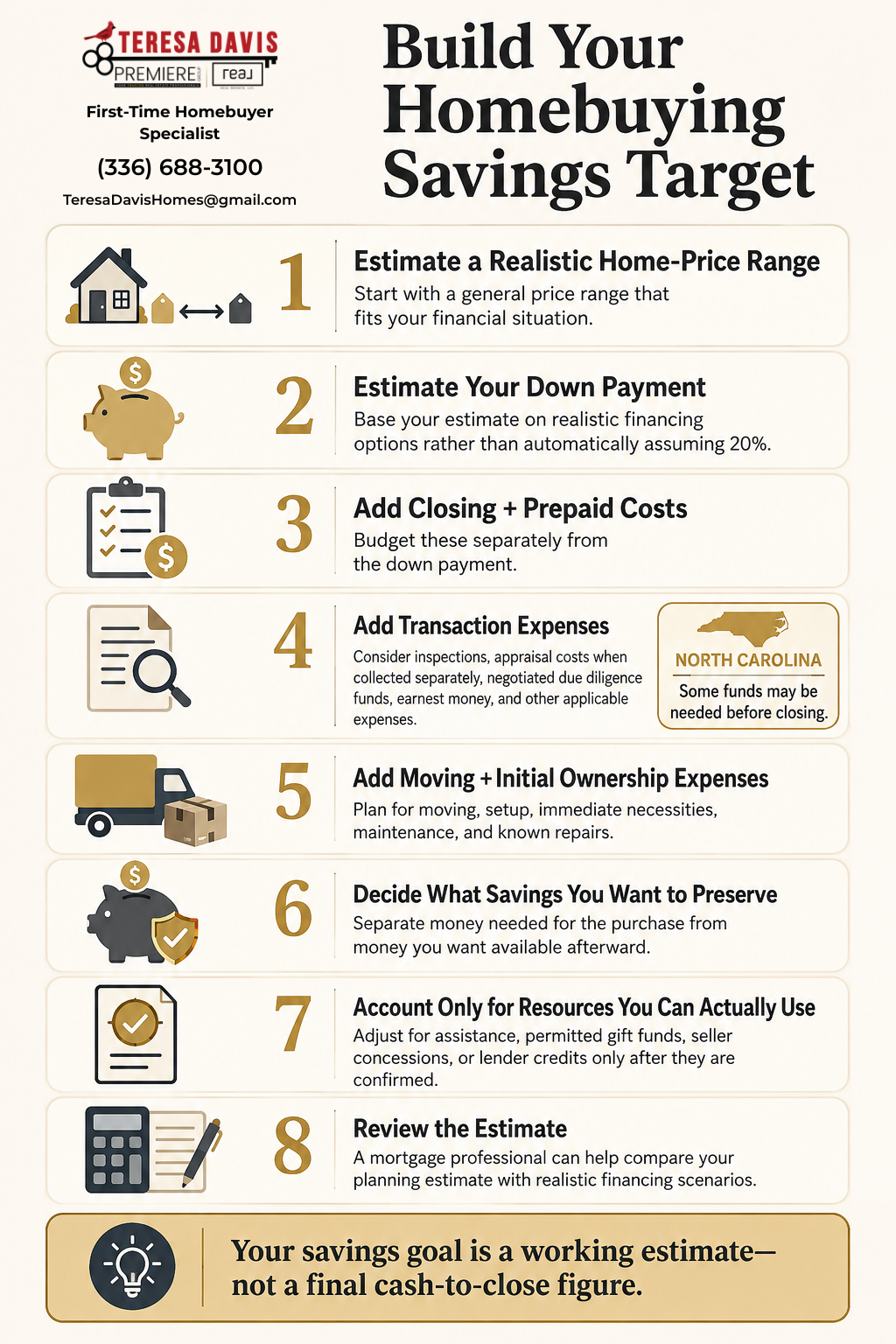
Frequently Asked Questions
Do I need to have 20% of the home's price saved before I can buy?
No. A 20% down payment is not a universal requirement for buying a home. Some mortgage programs permit qualified borrowers to purchase with substantially less than 20% down, and certain eligible buyers may have access to financing or assistance that further changes the amount they personally need to provide.
The down payment should also be considered alongside closing costs, transaction expenses, monthly housing costs, mortgage insurance when applicable, and the savings you want to retain after closing. The appropriate amount depends on the mortgage program, your qualifications, the property, and the specific transaction.
Should my down payment and closing costs be saved separately?
It is helpful to treat them as separate planning categories because they are different expenses.
Your down payment represents the portion of the purchase price you are not financing through your primary mortgage. Closing costs and prepaid expenses can include lender charges, appraisal or title-related expenses, recording charges, insurance, prepaid interest, escrow funding when applicable, and other transaction-specific expenses.
Separating the categories helps prevent you from assuming that every dollar in your savings account can go toward the down payment when some of those funds may be needed for other costs.
Should I use all of my savings to buy a home?
Not necessarily. Having enough money available to complete a purchase does not automatically mean you will be comfortable spending all of it.
Homeownership can bring moving expenses, maintenance, repairs, utility costs, and unexpected expenses after closing. When building your savings target, consider both the money you may need for the transaction and the amount you would prefer to keep available afterward.
There is no single reserve amount that is appropriate for everyone. Your preferred financial cushion depends on your expenses, income stability, obligations, property, household circumstances, and comfort with financial risk.
Can down payment assistance or gift money reduce how much I need to save?
Potentially. Qualified buyers may be able to use eligible down payment or closing-cost assistance, permitted gift funds, seller concessions, lender credits, or other approved sources depending on the mortgage program and transaction.
These funds should not be assumed to be available until eligibility and requirements have been confirmed. Mortgage programs can have specific rules governing acceptable sources of funds, documentation, contribution limits, and how assistance or concessions may be used.
A mortgage professional can help determine which sources may be permitted for your financing and how they could affect your estimated cash needed to close.
How can I get a more accurate estimate of how much I personally need to save?
Start with an approximate home-price range and then estimate the major savings categories: your potential down payment, closing and prepaid costs, transaction expenses, moving or initial setup costs, and the savings you want to preserve after closing.
A mortgage professional can then help you compare those estimates with realistic financing options based on your circumstances. As you move farther into the process, your financing disclosures, chosen property, negotiated contract terms, insurance, taxes, credits, deposits, and other transaction details will make the estimate more precise.
Your early savings target is a planning tool. Your actual cash-to-close requirement will depend on the specific financing and transaction.
What Happens Next?
Once you understand the different categories of money that may be needed to purchase a home, the next question is how much of your savings you should try to keep available after the purchase.
Cash needed for the transaction and emergency savings serve different purposes. A buyer may technically have enough money to complete a purchase while still deciding that using nearly all available savings would leave too little financial flexibility afterward.
The next Academy lesson, How much emergency savings should I have before buying a home?, looks more closely at post-closing reserves, unexpected homeownership expenses, and factors you can consider when deciding what financial cushion feels appropriate for your situation.
Ready to Take the Next Step?
If you are unsure whether your current savings are enough to begin the homebuying process, you do not have to wait until you reach an arbitrary dollar amount before learning what your numbers may look like. Understanding the different pieces of your potential cash needs can help you set a more useful savings goal.
Contact Teresa Davis
If you would like help understanding the real estate side of your expected purchase expenses, including where costs may arise during the search, offer, due diligence, inspection, and closing process, contact Teresa Davis
Teresa Davis
REALTOR® / Professional Real Estate Advisor
PREMIERE Group of Real Broker LLC
Start the One Real Mortgage Pre-Approval Process
If you are ready to explore financing possibilities and develop a more individualized estimate of potential down payment, closing costs, and cash-to-close needs, you can start the One Real Mortgage Pre-Approval Process. Using One Real Mortgage is optional and is not required in order to work with Teresa Davis as your REALTOR®.
Teresa Davis
Loan Originator NMLS #2597433
One Real Mortgage
Mortgage qualification, loan programs, terms, costs, and final approval depend on the borrower, property, transaction, documentation, underwriting, and applicable lending requirements. Beginning a pre-approval process does not guarantee financing or require you to purchase a home. It is a practical way to learn more about your potential financing options, estimated payment, and possible next steps.
Ready for the next lesson? Use “Next Question” below to continue to "How much emergency savings should I have before buying a home?".
2:9 - How much emergency savings should I have before buying a home?

Buying a home takes more than saving enough for the down payment and closing costs. It also means thinking about the money you want to still have available after closing. An emergency fund can provide an important financial cushion when an unexpected expense or interruption in income occurs.
That cushion can become especially important once you own a home. Homeowners are responsible for repairs and maintenance, while other unexpected expenses—such as a vehicle repair, medical bill, insurance deductible, or temporary loss of income—can happen at the same time. The Consumer Financial Protection Bureau defines an emergency fund as money specifically set aside for unplanned expenses or financial emergencies.
There is no single emergency-savings amount that is right for every first-time homebuyer. A useful starting point is to consider several months of essential household expenses. Current CFPB homebuying guidance describes three to six months of expenses as a general rule of thumb for an emergency cushion when determining how much cash to keep separate from the money available for closing.
The goal is not to reach an arbitrary number before you are “allowed” to buy. Instead, the goal is to understand how much financial flexibility you may have after the purchase and make an informed decision about how much of your savings to commit to the transaction.
Quick Answer
A common starting point is to aim for an emergency fund equal to about three to six months of essential expenses, but that is a financial-planning guideline—not a universal mortgage requirement.
Your appropriate cushion may be higher or lower depending on your income stability, monthly obligations, other available savings, anticipated homeownership expenses, and personal comfort with financial risk.
Most importantly, try to distinguish the money you expect to use to buy the home from the money you intend to preserve afterward. Your down payment, closing costs, moving expenses, and emergency fund may all compete for the same savings, but the same dollar cannot serve all of those purposes at once.
At a Glance
- There is no universal emergency-fund amount for every buyer.
- Three to six months of essential expenses is a useful general planning range, not a requirement to qualify for every mortgage.
- Emergency savings should generally be considered separately from your down payment and closing funds.
- Base your target on your household expenses and financial circumstances—not simply on the price of the home.
- Homeownership can bring unexpected repair and maintenance expenses, so preserving some accessible savings can provide valuable flexibility.
- Mortgage reserves and your personal emergency fund are not necessarily the same thing.
- Being able to close on a home and being financially comfortable after closing are two different considerations.
What Emergency Savings Actually Means
Emergency savings is money you intentionally keep available for unplanned expenses or financial disruptions. It is different from money you already expect to spend as part of buying the home.
For a first-time homebuyer, that distinction matters because several different financial needs may be competing for the same pool of savings. You may be preparing for a down payment, closing costs, moving expenses, immediate purchases for the home, and other planned costs. An emergency fund serves a different purpose: it gives you accessible money to handle something you did not plan for.
Examples might include:
- an unexpected home repair;
- an insurance deductible;
- an unplanned vehicle expense;
- a medical expense;
- a temporary interruption or reduction in household income; or
- another necessary expense that cannot reasonably be postponed.
The exact type of emergency will differ from household to household. The important idea is that emergency savings should generally be money you can access when an unexpected financial need occurs. That is why it helps to think about emergency savings separately from the amount you need to successfully complete the purchase.
Why Homeownership Changes the Emergency-Savings Conversation
Owning a home can introduce financial responsibilities that renters may not have previously handled directly. If an appliance stops working, a plumbing problem develops, the heating or cooling system needs attention, or another property issue arises, the homeowner generally has to decide how and when to address it. Some repairs may be minor, while others can be more significant.
At the same time, ordinary life does not stop because you bought a home. A vehicle problem, medical expense, job change, or other financial disruption can occur while you are also responsible for your mortgage payment and the ongoing costs of owning the property.
This does not mean buyers should expect something expensive to go wrong immediately after closing. It means homeownership makes financial flexibility valuable.
An emergency fund can help reduce the likelihood that one unexpected expense forces you to rely immediately on credit cards, personal loans, or other borrowed money. Whether borrowing is appropriate depends on the circumstances, but preserving accessible cash can give you more options when an unexpected expense occurs.
A Practical Way to Estimate Your Emergency-Savings Target
One of the simplest ways to begin estimating an emergency fund is to look at your essential monthly expenses.
A general planning framework is: Essential monthly expenses × number of months you want to cover = initial emergency-savings target
For example, rather than basing your emergency fund on the purchase price of the home, begin by asking: How much would my household need each month to continue paying its necessary expenses if our income were temporarily reduced or an unexpected expense occurred?
Current Consumer Financial Protection Bureau homebuying guidance uses approximately three to six months of expenses as a general rule of thumb when discussing the emergency cushion a buyer may want to keep separate from the cash available for closing.
That range is useful for planning, but it is not a rule that applies equally to every household. A buyer with highly predictable income, low required monthly obligations, and substantial additional accessible savings may evaluate the target differently from someone whose income varies considerably or whose household depends primarily on one income source.
The goal is not to make every buyer reach exactly three months or exactly six months. The goal is to create a deliberate savings target based on your actual financial situation.
What Should You Count as Essential Monthly Expenses?
When estimating an emergency fund, focus primarily on expenses your household would still need to pay even if you were trying to reduce discretionary spending. Depending on your circumstances, essential expenses may include:
- your expected mortgage payment or other housing expense;
- property-related expenses that you will be responsible for paying;
- utilities;
- groceries and other necessary household expenses;
- transportation costs;
- insurance premiums;
- minimum required debt payments;
- necessary child-care or dependent-care expenses, when applicable; and
- other recurring obligations that are necessary for your household.
Your calculation does not have to include every optional purchase or entertainment expense in your normal monthly budget. The objective is to estimate the amount needed to keep your household functioning and your essential obligations current during a financial disruption.
For a buyer who has not yet purchased the home, it can be useful to calculate this using the anticipated post-purchase budget, rather than relying only on current rental expenses. Your future housing costs may be different from what you pay today.
That expected housing budget may include more than principal and interest. Depending on the property and financing structure, the household may also need to plan for property taxes, homeowners insurance, homeowners association assessments when applicable, utilities, and ongoing maintenance.
These amounts vary by property and household, so the calculation should be based on realistic estimates rather than a generic national figure.
Should You Aim for Three Months, Six Months, or Something Different?
There is no single answer that is appropriate for every buyer. The three-to-six-month range can provide a useful starting point, but your personal circumstances may justify preserving a smaller or larger cushion.
Factors worth considering include:
Income Stability
Ask how predictable your household income is. Someone with stable, consistent income may evaluate emergency savings differently from someone who is self-employed, works on commission, receives seasonal income, regularly depends on overtime, or has income that fluctuates. The less predictable the income, the more important additional liquidity may feel to that household.
Number of Income Sources
A household relying primarily on one income source may view an interruption differently from a household with multiple independent sources of income. This does not automatically determine the correct emergency-fund amount, but it is an important part of assessing financial risk.
Required Monthly Obligations
Two households earning the same income can have very different financial flexibility. A household with significant required debt payments, transportation costs, dependent-care expenses, or other fixed obligations may need more cash each month to maintain essential expenses. That is one reason an emergency fund should be based on your own budget rather than someone else's savings goal.
Other Accessible Savings
Consider whether you have other liquid funds available beyond the amount designated as your emergency fund. Not every asset is equally accessible, and some accounts may have tax consequences, withdrawal restrictions, penalties, or other considerations. Emergency planning generally focuses on money that can be accessed when needed without creating another financial problem.
Questions involving retirement-account withdrawals, investment liquidation, taxes, or penalties should be discussed with the appropriate financial or tax professional.
The Home You Are Purchasing
The property itself can also influence how much financial cushion you are comfortable preserving. A buyer purchasing an older home with aging systems may think differently about post-closing liquidity than a buyer purchasing a property with newer major components. However, newer construction does not eliminate the possibility of unexpected expenses, and an older property does not mean a major repair will necessarily occur.
Inspection findings, maintenance history when available, insurance considerations, homeowners association obligations, and the condition of major systems can all provide useful context.
Your Comfort With Financial Uncertainty
Emergency savings is partly about numbers and partly about your ability to absorb an unexpected event without creating significant financial stress.
Some buyers are comfortable maintaining a smaller cash reserve because they have highly stable finances and additional resources. Others prefer a larger cushion before taking on homeownership.
Neither approach should be treated as universally correct. The better question is: After I complete the purchase, would the amount I have left give me reasonable flexibility if something unexpected happened? That question can help turn an abstract savings target into a more meaningful homebuying decision.
Do Not Count the Same Dollar Twice
One of the most important parts of preparing financially for a home purchase is separating the different jobs your savings may need to perform. Suppose you have money set aside for your home purchase. Some of that money may eventually be needed for:
- your down payment;
- closing costs and prepaid expenses;
- moving costs;
- immediate purchases or planned work after closing; and
- emergency savings that you want to preserve.
Those categories may all come from the same savings account today, but they do not represent the same available dollars once you begin assigning them to specific purposes. If money will be spent at closing, it will no longer be available as an emergency cushion afterward.
The Consumer Financial Protection Bureau's current homebuying guidance uses this same basic approach when helping buyers determine how much cash may actually be available for closing. It recommends accounting for other savings goals, moving or renovation expenses, and an emergency cushion before determining the maximum cash available for the transaction.
A useful way to organize your planning is to think in separate financial buckets:
Bucket 1 — Money needed for the home purchase
This may include your down payment, closing costs, prepaid expenses, and other transaction-related amounts.
Bucket 2 — Money for planned near-term expenses
This may include moving, necessary furnishings, planned improvements, utility setup costs, or other expenses you reasonably expect after purchasing the home.
Bucket 3 — Emergency savings
This is the money you intentionally plan to keep available for expenses or disruptions you cannot predict. The exact amount in each bucket will be different for every buyer. What matters is understanding which dollars are truly available for the purchase and which dollars you intend to protect for life after closing.
Emergency Savings and Home-Maintenance Savings Are Related but Different
It can also help to distinguish an emergency fund from money you intentionally save for routine home maintenance and future replacement expenses. A home requires ongoing care. Some expenses are reasonably foreseeable even if you do not know exactly when they will occur. For example, you may eventually need to pay for maintenance, service an appliance or major system, replace worn components, or make other repairs associated with owning the property.
Those expenses are different from a broader financial emergency such as an unexpected loss of income or major medical expense. A homeowner might therefore think about savings in two ways:
- emergency savings for unexpected financial events; and
- home-maintenance savings for the ongoing costs and eventual repairs associated with the property.
You do not necessarily need two separate bank accounts. The important distinction is understanding that home maintenance can consume savings even when no broader financial emergency occurs.
A buyer who closes with an emergency fund but immediately spends a large portion of it on predictable improvements or furnishings may have less emergency protection than the account balance originally suggested. Before closing, think realistically about what you intend to purchase or improve shortly after moving in. Planned spending should generally be treated as planned spending rather than counted as money you expect to preserve for emergencies.
Emergency Savings and Mortgage Reserves Are Not the Same Thing
The term reserves can cause confusion because lenders may also use it during the mortgage process. Your personal emergency fund and mortgage reserves are related to financial preparedness, but they are not necessarily the same concept.
Personal emergency savings is the financial cushion you choose to preserve for unexpected household expenses or disruptions.
Mortgage reserves generally refer to eligible assets considered under the applicable mortgage underwriting guidelines after accounting for funds needed to complete the transaction.
Reserve requirements are not identical for every borrower or every mortgage. They may depend on factors such as the transaction, occupancy, property characteristics, underwriting findings, and applicable loan-program requirements. Current Fannie Mae guidance, for example, establishes different minimum reserve requirements for different transaction circumstances rather than one universal reserve requirement for all borrowers.
This distinction matters for first-time buyers because hearing that a lender does—or does not—require a particular level of reserves does not automatically answer the separate personal question: How much emergency savings would I be comfortable having after I buy the home?
A lender evaluates whether a mortgage satisfies applicable qualification and underwriting requirements. Your personal emergency-savings decision involves your broader household finances and your ability to handle unexpected expenses after closing.
Ask your Loan Originator what assets will be required or considered for your specific mortgage rather than assuming that a general reserve rule applies to your transaction.
Should You Put More Money Down or Keep More in Savings?
Buyers sometimes face a tradeoff between using more cash for the purchase and preserving more cash after closing. A larger down payment can affect the mortgage in several ways depending on the financing structure. At the same time, putting additional money into the home means that money is no longer sitting in an easily accessible savings account.
That does not mean preserving cash is always better than making a larger down payment—or that making a larger down payment is always better than preserving cash. The better approach is to evaluate the complete financial picture.
Before deciding how much cash to commit, consider questions such as:
- How much will I need for the required transaction expenses?
- How much cash would remain afterward?
- What will my expected monthly housing payment be?
- What planned expenses will I have soon after closing?
- How much emergency savings do I want to preserve?
- How would different down-payment choices affect my financing?
- How quickly could I rebuild savings after the purchase?
Current CFPB homebuying guidance specifically recommends setting aside an emergency cushion before determining the maximum cash available for closing, reinforcing the importance of evaluating liquidity alongside the amount committed to the purchase.
Your Loan Originator can help you understand how different down-payment amounts may affect your mortgage options, estimated payment, cash needed for closing, and applicable underwriting requirements. That information can help you make a more informed decision about how much cash you are comfortable using.
Why Using Nearly All Your Available Cash Can Create Risk
It can be tempting to focus on one goal: accumulating enough money to complete the purchase. But closing day is the beginning of homeownership, not the end of your financial responsibilities. If nearly every available dollar is used for the transaction, there may be very little flexibility if an unexpected expense occurs shortly afterward.
For example, imagine that a buyer reaches closing successfully but then encounters an unrelated vehicle repair or medical expense a few weeks later. The home purchase did not cause that expense, but using nearly all available savings at closing may make the expense more difficult to absorb.
The CFPB identifies home repairs, car repairs, medical bills, and loss of income as examples of circumstances for which emergency savings may be used.
Preserving savings cannot prevent emergencies, and an emergency fund does not eliminate financial risk. It can, however, give a household another resource to draw from when something unexpected happens.
That is why the question should not be limited to: Can I come up with enough money to close?
It should also include: What will my financial position look like the day after closing?
What If You Have Not Reached Your Ideal Emergency-Fund Goal?
Not having a full three-to-six-month emergency fund does not automatically mean that you cannot purchase a home. The three-to-six-month figure is a general consumer planning benchmark, not a universal mortgage qualification standard. CFPB homebuying guidance presents it as a rule of thumb for an emergency cushion when evaluating available cash for a purchase.
Instead of treating the benchmark as an all-or-nothing test, evaluate your overall position. Consider:
- how much emergency savings you currently have;
- how much you expect to use for the transaction;
- how much will remain after closing;
- whether your income is stable or variable;
- your essential monthly obligations;
- your expected housing expenses;
- known near-term expenses;
- the condition and anticipated needs of the property;
- how quickly you could reasonably rebuild savings; and
- whether changing your purchase budget or down-payment strategy would leave you with more flexibility.
For some buyers, the result of that analysis may be a decision to keep saving before purchasing. For others, a smaller emergency fund may feel manageable because of their overall financial circumstances. And some buyers may decide to adjust the price range, down payment, or timing of the purchase so they do not have to use as much of their available cash.
The purpose of the exercise is not to produce the same answer for everyone. It is to make the decision intentionally rather than discovering after closing that the purchase left less financial flexibility than expected.
Protecting and Rebuilding Your Savings After Closing
Emergency-savings planning should continue after you receive the keys. Once you have lived in the home for a while, you will have a clearer picture of your actual expenses. Your utility costs, maintenance needs, insurance expenses, transportation costs, and other household obligations may differ from the estimates you used before purchasing.
Review your budget after closing and compare your actual costs with what you anticipated. If you used part of your savings for the purchase or for an unexpected expense, consider creating a realistic plan for rebuilding it over time.
That could mean establishing a regular savings amount within your monthly budget or directing occasional additional funds toward the emergency account when your finances allow. The goal is not perfection. It is maintaining a financial cushion that supports sustainable homeownership.
A first-time buyer's savings plan therefore should not end with the question: How much do I need to buy the home?
It should also address: How much do I want to keep available once the home is mine?
Thinking about both questions before you make the purchase can help you enter homeownership with a clearer understanding of not only what it takes to close, but what it may take to remain financially prepared afterward.
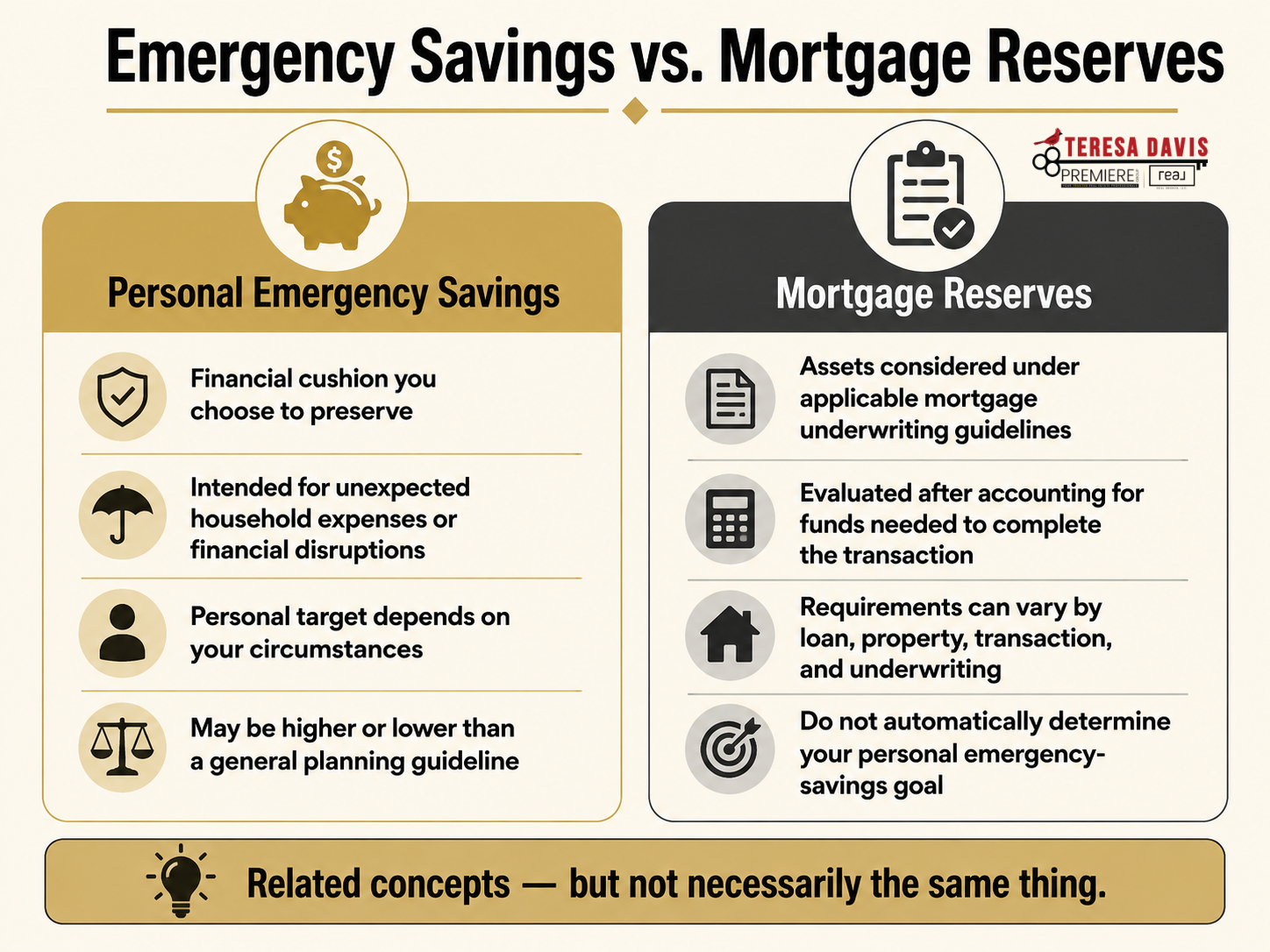
REALTOR® Guidance — Consider the Property Along With Your Savings Plan
Your emergency-savings decision is primarily a household financial-planning decision, but the specific home you are considering can provide important context for that decision.
As your REALTOR®, I can help you look beyond the purchase price and identify property-related information that may affect your expectations for ownership expenses. That does not mean predicting exactly what a home will cost to maintain or guaranteeing that a repair will—or will not—occur. It means gathering as much relevant information as reasonably possible so you can make a more informed decision.
When evaluating a property, consider factors such as:
- the apparent age and condition of major systems and components;
- information provided in available property disclosures;
- findings from inspections and other evaluations you choose to obtain;
- known homeowners association assessments or other recurring property obligations, when applicable;
- insurance considerations you should investigate with an appropriate insurance professional;
- maintenance responsibilities associated with the type of property; and
- improvements or purchases you already expect to make after closing.
A home inspection can be especially valuable because it may identify conditions that deserve additional investigation or future planning. An inspection cannot predict every future repair, and even a home that appears to be in excellent condition can have unexpected expenses after closing.
The goal is not to determine a perfect emergency-fund number based on the property. Instead, property information can help you decide whether the amount of cash you plan to preserve after closing feels reasonable in light of the home you are purchasing.
This is also one reason I encourage buyers to avoid evaluating a home solely by asking, “Can I afford the purchase price?”
A more complete question is: “Can I comfortably manage the purchase, the expected costs of owning this particular property, and an unexpected expense if one occurs?”
That broader perspective can help you make a purchase decision that supports both your immediate homeownership goals and your longer-term financial comfort.
Teresa’s Professional Insight
One distinction I want first-time buyers to understand is that being able to close on a home and feeling financially comfortable after closing are not necessarily the same thing.
During the mortgage process, we may discuss your down payment, estimated cash needed for closing, loan requirements, and any applicable mortgage reserves. Those numbers are important, but they do not automatically determine how much personal emergency savings you should keep.
Your lender's underwriting requirements answer one question: Does the mortgage meet the applicable qualification requirements? Your personal emergency-savings plan answers another: How prepared do I want to be for the financial realities of homeownership after the transaction is complete? Those questions are connected, but they are not interchangeable.
Because I work with buyers as both a REALTOR® / Professional Real Estate Advisor with the PREMIERE Group of Real Broker and Loan Originator NMLS #2597433 with One Real Mortgage, I believe it is helpful to look at the complete picture before committing your savings. That includes understanding what may be required for the transaction, how different financing choices could affect your cash needs, what you expect to spend after moving, and how much savings you would like to preserve.
Sometimes buyers naturally focus on putting as much money as possible toward the purchase. In other situations, maintaining additional liquidity may be important to them. There is no one strategy that is automatically right for every household.
The objective is to understand the tradeoffs before you make the decision. For buyers in Davidson, Randolph, Guilford, Forsyth, and surrounding North Carolina counties, I can help you evaluate the real estate side of that picture and explain how different properties may affect your planning.
As a Loan Originator NMLS #2597433 with One Real Mortgage, I can also help explain how potential mortgage structures may affect estimated cash-to-close and applicable lending requirements. For individualized investment, tax, or broader financial-planning advice, consult the appropriate qualified professional.
Helpful Tip
Before deciding how much of your savings to use for a home purchase, divide your available money into three planning buckets:
Bucket 1 — Purchase Money
Include money you expect to use for the transaction, such as your down payment and estimated closing-related expenses.
Bucket 2 — Planned After-Closing Money
Include expenses you already expect, such as moving costs, necessary household purchases, planned improvements, utility setup, or other known near-term expenses.
Bucket 3 — Emergency Money
Identify the amount you would like to remain available for expenses or financial disruptions you cannot predict.
Then ask: After Buckets 1 and 2 are paid, how much will actually remain in Bucket 3?
This simple exercise can prevent one of the easiest homebuying planning mistakes: counting the same dollar more than once.
Keep in Mind
A mortgage approval tells you whether you meet the applicable requirements for a particular financing scenario. It does not necessarily tell you how much of your savings you should personally feel comfortable spending.
Likewise, a lender's mortgage-reserve requirement—when one applies—is not automatically the same as your personal emergency-savings goal. Before committing most of your available cash to a home purchase, consider the complete picture:
- the amount needed for the transaction;
- the savings you expect to use shortly after closing;
- the amount you want to preserve for emergencies;
- your expected monthly housing expenses;
- your income stability and other required obligations;
- the particular property's condition and ownership responsibilities; and
- how quickly you could realistically rebuild savings.
There is no universal emergency-fund balance that guarantees someone is financially ready to buy a home. The purpose of emergency-savings planning is to help you make the purchase with a clearer understanding of the financial cushion you will have after closing—not simply whether you can reach the closing table.
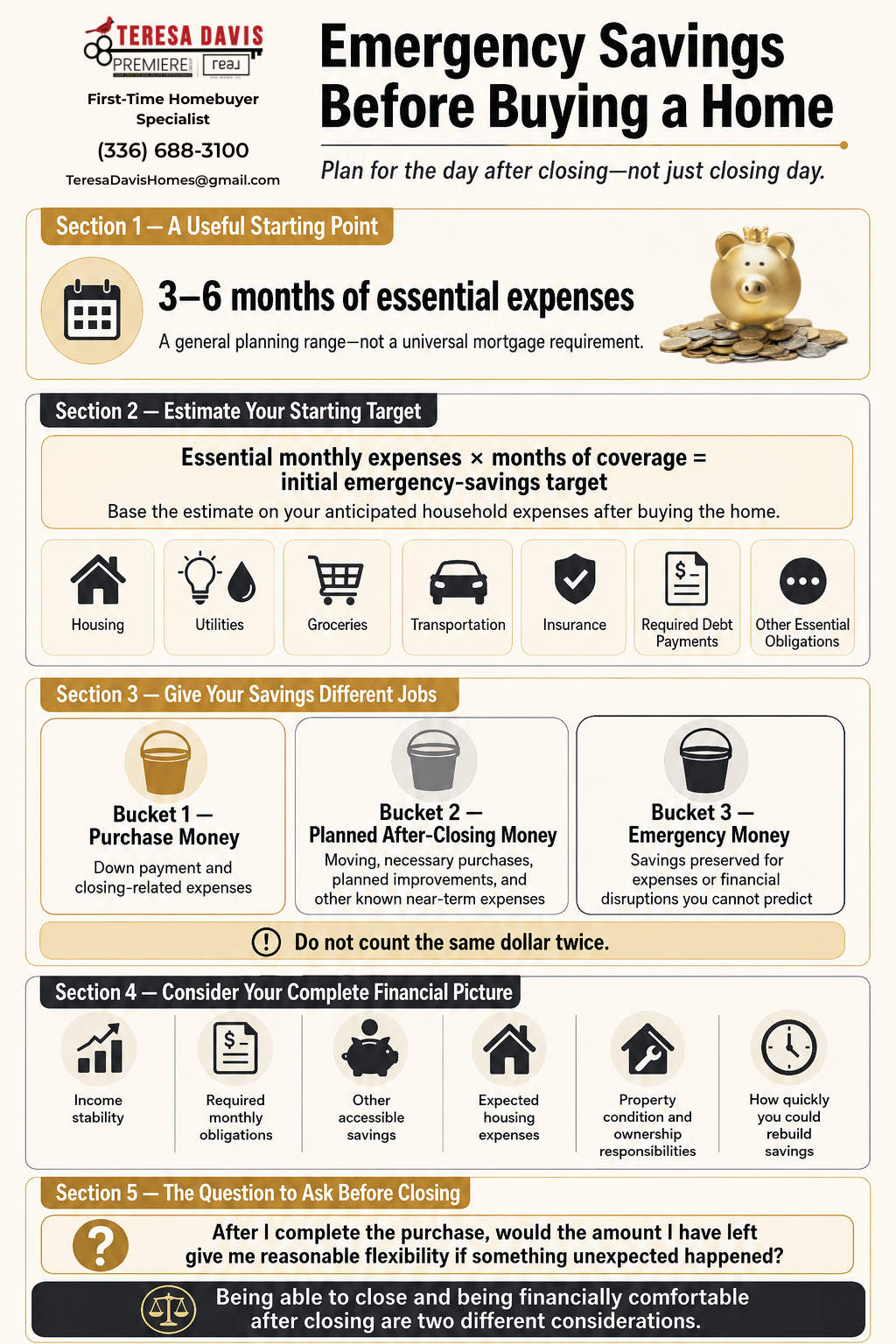
Frequently Asked Questions
Do I need three to six months of emergency savings before I can buy a home?
No. Three to six months of essential expenses is a common financial-planning guideline for an emergency cushion, but it is not a universal mortgage qualification requirement.
Your appropriate emergency-savings target depends on your household finances, income stability, monthly obligations, other accessible savings, anticipated homeownership expenses, and comfort with financial uncertainty. Some buyers may decide they want a larger cushion, while others may move forward with less after considering their complete financial picture. Mortgage qualification is evaluated separately under the requirements applicable to your financing.
What expenses should I include when calculating my emergency-fund target?
Start with expenses your household would still need to pay during a financial disruption. Depending on your circumstances, those may include your expected housing payment, utilities, groceries, transportation, insurance, minimum required debt payments, necessary dependent-care expenses, and other essential recurring obligations.
For a prospective homebuyer, using your anticipated post-purchase expenses can provide a more realistic estimate than relying only on your current rental budget.
Can I use my emergency savings for my down payment or closing costs?
You can choose how to allocate your available savings, but money spent on the down payment or closing costs will no longer be available as an emergency cushion after closing. That is why it is helpful to separate your savings into different purposes before deciding how much cash to commit to the purchase.
Consider identifying:
- money needed for the transaction;
- money for planned moving and near-term expenses; and
- money you intend to preserve for unexpected expenses.
This helps prevent the same dollars from being counted toward more than one financial goal.
Are mortgage reserves the same thing as an emergency fund?
Not necessarily. An emergency fund is the personal financial cushion you choose to preserve for unexpected household expenses or financial disruptions.
Mortgage reserves are assets considered under applicable mortgage underwriting requirements after accounting for funds needed to complete the transaction. Whether reserves are required and how they are calculated can depend on the loan, property, transaction, occupancy, underwriting findings, and other applicable requirements.
Ask your Loan Originator what reserve requirements, if any, apply to your specific mortgage rather than assuming that a general reserve rule applies to every buyer.
Should I wait to buy a home if I do not have a full emergency fund yet?
Not necessarily. A three-to-six-month emergency fund is a general planning benchmark, not an automatic pass-or-fail test for whether you should buy a home.
Instead, evaluate your complete financial position, including:
- how much savings you currently have;
- how much you expect to use for the purchase;
- what will remain after closing;
- your income stability;
- your required monthly obligations;
- the property's expected ownership costs;
- known near-term expenses; and
- how quickly you could realistically rebuild your savings.
For some buyers, waiting and saving more may be the better decision. Others may determine that their existing cushion is reasonable for their circumstances. The goal is to make that decision intentionally rather than discovering after closing that you have less financial flexibility than expected.
What Happens Next?
Once you have decided how much savings you would like to preserve after buying a home, the next step is to understand how much money may actually be required to complete the transaction.
Your down payment is only one part of that calculation. Buyers may also encounter lender charges, third-party services, prepaid expenses, escrow funding, attorney or settlement-related expenses, and other closing costs depending on the property and financing.
Understanding those expenses can help you estimate your expected cash needs more realistically while keeping your emergency-savings goal separate.
The next Academy lesson explains: What closing costs should I expect when buying a home?
That lesson will help you identify the types of closing expenses you may see and prepare for the difference between money you expect to spend on the transaction and money you want to keep available after closing.
Ready to Take the Next Step?
You do not have to determine your entire financial plan by yourself before asking questions. If you are trying to understand how your savings, homebuying budget, property choices, and mortgage options fit together, the next step can simply be gathering better information.
Contact Teresa Davis
If you would like help thinking through the real estate side of your homebuying plan, including how different properties may affect your expected ownership expenses and overall budget, you can contact Teresa Davis, REALTOR® / Professional Real Estate Advisor with PREMIERE Group of Real Broker LLC and Loan Originator NMLS #2597433 with One Real Mortgage.
I can help you understand how the pieces of the North Carolina homebuying process connect and identify questions that may be helpful to address before you make an offer or commit a large portion of your savings.
One Real Mortgage — Pre-Approval
If you are ready for an individualized mortgage review, you can begin the One Real Mortgage pre-approval process. Using One Real Mortgage is optional and is not required in order to work with Teresa Davis as your REALTOR®.
A mortgage review can help you better understand estimated cash-to-close, possible financing structures, and any applicable lending or reserve requirements for your situation. Mortgage qualification and final approval depend on the complete application, documentation, property, underwriting, loan terms, and applicable lending requirements.
Ready for the next lesson? Use “Next Question” below to continue to "What closing costs should I expect when buying a home?".
2:10 - What closing costs should I expect when buying a home?

When you are preparing to buy a home, the down payment is only one part of the cash you may need. Closing costs are additional expenses connected with obtaining your mortgage and completing the purchase, and understanding them early can help you build a more realistic homebuying budget.
Closing costs vary from one transaction to another. Your loan type, lender, purchase price, property, insurance, taxes, services needed for the transaction, and negotiated credits can all affect the final amount. As a broad planning guideline, the Consumer Financial Protection Bureau notes that closing costs are typically about 2% to 5% of the home purchase price, not including the down payment. Your actual costs may fall outside that range, so a percentage should be used for early planning—not as a guaranteed quote.
For first-time buyers in Davidson, Randolph, Guilford, Forsyth, and surrounding North Carolina counties, one of the most important distinctions to understand is the difference between closing costs, your down payment, and your Cash to Close. They are related, but they are not interchangeable. Your Loan Estimate and, later, your Closing Disclosure provide the transaction-specific numbers you should use as you move toward closing.
Quick Answer
Closing costs are the expenses associated with your mortgage and the closing of your home purchase. Depending on the transaction, they may include lender charges, appraisal and other third-party services, title or settlement expenses, recording or government charges, prepaid interest, homeowners insurance, and money collected to establish an escrow account.
As an early budgeting guideline, you may want to plan for roughly 2% to 5% of the home's purchase price, in addition to your down payment, while recognizing that your actual amount can be higher or lower.
Your Cash to Close is different from your closing costs. It is the broader calculation of how much money you are expected to bring to closing. The CFPB explains that this calculation can include your down payment and closing costs while also accounting for deposits already paid, seller credits, and other adjustments.
The best way to know what you should expect is to review your Loan Estimate once you apply for financing and then compare it with your Closing Disclosure before closing. Those documents provide increasingly specific information about the costs associated with your actual loan and transaction.
At a Glance
- Closing costs are separate from your down payment. Both may contribute to the total amount of money you need for the purchase.
- A rough 2%–5% estimate can help with early planning, but it is not a guaranteed amount. Actual costs depend on the details of your mortgage and transaction.
- Closing costs can include several different categories of expenses. These may include lender charges, third-party services, title or settlement expenses, government or recording charges, prepaids, and initial escrow funding.
- Closing Costs and Cash to Close are not the same number. Cash to Close can also reflect your down payment, deposits already paid, credits, and other adjustments.
- Credits can change what you pay at closing. Depending on the transaction and financing, seller credits or lender credits may reduce some upfront costs, but they should not be assumed or treated as guaranteed.
- Your Loan Estimate is more useful than a generic percentage once you apply for a mortgage. It provides estimated loan terms and closing costs for the financing being offered.
- Your Closing Disclosure provides the final figures to review before closing. For applicable mortgage transactions, you generally must receive it at least three business days before closing so you have time to compare it with your Loan Estimate and ask questions.
- Plan for closing costs without draining the emergency savings you want available after you become a homeowner. A stronger financial plan treats the down payment, closing expenses, and post-closing reserves as separate needs.
What Are Closing Costs?
Closing costs are the upfront expenses associated with obtaining your mortgage and completing the transfer of the property. They are part of the financial picture at closing, but they are not the same thing as your down payment. The Consumer Financial Protection Bureau describes closing or settlement costs as the upfront costs charged to obtain the loan and transfer ownership of the property.
That distinction matters because first-time buyers sometimes save for a down payment and assume that amount represents everything they will need. In reality, you may need money for your down payment plus closing costs, subject to any deposits, credits, or other transaction adjustments that affect the final amount due.
It also helps to separate three terms that appear throughout the homebuying process:
- Down payment: The portion of the purchase price you are paying rather than financing with the mortgage.
- Closing costs: The loan, settlement, third-party, government, prepaid, and other applicable expenses associated with completing the mortgage and purchase.
- Cash to Close: The broader final calculation of how much money you are expected to bring to closing after accounting for items such as your down payment, closing costs, deposits already paid, credits, and applicable adjustments. CFPB's Loan Estimate specifically separates Estimated Closing Costs from Estimated Cash to Close.
Understanding these as separate numbers makes it easier to build a realistic financial plan and to understand the documents you receive from your lender.
How Much Should You Plan for Closing Costs?
For early budgeting, the CFPB currently advises that closing costs typically range from about 2% to 5% of the purchase price, not including the down payment. Your actual closing costs can be higher or lower because they depend on factors such as the home's price, your down payment, lender costs, loan type, property type, and location.
For example, a percentage can give you a useful starting point while you are deciding how much cash to save. It should not be treated as a quote or a guaranteed amount for a particular home.
That is especially important because two buyers purchasing similarly priced homes can have different closing costs. They may use different lenders, loan structures, insurance policies, service providers, interest-rate options, or negotiated credits. Even the timing of the closing can affect certain prepaid amounts.
As you move from financial preparation into mortgage shopping, replace the rough percentage estimate with the actual figures shown on your Loan Estimate. That document will give you a much more useful picture of the costs associated with the mortgage being offered. CFPB also notes that closing-cost estimates can vary among lenders, which is one reason buyers should compare the complete loan offer rather than focusing only on the interest rate.
What Loan-Related Costs Might You See?
Some closing expenses are directly connected with obtaining the mortgage. The exact names and amounts can vary, and not every loan will include every charge.
Common lender-related charges may be described as origination, application, underwriting, processing, administrative, or similar fees. CFPB explains that these charges are part of the cost of originating or making the loan and advises consumers to pay attention to the total lender charges even when lenders use different names for individual fees.
You may also see other mortgage-related expenses, depending on your loan and transaction. These can include an appraisal or other valuation-related service, credit or verification services, mortgage-insurance-related charges when applicable, and discount points if you choose to pay an upfront amount in connection with obtaining a lower interest rate.
Your Loan Estimate organizes these expenses so that you can see origination charges, services you cannot shop for, and services you may be permitted to shop for. That structure can help you understand not only how much you are being charged, but also who is providing the service and whether comparison shopping may be possible.
When comparing lenders, look beyond a single fee. A loan with a lower origination charge is not automatically the least-expensive option if other costs, credits, points, or the interest rate are substantially different. The goal is to understand the complete financing offer.
Title, Attorney, Settlement, and Recording Costs in North Carolina
Closing costs can also include expenses associated with the legal and settlement work required to complete the transaction. Depending on the property and transaction, you may encounter charges related to title examination or title work, title insurance, attorney or settlement services, recording documents, and other property-specific services. Some services may be required by the lender, while others may depend on the buyer's choices or the circumstances of the transaction.
North Carolina has an important state-specific component: attorneys perform the legal functions involved in real estate closings. North Carolina Real Estate Commission guidance explains that legal closing functions include matters such as title work and explaining the legal status of title, and its closing guidance recognizes the closing attorney's role in completing the closing, updating title, recording documents, and disbursing funds.
Your REALTOR® can help you understand where these expenses fit within the transaction and help coordinate communication among the professionals involved. However, questions about title ownership, legal documents, the legal effect of a contract provision, or other legal matters should be directed to the North Carolina closing attorney.
Recording and government-related charges may also appear among your closing expenses. These are different from a lender's origination fee because they relate to documenting or completing the transaction rather than compensating the lender for making the loan.
The key is not to memorize every possible fee. Learn to recognize the major categories and then review the actual charges for your transaction. If you do not understand an item on your Loan Estimate or later Closing Disclosure, ask what the charge is, who receives it, why it is required, and whether it can change before closing. CFPB specifically encourages buyers to compare their final Closing Disclosure with their Loan Estimate and ask questions when something differs from what they expected.
Prepaids Are Different From Ordinary Loan Fees
Not every amount you pay at closing is a fee charged by your lender or closing attorney. Some amounts are prepaids—expenses associated with owning or financing the home that are collected in advance because of when they become due.
One common example is prepaid interest. Mortgage interest generally begins accruing when your loan closes, so you may pay interest at closing for the period between your closing date and the period covered by your first regular mortgage payment. The CFPB identifies prepaid interest separately on the Loan Estimate and Closing Disclosure and notes that the amount can change between the two documents.
You may also pay homeowners insurance premiums at or before closing. The amount depends on the policy and insurer you choose, not simply on the lender. CFPB's current Loan Estimate guidance notes that buyers commonly pay several months of homeowners insurance premiums at or before closing, so this expense should be included in your planning even though it is not an origination fee.
This distinction can make a Closing Disclosure easier to understand. A prepaid expense may increase the amount you need at closing, but its purpose is different from a charge for originating the loan or performing a settlement service.
Why You May Need Money to Start an Escrow Account
If your mortgage includes an escrow account, your lender may collect money at closing to begin funding that account. An escrow account is commonly used to hold money for future expenses such as property taxes and homeowners insurance. Instead of paying those bills entirely on your own when they become due, a portion may be collected with your mortgage payment and held until the lender or mortgage servicer pays the applicable bill.
The amount initially deposited into escrow can vary because taxes, insurance premiums, the timing of closing, and the dates future bills are due all affect the calculation. Federal escrow rules also limit how much cushion a lender may require.
For budgeting purposes, remember that initial escrow funding can be part of the amount due at closing even though that money is being set aside for future property-related bills rather than paid to the lender as an ordinary loan fee.
How Credits Can Affect What You Pay at Closing
Closing costs do not always come entirely from the buyer's own funds. Depending on the financing and transaction, certain credits may reduce the amount the buyer has to pay toward eligible costs.
A lender credit is a credit from the lender that offsets some or all of the buyer's closing costs. CFPB explains that lender credits are commonly associated with a tradeoff: the buyer pays less upfront but may receive a higher interest rate than a comparable option without the credit.
The opposite tradeoff can occur with discount points. A buyer may pay more upfront in exchange for a lower interest rate. That means the loan with the lowest closing costs is not automatically the loan with the lowest overall cost.
A buyer may also negotiate for a seller credit or concession toward eligible closing expenses. Whether a seller agrees to provide a credit is part of the negotiation, and the amount that can actually be used can depend on the loan program and transaction. It should never be assumed that a seller will pay a buyer's closing costs. CFPB recognizes seller credits as one factor that can reduce the buyer's Estimated Cash to Close.
If you are considering credits, evaluate the complete transaction rather than focusing only on how much cash they save at closing. Your lender can explain how a lender credit, discount points, seller credit, or other financing choice affects your loan terms and actual Cash to Close.
North Carolina Due Diligence Fees and Earnest Money Are Different
North Carolina buyers may also pay money earlier in the transaction that should not simply be grouped together with lender closing costs. Under commonly used North Carolina purchase contracts, a Due Diligence Fee and Earnest Money Deposit are separate contractual payments with different purposes and rules.
North Carolina Real Estate Commission guidance describes the Due Diligence Fee as separate from earnest money and explains that the contractual treatment of those funds depends on the agreement and circumstances. These amounts are important to your overall cash planning, but they are not simply additional lender closing-cost fees. Money already paid during the transaction may also affect the final Cash to Close calculation.
Because rights to deposits and fees can depend on the specific North Carolina contract and the circumstances of the transaction, questions about whether money is refundable, forfeited, credited, or otherwise legally recoverable should be discussed with your REALTOR® and, when legal interpretation is needed, a North Carolina real estate attorney. NCREC guidance specifically directs legal questions involving contractual rights and remedies to an attorney.
Your Loan Estimate Gives You a Transaction-Specific Starting Point
Once you apply for mortgage financing, stop relying primarily on a generic percentage and start working from your Loan Estimate.
The Loan Estimate provides important details about the mortgage you requested, including the estimated closing costs and Estimated Cash to Close. It also organizes costs into categories that help you identify origination charges, services you cannot shop for, services you may be able to shop for, and other costs associated with the transaction.
Pay particular attention to:
- the loan amount and basic loan terms;
- origination charges;
- services required by the lender;
- services you may be permitted to shop for;
- taxes, insurance, and other estimated costs;
- points, if any;
- lender credits, if any;
- Estimated Closing Cost; and
- Estimated Cash to Close.
Your Estimated Cash to Close includes more than closing costs alone. CFPB explains that the calculation can include the down payment and closing costs while subtracting deposits already paid to the seller, seller credits, and other applicable adjustments.
If the number is substantially different from what you expected, ask your lender to explain the calculation rather than assuming that the difference represents a new lender fee.
Use the Closing Disclosure for Your Final Review
As closing approaches, the Closing Disclosure becomes the key document for reviewing the final mortgage terms and closing costs.
For most mortgages subject to these disclosure rules, the lender must provide the Closing Disclosure at least three business days before closing. This review period gives you time to compare the final terms and costs with your Loan Estimate and ask questions before signing.
Compare the two documents carefully. Review:
- the loan amount;
- interest rate and loan terms;
- points or lender credits;
- lender and third-party charges;
- prepaid expenses;
- escrow funding;
- seller credits or other adjustments;
- Total Closing Costs; and
- Cash to Close.
If something does not match what you expected, ask why before closing. CFPB specifically recommends comparing the Closing Disclosure with the most recent Loan Estimate and resolving questions or unexpected differences before signing the closing documents.
Why Can Closing Costs Change?
A Loan Estimate is an estimate, but that does not mean every charge can increase without restriction.
Federal mortgage disclosure rules limit how certain costs may change. Some fees generally cannot increase unless a permitted change occurs, some categories are subject to an aggregate tolerance, and other costs can change based on the circumstances. CFPB advises borrowers to ask for an explanation when costs on the Closing Disclosure differ from the Loan Estimate.
Changes can also occur because transaction information changes. Examples may include:
- a change to the loan or interest-rate structure;
- updated property or borrower information;
- selection of a different service provider;
- revised insurance premiums;
- property-tax information;
- the timing of closing and prepaid interest;
- negotiated credits or adjustments; or
- other legitimate transaction-specific changes.
The goal is not to memorize every federal tolerance rule. The practical lesson is to compare your documents and ask questions about changes rather than assuming every increase is normal or every difference is an error.
A Better Way to Plan for Closing Costs
Think of closing-cost planning as a process that becomes more precise as your purchase moves forward: Early planning estimate → Loan Estimate → Closing Disclosure
During the early planning stage, a broad percentage can help you establish a savings target. Once you apply for a mortgage, your Loan Estimate should replace that broad estimate as your primary planning tool because it reflects the specific financing being offered. Before closing, your Closing Disclosure provides the final terms and costs that you should review against your Loan Estimate.
This approach helps prevent one of the most common budgeting mistakes first-time buyers can make: saving for the down payment but failing to plan separately for closing expenses and the emergency savings they want to retain after becoming homeowners.
A well-prepared buyer does not need to predict every closing charge months in advance. You need to understand the major categories, maintain enough financial flexibility for the transaction, and replace rough estimates with actual disclosure figures as soon as they become available.
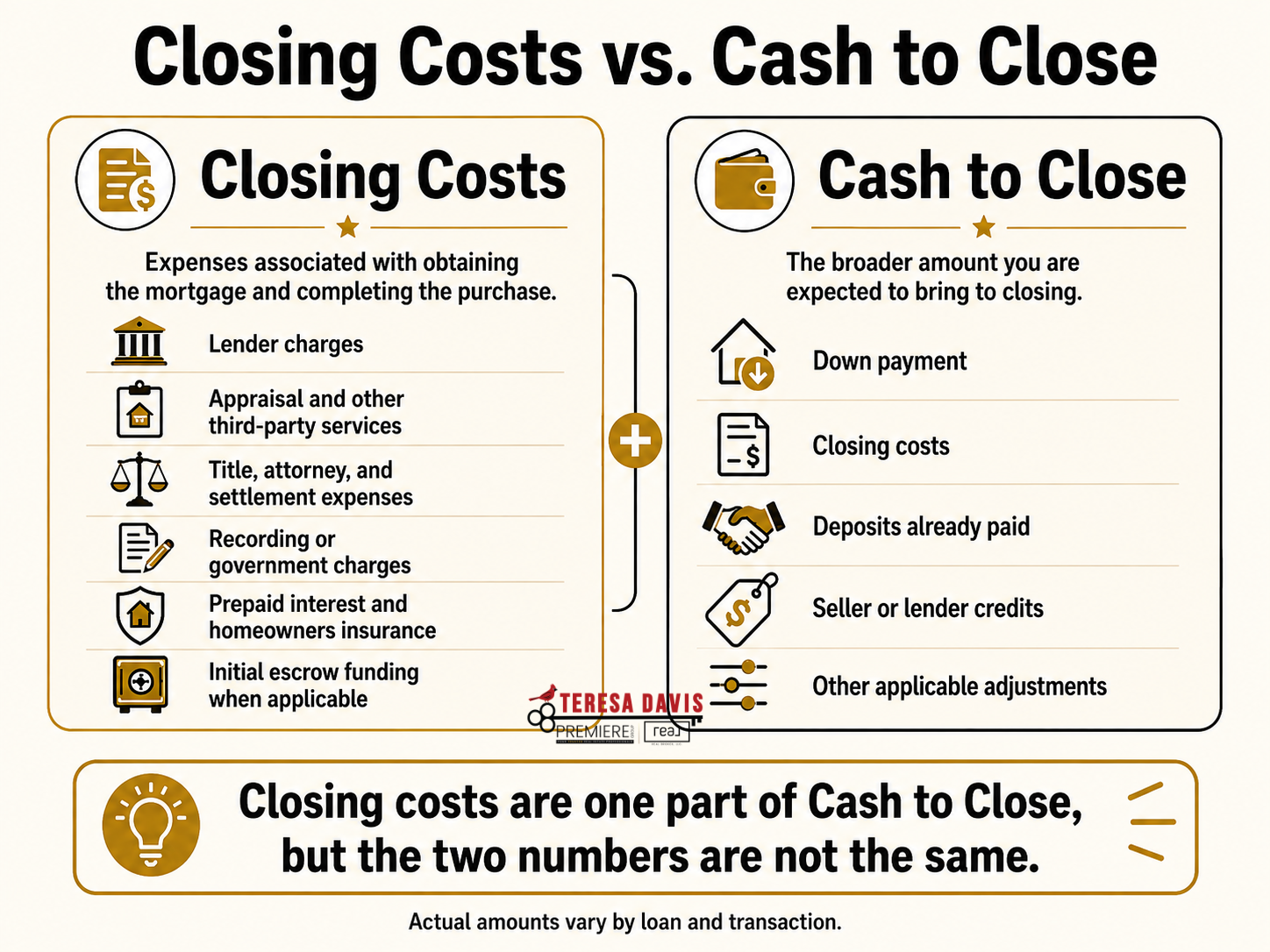
How Your REALTOR® Helps You Prepare for Closing Costs
Closing costs involve several professionals and several different parts of the transaction. Your lender determines and explains the mortgage-related charges and financing requirements. Your North Carolina closing attorney handles the legal closing work and can answer questions involving title, legal documents, recording, and other legal matters. Your insurance professional explains your homeowners insurance coverage and premium.
Your REALTOR® helps you understand how those pieces fit together within the purchase transaction.
One of the most useful things your REALTOR® can do is help you recognize which amounts are connected with the purchase contract and which amounts come from your financing or closing process. For a first-time buyer, terms such as down payment, Due Diligence Fee, Earnest Money Deposit, closing costs, seller credit, and Cash to Close can begin to sound like different names for the same pool of money. They are not.
Your REALTOR® can help you:
- identify transaction expenses that should be considered before you make an offer;
- understand how the Due Diligence Fee and Earnest Money Deposit fit into your broader cash-planning picture;
- discuss whether requesting a seller credit toward eligible closing costs may be appropriate as part of your offer strategy;
- understand that seller credits are negotiated rather than guaranteed;
- coordinate with your lender when an offer term could affect your financing or the amount you need for closing;
- communicate with the closing attorney and other professionals as the transaction progresses;
- review the transaction timeline so you know when different payments or decisions may occur; and
- identify questions that should be answered by your lender, closing attorney, insurance professional, tax professional, or another qualified specialist.
Seller credits can sometimes be valuable, but they should be considered as part of the complete offer, not automatically added to every purchase proposal. The price of the home, competing offers, market conditions, financing requirements, appraisal considerations, and the seller's willingness to negotiate can all influence whether requesting a credit makes sense.
Your REALTOR® can help you evaluate that strategy from the real estate side while your lender confirms what your financing permits and how a proposed credit would affect your loan.
For buyers in Davidson, Randolph, Guilford, Forsyth, and surrounding North Carolina counties, the goal is not simply to reach closing with enough money. The goal is to understand the transaction well enough that your financial decisions support the purchase without unnecessarily creating problems elsewhere in your budget.
Teresa’s Professional Insight
One of the most important things I encourage first-time buyers to do is stop thinking about the down payment as the entire amount needed to buy a home.
A buyer may be prepared for the down payment and still feel surprised when the Loan Estimate shows lender charges, title or attorney expenses, prepaid insurance, prepaid interest, escrow funding, and other costs associated with closing. That does not necessarily mean something went wrong. It often means the buyer is seeing the complete transaction instead of only one part of it.
That is why I prefer to discuss the financial picture early. Before you begin making offers, I want you to understand that your purchase budget may need separate amounts for:
- your down payment;
- North Carolina contract deposits or fees;
- estimated closing costs;
- inspections and other transaction expenses when applicable; and
- emergency savings you want to retain after closing.
You do not need to know every final number before you find a home. In fact, you cannot know every final number that early. What you can do is build enough flexibility into your plan that ordinary transaction expenses do not automatically force you to drain the savings you intended to keep after becoming a homeowner.
Once you have a Loan Estimate, the conversation becomes much more specific. Instead of relying on a generic percentage, you and your lender can review the financing that is actually being offered. As closing approaches, the Closing Disclosure gives you another opportunity to compare the final figures and ask questions before you sign.
My role as your REALTOR® / Professional Real Estate Advisor with the PREMIERE Group of Real Broker LLC is to help you understand the real estate side of that process, coordinate with the professionals involved, and make sure important financial questions are addressed rather than overlooked. As a Loan Originator NMLS #2597433 with One Real Mortgage, I can also help explain mortgage concepts within the appropriate lending process when I am serving in that capacity.
The strongest homebuying plan is not necessarily the one that uses every available dollar to get to the closing table. It is the one that allows you to understand what you are paying, why you are paying it, and what your financial position may look like after you receive the keys.
Helpful Tip
Create three separate savings categories while you are preparing to buy:
- 1. Down Payment
- 2. Estimated Closing Costs
- 3. Emergency Savings
Keeping those amounts separate can give you a clearer picture of your readiness than combining everything into one general savings balance. During early planning, you can use a broad closing-cost estimate to establish the second category. Once you receive your Loan Estimate, replace that rough estimate with the transaction-specific figures your lender provides.
Then review the amount again when your Closing Disclosure becomes available before closing. This simple process helps prevent you from accidentally treating money intended for emergency savings as money that is automatically available for the transaction.
Keep in Mind
The financing option with the lowest amount due at closing is not automatically the least-expensive option overall.
For example, a lender credit may reduce some upfront closing costs but can be associated with a higher interest rate. Discount points may increase the amount you pay upfront while reducing the interest rate. A seller credit may reduce the amount you need for eligible closing expenses, but it depends on negotiation and the requirements of your financing. Those choices involve tradeoffs.
When comparing mortgage options, consider more than: “How much do I have to bring to closing?”
Also ask:
- What is my interest rate?
- Am I paying discount points?
- Am I receiving lender credits?
- What lender charges are included?
- What is my estimated monthly payment?
- How much will I pay upfront?
- How long do I expect to keep this mortgage?
- How does this option affect the emergency savings I want to retain?
Your lender can help you compare financing options using your actual loan information. Closing costs are an important part of buying a home, but they should be evaluated as part of your complete financial plan—not as an isolated number to minimize at any cost.
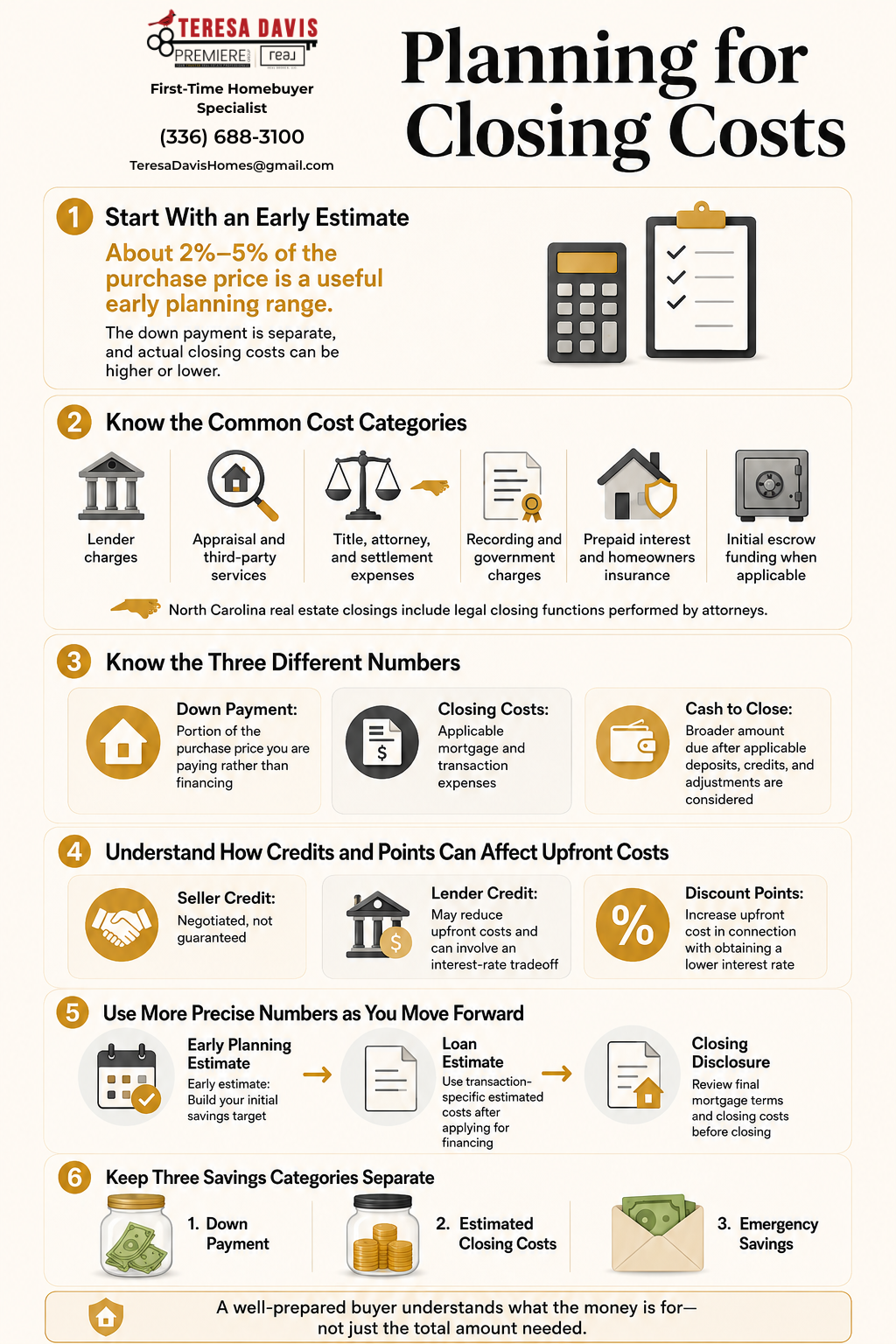
Frequently Asked Questions
Are closing costs separate from my down payment?
Yes. Your down payment and closing costs are separate parts of the transaction.
Your down payment is the portion of the home's purchase price that you are paying rather than financing with your mortgage. Closing costs are the expenses associated with obtaining the mortgage and completing the purchase, such as applicable lender charges, third-party services, title or attorney expenses, recording charges, prepaids, and initial escrow funding.
Both can affect the amount of money you need to complete the purchase, but they serve different purposes. Your final Cash to Close is broader than either number by itself. It can reflect your down payment and closing costs while also accounting for deposits already paid, seller credits, lender credits, and other applicable transaction adjustments.
What fees are usually included in buyer closing costs?
Closing costs can include several categories of expenses, and not every buyer will have every charge. Depending on the mortgage and transaction, your costs may include:
- lender origination or related loan charges;
- appraisal or other required third-party services;
- title examination, title insurance, attorney, or settlement-related expenses;
- recording or government-related charges;
- prepaid interest;
- homeowners insurance premiums;
- initial escrow funding for applicable property taxes and insurance; and
- other transaction-specific charges.
The best way to understand your own costs is to review the individual charges on your Loan Estimate and ask about anything you do not recognize.
How much should I budget for closing costs?
For early planning, a broad estimate of roughly 2% to 5% of the purchase price can provide a useful starting point, but it should not be treated as a guaranteed amount.
Actual closing costs can be higher or lower depending on your mortgage, lender, purchase price, property, insurance, taxes, service providers, loan structure, credits, and other transaction details.
Once you apply for financing, use your Loan Estimate instead of continuing to rely primarily on a generic percentage. It provides a transaction-specific estimate based on the financing being offered.
Can the seller or lender help pay some of my closing costs?
Possibly, depending on the transaction and your financing. A buyer may negotiate for a seller credit or concession toward eligible closing expenses. Whether the seller agrees depends on the offer and negotiation, and the amount that can be used may also be affected by mortgage-program requirements and other transaction considerations.
A lender credit may also reduce some upfront closing costs. However, lender credits can involve a tradeoff, such as accepting a higher interest rate compared with another available loan structure.
Neither seller credits nor lender credits should be assumed to be free money or guaranteed. Your REALTOR® can help you evaluate seller-credit strategy as part of the offer, while your lender can explain what your financing permits and how the credit affects your mortgage.
Why is my Cash to Close different from my closing costs?
Because Cash to Close includes more than closing costs alone. Closing costs represent the applicable charges and expenses associated with the mortgage and transaction. Cash to Close is the broader calculation of the money you are expected to bring to closing.
Depending on your transaction, the calculation can reflect:
- your down payment;
- closing costs;
- deposits or other amounts already paid;
- seller credits;
- lender credits; and
- other applicable adjustments.
That is why the amount labeled Closing Costs on your mortgage disclosures may not equal the amount labeled Cash to Close. Review both figures and ask your lender to explain how your final Cash to Close was calculated.
What Happens Next?
Once you understand the major categories of closing costs, the next step is to think about where the money for your home purchase can come from.
Your own savings may be one source, but depending on your mortgage program and circumstances, other permitted sources may also be available. One of the most common questions first-time buyers have is whether money received from a family member or another eligible donor can be used toward the purchase.
Gift funds have documentation and eligibility requirements that can vary by mortgage program, so it is important not to assume that money transferred into your account will automatically be acceptable to the lender.
The next Academy lesson explains what gift money is, how lenders generally document it, and why you should discuss the gift with your lender before funds are transferred whenever possible.
See Next Question below: Can I use gift money for my down payment?
Ready to Take the Next Step?
Understanding closing costs early can help you prepare for the complete financial picture rather than focusing only on the down payment. If you are considering buying a home in Davidson, Randolph, Guilford, Forsyth, or a surrounding North Carolina county, you can get help understanding both the real estate transaction and the mortgage process at the pace that makes sense for you.
Contact Teresa Davis
If you have questions about the North Carolina homebuying process, transaction expenses, offer strategy, or how the different parts of a purchase fit together, you can contact Teresa Davis.
Teresa Davis - REALTOR® / Professional Real Estate Advisor
PREMIERE Group of Real Broker LLC
Start the One Real Mortgage Pre-Approval Process
When you are ready for transaction-specific mortgage information, the pre-approval process can help you better understand your financing options, estimated loan costs, and the amount of cash you may need for your purchase. Using One Real Mortgage is optional and is not required in order to work with Teresa Davis as your REALTOR®.
Teresa Davis - Loan Originator NMLS #2597433
One Real Mortgage
Mortgage qualification, loan programs, terms, costs, and final approval depend on the borrower, property, transaction, documentation, underwriting, and applicable lending requirements. Beginning a pre-approval process does not guarantee financing or require you to purchase a home. It is a practical way to learn more about your potential financing options, estimated payment, and possible next steps.
Ready for the next lesson? Use “Next Question” below to continue to "Can I use gift money for my down payment?".
2:11 - Can I use gift money for my down payment?

If someone has offered to help with your down payment, that gift could make buying a home more attainable. Many mortgage programs allow eligible gift funds to be used toward some or all of the money needed for a down payment, but the rules are not the same for every loan or transaction.
Mortgage lenders generally need to know who is providing the money, whether that person or organization is an eligible donor, and whether the funds are truly a gift rather than money you are expected to repay. The lender may also require a gift letter and documentation showing where the money came from and how it was transferred.
Because those requirements can affect how the gift should be handled, it is important to tell your lender about the planned gift before the money is moved. A little coordination early in the process can make it easier to document the funds properly and avoid unnecessary questions during mortgage underwriting.
Quick Answer
Yes. Gift money can often be used for some or all of your down payment, depending on your mortgage program, property type, transaction, and the source of the gift.
The lender will generally need to confirm that the donor is eligible, document that repayment is not expected, and verify the source and transfer of the funds. In some mortgage programs, qualifying gift funds may also be used toward approved closing costs or other permitted cash requirements.
The safest approach is to speak with your lender before the donor transfers any money. Your lender can explain exactly who may provide the gift, what documentation is required, and how the funds should be transferred for your particular mortgage.
At a Glance
- Gift funds can often be used toward a homebuyer's down payment.
- Some qualifying transactions may allow the entire down payment to come from eligible gift funds, while others may require the buyer to contribute some of their own money.
- The person or organization providing the gift must meet the requirements of the applicable mortgage program.
- A lender will typically require documentation showing that the money is a genuine gift and is not expected to be repaid.
- A gift letter may be required to document the donor, the amount of the gift, the relationship or qualifying source, and the no-repayment expectation.
- The lender may need documentation showing where the money came from and how it was transferred.
- Gift funds may sometimes be used for approved closing costs or other permitted transaction expenses in addition to the down payment.
- Buyers should talk with their lender before moving gift money so the transfer can be handled and documented correctly.
- Receiving gift funds does not replace the normal mortgage qualification review of income, credit, debt, assets, and overall affordability.
What Are Gift Funds?
Gift funds are money provided by an eligible person or organization to help you purchase a home. Depending on the mortgage program and transaction, the funds may be used toward some or all of your down payment and, in certain situations, other permitted homebuying costs.
For mortgage purposes, an important part of the word gift is that the money is not expected to be repaid. If someone gives you money but expects you to pay it back later, the lender may need to treat that arrangement differently because it could represent an additional financial obligation.
That distinction matters because your lender evaluates your debts, assets, income, and available funds when determining whether you qualify for a mortgage. An undisclosed loan from a relative or another person could affect that evaluation.
This does not mean accepting financial help is unusual or automatically creates a problem. Gift funds are an established source of money for many qualifying mortgage transactions. The key is making sure the gift follows the requirements of your particular loan program and is properly documented.
Can My Entire Down Payment Come From Gift Money?
Sometimes. A qualifying homebuyer may be able to use gift funds for the entire required down payment, while another buyer may be required to contribute some of their own funds. Whether you can use gift funds for all or part of your down payment can depend on factors such as:
- The mortgage program you are using.
- The type of property you are purchasing.
- Whether the home will be your primary residence.
- The structure of the transaction.
- Any minimum borrower-contribution requirements that apply to your loan.
This is why it is helpful to separate two different questions: How much is my required down payment? and Where is that money allowed to come from?
For example, you might qualify for a mortgage with a relatively small required down payment and also be permitted to use eligible gift funds toward that amount. In another transaction, the mortgage guidelines may require you to contribute some of your own money even though gift funds are still permitted for part of the purchase.
You should not assume that you personally have to save every dollar of the down payment. At the same time, you should not assume that a gift can automatically replace every dollar you would otherwise need. Your lender can determine the requirements that apply to your specific mortgage before you make plans around a particular gift amount.
Who Can Give Me Gift Money?
The answer depends on the mortgage program. Many mortgage programs permit gifts from certain family members or other qualifying personal relationships. Some programs may also allow funds from other approved sources, such as certain employers, nonprofit organizations, charitable organizations, or public entities.
However, not everyone who wants to contribute money will automatically qualify as an acceptable donor. The lender may consider:
- Who the donor is.
- The donor's relationship to you.
- Whether the donor has a financial interest in the sale.
- The mortgage program being used.
- How the gift will be documented and transferred.
Someone who is directly involved in the transaction, such as a party who may benefit financially from the sale, can be subject to different restrictions than an eligible personal donor.
Because donor requirements can differ among conventional, FHA, VA, USDA, and other mortgage programs, the safest approach is to tell your lender who wants to provide the gift before the money is transferred. Your lender can then confirm whether that donor is acceptable for your particular financing.
What Is a Mortgage Gift Letter?
A gift letter is documentation used by the lender to establish the nature of the funds being provided to you. The exact form and wording can vary by lender and mortgage program, but a gift letter commonly documents information such as:
- The donor's name.
- The donor's relationship to you or other qualifying connection.
- The amount of the gift.
- A statement that the money is being provided as a gift.
- Confirmation that repayment is not expected.
- Other information required by the applicable mortgage guidelines.
The gift letter helps the lender distinguish a legitimate gift from borrowed money or another financial obligation that has not been disclosed. You may be tempted to prepare your own letter before speaking with the lender, but it is generally better to ask the lender what documentation is required first. The lender may have a specific gift-letter form or particular information that must be included.
Completing the lender's required documentation from the beginning can reduce the chance that the donor will have to prepare additional paperwork later.
Why Does the Lender Need to Document the Gift Money?
Mortgage lenders need to verify the source of funds being used in a home purchase. When part of your money comes from a gift, the lender may need documentation showing both where the gift came from and how the money reached the transaction.
The exact documentation depends on the mortgage program, lender, donor, and method used to transfer the funds. Depending on the circumstances, documentation may include:
- Evidence of an electronic transfer from the donor.
- A copy of a donor check and documentation showing the corresponding deposit.
- Documentation showing that the donor transferred funds directly to the closing agent.
- Account records or other documentation requested by the lender to establish the source and transfer of the gift.
These requirements are not simply about proving that money exists in an account. The lender also needs to determine whether the funds are an acceptable source for the mortgage transaction and whether an undisclosed debt or other financial obligation is involved.
For that reason, receiving a large deposit and then explaining it afterward can sometimes create more documentation than coordinating the gift with your lender from the beginning.
Talk With Your Lender Before the Money Is Transferred
One of the most useful steps you can take is to tell your lender about a planned gift before anyone moves the money. Your lender can explain:
- Whether the proposed donor is eligible.
- Whether the amount can be used for the intended purpose.
- What gift documentation is required.
- Where the funds should be sent.
- How the transfer should be completed.
- What records you and the donor should keep.
Following those instructions can help create a clear documentation trail. Without guidance, a well-meaning donor might give you cash, transfer money through multiple accounts, send funds using a method that is difficult to document, or move the money before required documentation is completed.
Those actions do not necessarily mean the gift cannot be used, but they can make the lender's verification process more complicated. A simple conversation before the transfer can help you and the donor understand what will be needed.
Can Gift Funds Be Used for More Than the Down Payment?
Depending on the mortgage program and transaction, qualifying gift funds may be permitted for more than just the down payment. They may potentially help with approved expenses such as:
- The required down payment.
- Eligible closing costs.
- Certain prepaid expenses.
- Financial reserves when permitted by the applicable mortgage guidelines.
- Other allowable funds needed to complete the transaction.
The important word is allowable. The amount and permitted use of gift funds can vary depending on the mortgage program and your particular transaction.
This is especially important when you are calculating your total cash to close. Your down payment is only one part of the money you may need when purchasing a home. Closing costs, prepaid expenses, deposits, inspections, and other transaction expenses can also affect how much money you should prepare for.
If someone has offered to help you financially, tell your lender the amount of the proposed gift and what you expect the money to cover. That allows the lender to determine how the gift can be applied under your mortgage guidelines.
What Could the Gift-Fund Process Look Like?
Consider a simple example. Suppose you have been saving toward a home purchase, and an eligible donor offers to provide additional money to help with your down payment.
Instead of having the donor immediately transfer the funds, you first tell your lender about the planned gift. The lender reviews your mortgage program and confirms whether the proposed donor and gift are acceptable. You receive instructions for completing the required gift documentation and for transferring the money.
The donor follows those instructions, and the required records are provided to the lender. In this example, the gift does not determine whether you qualify for the mortgage. It simply becomes one properly documented source of funds used as part of the transaction. The exact process can look different for another buyer, which is why lender guidance should come before the transfer rather than after it.
Gift Money Is Only One Part of Financial Readiness
Receiving help with a down payment can reduce one of the financial hurdles involved in buying a home, but it does not replace the rest of the mortgage qualification process. Your lender will still evaluate factors that may include:
- Your income.
- Your employment or other qualifying income sources.
- Your credit history and credit profile.
- Your monthly debt obligations.
- Your assets.
- Your available funds.
- The mortgage payment and other housing expenses.
- Your overall ability to qualify under the applicable loan guidelines.
It is also wise to think beyond the amount required to complete the purchase. Owning a home can bring expenses after closing, including maintenance, repairs, utilities, insurance-related costs, and other ongoing responsibilities.
A gift may help you reach the amount needed for a down payment or other eligible purchase costs, but maintaining appropriate savings and understanding your ongoing housing budget can still be an important part of preparing for homeownership.
The goal is not simply to gather enough money to reach the closing table. It is to enter homeownership with a financing plan you understand and a financial foundation that supports the responsibilities that come afterward.
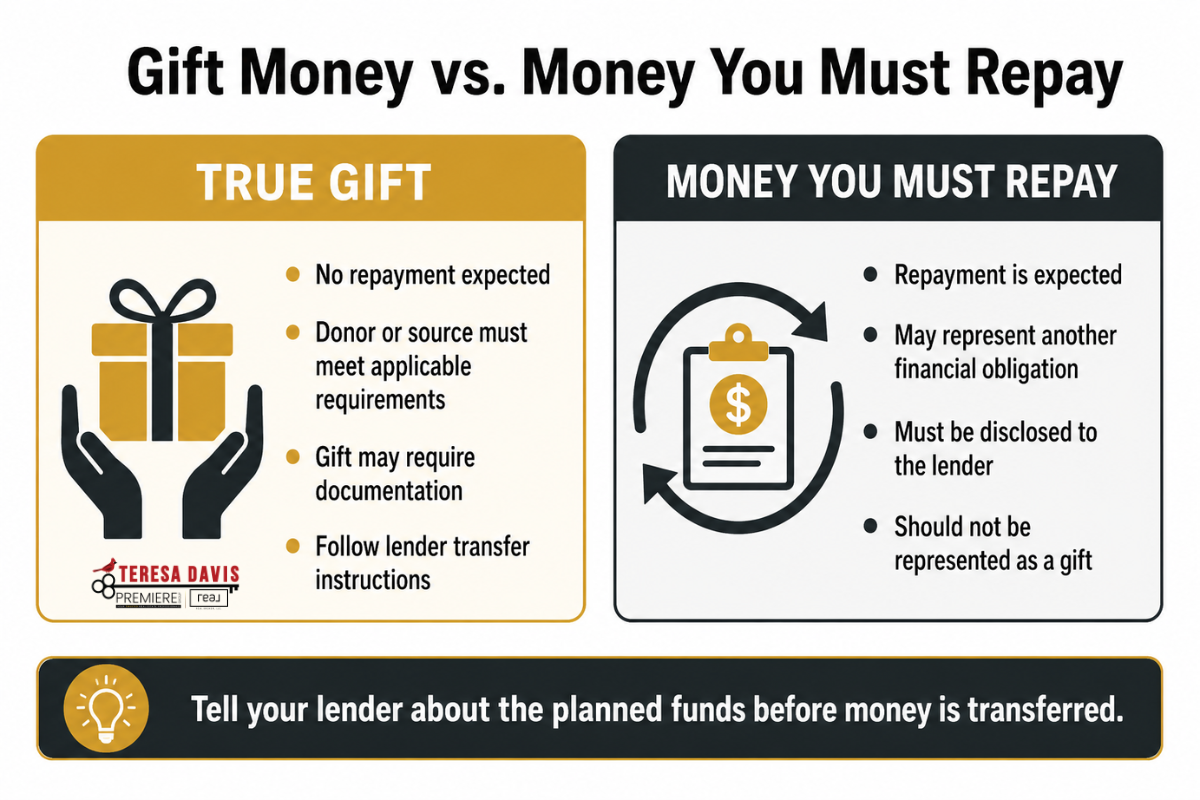
How Your REALTOR® Can Help You Plan Around Gift Funds
Gift funds are primarily a mortgage and underwriting matter, so your lender determines whether the proposed gift, donor, amount, and documentation meet the requirements of your financing. Your REALTOR® can still play an important role by helping you coordinate the real estate side of the purchase around that financing plan.
If gift funds will be important to your available cash, it is helpful to discuss that with your lender before you begin making offers. Knowing how much money you expect to have available—and when it will be available—can help you make informed decisions about your price range, deposits, closing costs, and other expenses connected with the transaction.
Your REALTOR® can also help you understand when different expenses may occur during the homebuying process. Some costs may be due before closing, while other funds are collected later as part of the closing process. Knowing the timing can help you avoid assuming that all of your available money will be needed at the same time or for the same purpose.
As the transaction moves forward, your REALTOR®, lender, and closing professionals may need to coordinate around important dates and funding requirements. Clear communication among everyone involved can help reduce last-minute surprises.
The lender remains responsible for determining whether the gift funds satisfy mortgage requirements. Your REALTOR®'s role is to help you understand the purchase process, transaction timing, and how your financing plan connects with the real estate decisions you are making.
Teresa’s Professional Insight
If you think someone may help you with your down payment, bring that up early—even if you have not decided exactly how much the gift will be. One of the most avoidable problems I see in financial preparation is waiting until a transaction is already moving quickly before asking how money should be documented. A donor may have every intention of helping, but transferring funds first and asking questions afterward can create unnecessary paperwork or delays.
As both a REALTOR® / Professional Real Estate Advisor with the PREMIERE Group of Real Broker and Loan Originator NMLS #2597433 with One Real Mortgage, I encourage buyers to look at the real estate and financing pieces together. Before you depend on gift money as part of your buying plan, make sure you understand whether the proposed gift is acceptable for your mortgage and what steps need to happen before the funds are moved.
For buyers preparing to purchase in Davidson, Randolph, Guilford, Forsyth, or surrounding North Carolina counties, early coordination can make the process easier to understand and help you plan your available funds more confidently.
Helpful Tip
Ask your lender for gift-fund instructions before the donor transfers the money. Find out who may provide the gift, what documentation is required, how the money should be transferred, and what records should be kept. Following the lender's process from the beginning is generally much easier than trying to recreate the documentation trail after the money has already moved.
Keep in Mind
Gift money can be a valuable part of your homebuying plan, but the rules are specific to the mortgage program and transaction. A few important points to remember:
- A true gift is different from money that you are secretly expected to repay.
- An acceptable donor under one mortgage program may not automatically be acceptable under another.
- The lender may need to verify both the source of the money and the way it was transferred.
- Gift funds may help with certain purchase expenses, but they do not replace the rest of the mortgage qualification process.
- Do not assume that a particular donor, amount, or transfer method will be acceptable until your lender confirms the requirements for your loan.
If you or the person providing the gift has questions about possible tax consequences or reporting requirements, consult a qualified tax professional. Mortgage and real estate professionals can explain the homebuying process, but individualized tax guidance should come from the appropriate tax advisor.
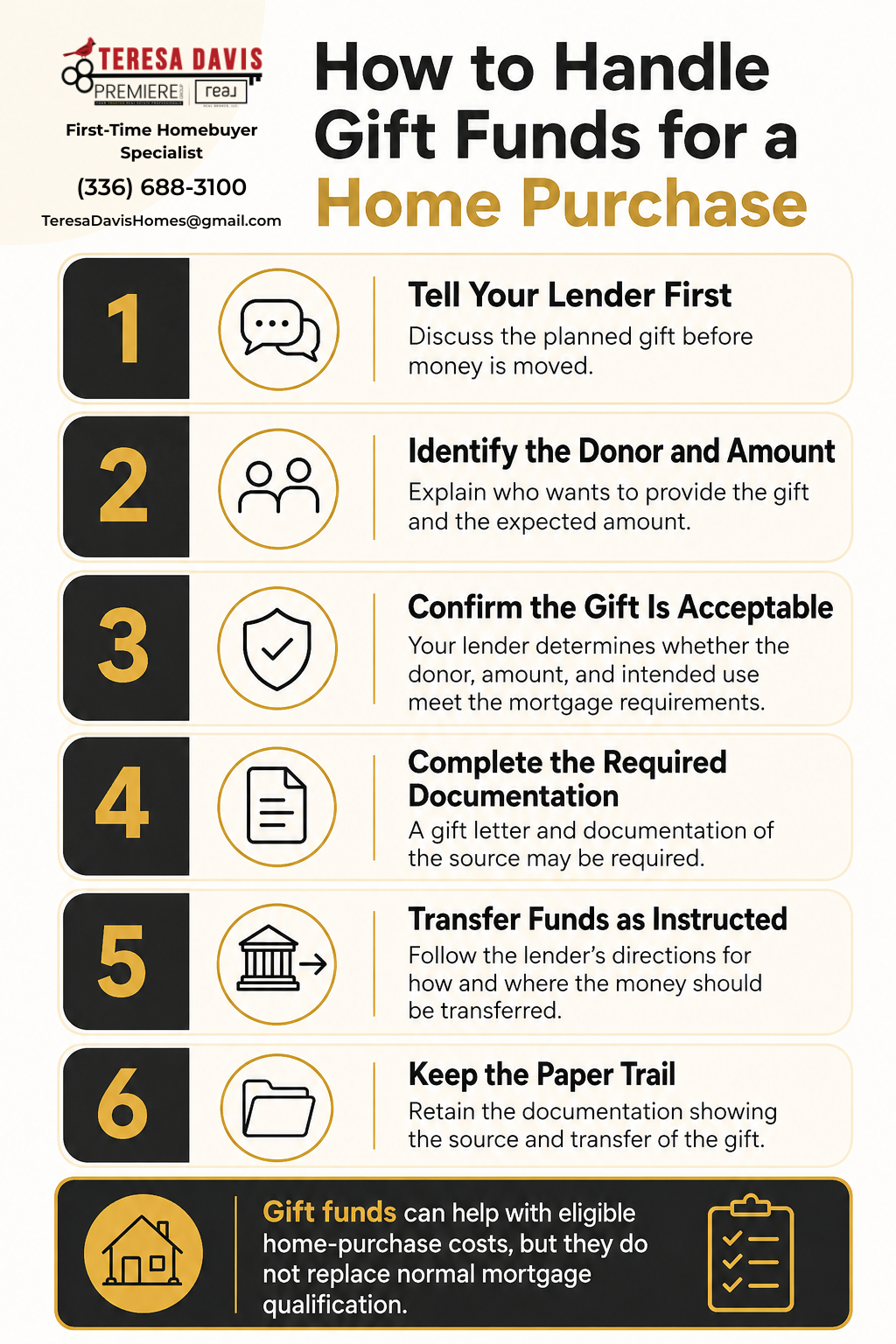
Frequently Asked Questions
Can my entire down payment come from gift money?
Possibly. Some qualifying mortgage transactions may allow eligible gift funds to cover the entire required down payment, while other transactions may require you to contribute some of your own funds. The answer depends on factors such as your mortgage program, property type, occupancy, and transaction structure. Your lender can determine the borrower-contribution requirements that apply to your loan.
Who is allowed to give me gift money for a mortgage?
Eligible donors vary by mortgage program. Certain family members and other qualifying personal relationships may be acceptable under applicable guidelines, and some mortgage programs may permit additional approved sources. Because the rules are not identical for every loan, confirm that the proposed donor is eligible before the money is transferred.
What is a gift letter for a mortgage?
A gift letter documents important information about the money being provided to you. It commonly identifies the donor, the amount of the gift, the donor's relationship or qualifying connection to you, and confirms that repayment is not expected. Your lender may provide a specific form or require particular information, so ask what is needed before preparing the letter.
Does the gift money have to be in my bank account before closing?
Not necessarily. The permitted transfer process depends on the mortgage program and lender requirements. In some qualifying transactions, gift funds may be transferred to the borrower, while another acceptable process may allow properly documented funds to be sent directly to the closing agent. Follow your lender's instructions so the source and transfer of the money can be documented correctly.
Can gift money also be used for closing costs?
In some mortgage transactions, yes. Eligible gift funds may be permitted for approved closing costs or other allowable transaction expenses in addition to the down payment. The permitted uses and amounts depend on your mortgage program and specific transaction, so your lender should confirm how the gift can be applied.
What Happens Next?
Once you understand how gift funds may fit into your homebuying plan, the next step is preparing the financial information your lender will need to evaluate your mortgage application.
Pre-approval commonly involves documentation related to your income, employment, assets, debts, and other financial information. If gift funds will be part of your purchase, your lender may also explain what additional documentation will be required for those funds.
Organizing these documents early can make the mortgage process easier to understand and help you respond more efficiently when your lender requests information. Next, continue to the Next Question below What documents do I need to get pre-approved for a mortgage? to learn what you may want to begin gathering.
Ready to Take the Next Step?
If you are preparing to buy a home and someone may be helping with your down payment, you do not have to figure out how the real estate and financing pieces fit together on your own. I can help you understand the homebuying process and discuss the next steps for preparing for a purchase in Davidson, Randolph, Guilford, Forsyth, and surrounding North Carolina counties.
Contact Teresa Davis if you have questions about preparing for a home purchase or want help planning the real estate side of your next steps.
Teresa Davis
REALTOR® / Professional Real Estate Advisor
PREMIERE Group of Real Broker LLC
Start the One Real Mortgage pre-approval process when you are ready to discuss your financing and determine how proposed gift funds may fit into your specific mortgage. Using One Real Mortgage is optional and is not required in order to work with Teresa Davis as your REALTOR®.
Teresa Davis
Loan Originator NMLS #2597433
One Real Mortgage
Mortgage qualification, loan programs, terms, costs, and final approval depend on the borrower, property, transaction, documentation, underwriting, and applicable lending requirements. Beginning a pre-approval process does not guarantee financing or require you to purchase a home. It is a practical way to learn more about your potential financing options, estimated payment, and possible next steps.
Ready for the next lesson? Use “Next Question” below to continue to "What documents do I need to get pre-approved for a mortgage?".
2:12 - What documents do I need to get pre-approved for a mortgage?

Getting pre-approved for a mortgage usually involves more than completing an application. A lender may need to verify the financial information being used to evaluate your ability to qualify, including your income, employment, assets, debts, credit history, and the funds you expect to use toward your home purchase.
For many first-time homebuyers, the document request can initially feel overwhelming. In practice, most requests fall into a few basic categories, and getting organized before you begin can make the process much easier. You may be asked for items such as recent income documentation, bank or investment account information, employment details, and records supporting other income or funds you want the lender to consider.
The exact checklist is not the same for every borrower. Your documentation can vary based on how you earn income, the assets you plan to use, your loan program, your lender's verification process, and the information identified during mortgage review. Some income, employment, or asset information may also be verified electronically with your authorization, which can reduce the number of documents you need to upload manually.
The goal is not to collect every financial document you own. It is to provide the information your lender needs to accurately evaluate your mortgage application and to be prepared for additional questions when something in your financial picture requires further documentation.
Quick Answer
To get pre-approved for a mortgage, you should generally be prepared to provide information or documentation that helps the lender verify your identity, income, employment, assets, debts, credit history, and available funds for the purchase.
Common documents may include recent pay statements, W-2 forms, bank or investment account statements, employment information, and documentation supporting other income or assets you want considered. Depending on your situation, the lender may also request tax returns, self-employment records, gift-fund documentation, explanations or records related to certain deposits or transfers, or other supporting information.
You do not necessarily need every item on a traditional mortgage checklist. Some lenders can verify certain income, employment, or asset information electronically. Your lender should tell you exactly what is required for your application.
A mortgage pre-approval is also not final loan approval. Additional or updated documentation may be requested later as you select a property and your loan moves through underwriting toward closing.
At a Glance
- Income and employment: Be prepared to document the income you want the lender to use when evaluating your mortgage application.
- Assets: The lender may verify bank accounts, investments, or other funds being used for your down payment, closing costs, or required reserves.
- Debts and credit: Your lender will generally obtain a credit report and may request additional information about financial obligations when clarification is needed.
- Special circumstances: Self-employment, gift funds, variable income, additional income sources, or certain deposits and transfers can require additional documentation.
- Electronic verification may help: Depending on the lender and your circumstances, some financial information may be verified electronically rather than through traditional paper documents.
- Requirements can change during the process: Pre-approval is an early financing step, and updated or additional documents may be requested before final loan approval.
- Organization matters: Keeping your financial records organized and using your lender's secure document-upload process can make responding to requests easier and more efficient.
Why Mortgage Lenders Ask for Documentation
A mortgage application includes information about your income, employment, assets, debts, and other parts of your financial picture. During pre-approval, the lender may need to verify that information rather than relying only on what was entered on the application.
The purpose of the documentation is to help the lender evaluate whether the information being used for the mortgage decision can be supported. Depending on your circumstances, the review may include:
- income you want considered for qualification;
- your employment or other sources of earnings;
- money available in bank, investment, or other eligible accounts;
- financial obligations that affect your overall monthly debt picture;
- credit history obtained through the lender's credit-review process; and
- funds you expect to use toward the home purchase.
This is one reason mortgage documentation can look different from one borrower to another. A buyer with straightforward salaried employment and established savings may have a different document request than someone who is self-employed, receives variable income, plans to use gift funds, or has money moving between several accounts.
The important point is that the lender needs enough information to evaluate your particular application. A general document checklist can help you prepare, but your lender's actual request is what controls what you will need to provide.
Income and Employment Documentation
For many borrowers, income and employment documentation represents a significant part of the pre-approval review. The lender generally needs to determine what income can be considered and whether it can be appropriately documented for the mortgage being evaluated.
If you receive wages or salary from an employer, commonly requested information may include items such as:
- recent pay statements;
- W-2 forms;
- employer information; and
- other documentation requested to verify the income being used for qualification.
That does not mean every borrower will be required to upload the same number or combination of documents. Depending on the lender, mortgage program, available verification systems, and your individual circumstances, some employment or income information may be verified through other approved methods.
If Your Income Is More Than a Regular Salary
Many homebuyers receive income from more than one source. Examples can include overtime, bonuses, commissions, retirement income, investment income, rental income, benefits, or another source the borrower wants considered.
Having an additional source of income does not automatically mean it can or cannot be used for mortgage qualification. The lender must determine whether the income meets the applicable requirements and what documentation is necessary to support it.
A practical approach is to tell your lender about all income you would like considered and allow the lender to identify what supporting information is needed. Do not assume that depositing money into your bank account makes it qualifying mortgage income. The lender may need to determine the nature, history, and documentation of that income before deciding whether it can be used.
Do I Always Need Tax Returns?
Tax returns are commonly associated with mortgage applications, but they should not be treated as a universal requirement for every borrower. Whether tax returns are needed can depend on factors such as:
- how you earn your income;
- whether you are self-employed;
- which income sources are being used;
- the mortgage program;
- the lender's verification method; and
- information identified during the application or underwriting review.
For example, a borrower whose qualifying income comes from self-employment may face different documentation requirements than a borrower whose qualifying income consists entirely of straightforward wages. If your lender does not request a particular document, you do not need to assume that something is missing simply because it appears on a generic internet checklist.
Asset Documentation: Showing the Funds Available to You
Income answers one financial question. Assets answer another. Your lender may need to verify funds that are relevant to the mortgage transaction, which can include money expected to be used for:
- the down payment;
- closing costs;
- other required purchase funds; and
- reserves when they are required for the particular mortgage.
Depending on the account and the verification method being used, this may involve bank statements, investment account information, or another approved form of asset verification. The lender is generally looking for more than an account balance. The review may also need to establish that the funds are available to you and that their source can be documented when required.
Bank Statements and Account Records
A common first-time-buyer question is, "How many bank statements will I need?" There is not one universal answer that applies to every mortgage application. The documentation period and type of account information required can vary based on the mortgage program, lender, verification method, account type, and underwriting findings.
Instead of trying to predict an exact number of statements, prepare by keeping your financial accounts organized and accessible. When your lender asks for a statement or account record, provide the complete requested document rather than assuming that a screenshot of the current balance contains everything needed.
If the lender uses an authorized electronic asset-verification process, you may not need to manually upload the same traditional account documents.
Why Deposits and Transfers Can Lead to Questions
Homebuyers often move money while preparing for a purchase. You might transfer savings between accounts, receive money from another person, sell an asset, receive a bonus, or deposit funds that are not part of your normal pattern.
A deposit or transfer is not automatically a mortgage problem. However, when the source of funds must be established, the lender may request documentation showing where the money came from. That is why keeping a clear record of significant financial transactions can be helpful.
For example, if you move money from one account to another, retaining the records showing the movement between the accounts may make it easier to respond if your lender later asks about the transaction.
Similarly, if someone plans to provide gift funds toward the purchase, discuss that with your lender before relying on the money. Gift funds can have specific documentation requirements depending on the mortgage being used.
Avoid Creating Unnecessary Documentation Problems
You do not need to stop using your bank accounts while you are preparing to buy a home. Normal financial activity continues. However, making unnecessary large transfers, moving funds repeatedly between accounts, or accepting money without keeping documentation can make the financial trail more complicated than it needs to be.
A simpler approach is to:
- keep purchase funds organized;
- retain statements and transaction records;
- keep documentation showing significant transfers when appropriate;
- tell your lender before relying on funds from another person; and
- ask before making a financial move if you are unsure whether it could create additional documentation requirements.
The goal is not to make your finances look a certain way. The goal is to make sure the lender can understand and document the financial information that is relevant to your application.
Debts and Financial Obligations
Your mortgage application is not evaluated only by looking at income and savings. The lender also reviews financial obligations that may affect your ability to qualify.
A credit report provides important information about many debts, but it may not answer every question. You may be asked for additional information when an obligation:
- does not appear clearly on the credit report;
- has recently changed;
- requires clarification;
- is being paid by another party;
- is expected to be paid off in connection with the mortgage; or
- otherwise needs supporting documentation for the lender's analysis.
You generally do not need to bring your own consumer credit report to the lender for mortgage pre-approval. The lender will typically obtain the credit information needed for its mortgage review after receiving the appropriate authorization.
If you know that something in your debt or credit history may require explanation, bringing it up early can be more useful than waiting for the lender to discover it later in the process.
What if the Information on My Application Changes?
The lender's review is based on the financial information available at that point in the mortgage process. If something changes, additional documentation may be necessary.
Changes that can affect the documentation process may include:
- starting or leaving a job;
- a change in the way you are paid;
- taking on a new financial obligation;
- paying off an existing obligation;
- receiving funds that will be used toward the purchase;
- moving substantial funds between accounts; or
- changing the source of your down payment or closing funds.
A change does not automatically mean you will no longer qualify. It does mean you should communicate with your lender so the updated information can be evaluated correctly. Keeping the lender informed is especially important after pre-approval because pre-approval is an early financing decision, not final loan approval.
Identification and Application Information
Mortgage documentation is not limited to paychecks and bank accounts. Your lender also needs enough identifying and application information to complete the mortgage review and connect the supporting documents to the correct borrower.
You should be prepared to provide information such as:
- your legal name and current contact information;
- identifying information required for the mortgage application and credit review;
- employment information;
- information about where you currently live and, when requested, your recent residence history; and
- other application details your lender needs for your particular mortgage.
Your lender may also request documentation to confirm your identity. Follow the lender's instructions rather than relying on a generic checklist, because the exact identification or application documentation requested can vary.
Sensitive information should be provided through the lender's approved secure process. Avoid sending documents containing Social Security numbers, account numbers, tax information, or other sensitive financial information through unsecured channels unless your lender specifically confirms that the method is appropriate.
When Your Financial Situation Requires Additional Documentation
Some mortgage applications are relatively straightforward. Others require a deeper review because the borrower's income, employment, assets, or funds do not fit neatly into a standard paycheck-and-savings-account profile.
Needing additional documentation does not mean there is necessarily a problem with your application. It often means the lender needs more information to determine how a particular income source, asset, obligation, or source of funds should be treated.
Examples of circumstances that may require additional documentation include:
- self-employment;
- irregular or seasonal income;
- commissions, bonuses, overtime, or other variable earnings;
- income from multiple sources;
- gift funds;
- retirement, rental, investment, or other income;
- recent changes in employment;
- significant deposits or transfers;
- funds coming from the sale of another asset; or
- other financial circumstances that need clarification.
The safest approach is to describe your financial situation accurately and allow your lender to tell you what documentation is required.
If You Are Self-Employed
Self-employed borrowers often need to document income differently from borrowers who receive traditional wages from an employer. Depending on the business structure, income history, mortgage program, and underwriting requirements, the lender may request documentation such as:
- personal federal income tax returns;
- business federal income tax returns when applicable;
- applicable tax schedules;
- business financial information; or
- other records needed to evaluate the income being used for qualification.
The exact requirements can vary substantially, so a self-employed borrower should not assume that a generic online checklist represents the lender's final document request. If you own a business or receive income through self-employment, discuss that with your lender early. Providing the lender with a clear picture of how you are paid can help identify the appropriate documentation before you are under pressure from a purchase timeline.
If You Plan to Use Gift Funds
Gift money can sometimes be used toward a home purchase when the applicable mortgage requirements permit it, but the funds may need to be documented. Depending on the mortgage and circumstances, your lender may need information showing:
- that the funds qualify as an acceptable gift;
- who provided the gift;
- the amount of the gift;
- the source of the funds; and
- evidence of the transfer when required.
Because requirements vary, talk with your lender before moving or depositing gift funds whenever possible. This is especially important if you are counting on the gift for your down payment or closing costs. Knowing the documentation requirements in advance can help you and the person providing the gift keep the necessary records.
Other Income You Want the Lender to Consider
A borrower may have income beyond a traditional salary. If you want another source of income considered for mortgage qualification, tell your lender about it rather than assuming the lender will automatically recognize it from your bank deposits or tax documents.
Depending on the income source, the lender may need to review its:
- amount;
- history;
- documentation;
- consistency; and
- expected continuation when applicable to the mortgage requirements.
The documentation appropriate for one income source may be very different from the documentation appropriate for another. This is why the most useful question is not simply, "What documents does every borrower need?" A better question is, "What documentation do you need for the income I want to use to qualify?"
Electronic Verification May Reduce the Paperwork
Mortgage verification does not always require a borrower to manually upload every traditional document. Depending on the lender, loan program, available technology, and your authorization, certain income, employment, or asset information may be obtained or assessed electronically through approved verification systems.
When electronic verification is available, your lender may ask you to authorize access to qualifying information rather than provide the same information through traditional paper statements or forms.
Electronic verification does not eliminate the lender's responsibility to evaluate the information. It changes how some of that information may be obtained or documented. You may still be asked for additional documents if:
- the electronic information is incomplete;
- something conflicts with the application;
- an income source or asset is not covered by the verification;
- the lender needs clarification; or
- underwriting identifies an additional documentation requirement.
For that reason, even borrowers who use electronic verification should keep their financial records organized and accessible.
Pre-Approval Documentation Is Different From the Information Needed for a Loan Estimate
Homebuyers sometimes hear that a lender cannot require pay stubs, W-2s, tax returns, or bank statements before providing a Loan Estimate and understandably wonder why those documents may still be requested during pre-approval. These are two different issues.
Federal mortgage disclosure rules identify specific information that triggers the lender's obligation to provide a Loan Estimate. Once the lender has the required application information, supporting documents such as pay stubs or W-2s are not a prerequisite to issuing that disclosure.
A mortgage pre-approval, however, is an evaluation of the borrower's ability to obtain financing based on the lender's process and the information available at that time. A lender may need documentation or verification of income, employment, assets, debts, and other financial information before issuing the type of pre-approval the lender provides.
In plain English: the documents a lender needs to evaluate your pre-approval are not the same thing as the minimum application information that triggers a Loan Estimate.
Why You May Be Asked for Updated Documents Later
Receiving a pre-approval does not mean the documentation stage of the mortgage process is finished. Your financial information can become outdated, and your circumstances can change between pre-approval and closing. As the mortgage progresses, the lender may request updated or additional information.
For example, the lender may need to confirm or update information concerning:
- employment;
- income;
- account balances;
- funds needed for the transaction;
- financial obligations; or
- other information relevant to final underwriting.
The specific documents and timing depend on the mortgage requirements and your circumstances. If your lender asks for something you already provided earlier, do not assume the request is a mistake. Ask what updated information is needed and provide the requested documentation through the lender's approved process.
Pre-Approval Is Not Final Loan Approval
A pre-approval can be an important step because it gives you an early understanding of the financing a lender may be willing to consider based on the information reviewed at that time.
It is not a guarantee that the mortgage will ultimately close. Final financing can depend on additional factors, including:
- continued verification of the borrower's financial qualifications;
- satisfactory underwriting;
- the property involved in the transaction;
- the mortgage program's requirements;
- updated information when required; and
- other conditions applicable to the loan.
This distinction is important when you begin shopping for homes. Treat the pre-approval as an important financing checkpoint, not permission to make significant financial changes without discussing them with your lender.
Create a Mortgage Document Folder Before You Need It
A simple organization system can make mortgage requests much easier to manage. Consider creating a secure digital folder with separate categories for:
- Income
- Employment
- Bank and Investment Accounts
- Other Assets
- Debts and Financial Obligations
- Gift Funds
- Tax Documents
- Additional Lender Requests
When you receive a new document that may be relevant, save it in the appropriate folder rather than waiting until your lender asks for it. When a lender requests a complete statement, provide the complete requested document rather than only the page showing the balance. Keep original PDF files when available, and do not alter financial records before submitting them.
If you transfer significant funds between accounts, retain records showing both sides of the transfer when available. If another person provides money toward the purchase, keep the documentation associated with that transaction and follow your lender's instructions.
Most importantly, protect your personal information. Use the secure document-delivery method provided or approved by your lender whenever you submit sensitive mortgage records.
The Best Checklist Is the One Your Lender Gives You
Mortgage document checklists are useful for getting organized, but they cannot account for every borrower's financial circumstances. Start by gathering the records you are most likely to need, including income, employment, asset, and other relevant financial information. Then let your lender refine the checklist based on your application.
If something about your finances is unusual, complicated, or difficult to document, mention it early. It is usually easier to address documentation questions during preparation than after you have found a home and are working against contract and closing deadlines.
The goal is not perfect paperwork. The goal is a complete, accurate, and well-documented mortgage application that gives the lender the information needed to evaluate your financing.
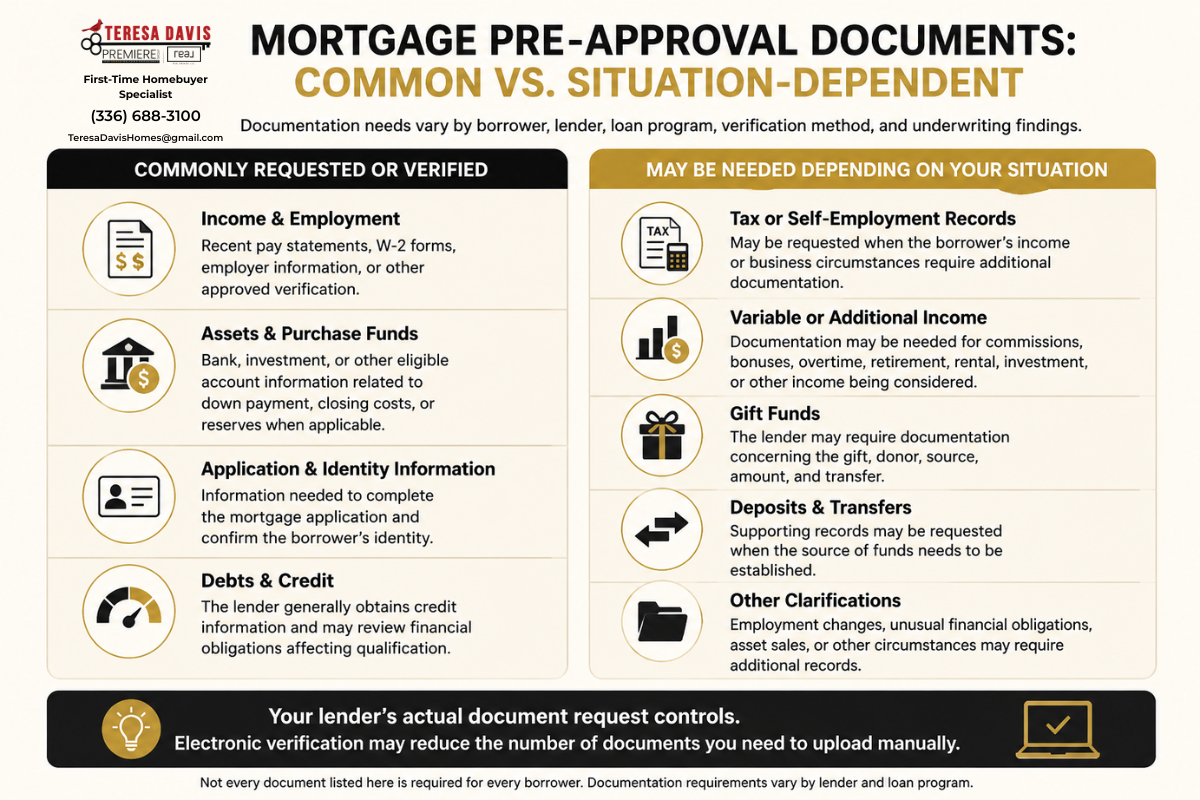
REALTOR® Guidance
Getting your mortgage documents organized before serious home shopping can help you understand whether your financing preparation is actually complete—not just whether an online calculator suggests that a certain price range may be affordable.
From the real estate side of the process, documentation readiness matters because financing questions can affect the timing and strength of your home search. Before you become focused on a particular property, it helps to know that your lender has reviewed the financial information needed for the level of pre-approval being provided.
A REALTOR® can help you coordinate the home-search process with your financing timeline, but mortgage underwriting and document requirements belong with your lender or Loan Originator. If your lender asks for additional documentation, needs clarification about income or assets, or identifies a financing issue, address those questions directly with the mortgage professional handling your application.
Being prepared can also help when a property requires timely decisions. If you already know what documentation your lender needs and you have your records organized, you are in a better position to respond promptly without trying to locate important financial documents while you are also evaluating a home.
For buyers in Davidson, Randolph, Guilford, Forsyth, and surrounding North Carolina counties, the goal is to coordinate mortgage readiness with the home-search timeline so financing preparation and property decisions support each other.
Teresa’s Professional Insight
One of the most useful things you can do before beginning a serious home search is to be open about anything in your financial picture that may require extra documentation. You do not need to gather every mortgage document imaginable. You need to organize the documents that apply to your situation and make sure your lender understands how you earn your income, where your purchase funds are coming from, and whether anything has recently changed.
If you are self-employed, receive variable income, plan to use gift funds, have recently moved significant amounts of money, or have another circumstance that may need explanation, discussing it early can give your lender time to identify the appropriate documentation before you are working against a purchase or closing timeline.
As both a REALTOR® / Professional Real Estate Advisor with PREMIERE Group of Real Broker LLC and a Loan Originator NMLS #2597433 with One Real Mortgage, I see value in keeping the financing conversation and the home-search process coordinated. A well-organized buyer can focus more clearly on evaluating homes because important financing questions are being addressed alongside the search rather than after an offer is already on the table.
Pre-approval does not guarantee final mortgage approval, and individual documentation requirements depend on the borrower, lender, loan program, underwriting findings, and transaction.
Helpful Tip
Create your mortgage document folder before you begin serious home shopping rather than waiting until you find a house you want to buy. Organize documents into simple categories such as income, employment, bank and investment accounts, tax records, gift funds, and additional lender requests. Keep original PDF statements when available and use your lender's approved secure upload process for sensitive information.
When you begin the pre-approval conversation, consider asking: “Is there anything else about my income, assets, employment, or funds that I should document now?” That question can help identify special documentation needs early, when you have more time to address them.
Keep in Mind
A mortgage document checklist is a preparation tool—not a universal underwriting rule.
- Not every borrower will need the same documents.
- Tax returns are not automatically required in every mortgage application.
- Self-employed borrowers and borrowers with variable or nontraditional income may need additional documentation.
- Gift funds and certain deposits or transfers may require supporting records.
- Some income, employment, or asset information may be verified electronically instead of through traditional paper documents.
- Your lender may request updated or additional records later in the mortgage process.
- A pre-approval is not final loan approval.
- Do not assume that a document is unnecessary because it was not requested at the beginning of the process.
- Do not alter financial statements or other records before submitting them.
- Protect sensitive financial information by using the secure document-delivery method approved by your lender.
Mortgage requirements vary by borrower, lender, loan program, underwriting findings, and transaction. This lesson provides general homebuyer education and is not individualized financial, legal, or tax advice.
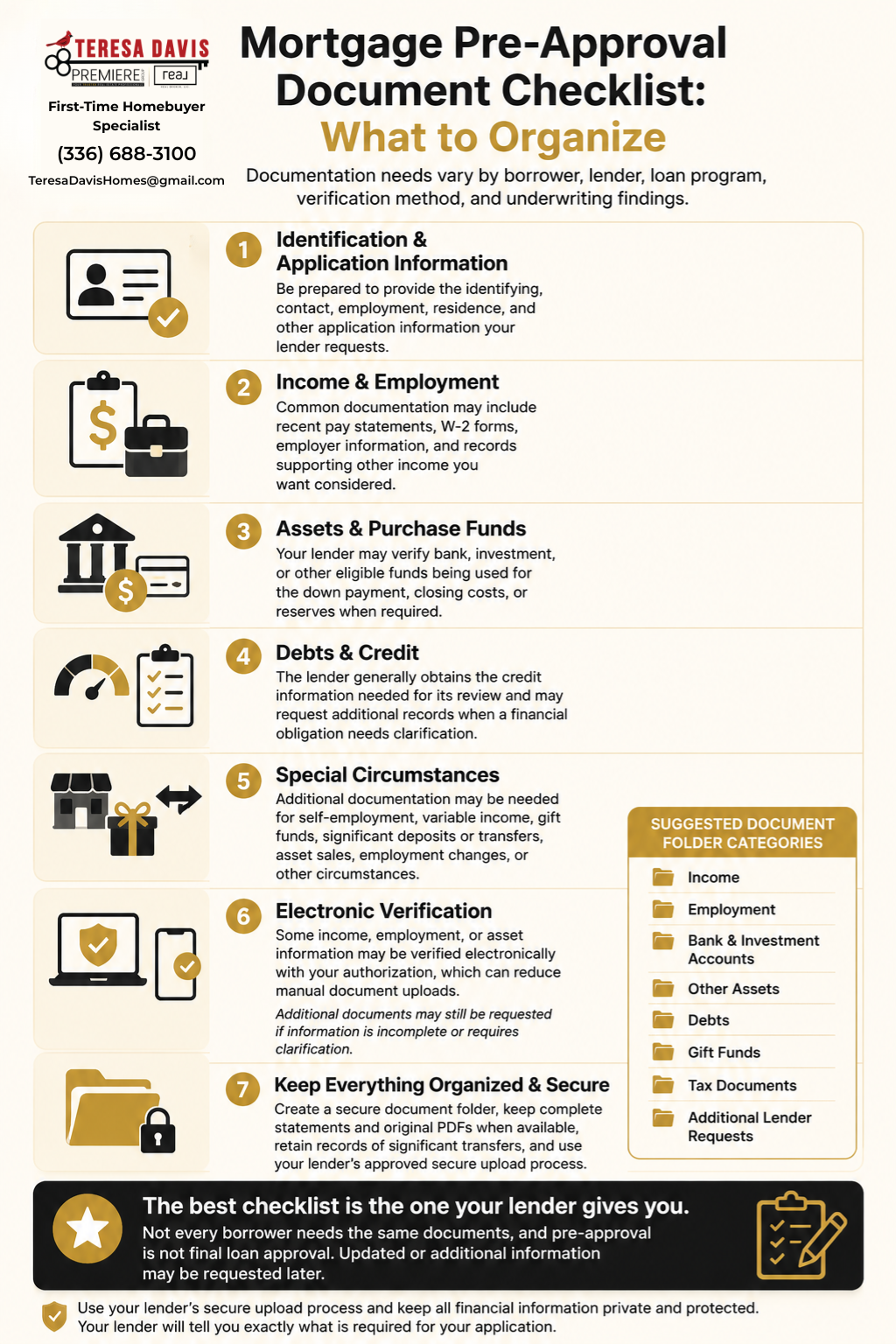
Frequently Asked Questions
Do I need tax returns to get pre-approved for a mortgage?
Not every borrower is required to provide tax returns for mortgage pre-approval. Whether they are needed can depend on how you earn your income, whether you are self-employed, which income sources you want considered, the loan program, the lender's verification method, and underwriting requirements. Follow your lender's specific documentation request rather than assuming that every item on a generic mortgage checklist applies to you.
How many bank statements do I need for mortgage pre-approval?
There is not one universal number that applies to every borrower or mortgage. The lender may request account statements or use another approved method to verify assets, and the documentation period can vary according to the loan program, account type, lender process, verification method, and underwriting findings. When statements are requested, provide the complete documents requested rather than only screenshots showing account balances.
What documents do I need if I am self-employed?
Self-employed borrowers may need additional documentation because the lender has to evaluate income differently from traditional wage income. Depending on the circumstances, requested records may include personal or business tax returns, applicable tax schedules, business financial information, or other records needed to evaluate the income being used for qualification. Your lender should identify the documents required for your specific business structure and mortgage application.
Do I need to provide documents for gift money or large deposits?
You may. Gift funds can have documentation requirements concerning the donor, amount, source, and transfer of the money, depending on the mortgage requirements. Certain deposits or transfers may also require supporting records when the lender needs to establish the source of funds. Discuss gift money or significant movement of purchase funds with your lender early and retain records that may help document the transaction.
Will I have to provide the same documents again after I am pre-approved?
Possibly. Pre-approval occurs before final underwriting and closing, so some financial information may need to be updated or verified again later. Your lender may also request additional documents if circumstances change or underwriting identifies another question. A request for an updated document does not necessarily mean something is wrong; it may simply mean the lender needs current information for the stage of the mortgage process you have reached.
What Happens Next?
Once your mortgage documents are organized, the next question is often whether you have enough money saved to begin the lender conversation. The next Academy lesson, How much should I have saved before talking to a lender?, explains why there is not one savings amount that every first-time homebuyer must reach before asking about mortgage options.
Speaking with a lender can help you understand how your available savings, expected down payment, closing costs, reserves when applicable, loan options, and overall financial profile fit together. You can then decide whether you are ready to move forward or whether building additional savings should be part of your preparation plan.
Ready to Take the Next Step?
If you are preparing to buy a home in Davidson, Randolph, Guilford, Forsyth, or a surrounding North Carolina county, you do not have to figure out the real estate and mortgage preparation steps separately. You can get your questions answered, organize the next steps, and decide when you are comfortable moving forward.
Contact Teresa Davis
If you have questions about coordinating your mortgage preparation with your home search, contact Teresa Davis, REALTOR® / Professional Real Estate Advisor with PREMIERE Group of Real Broker LLC and Loan Originator NMLS #2597433 with One Real Mortgage.
One Real Mortgage — Pre-Approval
When you are ready to have your individual financial information reviewed, you can begin the One Real Mortgage pre-approval process. Mortgage qualification and approval are subject to application, documentation, applicable loan requirements, underwriting, loan terms, and the specific transaction. Using One Real Mortgage is optional and is not required in order to work with Teresa Davis as your REALTOR®.
Ready for the next lesson? Use “Next Question” below to continue to "How much should I have saved before talking to a lender?"
2:13 - How much should I have saved before talking to a lender?

One of the most common reasons first-time homebuyers delay talking with a mortgage lender is the belief that they need to have a certain amount of money saved first. You may feel like you should already have your full down payment, closing costs, and a comfortable savings cushion in the bank before you ask a lender what your options are.
In reality, you generally do not need to reach one specific savings amount before having an initial conversation with a lender. Talking with a lender earlier can help you determine what your personal savings target may need to be instead of trying to guess on your own.
The amount you may ultimately need to purchase a home depends on several factors, including the price of the home, the type of mortgage you qualify for, the down payment required for that financing, closing costs, prepaid expenses, and other transaction-specific costs. Your available savings and the amount you want to keep available after closing also matter.
That is why it helps to separate two different questions: “Do I have enough saved to talk with a lender?” and “Do I have enough saved to complete a home purchase?” You do not have to have the second question completely answered before you begin asking the first.
For a first-time homebuyer, an early lender conversation can be part of the planning process. It can help turn a vague goal such as “I need to save more money” into a clearer understanding of what you may need to work toward before you are ready to buy.
Quick Answer
You do not need a specific amount of money saved before talking with a mortgage lender. You can have the conversation while you are still saving.
A lender can review your financial situation and help you understand what financing options may be available, what kind of down payment may apply, and what other funds you may need to prepare for. If you are not financially ready to move forward yet, the conversation can still give you a more realistic savings goal and a clearer plan.
The important distinction is that being ready to talk with a lender is not the same as being ready to close on a home. Before a purchase is completed, you may need funds for your down payment, closing costs, prepaid expenses, and other costs associated with the transaction. You may also want to preserve emergency savings rather than using every available dollar for the purchase.
Starting the conversation does not obligate you to buy a home, and it does not guarantee mortgage approval. It simply gives you better information for deciding what your next financial steps should be.
At a Glance
- You do not have to save a predetermined dollar amount before contacting a lender.
- An early lender conversation can help you establish a savings target based on your actual financial situation instead of an assumption.
- The amount you may eventually need depends on factors such as your mortgage, purchase price, down payment, closing costs, prepaid expenses, and other transaction details.
- Your down payment is only one part of the money you may need for a home purchase.
- Having limited savings today does not prevent you from asking questions and learning what you may need to work toward.
- Having more money saved can provide flexibility, but that does not automatically mean you should use all of your savings toward the purchase.
- A lender can help you understand the financing side of your plan, but mortgage qualification and final approval depend on your complete financial profile and the requirements that apply to your loan.
- The goal of the first conversation is not to have everything figured out—it is to get enough information to make a more informed plan.
You Do Not Need to Be “Fully Saved” Before You Talk With a Lender
Many first-time homebuyers assume the lender conversation should happen only after they have saved what they believe will be enough for a down payment and closing costs. That can put the steps in the wrong order.
An initial conversation with a mortgage lender can be part of your financial planning process. You can ask questions, discuss your goals, and learn what factors may affect your financing before you have accumulated every dollar you may eventually need for the purchase.
The purpose of starting the conversation early is not to rush into buying a home. It is to replace assumptions with information.
For example, if you decide on your own that you must save a certain percentage of a future purchase price before speaking with anyone, you could spend months working toward a target that may not reflect the financing options available to you. On the other hand, a lender may review your situation and determine that you need additional savings or other financial preparation before you are ready to move forward.
Either outcome gives you useful information. Instead of wondering, “Have I saved enough to be allowed to talk with a lender?”, a more helpful question is: “Based on my finances and my homebuying goals, what should I be working toward?” That is a question you can ask before you are ready to purchase.
There Is No Single Savings Number That Works for Every Buyer
There is no universal dollar amount that every first-time homebuyer must have saved before beginning the mortgage conversation. How much money you may eventually need depends on the details of your purchase and financing. Two buyers purchasing homes at similar prices could have different cash needs because their financial situations and mortgage structures are different.
Factors that can affect the amount you may need include:
- the price of the home you eventually purchase;
- the mortgage program and loan structure available to you;
- the down payment associated with that financing;
- closing costs;
- prepaid expenses and other transaction-related charges;
- credits or other permitted sources of funds that may apply to the transaction;
- your financial qualifications; and
- the amount of savings you want to keep available after closing.
This is one reason a percentage such as “20% down” should not automatically become your personal savings goal. Some buyers may choose or need to make a larger down payment, while others may qualify for financing that requires considerably less. Eligibility and requirements vary, so the appropriate target should be based on your circumstances rather than a general rule of thumb.
The goal is not necessarily to save the smallest amount possible. The goal is to understand your options well enough to make a decision that fits your overall financial situation.
Your Down Payment Is Only One Part of the Financial Picture
When buyers ask how much they should save, the conversation often begins with the down payment. That is important, but it is not the only expense to consider.
Depending on the transaction, money may also be needed for costs such as:
- closing costs associated with obtaining the mortgage and completing the transaction;
- prepaid homeowners insurance;
- prepaid property taxes or amounts collected for an escrow account;
- inspections and other due diligence expenses;
- appraisal-related costs when applicable; and
- other purchase expenses that arise before or at closing.
The exact amounts are transaction-specific, so you generally will not know the final cash requirement before you have selected a home and your loan is further along in the process. This is also why down payment and cash needed to close should not be treated as interchangeable terms. Your eventual cash requirement can include more than the amount you are putting toward the purchase price.
You also may have expenses that occur outside the closing itself. Moving costs, utility deposits, immediate household needs, repairs, furnishings, and other ownership expenses can affect how comfortable you feel financially after receiving the keys.
A strong homebuying plan therefore looks beyond the question, “Can I come up with enough money to close?”
It also considers: “What will my financial position look like after I become a homeowner?”
Keep Purchase Savings and Emergency Savings in Perspective
It can be tempting to view the entire balance in your savings account as money available for the home purchase. That may not reflect the way you want to manage your finances after closing.
Homeownership brings expenses that renters may not have been directly responsible for before. Appliances can fail, heating and cooling systems can need service, plumbing problems can arise, and ordinary maintenance becomes the homeowner’s responsibility.
For that reason, the amount you have saved and the amount you are comfortable using toward the purchase do not necessarily have to be the same number.
For example, if you have accumulated savings, part of your conversation with the lender can focus on how much may be needed for the transaction. Separately, you can consider how much money you want to keep available for emergencies and future homeownership expenses.
There is no single emergency-savings amount that is appropriate for every household. Your income stability, monthly obligations, property-related expenses, other financial resources, and personal comfort level all matter.
The important point is that qualifying to use money toward a purchase does not automatically mean using every available dollar is the right choice for you.
What a Lender Can Help You Clarify
A mortgage lender cannot know your exact final costs before all of the details of the eventual transaction are available. However, an early conversation can still help you develop a much more useful financial framework.
Depending on where you are in the process, a lender may be able to help you understand:
- what information will be reviewed when evaluating your mortgage qualifications;
- what financing options may be appropriate to explore;
- how different purchase-price or down-payment scenarios could affect your estimated cash needs;
- what additional expenses should be considered beyond the down payment;
- whether your current savings appear consistent with the type of purchase you are considering;
- whether additional saving may be advisable before moving forward; and
- what financial areas may need attention before you are ready for the next stage.
This does not mean the first conversation will produce a guaranteed purchase price, guaranteed loan approval, or final closing figure.
Instead, it can give you something many buyers do not have when they are saving on their own: a target based on their actual situation. If that target shows you are closer to being ready than you thought, you can begin considering the appropriate next steps.
If it shows that you need more time, you can use that information to create a more focused plan rather than continuing to save without knowing what you are trying to accomplish.
What If You Have Very Little Saved Right Now?
If your savings are still limited, you may assume there is no point in talking with a lender yet. That is not necessarily the case.
You do not need to be embarrassed about where you are starting. An initial lender conversation can help you understand whether your current savings may be enough for the financing you are considering or whether additional preparation is needed.
If more savings are necessary, the most useful information is not simply hearing, “You need more money.” You want to understand:
- approximately how much additional money you may need;
- what those funds are expected to cover;
- whether the goal relates primarily to a down payment, closing costs, reserves, or another requirement;
- whether there are other financial issues that should be addressed at the same time; and
- when it may make sense to review your situation again.
That can turn an uncertain goal into a more specific plan. For example, “I need to save more before I can buy” is difficult to act on because there is no defined finish line. A clearer goal such as “I need to strengthen my savings and then have my financing reviewed again” gives you a direction and a reason for the next step.
Having limited savings does not automatically mean you will qualify for a mortgage, nor does it mean that a particular low-down-payment option or assistance program will be available to you. Eligibility depends on the requirements that apply to your financial situation, the financing, and any program being considered.
The benefit of asking early is that you can learn what those requirements may mean for you before you make assumptions about your readiness.
What If You Already Have a Significant Amount Saved?
Having more money saved can give you additional flexibility, but the amount in your savings account is still only one part of the homebuying decision. You may have choices about how much money to use toward the purchase and how much to retain after closing. Those choices can affect your financial position as a homeowner.
For example, a larger down payment may reduce the amount you need to borrow, but that does not automatically mean putting every available dollar into the home is the best approach for your circumstances.
Before deciding how much of your savings to use, consider the broader picture:
- How much may be needed for the down payment?
- What should you expect for closing and transaction expenses?
- What funds do you want to keep available for emergencies?
- Are there anticipated moving, repair, maintenance, or household expenses?
- How much financial cushion would help you feel comfortable after closing?
The goal is not simply to prove that you have money available. It is to understand how your savings fit into the overall purchase.
A lender can help you evaluate financing scenarios, while you can decide what level of cash use feels appropriate within your broader financial plan.
Why Waiting for a “Perfect” Savings Number Can Work Against You
Saving before buying a home is important, but waiting for an arbitrary number can sometimes delay useful planning. A buyer might decide, for example, that homeownership cannot even be discussed until a certain percentage of the future purchase price has been saved. The problem is that the buyer may not yet know:
- what purchase price will be realistic;
- what financing options may be available;
- what down payment may apply;
- how much closing costs may add to the plan;
- whether additional reserves may be required or advisable; or
- how the buyer’s income, debts, credit, and other financial information affect qualification.
Without that information, the savings target may be based more on assumption than on the buyer’s actual financing picture. Talking with a lender does not mean you must immediately apply for every available loan, begin touring homes, or make an offer. It can simply help you determine whether your current plan makes sense.
There is an important difference between getting information early and buying before you are financially ready. The purpose of an early conversation is to help you prepare more intentionally.
You May Be Closer—or Farther Away—Than You Think
One reason the lender conversation can be valuable is that buyers often do not have enough information to accurately judge their own readiness. You might believe you are years away from buying because you assume you need substantially more cash than your financing may require.
Or you may believe you are ready because you have accumulated money for a down payment, only to learn that other areas of your financial profile need attention before mortgage approval is realistic.
Neither discovery should automatically be viewed as bad news. If you are closer than you expected, you can begin learning what the next stage of the process involves. If you need additional time, you can focus that time on the areas that actually matter instead of guessing.
A useful planning conversation should help answer more than: “How much money do I have?”
It should also help you understand: “What needs to be true financially before I am ready to move forward?”
When Should You Start the Lender Conversation?
There is no rule requiring you to wait until you are ready to make an offer on a home. For many first-time buyers, it can be helpful to begin asking questions while they are still in the preparation stage—especially if they are uncertain about their savings target, credit, debt, monthly-payment goals, or expected timeline.
An early conversation may be particularly useful if:
- you are actively saving but do not know what target to use;
- you are unsure whether your current savings are enough;
- you have heard conflicting information about down-payment requirements;
- you want to understand what your finances may support before setting a home-search budget;
- you are several months away from buying and want to know what to work on first; or
- you want to identify potential obstacles before you become emotionally invested in a particular home.
The appropriate timing for a formal mortgage application or pre-approval can depend on your circumstances and purchase timeline. But you do not have to wait for the formal application stage before asking educational and planning questions.
What to Have in Mind Before the Conversation
You do not need to calculate your own mortgage qualification before speaking with a lender. It is helpful, however, to have a general understanding of your current finances.
Before the conversation, consider gathering a simple snapshot of:
- approximately how much you currently have saved;
- your general income information;
- your recurring monthly debt obligations;
- your approximate homebuying timeline;
- the amount you currently spend on housing; and
- a monthly housing payment range that you believe may feel comfortable.
The lender may ultimately need more detailed documentation if you decide to proceed with mortgage qualification or pre-approval. At the early planning stage, however, the objective is to begin understanding how your finances fit together.
Being organized can make the conversation more productive, but you should not feel that you need to arrive with every answer already calculated.
Change the Question From “Am I Ready to Call?” to “What Should My Target Be?”
The most useful shift in thinking is moving away from this question: “How much money do I need before I am allowed to talk with a lender?”
Instead, ask: “Based on my finances and my homebuying goals, what should my savings target be?”
That change matters because the first question assumes you must prepare the entire plan before seeking professional guidance.
The second recognizes that professional guidance can help you build the plan. Your eventual savings goal may need to account for your down payment, closing costs, prepaid expenses, other transaction costs, and the money you want to preserve after closing. The specific amount will depend on your circumstances.
Once you understand those pieces, saving becomes more purposeful. You are no longer working toward an undefined idea of having “enough.” You are working toward a financial target that is connected to an actual homebuying plan. That is one of the most important reasons to start the conversation before you believe everything has to be perfect.
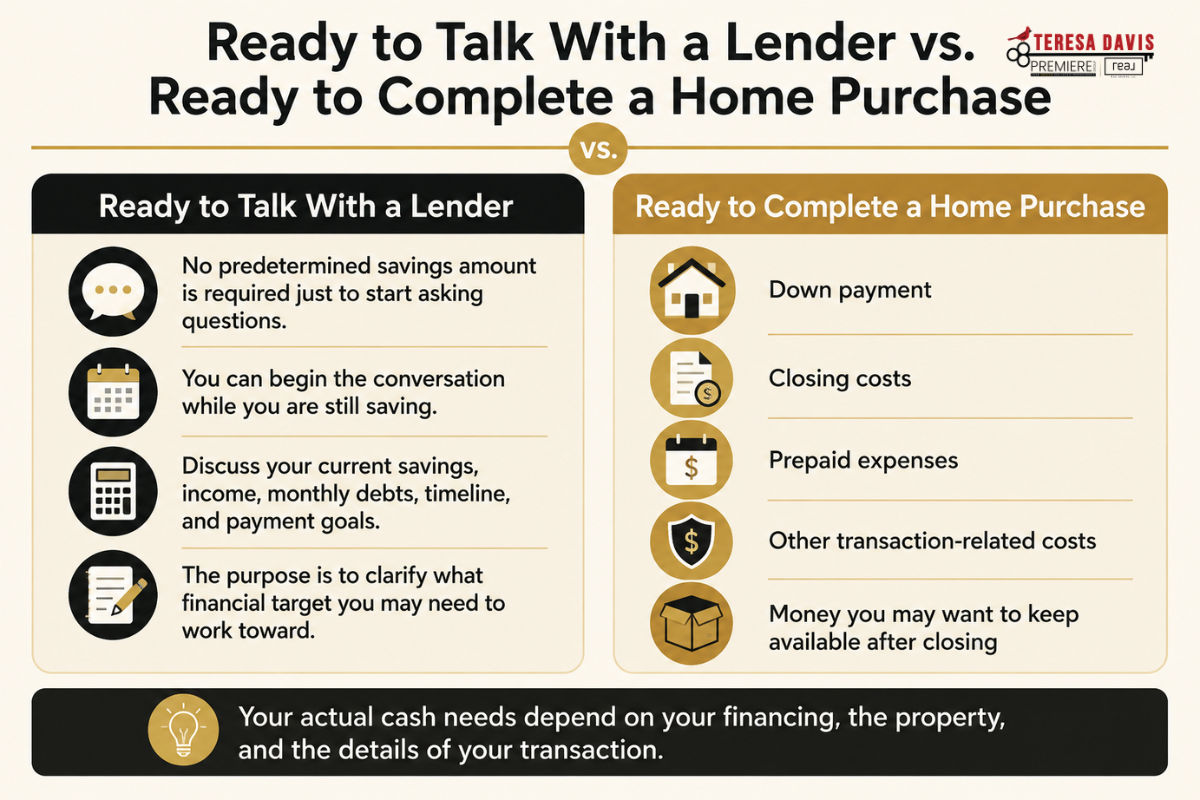
How Your REALTOR® and Lender Can Help You Build a Realistic Buying Plan
Your mortgage lender and your REALTOR® have different roles, but their guidance can work together to help you build a more realistic homebuying plan.
A lender evaluates the financing side of the purchase. That can include reviewing your income, debts, credit, available funds, and other financial information to determine what mortgage options may be available and what requirements may apply.
Your REALTOR® helps you understand how that financing picture connects to the homes you may actually consider. Once you have a clearer understanding of your price range, estimated cash needs, and monthly-payment considerations, your REALTOR® can help you evaluate properties and make decisions within those boundaries.
This coordination can be especially helpful for a first-time homebuyer because a mortgage pre-approval amount by itself does not answer every homebuying question. You also need to consider the expenses associated with the property, your personal comfort level, and how much money you want to have available after the purchase.
Understanding the financial framework before becoming emotionally attached to a particular home can help you approach the search more deliberately. You also have the right to choose the real estate professional and mortgage lender you want to work with. Educational guidance should help you understand your options and make informed decisions rather than pressure you toward a particular provider.
Teresa’s Professional Insight
Many first-time buyers believe they should wait to speak with a lender until they have everything completely figured out. In my experience, that belief can make the process feel more complicated than it needs to be.
You do not have to arrive at the first conversation already knowing exactly how much house you can afford, which mortgage is right for you, or precisely how much money you should save. Those are some of the questions the planning process is designed to help answer.
I encourage buyers to think of that first conversation as a planning conversation rather than a test. If you are financially ready, you can begin discussing the next steps. If you are not ready yet, learning what needs attention gives you something specific to work toward.
Because I work with homebuyers as a REALTOR® / Professional Real Estate Advisor with PREMIERE Group of Real Broker LLC and as a Loan Originator NMLS #2597433 with One Real Mortgage, I see how important it is for the financing plan and the home-search plan to make sense together. A price range may look reasonable on paper, but the real question is whether the overall purchase—including the expected monthly payment, upfront costs, and the money you want to keep available afterward—fits your goals.
For buyers throughout Davidson, Randolph, Guilford, Forsyth, and surrounding North Carolina counties, my goal is to help make those conversations understandable so you can move forward based on information rather than assumptions.
Helpful Tip
Before your first lender conversation, write down a simple snapshot of where you are today.
You may want to have a general idea of:
- how much you currently have saved;
- your income;
- your recurring monthly debts;
- what you currently spend on housing;
- your approximate timeframe for buying; and
- a monthly housing payment range that you believe may feel manageable.
You do not need to calculate your own mortgage qualification or determine your exact savings requirement before the conversation.
Instead, use this information to ask better questions. For example: “Based on where I am today, what financial goals should I work toward before I am ready to buy?” That question can give you a much more useful starting point than simply asking whether you have “enough” money saved.
Keep in Mind
Talking with a lender, completing a mortgage application, and receiving a pre-approval are different stages of the process. An early conversation does not guarantee mortgage approval, and even a pre-approval is not a guarantee that a loan will ultimately close.
Your financial circumstances, the property you choose, documentation, underwriting requirements, and other factors can affect final loan approval. Also remember that the amount you may qualify to borrow is not automatically the amount you should feel comfortable spending. Your own budget, financial priorities, emergency savings, and anticipated costs of homeownership should remain part of the decision.
Finally, try not to measure readiness only by the minimum amount of cash that may be required to complete a transaction. Buying a home is also about being prepared for the responsibilities that begin after closing.
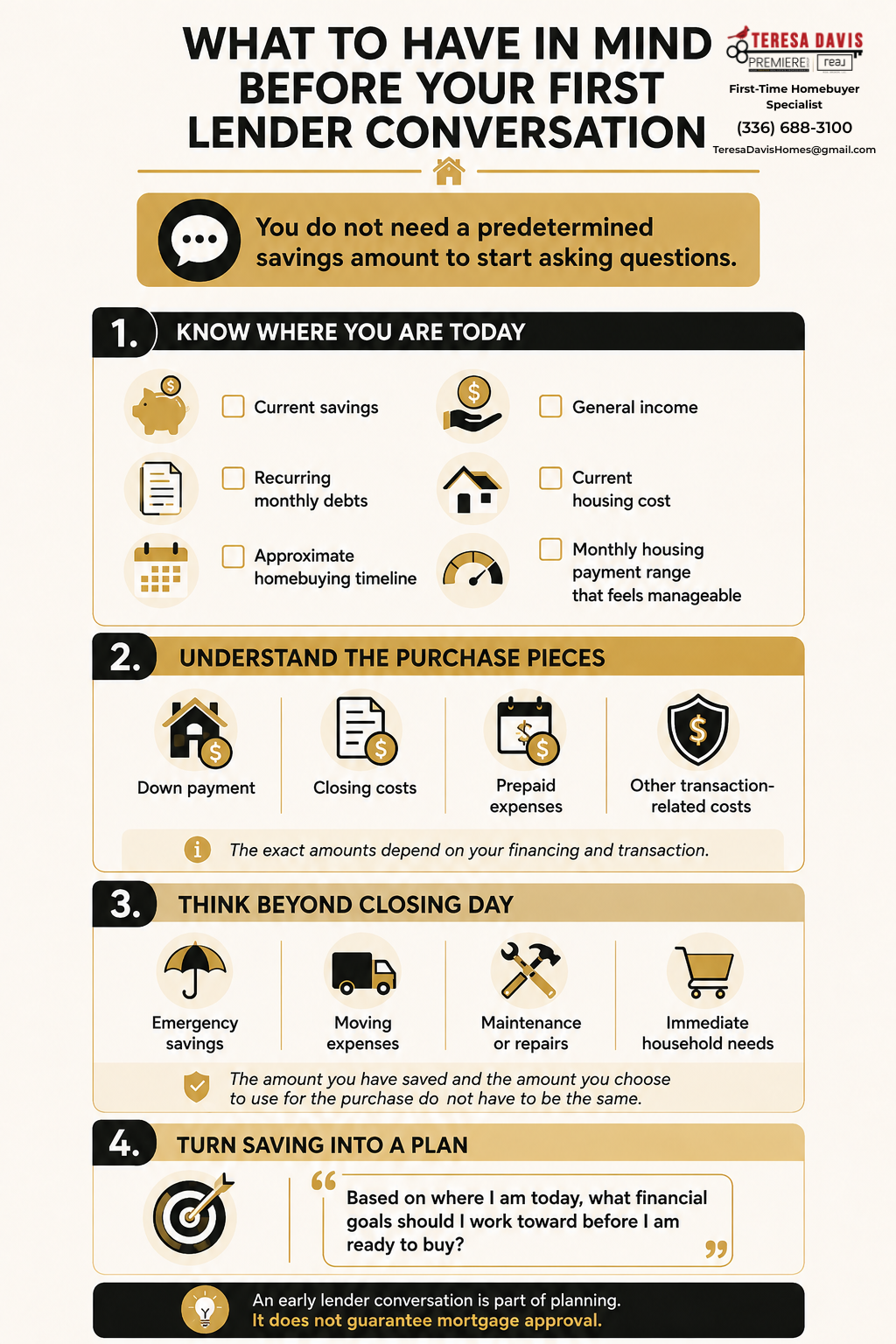
Frequently Asked Questions
Do I need to have my full down payment saved before talking to a lender?
No. You generally do not need to have your entire anticipated down payment saved simply to begin a conversation with a mortgage lender.
An early conversation can help you understand what financing options may be appropriate to explore and what down-payment requirements may apply to your situation. That information can help you establish a more realistic savings target.
You may ultimately need additional funds before you are ready to purchase, but you do not have to determine the complete amount on your own before asking questions.
Is it too early to talk to a lender if I am several months away from buying?
Not necessarily. If you are several months away from buying, an early lender conversation can help you identify financial goals before you reach the formal home-search stage. You may learn that you need additional savings, improvements to another part of your financial profile, or simply more time before pursuing pre-approval.
The appropriate timing for a formal mortgage application or pre-approval can depend on your situation and expected purchase timeline, but you can ask planning questions before you are ready to make an offer on a home.
What if a lender tells me I need to save more money before buying?
Ask for enough information to turn that recommendation into a specific preparation goal. You may want to understand approximately how much additional money is needed, what those funds are intended to cover, and whether there are other financial areas you should address before your situation is reviewed again.
Learning that you need more time does not make the conversation unsuccessful. It can give you a clearer plan and help you focus your savings on an identified goal instead of continuing to guess about how much you may need.
Should I use all of my savings for the down payment and closing costs?
Not automatically. The money available in your savings account and the amount you choose to use toward the purchase do not necessarily need to be the same.
In addition to your down payment and transaction expenses, consider the emergency savings and financial cushion you want to keep after closing. You may also have moving expenses, maintenance needs, repairs, utility costs, or other homeownership expenses after you receive the keys.
Your lender can help you understand the funds needed for the financing and transaction, while you can evaluate how much of your available savings you are comfortable committing to the purchase.
Can first-time homebuyer programs change how much money I need to save?
Potentially. Some financing or assistance programs may affect the amount an eligible buyer needs for a down payment or certain closing-related expenses. Eligibility, available benefits, program requirements, and permitted uses of funds vary.
Do not assume that a particular program will be available to you or that assistance will cover all of your purchase expenses. A lender or program administrator can help determine what options may apply to your circumstances.
The Teresa Davis Homebuyer Academy™ also covers North Carolina first-time homebuyer assistance separately so you can explore that topic in more detail without treating assistance as a substitute for a complete savings plan.
What Happens Next?
Once you begin talking with a lender or preparing for mortgage qualification, the next priority is protecting the financial profile you are working to establish. Changes that may seem routine in everyday life—such as taking on new debt, financing a major purchase, changing how you manage your available cash, or making other significant financial moves—can affect the information a lender uses when evaluating your mortgage.
That does not mean you should be afraid to make normal financial decisions. It means that once homebuying becomes an active goal, it is helpful to understand which changes should be discussed with your lender before you make them.
Next, we will look at What should I avoid doing before buying a home? so you can understand how to protect your progress as you move closer to mortgage pre-approval and a future home purchase.
Ready to Take the Next Step?
If you are wondering whether you have enough saved to begin the homebuying conversation, you do not have to determine the answer alone. Getting information early can help you understand what you may need to work toward and whether your current financial plan supports the next step.
Contact Teresa Davis
If you have questions about preparing to buy a home in Davidson, Randolph, Guilford, Forsyth, or a surrounding North Carolina county, you can contact Teresa Davis to talk through the homebuying process and the steps that may make sense for you.
Teresa Davis
REALTOR® / Professional Real Estate Advisor
PREMIERE Group of Real Broker LLC
Start the One Real Mortgage Pre-Approval Process
When you are ready to explore mortgage qualification, the pre-approval process can help you better understand your financing options, estimated purchase range, and the funds you may need for your home purchase. Using One Real Mortgage is optional and is not required in order to work with Teresa Davis as your REALTOR®.
Teresa Davis
Loan Originator NMLS #2597433
One Real Mortgage
Mortgage qualification, loan programs, terms, costs, and final approval depend on the borrower, property, transaction, documentation, underwriting, and applicable lending requirements. Beginning a pre-approval process does not guarantee financing or require you to purchase a home. It is a practical way to learn more about your potential financing options, estimated payment, and possible next steps.
Ready for the next lesson? Use “Next Question” below to continuem to "What should I avoid before buying a home?".
2:14 - What should I avoid doing before buying a home?

Buying a home involves more than getting financially prepared at the beginning of the process. Once you are preparing to apply for a mortgage—and especially after you have been pre-approved—it is important to keep your financial picture reasonably stable until closing.
That does not mean you have to stop living your normal life or avoid every financial decision. It does mean that significant changes to your credit, debt, employment, income, or available funds can sometimes affect the information your lender used to evaluate your mortgage qualification.
Actions that may seem unrelated to buying a home—such as financing a vehicle, opening a new credit card, changing jobs, moving a large amount of money between accounts, or making an expensive purchase—can create new questions for the lender or require additional documentation.
The goal is not to make you afraid to make financial decisions. It is to help you recognize which decisions are worth discussing with your lender before you act. A simple conversation ahead of time can help you understand whether a change is likely to affect your mortgage application and what documentation may be needed.
For first-time homebuyers in Davidson, Randolph, Guilford, Forsyth, and surrounding North Carolina counties, one of the most useful habits during the mortgage process is simple: when a significant financial change could affect your credit, debt, income, employment, or money available for the purchase, ask your lender before you make the change whenever possible.
Quick Answer
Before buying a home, it is generally wise to avoid making unnecessary major changes to your financial profile, particularly after you have applied for a mortgage or received a pre-approval.
Try to avoid taking on new debt, financing major purchases, substantially increasing credit-card balances, missing payments, opening or closing credit accounts simply to change your credit score, co-signing new debt, or making significant employment or income changes without first discussing the possible mortgage impact with your lender.
You should also be careful with large deposits and transfers between bank accounts. Moving money is not automatically a problem, but your lender may need to document where certain funds came from and verify that money being used for your home purchase is from an acceptable source.
Most importantly, do not assume that one financial change automatically means you cannot qualify for a mortgage. If something changes—or has already changed—tell your lender promptly and provide any requested documentation. Your lender can determine whether the change affects your particular loan.
A useful rule to remember is: ask before you act when a significant decision could change your credit, monthly debt, qualifying income, employment, or funds available for your home purchase.
At a Glance
- Avoid unnecessary new debt. Financing a vehicle, furniture, appliances, a personal loan, or another large purchase can add monthly obligations that may affect mortgage qualification.
- Keep making your existing payments on time. Do not intentionally skip bills or allow accounts to become late simply because you are trying to save more cash for the purchase.
- Be cautious about new credit. Avoid opening unnecessary credit cards or other accounts while preparing for or completing your mortgage.
- Do not make major credit-account changes based only on generic advice. Closing, opening, or significantly changing accounts may affect borrowers differently, so ask your lender before making the change.
- Discuss employment or income changes with your lender. A new job does not automatically prevent you from obtaining a mortgage, but changes in employment, pay structure, hours, or income may require additional review.
- Keep your money easy to document. Large deposits, cash deposits, or multiple transfers between accounts can create additional documentation requirements.
- Protect the funds you expect to use for the purchase. Avoid spending money needed for your down payment, closing costs, transaction expenses, or any required reserves.
- Do not hide financial changes. If something significant changes after pre-approval, tell your lender so your qualification can be reviewed using current information.
- Do not panic if you have already made a change. Contact your lender, explain what happened, and provide any documentation requested before assuming it has jeopardized your home purchase.
- When in doubt, ask before you act. Your lender can evaluate the potential effect of a financial decision based on your specific mortgage application and loan program.
Why Financial Stability Matters Before You Buy
When a lender evaluates your mortgage application, the decision is based on a financial picture that includes factors such as your credit history, monthly debts, income, employment, and assets. Those pieces work together to help determine whether you qualify for the mortgage and under what terms.
That is why financial preparation does not end when you receive a pre-approval. Information may need to be reviewed or verified again as your loan moves toward final approval and closing. If something important changes, your lender may need updated documents or may need to recalculate part of your qualification.
This does not mean your finances have to remain completely unchanged. You can continue paying bills, buying groceries, using your accounts, and handling normal expenses. The concern is generally with significant changes that could alter the financial information your lender is relying on.
For example, taking on a new monthly payment, substantially increasing a credit-card balance, changing the way you earn your income, or spending a large portion of the money you planned to use for your home purchase may require another look at your file.
The safest approach is to keep your financial picture as consistent as reasonably possible and communicate with your lender before making a significant change.
Avoid Taking On Unnecessary New Debt
One of the most important things to be cautious about before buying a home is taking on new debt.
A mortgage lender considers your existing monthly debt obligations when evaluating how much additional housing expense you may reasonably be able to carry. If you add a new monthly obligation after your application or pre-approval, the lender may need to include that payment when reevaluating your qualification.
Examples can include:
- financing a vehicle;
- taking out a personal loan;
- financing furniture or appliances;
- opening a retail financing account;
- substantially increasing debt on an existing credit card; or
- co-signing a new loan for someone else.
Co-signing deserves particular attention. Even when you are helping another person and expect that person to make the payments, the obligation may still need to be considered when your lender evaluates your mortgage file. This does not mean every new debt automatically prevents someone from obtaining a mortgage. The effect depends on factors such as the amount of the new payment, the buyer's income, existing obligations, loan program, and overall qualification.
The better question is not simply, “Can I afford this purchase?” It is also, “Could this new obligation affect the mortgage I am preparing to obtain?” If you are considering new financing while preparing to buy or while your mortgage is in process, ask your lender to review the potential impact before you sign the financing agreement whenever possible.
Be Careful With Large Purchases Before Closing
The advice to “wait until after closing to buy the furniture” may sound overly cautious, but there is a practical reason behind it. A major purchase can affect a mortgage application in more than one way.
If you finance the purchase, you may create a new monthly debt obligation. If you place a large amount on a credit card, the balance and required payment may increase. If you pay cash, you may reduce the amount of verified money available for your down payment, closing costs, other transaction expenses, or reserves that may be required for your particular loan.
Consider a buyer who has carefully saved money for a home and then decides to purchase new furniture before closing. The purchase itself is not automatically prohibited. The important question is whether paying for or financing that furniture changes any part of the financial picture the lender has already reviewed.
Large purchases can include more than furniture. Buyers should use the same caution before purchasing or financing items such as:
- vehicles;
- appliances;
- electronics;
- recreational equipment;
- expensive home furnishings; or
- other significant discretionary purchases.
There is also an important timing issue. An accepted offer does not mean the mortgage process is finished. The lender still has work to complete before final loan approval and closing.
When possible, wait until after the home has closed before making optional major purchases. If a significant purchase cannot wait, talk with your lender first so you understand whether it may affect your mortgage qualification or the funds available for your transaction.
Keep Paying Your Existing Bills on Time
While preparing to buy a home, continue managing your existing financial obligations responsibly. Trying to build your savings account by intentionally skipping a payment can create a much larger problem than the additional cash solves. A late payment may affect your credit profile, and an unpaid obligation can create questions that were not present when your mortgage application was originally reviewed.
Continue making required payments on time for obligations such as:
- credit cards;
- vehicle loans;
- student loans;
- personal loans; or
- other recurring debts.
It is also wise to be cautious about allowing revolving balances to increase substantially. A higher credit-card balance can change your credit utilization and may also change the minimum monthly payment associated with the account.
Your goal is not to achieve a perfect financial profile between application and closing. It is to avoid preventable negative changes while your lender is evaluating your ability to repay the mortgage.
If an unexpected financial hardship makes it difficult to keep an account current, communicate with your lender rather than assuming the issue automatically ends your opportunity to buy. Your lender can explain how the circumstances affect your particular mortgage application.
Think Carefully Before Opening or Closing Credit Accounts
Buyers sometimes receive conflicting advice about credit accounts before purchasing a home. One person may tell you to open another credit card to increase available credit. Someone else may tell you to close old accounts. Another source may suggest transferring balances or making several changes at once to try to improve a credit score quickly.
Generic advice like this can be risky because credit profiles are individual. Opening a new account may result in a new credit inquiry and create the possibility of additional debt. Closing an existing account may change the amount of credit available to you or otherwise affect your credit profile. Moving balances between accounts can also change how those balances appear.
For that reason, avoid making a major credit-account change solely because you believe it will improve your mortgage qualification. If you are actively preparing for a mortgage, ask your lender before you:
- apply for a new credit card;
- open a store account;
- request financing for a purchase;
- close an established credit account;
- transfer a significant balance between accounts; or
- make another substantial change intended specifically to affect your credit.
Your lender can review your actual mortgage situation and help you understand whether a proposed change is necessary or whether leaving your credit profile alone is the better approach. The important distinction is between responsibly managing the credit you already have and making unnecessary changes to your credit profile while your mortgage is being evaluated.
Talk With Your Lender Before Making a Significant Employment or Income Change
Employment and income are important parts of mortgage qualification, so a significant change in either area may require your lender to take another look at your application.
That does not mean you are required to remain in the same job simply because you are preparing to buy a home. People receive promotions, accept better opportunities, change careers, adjust work schedules, and experience other employment changes during the homebuying process.
A job change also does not automatically mean you will no longer qualify for a mortgage. What matters is how the change affects the income your lender can use when evaluating your loan.
Examples of changes worth discussing with your lender include:
- changing employers;
- leaving a job;
- reducing your work hours;
- moving from full-time to part-time employment;
- changing from a salary to commission-based compensation;
- receiving more income from bonuses, overtime, or other variable compensation;
- becoming self-employed;
- starting a new business;
- taking an extended unpaid leave; or
- experiencing another significant change in the way you are paid.
Some changes may have little or no negative effect. Others may require updated documentation or a different analysis of qualifying income. Timing is particularly important after mortgage application or pre-approval because employment and income information may be verified again as the loan progresses toward closing.
If you are considering a voluntary employment change, speak with your lender before making the change whenever possible. Explain what is changing, when the change will take effect, and how your compensation will work. If the employment change is unexpected or unavoidable, contact your lender promptly rather than assuming the mortgage cannot continue.
The goal is not to let a mortgage prevent you from making an important career decision. The goal is to understand the mortgage implications before you make a decision whenever circumstances allow.
Keep Your Money Easy to Document
Mortgage lenders generally need to verify the funds being used in a home purchase. Depending on the loan and transaction, that may include money for your down payment, closing costs, and other required funds. Because of this, the way money moves into and between your accounts can sometimes create additional documentation requests.
Normal banking activity is not automatically a problem. You can continue using your accounts and transferring money when necessary. The concern arises when significant deposits or transfers make it difficult to determine where the money came from.
Examples that may require additional explanation or documentation include:
- a large deposit that is unusual for your account;
- a substantial cash deposit;
- money transferred from an account the lender has not previously reviewed;
- several transfers among different accounts shortly before closing;
- money received from another person;
- proceeds from the sale of an asset; or
- other funds that do not clearly match your regular income or established account history.
The exact documentation required depends on the source of the funds, the loan program, the lender's requirements, and whether those funds are needed for the transaction. For that reason, avoid assuming that every deposit must be handled the same way.
If you expect to receive or transfer a significant amount of money, ask your lender what records you should keep before moving the funds whenever possible. Documentation might involve records showing where the money originated and how it reached the account being used for the home purchase. Your lender can tell you what is required for your particular loan.
Keeping a clear paper trail can make it easier to answer questions if the lender needs to verify the source of funds.
Be Especially Careful With Cash Deposits
Cash can be more difficult to document than money transferred electronically between identifiable accounts. For example, if you have been saving physical cash at home and deposit a large amount shortly before closing, a bank statement may show that the deposit occurred without showing where the cash originally came from.
That does not mean you should assume that cash can never be used in connection with a home purchase. It does mean you should speak with your lender before relying on a significant cash deposit as part of the money needed for the transaction.
Do not create documentation or provide an explanation that is not accurate simply because you believe it will make the mortgage process easier. If the lender asks about a deposit, provide truthful information and any legitimate documentation that is available.
Protect the Money You Expect to Use for Your Home Purchase
Saving enough money to buy a home is only part of the preparation. Once those funds are available, you also need to protect them until the transaction is complete. Money may be needed for several purposes during the buying process, depending on your particular transaction and financing.
Potential uses can include:
- down payment funds;
- closing costs;
- due diligence fees and earnest money in a North Carolina purchase when applicable;
- inspections and other due diligence expenses;
- appraisal or other transaction-related costs when applicable; and
- reserves required for a particular mortgage when applicable.
Avoid assuming that every dollar showing in your bank account is available for discretionary spending simply because you have already received a mortgage pre-approval. A substantial withdrawal or purchase could reduce the amount of verified assets available for closing.
Before using a large portion of the money you have set aside for your purchase, consider whether those funds are included in the financial picture your lender is relying upon. If you are uncertain, ask your lender how much money needs to remain available through closing.
Do Not Hide a Financial Change From Your Lender
One of the biggest mistakes a buyer can make is discovering that something has changed and then avoiding the conversation because they are afraid the lender will say no. If a meaningful financial change occurs, communicate promptly.
Examples might include:
- taking on new debt;
- opening a new credit account;
- increasing an existing debt balance significantly;
- changing employment;
- losing income;
- receiving an unexpected large deposit;
- changing the source of money you plan to use for closing;
- co-signing an obligation; or
- experiencing another substantial change in your financial circumstances.
Your lender may simply need additional documentation. In some situations, the lender may need to recalculate part of the mortgage qualification or reconsider a loan option.
What you should not do is assume that withholding the information will protect your approval. Mortgage qualification should reflect your current financial circumstances. Giving your lender accurate information allows the lender to determine what the change actually means for your loan.
What If You Already Made One of These Changes?
It is easy to read a list of things to avoid and immediately worry about something you have already done. Maybe you opened a credit card before realizing it could matter. Perhaps you changed jobs, transferred savings between accounts, purchased a vehicle, received money from a family member, or made a large purchase after your pre-approval.
Do not assume that your mortgage is automatically lost. Instead:
- Contact your lender. Explain the change as soon as reasonably possible.
- Describe exactly what happened. Give accurate information about the new debt, purchase, account, employment change, deposit, transfer, or other event.
- Provide requested documentation. Your lender may need updated statements, employment information, account records, or other documents.
- Allow your lender to reassess the file. The lender can determine whether the change affects qualification, requires updated underwriting, or does not materially affect the mortgage.
- Keep your REALTOR® informed when the change could affect the transaction. If financing assumptions, timing, or the ability to proceed with an offer may have changed, your REALTOR® and lender can help you understand the next steps within their respective roles.
The sooner a potential issue is identified, the sooner you can learn what it actually means rather than worrying about what it might mean.
Use the “Ask Before You Act” Rule
You do not need to memorize a long list of prohibited financial activities. Instead, use a simple decision-making rule while preparing to buy a home and while your mortgage is in process.
Before making a significant financial move, ask yourself:
- Could this create a new monthly debt?
- Could this significantly change my credit profile?
- Could this change my employment or the income I use to qualify?
- Could this reduce the money I have available for the purchase?
- Could this make the source of my funds more difficult to document?
If the answer to any of these questions might be yes, contact your lender before acting whenever possible. The purpose of this rule is not to restrict every financial decision. It is to help you identify the decisions that deserve a conversation before they create an unexpected complication.
Maintaining good communication with your lender throughout the mortgage process can help you understand which changes matter, which do not, and what documentation may be needed to keep your home purchase moving forward.
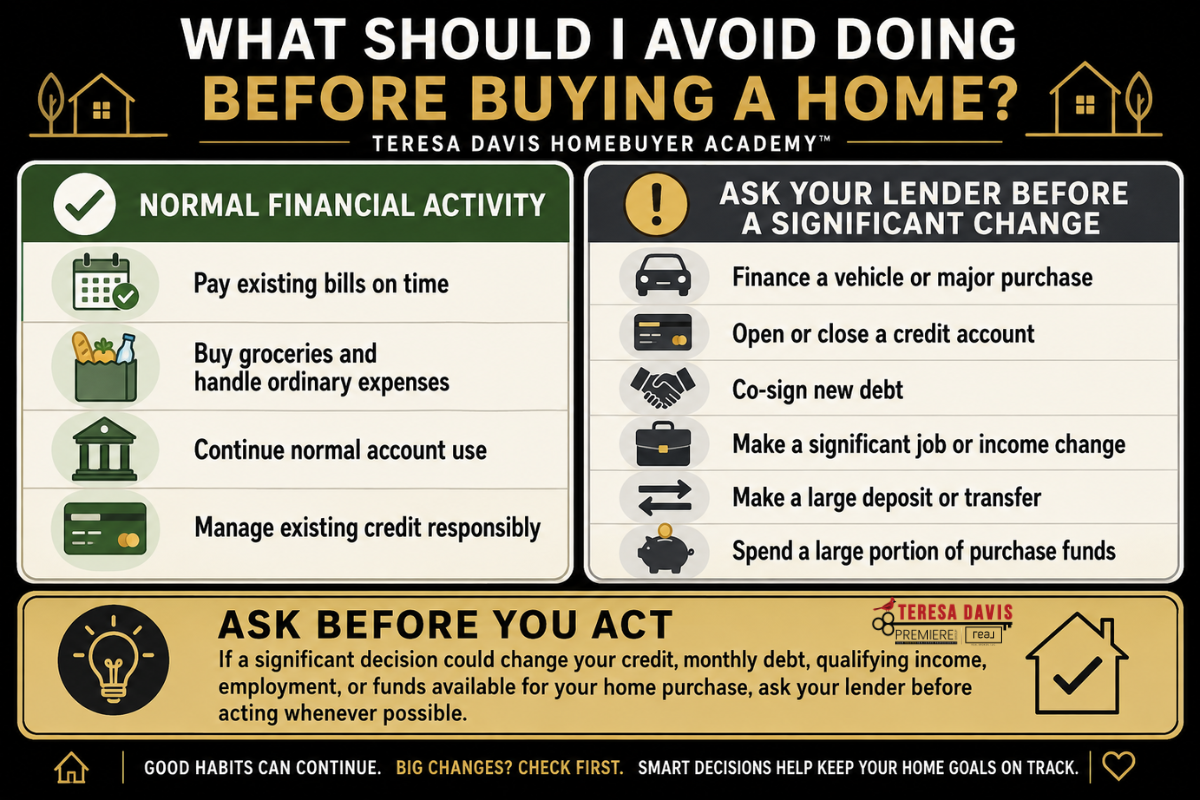
How Your REALTOR® Can Help You Protect the Transaction
Your REALTOR® does not determine whether you qualify for a mortgage and cannot make underwriting decisions for your lender. However, your REALTOR® can help you recognize when a financial change may affect the real estate side of your transaction and when it is important to involve your lender before moving forward.
Once you are actively searching for a home—or especially after you are under contract—your financing, contract deadlines, due diligence activities, appraisal, and closing timeline begin working together. A change that affects your financing can therefore affect more than the mortgage itself.
For example, if you are considering financing a vehicle, changing jobs, making a major purchase, or taking on another financial obligation, your REALTOR® can remind you to speak with your lender before making the change. If the lender determines that your mortgage qualification has changed, your REALTOR® can then help you understand how that development may affect your home search, offer strategy, timing, or an existing transaction.
Your REALTOR® can also help you avoid treating an accepted offer as though the financial part of the process is finished. Even after a seller accepts your offer, there are still important steps between contract and closing. Keeping your lender informed and avoiding unnecessary financial changes can help keep the financing assumptions behind your purchase current.
If a significant financial change has already occurred, it is important for the professionals involved in your transaction to communicate within their appropriate roles. Your lender can evaluate the mortgage implications, while your REALTOR® can help you understand how any resulting change may affect the real estate transaction and your next steps.
Teresa’s Professional Insight
Many of the financial decisions that create complications during a home purchase are not irresponsible decisions. They are ordinary decisions that buyers simply did not realize could matter to a mortgage.
A buyer may need another vehicle. Someone may receive an exciting new job opportunity. A family member may ask for help co-signing a loan. A buyer may find furniture on sale and decide to finance it before moving. Another buyer may transfer savings between accounts because they are trying to organize their money before closing.
Any one of those decisions may seem completely separate from buying a home. The important question is whether the decision changes something the lender is relying on—such as your monthly debt, credit profile, qualifying income, employment, or available funds.
That is why I encourage first-time buyers to use a simple approach rather than becoming anxious about every financial decision: ask before you act when the change is significant. You do not have to put your entire financial life on hold. You do want to avoid finding out after the fact that a decision created an issue that could have been discussed beforehand.
When I work with buyers in Davidson, Randolph, Guilford, Forsyth, and surrounding North Carolina counties, I want the real estate and financing sides of the purchase to stay coordinated. Your lender is the professional who determines how a financial change affects your mortgage qualification. My role as your REALTOR® is to help you understand where that financing information fits into the homebuying process and how it may affect the transaction.
Good communication among you, your lender, and your REALTOR® can prevent unnecessary surprises and help you make decisions with better information.
Helpful Tip
Save your loan officer’s contact information where you can reach it easily throughout the homebuying process.
Before you take on new debt, finance a major purchase, make an unusually large transfer or deposit, or make a significant employment or income change, send a quick message or make a call and ask whether the change could affect your mortgage.
A short conversation before the decision is usually more useful than trying to fix an unexpected problem afterward.
Keep in Mind
Not every financial change will create a mortgage problem, and there is no single rule that applies identically to every buyer. The effect of a change can depend on your overall financial profile, the type of mortgage you are using, lender requirements, underwriting findings, the amount involved, and where you are in the mortgage process.
That is why statements such as “never change jobs,” “never move money,” or “one new credit inquiry will ruin your mortgage” are too broad to use as universal rules.
If a significant change is necessary, do not make an important employment, family, or financial decision solely out of fear that you might lose a mortgage approval. Instead, ask your lender to explain the mortgage implications so you can consider them along with the other factors that matter in your decision.
If the issue involves legal, tax, accounting, employment, or other specialized questions, consult the appropriate professional for guidance in that area. The goal is not to make your finances perfectly motionless until closing. It is to avoid unnecessary surprises, preserve accurate information for your lender, and keep communication open when something important changes.
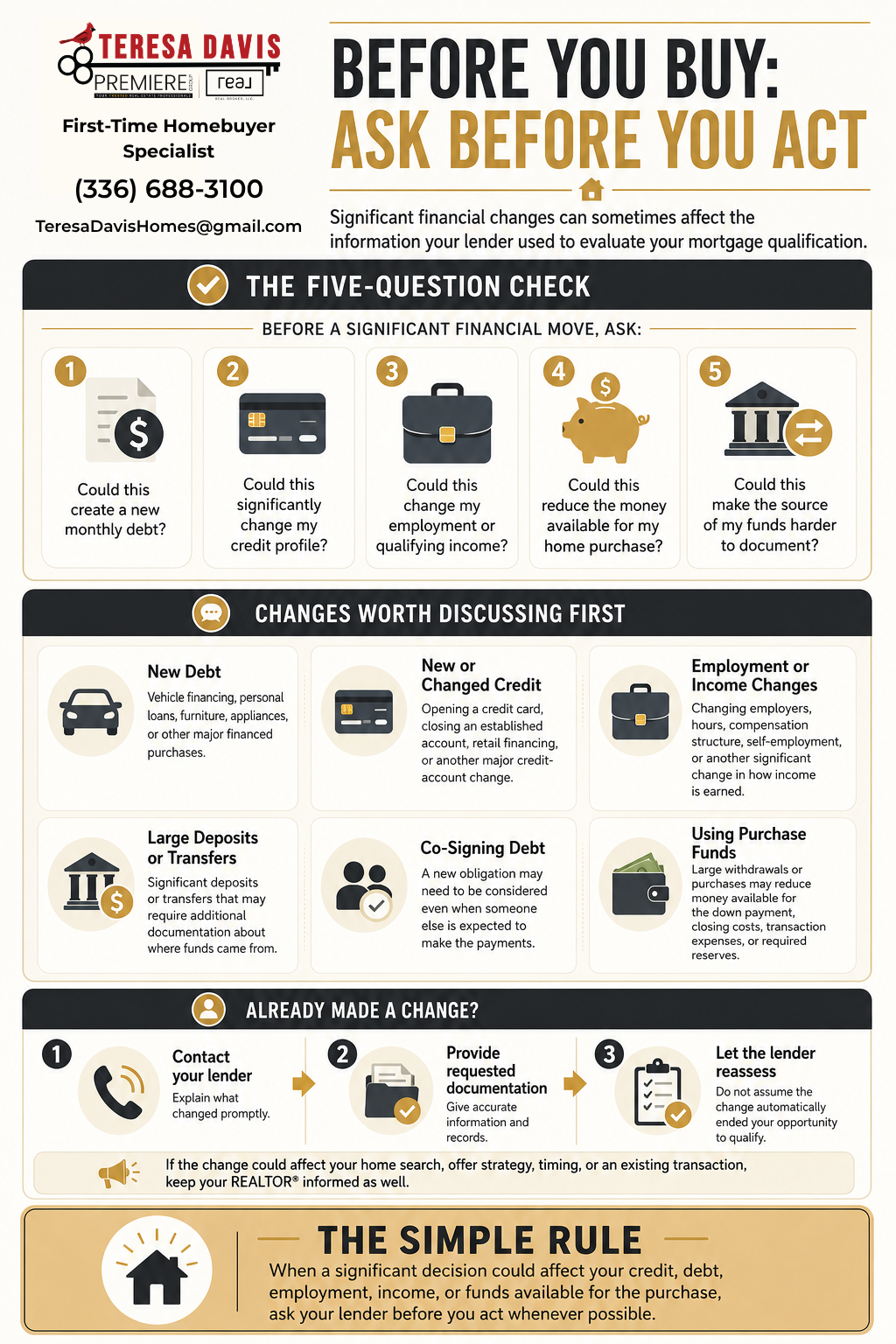
Frequently Asked Questions
Can I buy a car before buying or closing on a house?
You can purchase a vehicle while preparing to buy a home, but financing it may create a new monthly debt obligation that could affect your mortgage qualification.
The effect depends on factors such as the vehicle payment, your income, your existing debts, your loan program, and your overall financial profile. A new auto loan does not automatically mean that you cannot qualify for a mortgage.
If the vehicle purchase can wait, postponing optional financing until after your home closes may help you avoid introducing a new variable into the mortgage process. If you need to purchase a vehicle before closing, ask your lender to evaluate the potential impact before you sign the financing agreement whenever possible.
Can I open a new credit card while I am buying a home?
It is generally wise to avoid opening unnecessary new credit accounts while your mortgage is being evaluated.
A new credit-card application may add a credit inquiry, create a new account, and potentially lead to additional debt. How much any of those factors matter depends on your individual credit and mortgage profile.
That does not mean one new credit card automatically causes a mortgage denial. The better approach is to ask your lender before applying for new credit so you understand whether the change could affect your specific loan.
Can I change jobs after I am pre-approved for a mortgage?
A job change does not automatically mean you will lose your mortgage pre-approval or be unable to close on a home.
However, your lender may need to reevaluate your employment and qualifying income. The impact can depend on factors such as your new position, compensation structure, start date, employment history, and the mortgage program you are using.
If you are considering a voluntary job change, speak with your lender before making the change whenever possible. If the change has already occurred or was unavoidable, let your lender know promptly and provide any updated employment or income documentation that is requested.
Can I move money between bank accounts before closing?
You can move money between accounts, but significant transfers may create additional documentation requirements.
Your lender may need to verify the funds you are using for your home purchase and understand where those funds came from. Moving money among several accounts shortly before closing can sometimes make that paper trail more complicated.
Before making a large transfer, ask your lender whether additional records will be needed. If you do transfer money, keep the statements and transaction records that show where the funds originated and where they were deposited.
What should I do if I already made a big financial change after pre-approval?
Do not assume that your mortgage is automatically in trouble. Contact your lender and explain exactly what changed. That could include new debt, a major purchase, an employment change, a new credit account, a large deposit, a transfer of funds, or another significant financial event.
Provide any documentation your lender requests and allow the lender to determine whether your mortgage qualification needs to be updated.
If the change could also affect your home search, offer strategy, contract timing, or ability to proceed with an existing transaction, keep your REALTOR® informed as well. Your lender can address the mortgage implications while your REALTOR® helps you understand how those financing developments may affect the real estate transaction.
What Happens Next?
Learning what to avoid before buying a home is really about protecting the financial preparation you have already completed. You do not need to stop making normal financial decisions. Instead, keep your lender informed and ask before making a significant change that could affect your credit, debt, employment, income, or funds available for the purchase.
Once you understand how to protect your financial profile, another important question is whether there may be programs designed to help eligible first-time buyers with some of the financial requirements of purchasing a home.
Next, we will look at Can I qualify for first-time homebuyer assistance in North Carolina? That lesson will explain what homebuyer assistance is, how eligibility can vary, and why current program requirements should be reviewed before deciding whether a particular option may fit your situation.
Ready to Take the Next Step?
If you are preparing to buy a home and are unsure whether a financial decision could affect your mortgage or your homebuying plans, you do not have to guess. I can help you understand where the question fits into the overall buying process and help keep the real estate and financing sides of your purchase coordinated.
Contact Teresa Davis
Have a question about preparing to buy, searching for a home, or navigating the North Carolina homebuying process contact Teresa Davis to discuss your next step.
Teresa Davis
REALTOR® / Professional Real Estate Advisor
PREMIERE Group of Real Broker LLC
Start the One Real Mortgage Pre-Approval Process
If you are ready for an individualized review of your mortgage options and qualification, you can start the One Real Mortgage pre-approval process. Using One Real Mortgage is optional and is not required in order to work with Teresa Davis as your REALTOR®.
Teresa Davis
Loan Originator NMLS #2597433
One Real Mortgage
Mortgage qualification, loan programs, terms, costs, and final approval depend on the borrower, property, transaction, documentation, underwriting, and applicable lending requirements. Beginning a pre-approval process does not guarantee financing or require you to purchase a home. It is a practical way to learn more about your potential financing options, estimated payment, and possible next steps.
Ready for the next lesson? Use “Next Question” below to continue to "Can I qualify for first-time homebuyer assistance in North Carolina?".
2:15 - Can I qualify for first-time homebuyer assistance in North Carolina?

For many first-time homebuyers, one of the biggest concerns is whether they have enough money saved to purchase a home. Homebuyer assistance programs may help reduce some of the upfront financial barriers, but eligibility is not automatic and there is no single program that applies to every buyer.
In North Carolina, assistance may be available through statewide programs as well as certain local or community-based programs. Depending on the program, assistance may help with a down payment, eligible closing costs, or other approved home-purchase expenses. The assistance itself may also be structured differently from one program to another. Some programs may provide forgivable assistance, deferred financing, subordinate loans, or other forms of financial help rather than money that is simply given to the buyer with no conditions.
Qualifying usually depends on more than whether this is your first home. A program may consider your income, credit profile, mortgage qualification, available funds, property location, purchase price, occupancy plans, and other eligibility requirements. Some programs also require homebuyer education, counseling, an approved lender, or a participating program partner.
It is also important not to assume that previously owning a home automatically makes you ineligible. The definition of a “first-time homebuyer” can vary by program, and some programs use a lookback period rather than requiring that you have never owned a home. Other programs may have separate eligibility provisions for certain buyers.
If you are considering a home in Davidson, Randolph, Guilford, Forsyth, or another North Carolina county, the best approach is to evaluate assistance as one part of your complete financing plan. Program availability, funding, eligibility limits, and requirements can change, so the specific assistance you may qualify for should be confirmed before you depend on it when planning your purchase.
Quick Answer
Yes, you may qualify for first-time homebuyer assistance in North Carolina, but qualification depends on the specific program and your individual circumstances.
Homebuyer assistance is not one universal grant. Different programs have different rules for income, credit, first-time-buyer status, mortgage qualification, property eligibility, occupancy, purchase price, and other requirements. Some programs are available statewide, while others may be limited to a particular city, county, community, or group of eligible buyers.
You may also encounter different types of assistance. Depending on the program, the help could be structured as forgivable assistance, a deferred second mortgage, another form of subordinate financing, or a different type of approved homebuyer benefit. That is why it is important to understand not only how much assistance may be available, but also whether it must eventually be repaid and what conditions apply.
Qualifying for homebuyer assistance does not automatically mean you qualify for the mortgage used to purchase the home. The assistance program and the underlying mortgage must both work for your financial situation and the property you plan to buy.
At a Glance
- You may qualify even if you have owned a home before. Some programs define a first-time homebuyer based on whether you have owned and occupied a principal residence during a specified period rather than whether you have ever owned real estate.
- Income requirements vary by program. Some programs use borrower income, while others may consider household income, family size, property location, or other factors.
- Your credit and mortgage qualification still matter. Down payment or homebuyer assistance does not replace the need to qualify for the mortgage financing used to purchase the home.
- The property may also have to qualify. Location, purchase price, property type, and principal-residence requirements may affect eligibility.
- Assistance is not always a grant. Some programs use forgivable, deferred, or repayable subordinate financing, so repayment and forgiveness terms should be reviewed carefully.
- Education or counseling may be required. Certain programs require approved homebuyer education, counseling, or participation through a designated lender or housing organization.
- Statewide and local opportunities can be different. A buyer may qualify for a North Carolina program, a local program, or potentially more than one source of assistance if the applicable rules allow it.
- Program rules and funding can change. Confirm current eligibility requirements and program availability before relying on assistance as part of your home-purchase budget.
- Assistance should be evaluated with the entire mortgage. Compare the monthly payment, cash needed at closing, loan terms, program obligations, and long-term costs—not simply the amount of assistance offered.
What Does “First-Time Homebuyer Assistance” Actually Mean?
“First-time homebuyer assistance” is a broad term for programs that can help eligible buyers overcome some of the financial barriers to purchasing a home. Depending on the program, assistance may help with a down payment, eligible closing costs, or other approved home-purchase expenses.
The assistance is usually separate from the first mortgage used to finance the home. For example, a buyer might use an FHA, VA, USDA, or conventional mortgage as the primary loan and receive additional assistance through a separate program.
That assistance can also be structured in different ways. Depending on the program, it might be:
- a forgivable subordinate loan;
- a deferred-payment second mortgage;
- a repayable subordinate loan;
- a grant;
- or another form of approved homebuyer assistance.
Those differences matter. Two programs may provide similar amounts of upfront help but have very different repayment requirements, eligibility rules, or long-term effects.
This is why buyers should avoid using the word “grant” as a general description for all down payment assistance. Some programs do provide grants, but others create a second mortgage or another financial obligation that may remain attached to the property for a period of time.
The right question is not simply, “How much assistance can I get?” It is also, “How does the assistance work, what requirements come with it, and how does it fit with my mortgage?”
Who Counts as a First-Time Homebuyer?
One of the most common misunderstandings is that a first-time homebuyer must be someone who has never owned a home. That is not always how assistance programs define the term.
For the NC 1st Home Advantage Down Payment program, a first-time buyer is generally someone who has not owned a home as a principal residence during the previous three years. This means a person who owned a home in the past may still qualify as a first-time buyer under the program if the applicable three-year requirement is met.
The program also provides separate eligibility pathways for certain military veterans and buyers purchasing in qualifying targeted census tracts. This distinction can be especially important for someone who:
- owned a home several years ago;
- previously owned a home with a former spouse or partner;
- sold a prior principal residence and has been renting;
- owned other real estate that was not a principal residence; or
- is unsure whether prior ownership affects eligibility.
The definition used by the specific assistance program always controls. Buyers should not assume they qualify simply because they consider themselves a first-time buyer, and they should not automatically rule themselves out because they owned a home sometime in the past.
Current Statewide Homebuyer Assistance Options in North Carolina
North Carolina buyers may have access to several statewide programs administered through the North Carolina Housing Finance Agency. These programs illustrate why assistance should be evaluated individually rather than treated as one universal benefit.
NC Home Advantage Mortgage™
The NC Home Advantage Mortgage™ is available to qualified first-time and move-up homebuyers purchasing a home in North Carolina. Eligible borrowers may receive down payment assistance of up to 3% of the mortgage loan amount in connection with an eligible NC Home Advantage Mortgage™.
Current program requirements include several important factors. Among them, buyers generally must:
- purchase a home in North Carolina;
- use the property as their principal residence;
- meet applicable mortgage and program requirements;
- have a qualifying credit score;
- meet the applicable income requirements;
- use an eligible mortgage type; and
- obtain the financing through a participating lender.
Current North Carolina Housing Finance Agency guidance identifies a minimum credit score of 640 for the program and a qualifying income limit of up to $158,000. The underlying mortgage may be conventional, FHA, VA, or USDA, subject to the requirements of the applicable loan type and the Agency.
An important point for first-time buyers is that the NC Home Advantage Mortgage™ is not limited to first-time homebuyers. Qualified move-up buyers may also use the program. This is a good example of why buyers should not assume that every form of homebuyer assistance requires first-time-buyer status.
NC 1st Home Advantage Down Payment
The NC 1st Home Advantage Down Payment provides $15,000 in down payment assistance to qualifying buyers who meet the program requirements.
Potential eligibility includes:
- qualifying first-time homebuyers;
- qualifying military veterans; and
- certain buyers purchasing in eligible targeted census tracts.
A buyer must also meet additional requirements, including applicable income and sales-price limits, credit requirements, mortgage requirements, North Carolina property requirements, and principal-residence requirements. The assistance is used in conjunction with an NC Home Advantage Mortgage™ rather than as a stand-alone mortgage program.
For first-time buyers, the program's current definition generally requires that the buyer has not owned a home as a principal residence during the previous three years. Because income and sales-price limits can vary, a buyer should have the requirements checked for the specific household and property rather than relying on a statewide number remembered from a previous year.
Community Partners Loan Pool
Some qualified low- and moderate-income homebuyers may also be eligible for assistance through the North Carolina Housing Finance Agency's Community Partners Loan Pool.
This program can currently provide assistance of up to 25% of the home's sales price, subject to a maximum assistance amount of $50,000, when combined with an eligible NC Home Advantage Mortgage™. Different limits apply when the program is used with certain USDA Section 502 financing.
The Community Partners Loan Pool has its own eligibility standards. Among other requirements, qualifying buyers generally must meet household-income requirements, mortgage qualification standards, credit requirements, property requirements, and program-partner requirements.
The program also requires approved homebuyer education and pre-purchase housing counseling. This illustrates an important point: a buyer who does not fit one assistance program may potentially fit another program with a different purpose or eligibility structure.
What Factors Commonly Determine Whether You Qualify?
Although every homebuyer assistance program has its own rules, several eligibility factors appear repeatedly. Understanding these factors can help you prepare before you apply.
First-Time-Buyer Status
Some programs require first-time-homebuyer status while others do not.
When a program does require it, determine exactly how that program defines a first-time buyer. A three-year lookback period is common in certain programs, but buyers should always follow the definition contained in the specific program requirements.
Income
Income limits are common, but programs do not necessarily calculate income the same way.
For example, the NC Home Advantage Mortgage™ bases its qualifying income limit on the income of the borrower or borrowers whose income is used for qualification. The NC 1st Home Advantage Down Payment uses household-income limits that vary by county and family size.
That difference can be significant. A buyer should not assume that an income calculation used for one program will automatically be the same for another.
Credit
Homebuyer assistance does not eliminate credit requirements.A program may establish its own minimum credit score, and the underlying mortgage program can also have separate underwriting requirements. Meeting an assistance program's minimum score does not automatically mean the buyer will qualify for the mortgage.
Credit history, outstanding obligations, payment history, and other underwriting factors may still affect the financing decision.
Mortgage Qualification
Down payment assistance does not replace the need for an eligible first mortgage. A buyer generally must qualify for the mortgage that will finance the purchase. Depending on the program, that could include conventional, FHA, VA, USDA, or another approved loan type.
Mortgage qualification may consider factors such as:
- income stability;
- credit;
- debt obligations;
- debt-to-income ratios;
- available assets;
- employment or qualifying income history;
- and the property's eligibility for the selected loan program.
An assistance approval and a mortgage approval are related, but they are not the same thing
Property Location
Where you buy may affect which programs are available. A statewide program may apply throughout North Carolina, while a city, county, nonprofit, or community program may be limited to a defined geographic area. Some programs may also provide special eligibility provisions for qualifying targeted census tracts.
For buyers considering Davidson, Randolph, Guilford, Forsyth, or surrounding North Carolina counties, the property's exact location should be checked before assuming that a particular assistance option applies.
Purchase Price
Some assistance programs establish maximum sales-price or purchase-price limits. Those limits can vary by program, county, household circumstances, mortgage type, or other criteria. A property that exceeds an applicable program limit may not qualify even when the buyer otherwise meets the program requirements.
Property Type
The type of home may also matter. Depending on the assistance program and mortgage, eligible properties may include certain:
- single-family homes;
- townhomes;
- condominiums;
- manufactured homes;
- duplexes;
- or other approved residential property types.
Property eligibility should be confirmed before relying on an assistance program for a particular home.
Principal-Residence Requirement
Many first-time homebuyer assistance programs are intended to help buyers purchase a home they will occupy as their principal residence.
Investment properties, vacation homes, or other non-owner-occupied properties may therefore be ineligible. A program may also specify how soon after closing the buyer must occupy the property.
Participating Lender or Program Partner
Not every assistance program is available through every lender. North Carolina Housing Finance Agency mortgage products, for example, are offered through participating lenders. Certain community-based programs also require buyers to work with an approved local organization or program partner.
A buyer can therefore meet the basic eligibility criteria for a program but still need to work through the appropriate lender or organization to access it.
Homebuyer Education or Counseling
Some programs require homebuyer education, housing counseling, or both. These requirements should not be viewed simply as another hurdle. A good homebuyer education program can help buyers understand budgeting, mortgage responsibilities, closing costs, home maintenance, and the long-term financial obligations that come with homeownership.
The important step is to confirm whether education or counseling is required and, if so, whether the course or counseling provider must meet specific program standards.
Homebuyer Assistance Is Not Necessarily Free Money
One of the most important things to understand about homebuyer assistance is that receiving money toward your purchase does not automatically mean the money is yours with no future obligation. Assistance programs can be structured in very different ways.
A program may offer:
- a grant that does not require repayment when all program conditions are satisfied;
- a forgivable second mortgage;
- a deferred-payment second mortgage;
- a subordinate loan that must eventually be repaid;
- or another form of assistance with its own repayment conditions.
The structure matters because it can affect what happens if you later sell the home, refinance your mortgage, transfer ownership, or otherwise trigger a repayment provision.
For example, current North Carolina Housing Finance Agency down payment assistance available through the NC Home Advantage Mortgage™ is generally structured so that assistance is forgiven gradually over time. If the home is sold, refinanced, or transferred before the assistance has been fully forgiven, the unforgiven portion may become due.
The NC 1st Home Advantage Down Payment is currently structured as a 0% deferred second mortgage. It does not require monthly payments, and forgiveness occurs over time under the program's rules. The practical lesson is simple: before accepting assistance, understand both sides of the transaction.
Ask:
- How much assistance am I receiving?
- Is the assistance a grant, loan, or forgivable loan?
- Will a lien be recorded against the property?
- Are monthly payments required?
- When does forgiveness begin?
- How long does complete forgiveness take?
- What events can cause repayment to become due?
- What happens if I want to refinance?
- What happens if I sell the home earlier than expected?
A larger assistance amount is not automatically better if the program's long-term conditions do not fit your plans.
Statewide Assistance and Local Assistance Are Different
North Carolina buyers should not limit their search to one statewide assistance program. In addition to programs administered through the North Carolina Housing Finance Agency, some cities, counties, housing organizations, nonprofits, and community partners may offer their own homebuyer assistance.
Local programs can operate very differently from statewide programs. A local program may establish requirements based on:
- where the property is located;
- household income;
- first-time-homebuyer status;
- the buyer's financial contribution;
- mortgage qualification;
- homebuyer education;
- housing counseling;
- use of a participating lender;
- property condition;
- purchase price;
- available program funding;
- or other local requirements.
For example, Greensboro currently maintains homebuyer assistance opportunities for eligible purchasers buying within Greensboro, while High Point publishes homebuyer assistance programs with their own qualification standards.
Those examples demonstrate why location matters. A home in Greensboro, High Point, Lexington, Thomasville, Asheboro, Winston-Salem, or another North Carolina community may not have access to the same local programs even when the buyers have similar finances.
A program that exists in one city should never be assumed to apply throughout Guilford County, Davidson County, Randolph County, Forsyth County, or the rest of North Carolina. Local program funding can also be limited or subject to change. A program that is available when you begin planning may have different funding, requirements, or availability by the time you are ready to purchase.
For that reason, local assistance should be verified for both the buyer and the specific property.
Can Homebuyer Assistance Be Combined With Other Funds?
Possibly. Some buyers may be able to use homebuyer assistance together with other approved sources of funds. Depending on the mortgage and assistance program, those sources might include:
- personal savings;
- eligible gift funds;
- seller concessions;
- other approved assistance;
- or another permitted source of funds.
But the ability to combine funds is not universal. Each source must be acceptable under:
- the first-mortgage guidelines;
- the assistance-program requirements;
- any applicable maximum financing limits;
- and the rules governing how the funds may be used.
For example, a buyer may receive an acceptable gift from an eligible donor but still need to document the gift according to the mortgage program's requirements. A seller may agree to provide concessions, but the amount and permitted uses can be limited by the mortgage program and transaction.
Likewise, two separate assistance programs cannot automatically be combined merely because the buyer appears eligible for each one individually. Before depending on multiple sources of funds, have the complete financing structure reviewed together. This helps prevent a situation in which a buyer plans a purchase around money that later cannot be used in the way expected.
Look Beyond the Assistance Amount
It is easy to focus on the largest number when comparing homebuyer assistance. If one program offers more upfront help than another, it may seem like the obvious choice. But the amount of assistance is only one part of the decision.
A better comparison considers the entire financing structure, including:
- the interest rate;
- monthly principal and interest payment;
- mortgage insurance, when applicable;
- estimated taxes and homeowners insurance;
- cash needed at closing;
- lender and program fees;
- assistance amount;
- assistance repayment terms;
- forgiveness period;
- second-mortgage terms;
- future refinancing considerations;
- and the long-term cost of the mortgage.
For example, one financing option may provide more assistance but have different mortgage pricing or repayment conditions. Another option may require more money upfront but provide a structure that better fits the buyer's longer-term plans.
The best option is not necessarily the one that provides the most money at closing. The goal is to find a mortgage and assistance combination that works with your finances, your homeownership plans, and your ability to maintain the home after closing.
Keep Some Financial Breathing Room When Possible
Homebuyer assistance can reduce the amount of cash you need upfront, but that does not mean every dollar you have should automatically go toward the purchase. Homeownership brings expenses beyond the down payment and closing.
After closing, you may encounter:
- moving expenses;
- utility deposits or setup costs;
- immediate maintenance;
- repairs;
- appliances or household items;
- homeowners insurance deductibles;
- property-related expenses;
- and unexpected costs.
If an assistance program allows you to purchase while preserving some appropriate emergency savings, that financial cushion can be valuable after you become a homeowner. Your available cash, assistance, mortgage structure, and post-closing reserves should be considered together rather than treated as separate decisions.
How to Find Out Whether You May Qualify
You do not need to memorize every assistance program before talking with a mortgage professional or housing-program provider. Instead, start by gathering the information that programs commonly use to determine eligibility.
Step 1: Clarify Your Homeownership History
Be prepared to explain whether you currently own a home and when you last owned and occupied a principal residence.
Do not assume that past ownership automatically disqualifies you. The specific program definition will determine whether you meet its first-time-homebuyer requirement.
Step 2: Review Your Income
Know the income sources that may be used for mortgage qualification and be prepared to provide documentation.
Also understand that an assistance program may calculate income differently from the mortgage lender. Some programs may evaluate borrower income, while others may evaluate household income.
Step 3: Review Your Credit and Debts
Assistance programs do not eliminate mortgage underwriting. Your credit profile, monthly debt obligations, and overall mortgage qualification can still affect whether the financing works.
If there are credit or debt issues that need attention, identifying them before shopping for a home gives you more time to develop an appropriate plan.
Step 4: Know Approximately How Much You Have Available
Identify:
- savings;
- checking-account funds;
- eligible gift funds you expect to receive;
- other available assets;
- and the amount you would prefer to retain after closing.
The purpose is not to spend every available dollar. It is to understand the complete financial picture.
Step 5: Identify Where You Are Likely to Buy
Location can determine whether local assistance is available. If you are considering more than one community, ask whether different assistance programs apply in each location.
This is especially useful when your search crosses city or county boundaries.
Step 6: Screen for Statewide and Relevant Local Programs
Once your basic financial information and likely purchase area are known, available programs can be compared more efficiently.
The screening should consider both:
- whether you appear to meet the program's eligibility requirements; and
- whether the program works with the mortgage you are likely to use.
Step 7: Confirm Whether a Participating Lender or Program Partner Is Required
Some programs must be accessed through participating lenders, housing agencies, nonprofit partners, or other designated organizations.
Do not assume that every lender can originate every assistance program. Confirm this early so you know whether the professionals involved can provide the financing structure being considered.
Step 8: Complete Required Education or Counseling
If a program requires homebuyer education or housing counseling, find out:
- which course or provider is acceptable;
- whether counseling is also required;
- when it must be completed;
- and what documentation you will need afterward.
Completing these requirements early can help prevent unnecessary delays later.
Step 9: Confirm That the Property Qualifies
A buyer may appear eligible while the property does not. Before relying on assistance for a specific home, confirm applicable requirements for:
- location;
- property type;
- purchase price;
- occupancy;
- property condition;
- and any other program-specific standard.
Step 10: Review the Assistance Terms Before Committing
Before moving forward, understand:
- the assistance amount;
- how the funds may be used;
- whether repayment is required;
- whether there is a second mortgage or lien;
- the forgiveness schedule, when applicable;
- what happens when the home is sold;
- what happens if you refinance;
- and any other conditions that could affect you later.
Assistance should solve a financial problem without creating an obligation you did not understand.
Common Misunderstandings About First-Time Homebuyer Assistance
Homebuyer assistance is frequently discussed in short advertisements, social-media posts, and conversations that leave out important details. Correcting a few common misunderstandings can make the process much easier to understand.
“I owned a home before, so I cannot qualify.”
Not necessarily. Some programs use a specific lookback period to determine first-time-homebuyer status, and some offer alternative eligibility provisions for certain buyers. Your actual ownership history should be compared with the requirements of the specific program.
“Down payment assistance is free money.”
Not always. Some assistance is structured as a grant, but other programs use forgivable loans, deferred second mortgages, or repayable subordinate financing. Always review the repayment and forgiveness terms.
“If I qualify for assistance, I automatically qualify for a mortgage.”
No. The assistance program and the first mortgage have separate but overlapping requirements. You generally still need to qualify for the mortgage financing used to purchase the home.
“Homebuyer assistance is only for people with extremely low incomes.”
Not necessarily. Income limits vary substantially by program. Some programs serve low- or moderate-income households, while other programs have broader income eligibility. The applicable limit must be checked for the specific program rather than assumed.
“Every lender offers the same assistance programs.”
No. Some programs require participating lenders or designated program partners. A lender may offer certain assistance options and not others.
“Assistance will cover everything I need at closing.”
Not necessarily. The assistance amount may not equal your total cash requirement. You may still need funds for expenses such as:
- required down payment not covered by assistance;
- closing costs;
- prepaid expenses;
- inspections;
- due diligence or earnest money;
- moving costs;
- and post-closing reserves.
The exact cash needed depends on the mortgage, assistance program, purchase contract, property, and transaction.
“The program with the most assistance is automatically the best choice.”
Not necessarily. Compare the complete mortgage and assistance structure. A good decision considers both today's cash requirement and tomorrow's payment, obligations, and flexibility.
Assistance Eligibility Is Only One Part of Being Ready to Buy
Homebuyer assistance can make homeownership more accessible for some buyers, but assistance does not replace financial preparation. Before buying, you still need to consider:
- whether the monthly payment is comfortable;
- whether you have appropriate savings;
- whether your credit and debts support mortgage qualification;
- whether you can manage ongoing homeownership expenses;
- and whether the timing of the purchase makes sense for your situation.
Assistance can help bridge a gap. It should not be used to make an otherwise unaffordable home appear affordable.
The most useful question is not simply, “Can I qualify for assistance?” It is: “Can I qualify for an assistance and mortgage combination that supports a sustainable home purchase?”
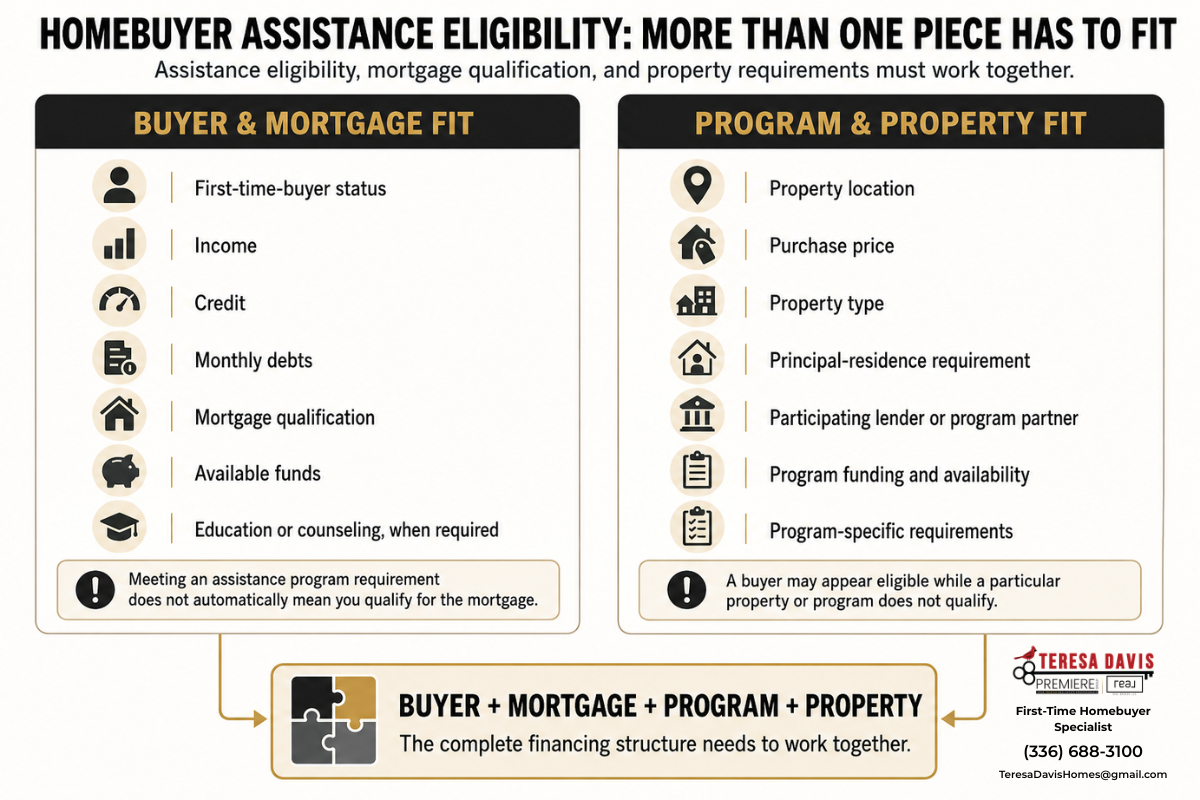
How Your REALTOR® Can Help You Plan Around Homebuyer Assistance
Homebuyer assistance is primarily a financing consideration, but it can also affect the way you approach your home search and purchase. That is why your financing plan and real estate strategy should be coordinated before you become deeply invested in a particular property.
Your REALTOR® does not determine whether you qualify for a mortgage or assistance program. Those eligibility decisions belong to the lender, housing agency, program administrator, or other organization responsible for the financing. However, your REALTOR® can help you understand how confirmed program requirements may affect the practical side of your home purchase.
For example, your REALTOR® can help you:
- focus your home search on properties and locations that are consistent with confirmed program requirements;
- communicate with your mortgage professional about financing-related property considerations;
- consider whether an assistance program could affect the anticipated closing timeline;
- understand how your available funds may influence offer terms and purchase decisions;
- identify property characteristics that should be confirmed with the lender or program administrator before you rely on a particular financing structure; and
- coordinate important transaction milestones so financing and real estate decisions remain aligned.
This coordination can be especially helpful when your search crosses city or county boundaries. A buyer considering homes in Davidson, Randolph, Guilford, Forsyth, or surrounding North Carolina counties may encounter different local assistance opportunities depending on the property's exact location.
If a particular assistance program is important to your purchase, tell your REALTOR® early. That allows the property search and offer strategy to reflect the financing requirements that have already been confirmed for you.
It is also important not to write an offer based on anticipated assistance that has not yet been verified. A program may have income limits, property restrictions, funding limitations, education requirements, participating-lender requirements, or other conditions that affect whether it can actually be used for your transaction.
The goal is to build your purchase strategy around financing that has been reasonably evaluated—not around an assistance amount you hope will be available later.
Teresa’s Professional Insight
One of the most useful things a first-time buyer can do is ask about homebuyer assistance early without making the assistance amount the center of the entire buying decision. It can be exciting to learn that a program may help with some of the money needed to purchase a home. But the better question is whether the complete financing structure supports a home purchase you can comfortably maintain.
From both the real estate and mortgage sides of the process, several pieces need to work together:
- the price of the home;
- the mortgage you qualify for;
- your monthly housing payment;
- the cash you need before and at closing;
- the savings you would like to keep after closing;
- any homebuyer assistance available to you;
- the terms attached to that assistance;
- and the property's eligibility for the financing being considered.
A buyer who receives more assistance is not necessarily in a stronger financial position than a buyer who receives less. The amount of help matters, but so do the interest rate, payment, closing costs, mortgage insurance when applicable, repayment obligations, future refinancing considerations, and the amount of financial breathing room you retain after the purchase.
I also encourage buyers not to disqualify themselves before asking questions. You may believe your income is too high, your previous homeownership makes you ineligible, or you have too much saved to qualify for assistance. The opposite can happen as well: a buyer may assume that being a first-time homebuyer automatically makes assistance available.
Neither assumption should replace an actual eligibility review. Program requirements can differ significantly, and availability can change. The safest approach is to have the current requirements reviewed for your specific circumstances before using assistance as part of your homebuying budget.
Because some programs must be accessed through participating lenders, housing organizations, or program partners, you should also confirm who is authorized to provide the particular program you are considering. Do not assume that every lender offers every assistance option.
My role is to help you understand the homebuying process, ask better questions, and coordinate the real estate and financing pieces as you move forward. Specific mortgage and assistance eligibility must ultimately be confirmed under the requirements of the applicable loan and assistance programs.
Helpful Tip
Use an Assistance Eligibility Pre-Check Before You Start Relying on a Program
You do not need a complete mortgage approval before asking whether homebuyer assistance may be worth exploring. But you will get a much more useful answer if you have some basic information ready.
Before discussing assistance, gather or estimate:
- Your homeownership history: When did you last own and occupy a principal residence, if ever?
- Your income: What income sources are expected to be used for mortgage qualification, and who lives in the household if the program evaluates household income?
- Your credit profile: Do you know your approximate credit standing, and are there any significant credit concerns?
- Your monthly debts: What recurring obligations may affect mortgage qualification?
- Your available funds: How much do you currently have in savings and other eligible assets?
- Potential gift funds: Do you expect help from an eligible donor, if permitted by your mortgage program?
- Your preferred purchase area: Are you looking in a particular city, county, or several communities?
- Your likely price range: What purchase range are you considering based on your overall financial plan?
- Your potential mortgage type: Has a mortgage professional discussed conventional, FHA, VA, USDA, or other financing with you?
- Education or counseling requirements: Does the assistance program require a specific course or counseling provider?
- Participating-provider requirements: Must the assistance be obtained through a particular lender, housing agency, nonprofit, or program partner?
Having this information available can make an initial assistance review much more productive. Ask about assistance before you assume you qualify—and before you assume you do not.
Keep in Mind
Homebuyer assistance can reduce some of the money you need upfront, but it should not be evaluated in isolation. Before relying on a program, confirm the current requirements for:
- first-time-homebuyer status;
- income;
- credit;
- mortgage qualification;
- purchase price;
- property location;
- property type;
- occupancy;
- participating lenders or program partners;
- homebuyer education or counseling;
- permitted uses of assistance funds;
- repayment requirements;
- forgiveness provisions;
- refinancing or sale restrictions;
- and current program funding or availability.
Program guidelines can change. Income limits, purchase-price limits, assistance amounts, funding availability, and other requirements that are accurate today may be different when you are ready to purchase. Local assistance programs may also open, close, exhaust available funding, or change their eligibility requirements. A program available in one North Carolina city or county should not be assumed to apply to another community.
Remember that assistance eligibility and mortgage approval are not the same thing. You may meet the requirements for an assistance program and still need to satisfy the underwriting requirements of the mortgage used to purchase the home.
You should also understand the long-term obligation attached to any assistance you accept. If the assistance involves a second mortgage, deferred repayment, or forgiveness schedule, find out what happens if you sell, refinance, transfer the property, or otherwise trigger the program's repayment provisions.
Finally, homebuyer assistance should help support a sustainable purchase—not stretch your budget beyond what is comfortable. The strongest financing plan is one that considers both the help available to you today and your ability to comfortably manage the home after closing.
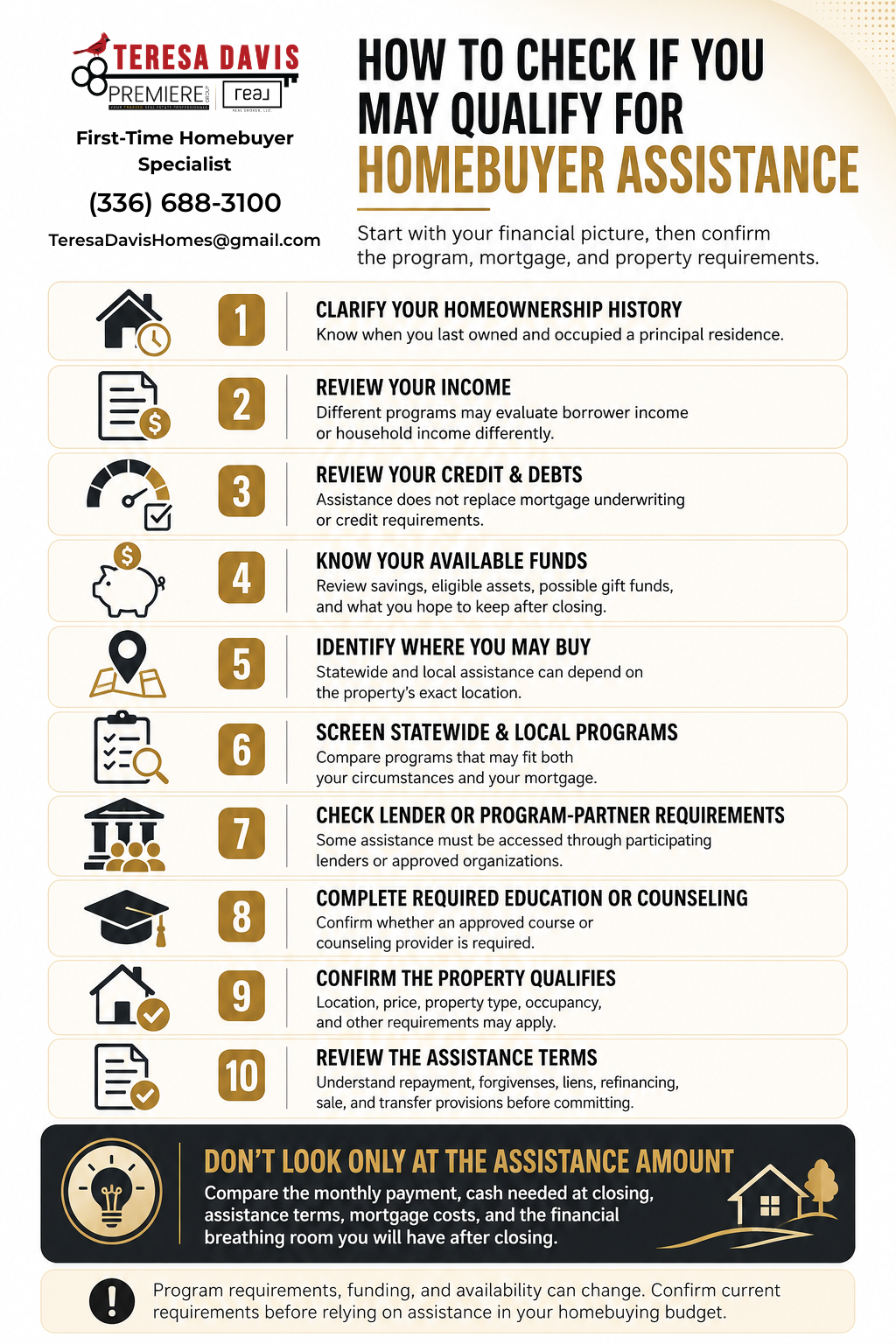
Frequently Asked Questions
What counts as a first-time homebuyer for North Carolina assistance programs?
It depends on the specific program. Some North Carolina programs use a three-year lookback period when determining first-time-homebuyer status. Under that type of definition, you may still be considered a first-time buyer if you owned a home in the past but have not owned and occupied a principal residence during the required period.
Certain programs may also provide separate eligibility pathways or exceptions for particular buyers, such as qualifying military veterans or buyers purchasing in designated areas. Do not assume that previous homeownership automatically disqualifies you. Your ownership history should be compared with the current definition used by the specific assistance program you are considering.
Are there income and credit-score limits for first-time homebuyer assistance in North Carolina?
Often, yes. Homebuyer assistance programs may establish income limits, credit requirements, or both. Those requirements can vary significantly from one program to another.
A program may evaluate borrower income, household income, family size, county, property location, mortgage type, or other factors. The credit requirement for an assistance program may also be different from the requirements of the underlying mortgage.
Meeting an assistance program's income or credit threshold does not automatically mean you will qualify for the mortgage. Your complete mortgage application still has to satisfy the applicable underwriting and program requirements.
Because limits and guidelines can change, current requirements should be verified for the specific program before you rely on assistance as part of your purchase plan.
How much first-time homebuyer assistance can I receive in North Carolina?
The amount depends on the program for which you qualify. As current examples, the North Carolina Housing Finance Agency's NC Home Advantage Mortgage™ can provide qualified buyers with down payment assistance of up to 3% of the mortgage loan amount. The NC 1st Home Advantage Down Payment currently provides $15,000 in down payment assistance to qualifying first-time buyers and military veterans who meet the additional program requirements.
Other programs can have different assistance amounts, eligibility rules, geographic requirements, and funding limits. The largest assistance amount is not automatically the best financing option. Compare the assistance with the mortgage rate, monthly payment, cash needed at closing, repayment or forgiveness terms, fees, and your longer-term homeownership plans.
Do I have to pay back first-time homebuyer assistance?
Maybe. It depends on how the program is structured. Homebuyer assistance can take several forms. A program may provide a grant, a forgivable subordinate loan, a deferred-payment second mortgage, a repayable subordinate loan, or another type of assistance.
If the assistance is structured as a forgivable or deferred second mortgage, you may not have a regular monthly payment, but repayment can still become due if certain events occur before the assistance is fully forgiven.
Before accepting assistance, ask:
- whether a lien will be recorded against the property;
- whether monthly payments are required;
- when forgiveness begins;
- how long complete forgiveness takes;
- what happens if you sell the home;
- what happens if you refinance;
- what happens if ownership is transferred; and
- what portion, if any, could still be owed at that time.
Understanding the future obligation is just as important as understanding the amount of assistance you receive at closing.
Can I combine down payment assistance with gift money or another homebuyer program?
Possibly, but the combination must be permitted by all of the programs involved. Depending on the mortgage and assistance program, you may be able to use assistance together with eligible gift funds, personal savings, seller concessions when permitted, or another approved source of funds.
Each source has its own rules. Gift funds may have donor and documentation requirements. Seller concessions have mortgage-program limits and permitted uses. Assistance programs may have restrictions on combining or stacking funds with another program.
Do not build your homebuying budget around several sources of money until the complete financing structure has been reviewed. The lender and applicable program administrators should confirm that the funds can be combined and used in the way you expect.
What Happens Next?
You have reached the end of Section 2 — Preparing Your Finances.
Throughout this section, you have worked through many of the financial questions that can affect your readiness to buy, including savings, credit, debt, debt-to-income considerations, cash needed for the purchase, closing costs, gift funds, mortgage documentation, financial changes to avoid, and possible first-time homebuyer assistance.
The next stage is Section 3 — Get Pre-Approved.
This is where the process begins moving from general financial preparation toward a more specific evaluation of your mortgage options and borrowing qualifications.
The first question in Section 3 is: What is the difference between mortgage pre-qualification and pre-approval?
Understanding that distinction can help you know what level of lender review you have completed, what information has been evaluated, and which step may be appropriate as you become more active in your home search.
Remember that being screened for a homebuyer assistance program is not the same thing as being pre-approved for a mortgage. The assistance and the first mortgage need to work together, and both may have requirements that must be satisfied before you can move forward with a particular financing plan.
Ready to Take the Next Step?
If you are wondering whether homebuyer assistance could fit into your North Carolina homebuying plan, you do not need to figure out every program on your own. Start by understanding your financial picture, asking questions about the programs that may apply to you, and confirming the requirements before you depend on assistance in your budget.
Contact Teresa Davis
If you would like help understanding the next steps in the homebuying process or coordinating the real estate and financing considerations that may affect your purchase, contact Teresa Davis.
Teresa Davis
REALTOR® / Professional Real Estate Advisor
PREMIERE Group of Real Broker LLC
Start the One Real Mortgage Pre-Approval Process
When you are ready to move from general financial preparation toward a more detailed review of your mortgage qualifications, you are ready to start the Pre-Approval Process. Using One Real Mortgage is optional and is not required in order to work with Teresa Davis as your REALTOR®.
Teresa Davis
Loan Originator NMLS #2597433
One Real Mortgage
Homebuyer-assistance availability and eligibility are program-specific. Beginning a mortgage application does not guarantee qualification for a particular assistance program. It is a practical way to learn more about your potential financing options, estimated payment, and possible next steps.
Ready for the next lesson? Use “Next Question” below to continue to "What is the difference between mortgage pre-qualification and pre-approval?".