

How Inflation Affects Mortgage Rates and Why Homebuyers Should Care
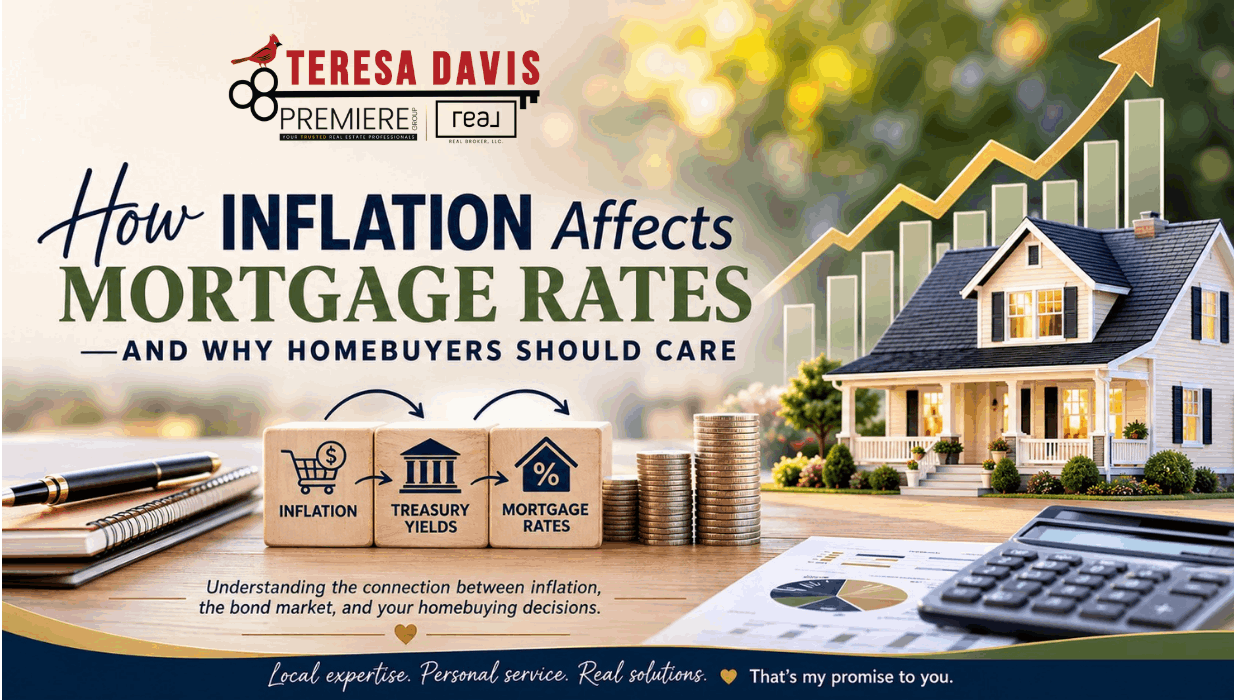
How Inflation Affects Mortgage Rates—and Why Homebuyers Should Care
When inflation makes the news, mortgage rates are often part of the conversation. You may hear that inflation is improving and expect mortgage rates to fall immediately. Or you may hear that the Federal Reserve changed interest rates and assume mortgage rates will move by the same amount.
The relationship is not quite that simple.
Inflation, Federal Reserve policy, Treasury yields, mortgage-backed securities, investor expectations, and a borrower’s individual financial profile can all affect mortgage pricing. Understanding these connections can help you look beyond the headlines and make a homebuying decision based on your finances, goals, and local housing market.
Key takeaway: Inflation can influence mortgage rates, but the Federal Reserve does not directly set the rate on a 30-year mortgage. Bond-market conditions and your individual financial profile also matter.
What Is Inflation?
Inflation is the general increase in the prices of goods and services over time. When inflation rises, each dollar buys less than it did before.
Most households experience inflation through everyday expenses such as:
- Groceries
- Gasoline
- Utilities
- Insurance
- Home repairs
- Construction materials
- Professional services
Inflation also matters to investors and lenders. When someone lends money for many years, inflation can reduce the future purchasing power of the money being repaid. Investors may therefore expect a higher return when they believe inflation will remain elevated.
That expectation can put upward pressure on longer-term interest rates, including mortgage rates.
However, inflation is only one factor. Mortgage rates can sometimes rise while inflation is falling or decline while inflation remains above the Federal Reserve’s preferred level. Financial markets respond not only to current inflation but also to expectations about where the economy may be headed.
Does the Federal Reserve Set Mortgage Rates?
No. The Federal Reserve does not directly set the interest rate on a 30-year fixed mortgage.
The Federal Reserve establishes a target range for the federal funds rate. This is the rate banks use when lending reserve balances to one another overnight. Changes to that rate can influence credit cards, home equity lines of credit, business financing, savings yields, and broader financial conditions.
Mortgage rates are different because most mortgages are long-term loans. Their pricing is influenced more directly by activity in the bond market.
The Federal Reserve can still affect mortgage rates indirectly. Its decisions and public statements can change expectations about inflation, economic growth, and future interest rates. Investors may react to those expectations before the Federal Reserve officially changes its policy rate.
That is why mortgage rates can:
- Move before a Federal Reserve meeting
- Remain relatively unchanged after a rate announcement
- Increase when the Federal Reserve lowers its policy rate
- Decrease when the Federal Reserve takes no immediate action
The financial markets are constantly evaluating what may happen next—not simply reacting to what happened today.
How Treasury Yields Influence Mortgage Rates
The yield on the 10-year U.S. Treasury note is one of the most closely watched benchmarks for mortgage rates.
A Treasury note is a form of government debt. Investors generally consider U.S. Treasury securities to have very low credit risk. Mortgages carry additional risks and expenses, so mortgage rates are generally higher than Treasury yields.
The 10-year Treasury does not determine a mortgage rate by itself, and the two rates do not move in perfect lockstep. However, they frequently move in the same general direction.
Inflation expectations rise
↓
Bond yields may rise
↓
Mortgage rates may rise
The difference between the 10-year Treasury yield and the average 30-year mortgage rate is commonly called the mortgage spread. That spread can widen or narrow depending on market volatility, investor demand, lender capacity, mortgage-servicing costs, prepayment risk, and other financial conditions.
As a result, a decrease in the 10-year Treasury yield does not guarantee an equal decrease in mortgage rates.
What Are Mortgage-Backed Securities?
Many home loans do not remain on the original lender’s books for the full loan term. Eligible mortgages may be bundled into investments called mortgage-backed securities, often abbreviated as MBS.
Investors purchase these securities and receive payments supported by the principal and interest collected from the underlying mortgages.
When demand for mortgage-backed securities is strong, mortgage pricing may improve. When investors require higher returns to purchase them, mortgage rates may increase.
Investors consider several risks, including the possibility that homeowners will refinance or sell their homes before the loan reaches maturity. For example, when interest rates fall, more homeowners may refinance. That means investors can receive their principal back earlier than anticipated and may have to reinvest it at a lower return.
These market dynamics help explain why mortgage rates may behave differently from other consumer interest rates.
Why Mortgage Rates Can Rise Even When Inflation Is Improving
Mortgage markets are forward-looking.
Suppose an inflation report shows that prices are increasing more slowly than before. That may sound like good news for mortgage rates, but investors will also consider questions such as:
- Was inflation lower than economists expected?
- Is the job market still strong?
- Are wages rising quickly?
- Is consumer spending increasing?
- Could energy prices push inflation higher again?
- Will government borrowing affect Treasury supply?
- What is the Federal Reserve likely to do next?
If improving inflation was already expected, the market may have priced that information into mortgage rates before the report was released. Rates may not change much afterward.
Mortgage rates can also react to economic data that appears unrelated to housing. Employment reports, consumer spending, wage growth, geopolitical developments, and investor sentiment can all influence the bond market.
This is why trying to predict the perfect day to lock a mortgage rate can be difficult.
Why Buyers Should Care About Mortgage Rates
A mortgage rate affects more than the amount of interest paid over the life of the loan. It also affects the monthly principal and interest payment and, therefore, the price range a buyer may be able to comfortably consider.
Even a relatively small rate movement can change:
- The monthly payment
- The debt-to-income ratio
- The maximum loan amount
- The amount of cash needed
- The homes that fit within a buyer’s budget
However, the interest rate is only one part of the total monthly housing expense. Buyers should also account for property taxes, homeowners insurance, mortgage insurance when applicable, homeowners association dues, and potential maintenance costs.
A lower mortgage rate does not automatically make a particular home affordable. Similarly, a higher-rate environment does not necessarily mean buying is the wrong decision. The full financial picture matters.
What Homebuyers Can Control
You cannot control inflation, the Federal Reserve, Treasury yields, or investor behavior. You can take steps that may improve your financing position and help you make a more informed purchase.
1. Strengthen Your Credit Profile
Credit history and credit scores can affect mortgage eligibility and pricing. Before applying for a home loan, review your credit reports and address inaccuracies when appropriate.
Continue paying bills on time and avoid making unnecessary changes that could affect your credit before closing.
Do not open new credit accounts, finance furniture, purchase a vehicle, or significantly increase credit-card balances without first discussing the potential impact with your loan originator.
2. Reduce Your Monthly Debt
Your debt-to-income ratio compares certain monthly debt obligations with your qualifying income. Paying down debt may improve that ratio, but buyers should request individualized guidance before using a large amount of savings to eliminate debt.
Preserving funds for closing costs, required reserves, repairs, moving expenses, and emergencies may also be important.
3. Consider the Down Payment Carefully
A larger down payment may reduce the loan amount and monthly payment. Depending on the loan program and borrower profile, it may also affect mortgage insurance or interest-rate pricing.
However, putting every available dollar into the down payment is not always the best strategy. Buyers should consider how much cash they will need after closing.
4. Compare the Complete Loan Offer
The lowest advertised interest rate is not automatically the least expensive loan.
When comparing options, consider:
- Interest rate
- Annual percentage rate
- Discount points
- Origination charges
- Lender credits
- Mortgage insurance
- Estimated cash needed at closing
- Loan term
- Fixed versus adjustable-rate structure
- How long you expect to own the home or keep the loan
A rate obtained by paying discount points may make sense in some situations but not in others. The potential savings should be compared with the upfront cost and the estimated time needed to recover that cost.
5. Ask About the Rate-Lock Strategy
A mortgage rate is generally not secured until it is locked.
Rate-lock periods, costs, expiration dates, extension policies, and float-down options vary. Before locking, ask what happens if the closing date changes and whether an extension would create an additional expense.
There is no guaranteed way to identify the lowest rate in advance. The practical objective is usually to secure financing that supports an affordable payment and a successful closing—not to win an attempt at perfectly timing the market.
6. Base the Decision on a Comfortable Payment
A lender may approve a borrower for more than the borrower wants to spend each month.
Create a budget that accounts for the full housing payment along with utilities, maintenance, savings, transportation, childcare, healthcare, and other household priorities. The right price range is one that works within your life, not simply the maximum amount available through financing.
Why Local Housing Conditions Matter
National mortgage-rate headlines do not tell the entire story of whether it is a good time to buy a home in the Piedmont Triad.
Local conditions can vary by county, city, neighborhood, price range, property type, and even the condition of an individual home. Inventory and buyer competition in one segment may look very different from conditions in another.
When higher mortgage rates reduce buyer demand, some buyers may encounter:
- Less competition
- Fewer multiple-offer situations
- More time to evaluate a property
- Greater seller flexibility
- Opportunities to request closing-cost assistance
- Opportunities to negotiate repairs or other terms
These possibilities are not guaranteed. A desirable, accurately priced home can still receive significant attention, particularly when inventory is limited.
When rates fall, affordability may improve for individual buyers, but lower rates can also bring more buyers into the market. Increased competition may affect home prices, negotiating leverage, and the number of offers submitted on well-positioned properties.
The best analysis considers mortgage costs and local real estate conditions together.
Should You Wait for Mortgage Rates to Fall?
No one can reliably predict the exact direction or timing of future mortgage-rate movements.
Waiting may be reasonable when you need time to improve your credit, stabilize your income, reduce debt, save money, or determine how long you expect to remain in an area.
Waiting only because you expect a substantially lower rate, however, involves uncertainty. During that time:
- Home prices may change
- Available inventory may increase or decrease
- Rents may rise
- Lending guidelines may change
- Your personal circumstances may change
- Lower rates may create additional buyer competition
Instead of asking only, “Will mortgage rates fall?” consider asking:
- Is my income stable?
- Do I have sufficient savings?
- Is the estimated payment comfortable?
- Do I plan to remain in the home long enough for the purchase to make sense?
- Are suitable homes available in my price range?
- What would buying allow me to accomplish?
- What are the financial and practical costs of waiting?
Those questions are usually more helpful than trying to predict the bond market.
Can You Refinance If Rates Fall Later?
Refinancing may be an option if mortgage rates decline after a purchase, but it should never be treated as a guarantee.
A future refinance will depend on factors that may include:
- The homeowner’s credit and income
- The property’s value
- Available equity
- The remaining loan balance
- The loan program
- Closing costs
- Market rates at that time
- Current underwriting requirements
The potential monthly savings should be compared with the cost of refinancing and the time required to recover that cost.
A buyer should be comfortable with the initial loan and payment rather than purchasing based on the assumption that refinancing will definitely be available later.
The Bottom Line
Inflation can influence mortgage rates, but it is not the only factor involved. The Federal Reserve does not directly set 30-year mortgage rates, and a change in the federal funds rate does not guarantee an identical change in mortgage pricing.
Treasury yields, mortgage-backed securities, investor expectations, economic reports, and a borrower’s individual qualifications all contribute to the rate ultimately offered.
Homebuyers cannot control the financial markets, but they can control how they prepare. Improving credit, managing debt, preserving savings, comparing complete loan costs, and selecting a comfortable payment can make a meaningful difference.
Most importantly, buying decisions should account for both financing and local housing conditions. A national headline cannot determine whether a particular home, payment, and purchase strategy are appropriate for you.
Considering Buying a Home in the Piedmont Triad?
As both a REALTOR® and licensed Loan Originator NMLS# 2597433, I can help you evaluate the real estate and financing sides of a potential purchase. If you are considering buying in Davidson, Guilford, Forsyth, Randolph, or a surrounding North Carolina county, contact me for a personalized conversation about your goals, budget, and available options.
Frequently Asked Questions
Does inflation cause mortgage rates to increase?
Inflation often puts upward pressure on mortgage rates because investors may require a higher return when they expect the purchasing power of future payments to decline. However, mortgage rates are affected by several factors and do not always move in the same direction as current inflation data.
Does the Federal Reserve set mortgage rates?
No. The Federal Reserve establishes a target range for the federal funds rate, which is an overnight bank-lending rate. Its policies can indirectly influence mortgage rates, but mortgage pricing is more directly connected to the bond and mortgage-backed securities markets.
Why do mortgage rates follow the 10-year Treasury?
The 10-year Treasury yield is widely used as a benchmark for long-term borrowing costs. Mortgage rates generally include the Treasury yield plus an additional spread reflecting mortgage-related risks, expenses, and market conditions. The two commonly move in the same direction, but not by identical amounts.
Should I wait until mortgage rates decrease before buying?
That depends on your financial readiness, expected length of ownership, available inventory, estimated payment, and local market conditions. Lower rates may improve borrowing power, but they can also attract more competing buyers.
Does a higher credit score help me obtain a lower mortgage rate?
Credit scores are among the factors lenders consider when determining mortgage eligibility and pricing. A stronger credit profile may help a borrower qualify for more favorable terms, although the final rate depends on multiple factors.
Can I refinance if rates decrease after I purchase?
Possibly. Refinancing depends on future rates, qualification requirements, property value, equity, closing costs, and the homeowner’s financial profile at that time. It should be viewed as a potential future option rather than a guaranteed strategy.
This article is for general educational purposes and is not a commitment to lend or a guarantee of financing, loan approval, interest-rate availability, property value, or future market conditions. Mortgage programs, rates, terms, and qualification requirements are subject to change and depend on the borrower’s individual circumstances.
Categories
Recent Posts







Teresa Davis
REALTOR® and Licensed Loan Originator License ID: 308937 / NMLS# 2597433